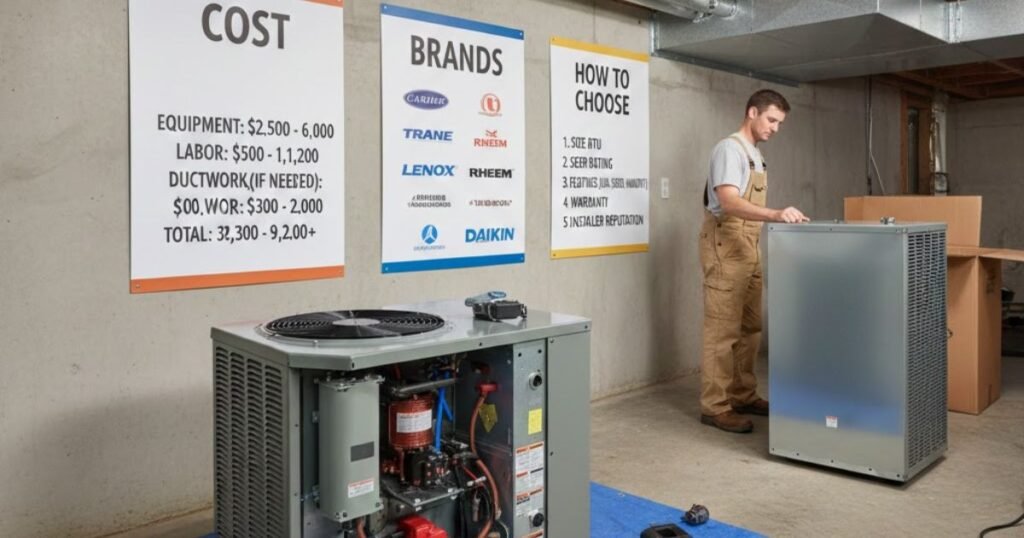
An air handler is the indoor heart of your central air-conditioning or heat-pump system. When it’s failing, homeowners often face one clear decision: replace the air handler alone or replace the whole system. The two biggest things that determine cost and comfort are the motor type (PSC vs. ECM/variable-speed) and whether your new handler is matched to the outdoor unit.
This guide walks U.S. homeowners through how air handlers work, realistic price ranges (unit-only and installed), a brand comparison, what to ask contractors, rebates and financing, and a clear FAQ with the most common search queries. Wherever I present numbers you’ll see the sources I checked so you can verify local pricing before you sign anything. Lets deep dive into “AC Air Handler Replacement: Cost, Brands, and How to Choose”
READ MORE: Best 3-Ton Heat Pumps of 2026: Reviews, Prices & Comparison
Maximize Your New Air Handler’s Efficiency:
Pair your replacement setup with the Google Nest Learning Thermostat (4th Gen) in Obsidian. Featuring AI-powered learning, a stunning bezel-free display, and an included 2nd-gen temperature sensor to eliminate cold spots, it’s the ultimate upgrade to lower your energy bills:

Air Handler Quick comparison
| Brand | Typical unit types (example model) | Typical motor type (PSC / ECM / Variable-speed) | Parts-only price range (U.S., unit only) | Typical installed replacement estimate (unit + labor) | Typical warranty | Quick pros | Quick cons |
| Trane / RunTru | Multi-positional air handlers (RT / A4AH) | Variable-speed / ECM options | ~$1,100 – $2,066. | $1,800–$4,000 depending on complexity | Varies by model; dealer/extended options 1–10 yrs parts | Durable; contractor-friendly service parts | Often higher dealer/labor markups |
| Carrier | Performance / Comfort series air handlers | PSC to variable-speed (model dependent) | ~$1,200 – $2,400 (marketplace listings & examples). | $1,800–$4,200 (size & labor dependent) | Varies by model/dealer | Industry leader in efficiency & options | Premium cost on top models |
| Lennox | CBX32MV & similar multi-positional handlers | Variable-speed / ECM | ~$1,200 – $2,500 (new/used + dealer listings). | $2,000–$4,500 (high-end variable-speed models cost more) | Strong on premium model warranties | Very quiet & precise airflow | Top-tier price for variable-speed |
| Goodman | AWUF multi-positional / wall-mount | PSC / two-speed (some ECM options) | ~$600 – $900 (budget brand retail listings). | $1,500–$3,500 (lower equipment cost typically) | Standard warranty (value-oriented) | Lower equipment cost; simple repairs | Fewer premium features; dealer network varies |
| Rheem | RH2VY / Endeavor variable-speed | Variable-speed / ECM | ~$1,680 – $3,025 (retailer listings examined). | $1,900–$4,200 depending on model & install | Competitive warranties; EcoNet options | Competitive mid-to-high range features | Some models priced at premium levels |
Notes under the table: “Parts-only price” = typical retail price for the air-handler cabinet / fan coil only (no condenser or evaporator coil unless explicitly noted). These are representative retailer/manufacturer listings checked during research. Prices vary by tonnage, motor type (PSC vs ECM), and stock/seasonal discounts; always confirm a current local quote. (Sources checked listed after the next section.)
READ MORE: AC Not Blowing Cold Air? Causes, DIY Fixes & When to Call a Pro
Track Your New System’s Savings:
Want to see the exact financial impact of your new high-efficiency air handler? The Emporia Vue 3 Home Energy Monitor installs right in your electrical panel to give you real-time, circuit-by-circuit power tracking and solar net metering straight to your phone:

What is an air handler?
An air handler (also called a fan coil or AHU in residential contexts) is the indoor cabinet that moves cooled or heated air through your ducts. The main parts are:
- Blower (fan) — pushes conditioned air through ductwork.
- Motor — drives the blower; common types are PSC (Permanent Split Capacitor), ECM (Electronically Commutated Motor), and variable-speed ECMs. ECMs are more energy-efficient and quieter; PSCs are simpler and cheaper.
- Coil (evaporator coil) — where refrigerant absorbs heat (located in the handler cabinet for split systems).
- Filter rack and access panels — where filters sit and technicians access components.
- Drain pan and condensate line — carry away moisture condensed from the coil.
Air handler vs. furnace:
a furnace contains a heat source (gas burners/electric heat strips) plus the blower. An air handler typically lacks combustion components and pairs with a heat pump or air conditioner outdoor unit.
Why replace one? Air handlers fail due to motor burnout, coil corrosion, leaking pans, or obsolete controls (older systems use R-22 refrigerant or inefficient motors). Replacing a failing handler can restore airflow and efficiency but matching to the outdoor unit matters for performance and warranty.
Pair Your New System with Elite Control:
Take full advantage of your new air handler with the Honeywell Home X8S Premium Smart Wi-Fi Thermostat. Featuring a stunning 5-inch customizable color touchscreen, built-in indoor air quality (IAQ) monitoring, and “feels like” temperature tracking, it delivers precision comfort while helping you maximize energy savings:

Signs you need an air handler replacement
Common red flags (if you see more than one, get a professional inspection):
1. Loud or unusual noises:
grinding, rattling, or booming when the blower starts. These may indicate failing bearings, loose components, or a damaged blower wheel.
2. Weak airflow or uneven cooling:
reduced airflow at vents, or some rooms always too warm/cold despite thermostat settings. A failing blower motor, dirty coil, or collapsed duct could be the cause.
3. Rising energy bills:
if your cooling costs climb without weather changes, inefficient motor or coil problems are common culprits. ECMs typically reduce blower electricity draw vs PSCs.
4. Frequent repairs:
if you’ve had repeated motor or control-board fixes, replacement becomes more economical.
5. Water leaks or mold near the handler:
standing water or persistent condensate overflow indicates drain pan or coil issues prolonged wet conditions damage cabinets and insulation.
6. Age:
air handlers older than ~10–15 years are often past their expected service life and may use older motor and control technology that loses efficiency and parts availability.
READ MORE: Carrier AC Reviews 2026 — Comparison, Performance, & Cost
Protect Your New Air Handler’s Motor:
A brand-new system requires proper airflow and clean filtration to run at peak efficiency. Stock up on the Filtrete 14x25x1 MERV 12 Air Filters (4-Pack) to capture microscopic allergens, bacteria, and virus particles while safeguarding your new equipment from premature wear:

Quick homeowner diagnostic checklist (visual & sound checks):
- With the system running, listen at the access panel is there grinding or humming louder than normal?
- Check the drain pan: is it wet, overflowing, or showing rust?
- Inspect the return-air filter is it extremely dirty or blocked? (A clogged filter reduces airflow and strains the blower.)
- Smell for musty odors when the system runs a sign of biological growth or standing water.
- Note whether some rooms are consistently underperforming versus others.
If two or more items are present, schedule a licensed tech for diagnosis. Many contractors will provide a short airflow test and visual inspection for a modest diagnostic fee.
Air Handler Cost breakdown: unit vs installed costs
Typical installed replacement ranges for a residential air handler: $1,500–$4,200 for most single-family homes, with an average around $2,800 reported by homeowner cost aggregators. HomeAdvisor and Angi report ranges that match this band and list typical averages near $2,800.
Parts-only vs installed:
the parts-only (cabinet/fan coil) prices vary widely: budget Goodman units appear under $1,000 in many catalogs; mid/high-end variable-speed Lennox/Trane/Rheem handlers frequently list from $1,200 up to $3,000 depending on tonnage and options see table above.
What drives the installed cost?
- Tonnage & model complexity. A 2-3 ton handler costs less than a 4-5 ton model. Variable-speed ECM units cost more than PSC or two-speed models.
- Labor & complexity. Simple like-for-like swaps (same cabinet orientation and electrical) are cheapest. Multi-positional changes, tucked cabinets, or tight crawlspaces increase labor.
- Ductwork repairs or modifications. If ducts are undersized, leaky, or require new plenums, costs rise. Duct sealing and minor repairs add a few hundred dollars; major duct replacement is one of the largest extra costs.
- Electrical upgrades. Newer ECMs may need different wiring or a hardwired disconnect; upgrading the breaker or adding wiring increases costs
- Controls & thermostat compatibility. If switching to a variable-speed handler, a compatible control board and thermostat may be needed.
- Refrigerant work / coil matching. If the evaporator coil is integrated into the handler and the outdoor condenser is older or uses a different refrigerant standard, additional work or a matched airflow coil may be required increasing cost.
- Permits & disposal. Some municipalities require permits; the contractor often pulls these (factor them into bids). Disposal of the old unit is generally included but confirm in writing.
Example calculating a typical replacement
- Parts-only: $1,200–$2,000 (mid-range variable-speed handler).
- Labor & tax: $600–$1,800 (depending on complexity).
- Minor duct sealing & filters: $100–$400.
Estimated installed total: $1,900–$4,200. This matches consumer-cost aggregators and the price-checks noted above.
READ MORE: Heat Pump Making Noise Outside Unit: Causes, Fixes & When to Call a Pro
Verify Your New System’s Savings:
Want hard proof that your high-efficiency air handler upgrade is lowering your utility bill? The SIEMENS Inhab Smart Home Energy Monitor installs directly into your breaker panel to provide real-time, circuit-by-circuit tracking—allowing you to pinpoint the exact power draw of your new HVAC system down to the second:

Brand comparison & how to read specs
Use the table near the top as a quick reference; here’s how to read the important lines and what they mean for you.
Motor types: PSC vs ECM vs variable-speed
- PSC (Permanent Split Capacitor): fixed-speed motors, lower upfront cost, rugged and easy to repair. They deliver full-on airflow only and are quieter than very old motors but less efficient than ECMs.
- ECM (Electronically Commutated Motor): electronically controlled DC motors that can run at multiple speeds. ECMs save electricity, maintain more constant airflow, and improve comfort. They often reduce blower electrical use by a significant percentage compared to PSCs, especially at lower speeds, but have higher replacement costs.
- Variable-speed ECMs: the premium option. Ramps up and down smoothly for better humidity control, quieter operation, and more consistent room temperatures.
How to read capacity & static pressure specs:
- Tonnage (or nominal capacity): usually 1.5–5 tons for homes. Match tonnage to the outdoor condenser. A mismatched pair can reduce efficiency or damage equipment.
- External static pressure (ESP): tells you how much resistance the motor will overcome in your ducts. If your home has long runs or high resistance, pick a unit with an appropriate motor or upgrade ducts. Some variable-speed handlers handle higher ESP with less performance loss.
- Multi-positional cabinets: many residential handlers are multi-positional (can be installed upflow, downflow, or horizontal). That flexibility matters for retrofit work.
Brand quick notes (what the table doesn’t say)
- Trane / RunTru: favored by pros for rugged components and parts availability in contractor channels. Often priced higher at dealer level, but durable.
- Carrier: strong efficiency and features across its line; premium pricing is common. Carrier publishes consumer pricing guidance for installed systems.
- Lennox: quiet, efficient variable-speed handlers (CBX32MV model line). High customer-perceived comfort at a premium price point
- Goodman: budget leader parts-only are often well under others; good value but fewer premium comfort features.
- Rheem: competitive mid/high-range with modern controls and warranty structures; many retailers list Rheem RH2VY models in the $1,400–$3,000 parts range.
Matching the handler to the outdoor unit
Manufacturers often recommend “matched systems” a handler and outdoor unit sized and programmed to work together. Matched systems usually maintain warranty coverage and optimize refrigerant charge and airflow. If your outdoor unit is old, mismatches can lead to poor performance or voided warranty coverage.
READ MORE: Emergency AC Service Near Me: How to Get Fast, Trusted Help
Optimize Your New System with Pro-Level Control:
Pair your newly installed air handler with the ecobee Smart Thermostat Premium. Featuring a vibrant glass display, built-in air quality monitoring, and an included SmartSensor to eliminate hot and cold spots, it’s designed to maximize the efficiency and lifespan of your new HVAC equipment:

Pros & cons: replacing just the air handler vs full system replacement
Replacing just the air handler — Pros
- Lower upfront cost compared to full-system replacement.
- Quick fix when the outdoor unit is healthy and only the indoor assembly failed.
- Can upgrade motor or controls (e.g., move to ECM) without replacing the condenser.
Replacing just the air handler — Cons
- If the outdoor unit is old or uses an incompatible refrigerant, the new handler may not reach full efficiency or could complicate warranty coverage.
- Mismatched components can lower overall efficiency and durability.
- You may miss out on system-level efficiency gains (SEER ratings, better inverter tech).
Full system replacement — Pros
- Optimized efficiency and warranty when both indoor and outdoor units are matched.
- New refrigerant standards and inverter-driven compressors (e.g., modern R-454B/R-410A compatible designs) improve overall performance and sometimes qualify for rebates.
- Fewer compatibility headaches and typically better long-term energy savings.
Full system replacement — Cons
- Higher upfront cost. Replacing both indoor and outdoor units is more expensive initially.
- Longer installation and added disposal/permitting steps.
When to replace the whole system: consider full replacement if the outdoor condenser is older than 10–12 years, uses phased-out refrigerant (R-22), or if you want a significant efficiency upgrade and rebates. If the outdoor unit has more life left and a matched coil is present, a handler-only replacement can be a sensible, lower-cost path.
READ MORE: Heat Pump Running but Not Cooling: Causes, Fixes & When to Call a Pro
Air Handler Maintenance tips after replacement
Keep your new handler running efficiently:
- Change or check filters monthly (or per manufacturer recommendation). A clean filter reduces strain and improves airflow.
- Annual tune-up: schedule the first post-install service within a year the tech will clean the coil, test the motor and controls, check condensate drain, and verify airflow.
- Watch condensate lines: clear or treat slow drains; algae growth is common. Consider a float switch or overflow safety switch where water can damage floors.
- Listen for changes: new motors run relatively quietly if you hear new knocking or humming, schedule a check.
- Keep return vents unobstructed and maintain attic/crawlspace insulation to help airflow and reduce energy use.
A modest annual tune-up typically costs a couple of hundred dollars and pays back through extended life and better efficiency.
Pros & Cons (brand quick bullets)
1. Goodman — Pros: lower equipment cost, parts widely available. Cons: fewer premium comfort features, variable dealer experience.
2. Lennox — Pros: quiet, efficient variable-speed units. Cons: higher parts cost.
3. Trane — Pros: contractor-friendly, robust parts. Cons: dealer/labor markups.
4. Carrier — Pros: wide efficiency options, strong brand support. Cons: can be pricey.
5. Rheem — Pros: competitive mid-to-high features and warranties. Cons: some models at premium list price.
READ MORE: Air to Water Heat Pump — Complete 2026 Buyer’s Guide (costs, brands, pros & cons)
FAQ (the 5 most-searched queries, answered)
How much does it cost to replace an air handler?
Typical installed costs range $1,500–$4,200, with averages near $2,800 depending on model, motor type (ECM vs PSC), tonnage, and local labor. Parts-only retail prices vary widely (budget units often under $1,000; variable-speed units can be $1,200–$3,000).
How long does an air handler last?
With regular maintenance, modern air handlers typically last 10–15 years. Life expectancy shortens with heavy use, corrosive environments, or deferred maintenance. If you’re having repeated motor or coil failures after year 10, replacement is often more economical than continual repairs.
Can I replace only the air handler, or should I replace the whole HVAC system?
You can replace only the handler if the outdoor condenser is healthy and compatible it’s a lower upfront cost. But if the condenser is old (10+ years), uses R-22 refrigerant, or you want top efficiency and a full warranty match, replacing the whole system is usually the smarter long-term investment.
What’s the difference between PSC and ECM motors, and which is better?
PSC motors are fixed-speed, lower cost, and easy to repair; ECMs are electronically controlled, more efficient, run at multiple speeds, and improve comfort by better airflow control. ECMs cost more up front but can lower electricity use and noise. For best humidity control and comfort, variable-speed ECMs are the top choice.
How do I choose the right size air handler for my home?
A contractor should perform an ACCA Manual J load calculation to size the system properly (not just “rule of thumb” by square footage). Proper sizing accounts for insulation, window areas, orientation, and occupancy. Oversized systems short-cycle; undersized systems won’t maintain comfort. Ask potential contractors if they will include a Manual J and supply the calculation in writing.
Final Verdict
replacing an air handler can be a straightforward, high-value home upgrade especially if you use the process to improve airflow, upgrade to an ECM, and get proper commissioning. Smart selections now save energy and headaches later.
Reviewed by: Jordan River, NATE-certified HVAC technician, EPA Section 608 certified, 8 years of residential HVAC installation & service experience. Jordan routinely performs Manual J load calculations and system commissioning for homeowners in multiple U.S. climate zones.
Sources checked
Parts and model price checks and retailer listings used to compile the table and price ranges: Trane listings (Trane/RunTru product pages / distributor listings). Retailer/market listings for Rheem RH2VY models and pricing. Goodman AWUF product listings and retailer pricing notes. Lennox CBX32MV product notes and used/retailer listings. Carrier pricing guidance and installed cost estimates (brand guidance pages). General installed-cost and national average data: HomeAdvisor cost guide and Angi cost guide.
Motor technology and PSC vs ECM explanations: Regal Rexnord insights and LibertySupply motor guidance. NATE and EPA 608 certification references.