A heat pump is supposed to keep your home comfortable. So when it is running but not cooling, it can be frustrating fast. You hear the system turn on. The fan may be blowing. But the house still feels warm.
That problem is more common than many homeowners think. A heat pump not cooling can happen for a lot of simple reasons. Sometimes it is a thermostat setting. Sometimes it is a dirty filter. In other cases, it may be a refrigerant issue, frozen coils, or a part that needs repair.
The good news is that some problems are easy to check on your own. And if the issue is more serious, knowing the signs can help you call an HVAC pro before the damage gets worse. Lets deep dive into “Heat Pump Not Cooling? Causes, Fixes & Homeowner Troubleshooting”
READ MORE: Carrier Heat Pump Reviews (2026) — Models, Costs, Pros & Cons
How a Heat Pump Cools a Home (In Plain English)
A heat pump cools your house by moving heat out of the indoor air and sending it outside. It does this with refrigerant, which is the fluid that absorbs and carries heat.
In cooling mode, the system works like an air conditioner:
- Warm air from inside your home passes over the indoor coil.
- The refrigerant absorbs the heat.
- The cooled air is sent back into your home.
- The heat is released outside through the outdoor unit.
So when a heat pump is working right, it does not just blow air. It removes heat from your home. That is why a heat pump blowing warm air in cooling mode is a sign something may be off.
Common Reasons a Heat Pump Is Not Cooling
When a heat pump decides to stop behaving, it’s usually one of a few usual suspects. Let’s look at the most common reasons your home is heating up instead of cooling down.
1. The Dirty Air Filter (The Silent Killer)
This is the number one cause of HVAC issues. If your air filter is clogged with dust, pet hair, and dander, your heat pump can’t “breathe.” If it can’t pull enough air in, it can’t pull the heat out. This often leads to the system working overtime, driving up your electric bill, and eventually causing the whole thing to freeze up.
2. Thermostat Settings
It sounds silly, but check your thermostat. Sometimes a kid bumps it, or a power flicker resets it. If it’s set to “Heat” instead of “Cool,” or if the fan is set to “On” instead of “Auto,” you might just be moving room-temperature air around.
3. Low Refrigerant
Remember the “delivery truck” analogy? Refrigerant is the truck that carries heat out of your house. If there’s a leak in the line, you don’t have enough “trucks” to get the job done. Why is my heat pump not cooling? A refrigerant leak is a top contender. Since these systems are closed loops, you should never “run out” of refrigerant unless there is a hole somewhere.
READ MORE: Fujitsu Heat Pump Reviews (2026): Models, Costs & Real-World Pros & Cons
4. Dirty Outdoor Unit
Your outdoor unit (the condenser) needs plenty of space to breathe. If it’s covered in grass clippings, “cottonwood” seeds, or overgrown bushes, it can’t release the heat it pulled from your house. It’s like trying to run a marathon while wearing a heavy winter coat.
5. Frozen Coils
It sounds backwards—how can a unit be “frozen” when it’s 95 degrees outside? But if airflow is restricted or refrigerant is low, the indoor evaporator coil can drop below freezing. Ice will actually build up on the coils, acting like an insulator and preventing the system from cooling your home.
6. Electrical Issues
Your heat pump has a lot of moving parts and electrical components. A tripped circuit breaker, a blown fuse, or a bad capacitor (a little part that helps the motor start) can stop the cooling process dead in its tracks.
7. Reversing Valve Problems
This is the “magic” part that makes a heat pump different from a standard air conditioner. The reversing valve tells the refrigerant which way to flow either to heat the house or cool it. If this valve gets stuck, your system might stay in “heat mode” even when you’re begging for cold air. This is a classic reason for a heat pump blowing warm air.
8. Blocked Vents or Airflow Problems
If you’ve recently moved furniture or closed vents in “unused” rooms, you might be throwing off the pressure of the system. Heat pumps need consistent airflow to work efficiently.
9. Incorrect System Size or Age
If your heat pump is 15 years old, it might just be reaching the end of its life. Similarly, if the unit was never sized correctly for your home’s square footage, it will struggle to keep up on the hottest days of the year.
READ MORE: Air to Water Heat Pump — Complete 2026 Buyer’s Guide (costs, brands, pros & cons)
Heat Pump Troubleshooting Steps Homeowners Can Try
Before you spend money on a service call, take 15 minutes to run through this DIY checklist. You might just save yourself a couple hundred bucks.
- Check the Thermostat Mode: Make sure it’s actually set to “Cool” and the temperature is at least 5 degrees lower than the current room temperature. If the screen is blank, change the batteries.
- Replace or Clean the Air Filter: If you can’t remember the last time you changed it, do it now. A fresh filter is the cheapest “repair” in the world.
- Inspect Your Air Vents: Walk through every room. Make sure the supply vents (where air comes out) and the return vents (where air goes in) aren’t blocked by curtains, rugs, or sofas.
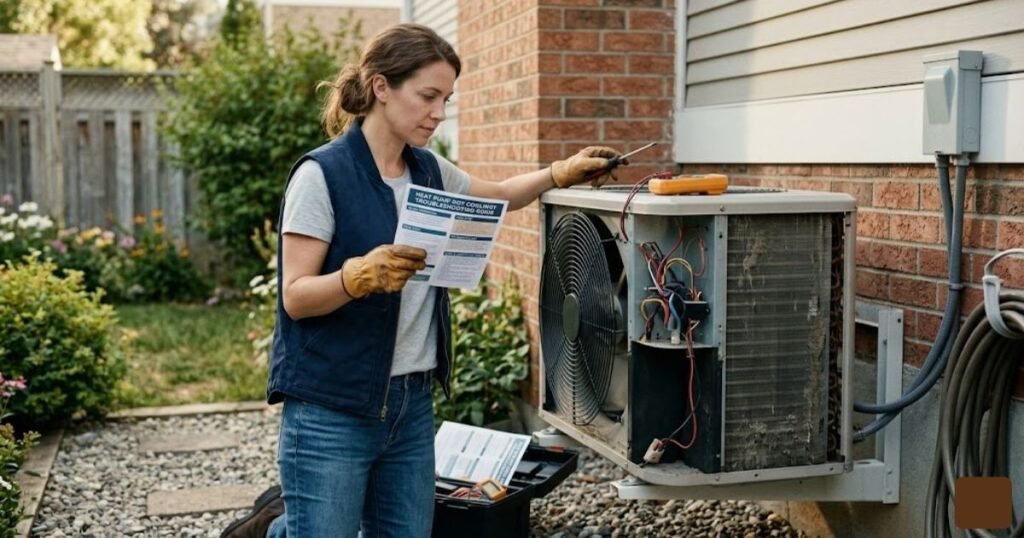
- Look at the Outdoor Unit: Go outside and look at the big metal box. Is it buried in weeds? Is there a bird’s nest inside? Clear away any debris for at least two feet around the unit. If the metal fins look caked in dirt, you can gently rinse them with a garden hose (don’t use a pressure washer you’ll bend the fins!).
- Reset the System: Sometimes the electronics just need a “reboot.” Turn the system off at the thermostat, then go to your home’s breaker panel. Flip the HVAC breaker to “Off,” wait 60 seconds, and flip it back “On.” Give it a few minutes to restart.
- Check for Ice Buildup: Open the door to your indoor air handler or look at the copper lines running to the outdoor unit. Do you see white frost or ice? If so, turn the system off immediately and let it melt. Running a frozen system can kill the compressor.
- Watch for Strange Noises: Listen to the system. Do you hear a loud buzzing, grinding, or a “thwacking” sound? Those are clues you can give a technician later.
When the Problem is More Serious
Look, we all love a good DIY win. But there are times when “fixing it yourself” can actually make things worse or even be dangerous. If you’ve tried the basics and you’re still seeing these heat pump repair signs, it’s time to call in a professional.
Weak Cooling After Basic Checks
If you changed the filter and cleaned the outdoor unit, but the air coming out of the vents is still barely cool, you likely have a refrigerant issue or a failing compressor. These require specialized tools and licenses to fix.
Frequent Short Cycling
If your heat pump turns on for three minutes, shuts off, and then turns back on again five minutes later, it’s “short cycling.” This puts immense strain on the motor and usually points to an electrical issue or an overheating component.
Ice That Keeps Coming Back
If you thawed out your system, changed the filter, and it still froze up again within a few hours, you have a deeper problem—likely a refrigerant leak or a faulty blower motor.
The “Burning” Smell
If you smell something like burning plastic or ozone, shut the power off at the breaker immediately. This usually means a wire has melted or a motor has burnt out. Don’t risk a house fire.
Water Leaks
If you see a puddle forming around your indoor unit, your condensate drain line is probably clogged. While some homeowners can clear this with a wet/dry vac, a pro can ensure the line is sanitized so it doesn’t happen again.
Electrical Tripping
If your heat pump keeps tripping the circuit breaker, stop flipping it back on. The breaker is doing its job by preventing an electrical surge. Repeatedly resetting it can damage the unit’s sensitive circuit boards.
READ MORE: Goodman Heat Pump Review 2026 | Efficiency, Cost, Pros & Cons
Heat Pump Quick Fix vs. Repair vs. Replacement
When the technician arrives, they’re going to give you some options. It helps to know where you stand before they start talking numbers.
- The Quick Fix: This is usually something like replacing a capacitor, cleaning a flame sensor, or clearing a drain line. These are generally affordable and should get you back up and running the same day.
- The Major Repair: This involves things like replacing a fan motor, fixing a refrigerant leak, or replacing the reversing valve. If your unit is less than 10 years old and otherwise in good shape, these repairs are usually worth the investment.
- The Replacement: If your heat pump is over 12–15 years old and needs a major part (like a compressor), it might be time to say goodbye. Putting $2,000 into a 15-year-old system is often “throwing good money after bad.” Newer systems are significantly more energy-efficient and will save you money on your monthly power bill.
Heat Pump Repair Cost Discussion:
Let’s talk turkey. No one likes surprise bills. While prices vary wildly depending on where you live in the U.S. and the specific brand of your unit, here are some “ballpark” figures to keep in mind for common repairs.
| Service / Repair | Estimated Cost Range |
| Diagnostic Fee (Service Call) | $75 – $150 |
| Standard Tune-Up / Cleaning | $100 – $250 |
| Capacitor Replacement | $150 – $450 |
| Refrigerant Recharge (incl. Leak Search) | $300 – $900+ |
| Blower Motor Replacement | $400 – $1,200 |
| Reversing Valve Replacement | $600 – $1,500 |
| Full Heat Pump Replacement | $5,000 – $12,000+ |
Note: Labor costs in major cities like New York or San Francisco will be higher than in rural areas. Also, if your system uses the older R-22 refrigerant (which is being phased out), a recharge will be much more expensive than the modern R-410A or R-32.
READ MORE: Heat Pump Installation Cost in 2026 (Real Prices, Examples & Savings)
Heat Pump Preventive Maintenance Tips
The best way to deal with a heat pump not cooling is to make sure it never happens in the first place. A little bit of love goes a long way with these machines.
- Seasonal Tune-ups: Have a pro come out twice a year once in the spring for cooling and once in the fall for heating. They can catch tiny problems (like a fraying wire) before they become “I’m sweating in my sleep” problems.
- Filter Changes Are Non-Negotiable: Check your filter every month. If it looks grey or fuzzy, swap it out. Most homes need a new one every 90 days, but if you have shedding pets, you might need to do it every 30.
- Keep the “Moat” Clear: Keep a 2-foot “no-fly zone” around your outdoor unit. No mulch, no tall grass, and definitely no dog houses or trash cans leaning against it.
- Check the Drain Line: Once a year, pour a cup of white vinegar down your condensate drain line. This helps kill the algae and “slime” that can clog the pipe and cause water damage to your floors.
- Keep Vents Open: You might think you’re saving money by closing vents in the guest room, but you’re actually making the heat pump work harder by increasing the “static pressure” in the ducts. Keep at least 80% of your vents open at all times.
- Listen to Your Unit: Get to know what your heat pump sounds like when it’s working perfectly. If it starts making a new “clunk” or “hiss,” you’ll know something is up before the house gets hot.
Conclusion
At the end of the day, your heat pump is a mechanical system, and like your car, it needs a little bit of attention to keep running smoothly. Dealing with a heat pump not cooling is a major headache, but most of the time, the fix is within reach.
Start with the basics: check that thermostat, swap out the filter, and make sure the outdoor unit isn’t buried in leaves. If those don’t do the trick, don’t be afraid to call in a trusted local HVAC pro. It’s better to pay for a repair now than to let a small issue turn into a total system meltdown.
Keep your cool, stay on top of your maintenance, and your heat pump will keep you comfortable for years to come.
READ MORE: Weil‑McLain Boiler Reviews (2026) — Models, Costs, Pros & Cons
Frequently Asked Questions
Why is my heat pump running but not cooling?
If the unit is humming along but the air isn’t cold, you likely have an airflow restriction or a refrigerant issue. Check your air filter first. If the filter is clean, the outdoor unit might be too dirty to release heat, or the system might be low on refrigerant due to a leak.
What should I check first if my heat pump is not cooling?
Start with the “Big Three”: The thermostat (is it on “Cool”?), the air filter (is it dirty?), and the circuit breaker (did the switch flip?). These three things account for a huge percentage of cooling issues and can be checked in less than five minutes.
Can a dirty filter make a heat pump stop cooling?
Absolutely. A dirty filter blocks airflow. Without enough air passing over the indoor coils, the heat pump can’t remove the heat from your home. This can also cause the coils to freeze into a block of ice, which stops the cooling process entirely.
Why is my heat pump blowing warm air in cooling mode?
This is often caused by a faulty reversing valve, which is the part that tells the heat pump whether to provide heat or AC. If it gets stuck, it might default to “heat mode.” It could also be a simple thermostat wiring issue or a very low refrigerant level.
When should I call an HVAC technician for a heat pump problem?
You should call a pro if you see ice on the lines, smell a burning odor, hear loud grinding noises, or if you’ve already changed the filter and checked the thermostat but the air is still warm. Also, any issue involving refrigerant or electrical wiring should always be handled by a licensed technician.