Pipe lining (CIPP) is usually the lower-disruption option and is often cheaper for shorter runs or when the existing pipe is mostly intact; typical pipe lining cost runs about $80–$250 per linear foot. Pipe bursting can be a better long-term fix for badly damaged or collapsed lines (and lets you upsize) but often costs more on complicated jobs about $60–$300 per linear foot. Most trenchless projects for a single-family home fall broadly between roughly $1,900 and $20,000 depending on length and site work.
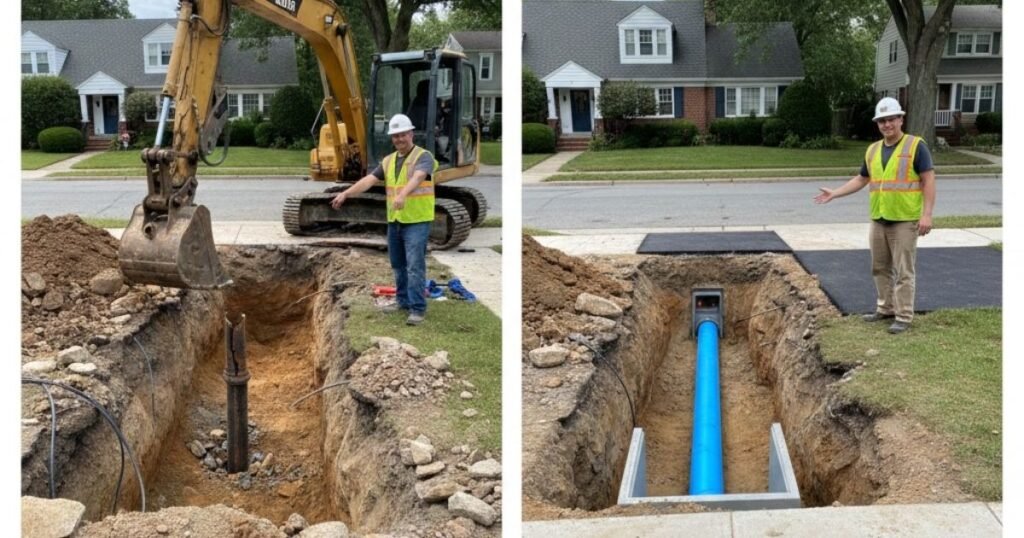
Comparison table Pipe Bursting vs. Pipe Lining Costs
The following table provides a high-level technical and financial comparison of the two primary trenchless methodologies alongside traditional excavation to help evaluate long-term value against upfront expenditure.
| Method | Cost per linear foot (typical) | 40-ft example (approx.) | Invasiveness | Best for | Lifespan estimate | Pros | Cons |
| Pipe lining (CIPP) | $80 – $250 / ft. | $3,200 – $10,000 | Low — 1 access pit | Pipes with intact host pipe (cracks, corrosion) | 25–50+ years | Minimal yard damage; quick | Reduces diameter slightly; can’t fix collapsed pipe |
| Pipe bursting | $60 – $300 / ft. | $2,400 – $12,000 | Moderate — 2 access pits; breaks old pipe | Collapsed or missing host pipe; upsizing | 50+ years (HDPE) | New pipe installed; can upsize | Heavier machinery; more surface access than lining |
| Open-cut replacement | $50 – $250 / ft (plus restoration) | $2,000 – $12,000+ (plus driveway/landscape) | High — full excavation | Severely damaged pipes or complex depth issues | 50+ years | Full control; can change depth/grade | Major yard/driveway disruption; high restoration cost |
Table footnote: exact quotes vary by region and job details — always request a camera inspection and line-item quotes that separate per-foot, access, and restoration costs.
READ MORE: Signs Your Pipes Need Replacing
What are Pipe Bursting and Pipe Lining?
Pipe Lining (CIPP)
also called cured-in-place pipe (CIPP) lining — is a trenchless rehab that installs a resin-saturated liner inside the existing pipe. The liner is inverted or pulled into place and cured (usually by heat or UV), creating a seamless new interior “pipe within a pipe.” Because the host pipe remains in place, only small access pits (typically one or two) are needed. CIPP is excellent for pipes that are cracked, corroded, or leaking but still largely continuous; it’s not suited for completely collapsed sections. Typical CIPP service is lower-disruption and preserves landscaping.
Pipe Bursting
replaces the old pipe by breaking it apart while simultaneously pulling a new pipe (usually HDPE) into place. The bursting head shatters the old pipe outwards into the soil and drags in the new line. Pipe bursting usually requires two access pits (start and end). It’s the preferred trenchless option when the host pipe is collapsed, missing, or when you want to upsize the line (for example, from 4″ to 6″). Because a brand-new pipe is installed, bursting can offer longer service life — but it’s a heavier operation and may require more site preparation than lining.
Both methods avoid long trenches and extensive landscape restoration in most cases, but neither is truly “no-work” — depth, roots, fittings, and local conditions drive feasibility and cost.
Sewer Line Repair Cost Per Foot
Understanding the financial breakdown of trenchless repairs requires looking beyond the sticker price and examining the variables of labor, material, and site restoration. Nationally, the average sewer line replacement costs approximately $3,319, but trenchless methods often carry a higher per-foot cost that is balanced by lower secondary expenses.
Per-Foot Pricing Variables
The national range for trenchless sewer repair is roughly $60 to $250 per linear foot, but several factors can push these numbers toward either extreme.
- Pipe Lining (CIPP) Cost: Typically runs $80 to $250 per linear foot. The cost is driven by the high price of epoxy resins and the specialized equipment needed for curing. Small-scale “spot repairs” can be more expensive per foot than a long, continuous run due to the setup time involved.
- Pipe Bursting Cost: Ranges from $60 to $300 per linear foot. The complexity of the machinery and the necessity for two access pits—which may require some excavation—can increase the labor costs relative to simple lining.
Total Project Examples
To put these rates into perspective, consider the following common residential scenarios:
- A 40-foot run of CIPP lining: At an average of $150 per foot, the pipe work costs $6,000. Because only one small access pit is used, restoration costs for the lawn might be only $500, leading to a total of $6,500.
- A 40-foot run of Pipe Bursting: At an average of $175 per foot, the pipe work costs $7,000. However, if the two access pits are located under a driveway and a sidewalk, restoration could add $3,000, totaling $10,000.
- Traditional Excavation (40 feet): The digging and pipe work might only cost $100 per foot ($4,000), but if it destroys 40 feet of a custom-paved driveway and professional landscaping, the restoration could easily hit $15,000, bringing the total to $19,000.
As one expert puts it: “In my experience, the ‘sticker shock’ of a $150-per-foot lining quote often fades when the homeowner realizes that the alternative is spending $15,000 to replace a custom-paver driveway and mature oak trees that stand directly over the sewer line” (Licensed plumber (example)).
Why the Wide Ranges?
The massive discrepancy between a $1,900 job and a $20,000 job is rarely about the method itself and more about the “jigsaw puzzle” of the property.
- Pipe Diameter: Lining a 6-inch pipe requires significantly more resin and a larger liner than a 4-inch pipe, increasing material costs.
- Depth: Excavating a pit 10 feet deep requires safety shoring and more labor hours than a 3-foot-deep pit. If the pipe is under a concrete slab, expect an additional $300 to $350 per foot just to reach it.
- Soil Type: Rocky soil or heavy clay can slow down a bursting head, requiring more hydraulic pressure and time, whereas sandy soil might be easier but more prone to cave-ins.
- Permits: City permits can range from a few hundred dollars to over $1,000, depending on the municipality’s requirements for inspections.
READ MORE: Best Practices to Prevent Frozen Pipes
Regional Cost Variation and Economic Factors
Research indicates that sewer repair costs correlate directly with regional income levels. In the Northeast, where household income is higher, sewer replacements can cost 83% more than in the Lower South.
| Region | Typical Cost (100ft Project) | Multiplier |
| Northeast (MA, NJ, CT) | $4,130 – $4,480 | 1.18x – 1.28x |
| West Coast (CA, WA, HI) | $4,060 – $4,305 | 1.16x – 1.23x |
| Upper Midwest (IL, MN, WI) | $3,360 – $3,815 | 0.96x – 1.09x |
| Lower South (MS, AR, LA) | $2,450 – $2,800 | 0.70x – 0.80x |
Data based on income-correlated cost models and regional plumber survey data.
Pros & Cons of Pipe Bursting vs. Pipe Lining
Each trenchless method offers distinct advantages and drawbacks. Homeowners must weigh the immediacy of the fix against the long-term structural needs of the property.
Pipe Lining (CIPP)
- Pros:
- Least Disruptive: Often requires only one small access point or none at all if a cleanout is available.
- Stops Root Intrusion: The seamless epoxy liner eliminates joints, which are the primary entry points for thirsty roots.
- Improved Flow: The smooth interior of the cured resin can actually increase water flow speed compared to old, pitted cast iron.
- Fast Completion: Most residential jobs are completed and cured within a single day.
- Cons:
- Not for Collapsed Pipes: Requires an intact host pipe to act as a mold for the liner.
- Diameter Reduction: The new pipe is inside the old one, reducing the interior diameter slightly (usually about 1/4 inch).
- Branch Lines: Connections from other bathrooms must be robotically cut open after lining, which adds complexity and cost.
Pipe Bursting
- Pros:
- Brand-New Pipe: You aren’t just reinforcing an old pipe; you are installing a brand-new HDPE line.
- Upsizing: Only trenchless method that allows you to increase the pipe’s capacity.
- Structural Independence: Works even if sections of the old pipe are missing or the line has collapsed.
- Lifespan: HDPE is incredibly durable, often lasting 50 to 100 years.
- Cons:
- More Digging: Requires at least two access pits (insertion and pulling).
- Utility Interference: The outward force of the bursting head can potentially damage nearby water or gas lines.
Upfront Cost: Generally more expensive than lining due to the heavier equipment and labor required for two pits.
READ MORE: How to Repair a Burst Water Pipe
How to decide: site factors that determine the right method
When contractors evaluate trenchless suitability they look at:
1. Condition of the host pipe — If the pipe is cracked but continuous, CIPP lining is usually an economical fix. If the pipe is collapsed, missing, or has severe offsets, pipe bursting or open-cut replacement is probably required
2. Ability to access start & end points — Pipe bursting almost always needs two clear access pits (start and pull). If your property layout or underground utilities prevent that, lining (which can often be done from a single access point) might be the only trenchless option.
3. Need (or desire) to upsiz — Only pipe bursting routinely allows upsizing (e.g., 4″ → 6″). If you have frequent backups tied to undersized lines, upsizing could be worth the extra cost.
4. Surface features — Driveways, patios, or decks above the pipe raise the real cost of open-cut replacement. Trenchless options often save money when major hardscape restoration would otherwise be required. However, some trenchless jobs require localized cutting and then expensive concrete restoration — ask whether the quote includes restoration.
5. Soil & depth — Rocky soil, high groundwater, or very deep pipes raise costs for both methods. Some contractors add depth premiums or charge for dewatering or rock removal.
6. Local permitting and regulations — Permit fees and inspection requirements vary. In some municipalities you’ll need permits that add to the project cost and timeline. Always confirm who pulls permits and whether the permit cost is in the quote.
7. Budget vs. long-term value — Lining can be cheaper up front and fast to do. Bursting gives a full replacement and potentially longer life. If you expect to stay in the house a long time, investing in a full bursting replacement (or a combined approach) may make sense; if you plan to sell soon, minimal disruption and cost might be more attractive.
READ MORE: How to Indicate and Fix Water Pipe Leaking Outside House
Step-by-step: Sewer Line Repair
Typical timeline (single-family home):
- Pre-job camera inspection (30–90 minutes) — documents the problem and helps the contractor pick method and materials.
- Permits & utility marking (a few days to a week depending on locality).
- Mobilization & access pit excavation (half day to a day).
- Main work — lining or bursting (often 1–3 days for typical residential runs). Curing time for CIPP can add a half-day.
- Connection, testing & post-job camera inspection (same day).
- Site clean-up & restoration (1–3 days for lawn; longer for concrete replacement).
Homeowner checklist to prepare
- Move vehicles from driveway and clear work area.
- Mark sprinkler heads, invisible dog fences, and any buried features.
- Secure pets and keep children away from the work zone.
- Ask the contractor what utilities they need located and whether you need to be present for inspections.
- Request a written timeline and a sample warranty document before work begins.
After completion: get a copy of the post-job camera run and written warranty (materials and labor). Confirm whether the contractor covers restoration and for how long.
FAQs
How much does pipe bursting cost per foot and for a typical house sewer line?
Pipe bursting cost per foot typically runs about $60–$300 per linear foot, depending on complexity. For a typical 40-ft house sewer line expect roughly $2,400–$12,000 before driveway or major restoration deep pipelines or curb work can push totals higher. When to call a pro: schedule a camera inspection if you have recurring backups or suspect a collapsed pipe.
How much does pipe lining (CIPP) cost per foot and will it stop roots?
Pipe lining cost (CIPP) typically ranges about $80–$250 per linear foot. Lining seals cracks and often stops roots from penetrating where they were entering through joints and cracks, though heavy root systems may require cutting or chemical root control before lining. When to call a pro: get a camera inspection to confirm root source and whether lining is suitable.
Which is better: pipe bursting or pipe lining — and how long do they last?
Which is better depends on condition: pipe lining (CIPP) is best when the host pipe is intact but leaking; pipe bursting is better for collapsed pipes or when upsizing is needed. Lifespan: CIPP liners commonly estimate 25–50+ years, while new HDPE pipes from bursting can provide 50+ years under normal conditions. When to call a pro: if camera inspection shows collapse, bursting or open-cut replacement may be required.
Can I upsiz my sewer line with pipe bursting, and is it worth the extra cost?
Yes — pipe bursting can upsiz a line (for example 4″ to 6″), which improves capacity and reduces future blockages. Whether it’s worth it depends on your current and future needs (e.g., adding bathrooms). Upsizing adds cost but can be a one-time upgrade that saves money long-term. When to call a pro: discuss household plans (additions, rental units) with a contractor before choosing bursting.
Will homeowners insurance or a local utility cover trenchless sewer repairs?
Typically homeowners insurance does not cover normal wear-and-tear sewer failures; coverage may apply only for sudden, accidental damage (check your policy). Municipal utilities rarely cover private laterals (home to main) some cities offer rebates or partial programs, but most costs fall to the homeowner. When to call a pro: get written estimates and check your policy and municipal rules before authorizing work.
Call-to-action
Get a camera inspection first, then obtain 3 written quotes that break out per-foot, access, and restoration costs. Ask for references, post-job camera proof, and a clear warranty (materials and labor) before you sign anything.

