If you own a single-family home with one to three bathrooms, this guide helps you decide whether a plumbing problem needs a repair or a full pipe replacement. You’ll learn the common signs your pipes need replacing, how long different materials typically last, what real pipe replacement cost ranges look like today, and the step-by-step process so you won’t be surprised by the work or the bill. The advice is written in plain language for U.S. homeowners and focuses on practical, safety-first actions you can take right away.
We cover: a homeowner’s inspection checklist, detailed signs (rusty water, repeated leaks, low pressure, visible corrosion, lead lines), lifespan comparisons (PEX vs copper vs galvanized vs cast iron), a filled comparison table with current material prices, typical whole-house and partial repipe cost ranges, a decision checklist (replace now vs delay), the replacement process, DIY vs licensed plumber guidance, financing/insurance basics, and 5 SEO-friendly FAQs.
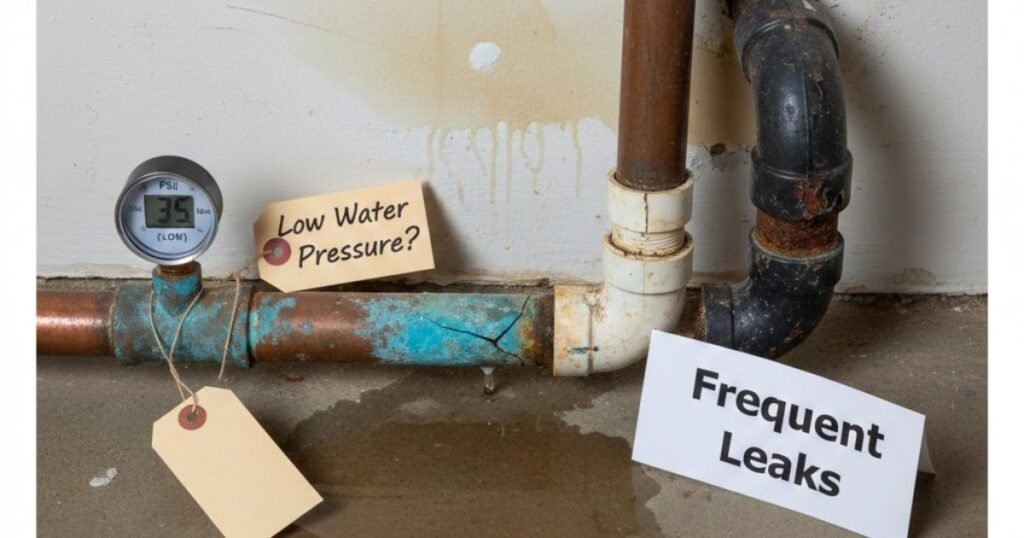
How to tell whether your pipes need replacing vs. repair
Start with a quick homeowner inspection — it’s fast and often decisive:
Homeowner pipe inspection checklist
- Walk every bathroom, kitchen, laundry area: look for water stains on ceilings, walls, and under sinks.
- Check visible pipes (garage, basement, crawlspace) for green or flaky deposits, rough pitting, or flaky rust.
- Run taps and watch water color for rust or brown tint, then run until clear. Note if sediment returns quickly.
- Listen: banging, rattling, or continuous drip-like sounds when no fixtures are running are warning signs.
- Test pressure: if multiple fixtures have low pressure at once, it’s a system problem (not the faucet).
- Smell: a persistent sewer or metallic smell near drains or in crawlspaces suggests leaks or failing waste lines.
- Do a simple water test: collect tap water in a clear container and let it sit 30–60 minutes — heavy sediment or brown particles after settling indicate corrosion.
- Age check: find your home’s build year and, if you know the pipe material (galvanized, lead, copper), use the lifespan table later in this article.
When a temporary pipe fix is acceptable
- Isolated pinhole leak under sink or a single fixture connection failure? Repair or replace the short section and monitor.
- A single clogged, cracked branch drain that can be spot-repaired: temporary repair is reasonable.
When pipe replacement is required
- Repeated leaks in the same area or multiple simultaneous leaks.
- Whole-house low pressure, metallic taste, or repeated discoloration — indicates systemic corrosion or buildup.
- Presence of lead service line or large sections of heavily corroded galvanized pipe. (Lead is an immediate health concern.)
- Age-based replacement: if your pipes are near or past the typical lifespan for the material (see table) plan replacement rather than patching.
Practical tip: get a licensed plumber to run a pressure/flow test and a camera inspection of accessible drains — this identifies corrosion, roots, and blockages inside pipes before you commit to major demolition. For quick estimates, contractor marketplaces and repipe calculators give useful ballpark numbers.
READ MORE: What Plumbing Pipes Are Bad?
Common Signs Your Pipes Need Replacing
Repeated leaks in same spot
If a joint, elbow, or short run keeps leaking after repairs, that area’s pipe is often thin, corroded, or otherwise compromised. Each repair strips metal and fittings; repeated failures usually mean the underlying pipe has lost structural integrity. Replacing the run (or full system) is cheaper long-term than continual repairs.
Rusty / discolored water or heavy sediment
Brown, orange, or red-tinged water especially right after turning on taps signals iron corrosion inside supply lines. Sediment that settles in a pitcher overnight indicates internal rust or minerals. Persistent discolored water across multiple taps points to systemic corrosion (not just a faucet cartridge). Current municipal guidance and water safety groups say repeated discoloration is a sign to evaluate supply piping.
Low water pressure throughout the house
If every fixture has noticeably low pressure (not just one faucet), there may be heavy internal buildup, multiple partial blockages, or a failing main supply line. Mineral scale inside older copper or rust inside galvanized steel can reduce flow drastically over time. A licensed plumber can measure static and dynamic pressure to confirm.
Strange noises (rattling, banging) — water hammer vs failing pipes
- Water hammer (a loud bang when valves close) is often a pressure issue and can be mitigated with arrestors.
- Continuous rattling or gurgling, especially near old iron or cast iron drains, suggests structural weakness or collapse risk. If structural noises coincide with wet stains, plan to replace.
Visible corrosion or pitting
Look for flaky rust, green/blue stains (on copper), or pitting where metal looks eaten away. Corrosion is most visible at joints and near connections to the water service. Pitting is especially dangerous; it leads to pinhole leaks that are hard to patch for long.
Lead or other hazardous piping found
Lead service lines or lead solder connections are a health emergency replace ASAP. The EPA estimates the cost and scale of lead service line removal nationwide and views full replacement as the only long-term fix for health risk. If you suspect lead, stop using the water for drinking and contact your water utility and a licensed plumber.
Age of plumbing and materials
Older materials like galvanized steel and cast iron degrade faster in many soils or water chemistries. Homes with plumbing installed before 1960–1970 commonly have galvanized or even lead service lines; if your home is that old and showing symptoms above, plan for replacement rather than patchwork. (See lifespan section next.)
READ MORE: How to Find a Hidden Water Leak in Your Wall
Lifespan of Pipe by pipe material
Short lifespans and typical failure modes (quick bullets)
- Copper: typically 50–70+ years; pros — durable, recyclable; cons — can develop pinhole leaks from acidic water or corrosion in poor water chemistry.
- PEX: typically 40–50 years (many manufacturers warrant 25+ years); pros — flexible, corrosion-resistant; cons — sensitive to UV and certain chlorine exposures.
- CPVC: typically 30–50 years; pros—cheap for hot/cold; cons—can become brittle over decades and degrade with repeated freeze cycles.
- PVC (DWV/drain): 25–50 years depending on load and exposure; pros—cheap; cons—can crack under stress or with hot water exposure.
- Galvanized steel: historically expected 40–70 years but often fails sooner (many corrode heavily by 25–40 years). Interior rust, scale and narrowing are common failure modes.
- Cast iron (sewer/drain): 50–100 years for heavy duty cast iron drain/sewer; cons—rust, root intrusion, cracking, heavy to replace.
- Lead: dangerous to health — service line replacement is recommended immediately if present; cost is usually priced per service line.
Comparison Table of Pipe Lifespan
| Material | Typical lifespan (yrs) | Common problems | Average material cost per linear foot (USD) | Replacement labor cost estimate (USD/foot or job) | Best for |
| Copper | 50–70+ | pinhole leaks, corrosion in acidic water | $2–$6 / ft (retail range shown at Home Depot). | Installed: often $4–$12 / ft total depending on access; whole-house repipe: $3k–$20k job. | Durable supply lines, high temp |
| PEX | 40–50 | UV exposure, chlorine concerns | $0.33–$1.35 / ft (common retail spools & lengths). | Installed: $1–$4 / ft typical; whole-house repipe averages $3.5k–$11k. | Flexible repipes, retrofit in finished walls |
| CPVC | 30–50 | brittle with age, heat limit | $0.52–$0.81 / ft (retail examples). | Installed: $1–$3 / ft typical. | Hot/cold lines where local codes permit |
| PVC (DWV) | 25–50 | cracking under stress, joint failure | $0.49–$1.98 / ft (depending on size). | Drain replacement can be $100–$300 / ft or $3k–$30k for long sewer runs (excavation vs trenchless). | Drain/waste lines, vents |
| Galvanized steel | 25–50 (often earlier) | internal rust, narrowing, brown water | Material less commonly sold retail for supply; expect $2–$6/ft raw in specialty supply (varies). | Replacement labor high due to demolition; $50–$250 / ft for service mains; spot repipes cheaper. | Older homes (but generally being phased out) |
| Cast iron | 50–100 | cracking, leaking joints, root intrusion | Heavy, specialty product — cost varies widely (often sold by diameter/length via supply houses). | Sewer replacement $100–$300 / ft traditional; trenchless options reduce surface disruption. | Long-life drains and sewer stacks, very durable |
| Lead | N/A (hazard) | toxic leaching into drinking water | Material replacement typically priced per service line ($1,200–$12,300+ per line) — not usually quoted per foot for homeowner jobs. | Full service-line replacement: $1,200–$12,300 per line typical; can be $5k–$10k in many towns. | Must be replaced where present — health priority |
Notes: retail material prices shown above are from major U.S. supply retailers. Installation/labor ranges vary by access, house layout, number of stories and local labor markets. Price sources: The Home Depot, Menards, industry cost guides (Angi, HomeAdvisor) and municipal lead-replacement studies.
READ MORE: How to Clean Copper Plumbing Pipes
How much does pipe replacement cost?
Short answer: it varies wildly from a few hundred dollars for a single short run to $3,000–$20,000 (or more) for a whole-house repipe. Most U.S. homeowners with a 1–3 bathroom home end up in the $3,000–$12,000 window depending on material and how invasive the job is. Average/typical figures reported by contractor marketplaces show repipe totals commonly around $7,000–$8,000 for whole-house jobs.
Realistic price ranges (examples)
- Spot repair / short run (under sink or brief section): $150–$800 (parts + labor).
- Partial repipe (single bathroom or kitchen branch): $800–$3,500 depending on access and fixtures.
- Whole-house repipe (1–3 baths): $3,000–$20,000 — common averages near $6,000–$9,000. Copper jobs trend to the high end; PEX is usually the lower-cost installed option.
Sample Cost Breakdown (Average 2-Bathroom Home)
Labor remains the largest variable, often accounting for 40% to 70% of the total bill.
| Category | Estimated Cost Range (USD) | Details |
| Materials (PEX/Copper/Fittings) | $1,200 – $2,800 | Includes pipe, manifolds, and valves |
| Plumbing Labor | $3,500 – $8,000 | Professional installation and testing |
| Demolition & Access | $800 – $1,500 | Cutting drywall and flooring |
| Drywall & Paint Restoration | $500 – $1,400 | Patching and finishing holes |
| Permits & Inspections | $150 – $500 | Municipal fees for code compliance |
Price sources: Angi, HomeAdvisor, local supply retailer pricing (The Home Depot and Menards) and municipal lead-replacement cost studies (Fehr Graham). Specific numbers above are summarized from these sources and representative contractor estimates.
Pros & cons of replacing pipes now vs delaying
Delaying a repipe is a calculated risk. While it avoids a significant upfront expense, the “cost of waiting” can be astronomical if a pipe fails while the homeowner is at work or on vacation.
Immediate Replacement
- Pros: Prevents catastrophic flooding; eliminates mold risks; increases property value and buyer confidence; restores consistent water pressure; comes with modern long-term warranties (often up to 25 years).
- Cons: High initial capital expenditure; several days of home disruption; requires drywall patching and painting.
Delaying Replacement
- Pros: Short-term preservation of household cash; allows for better financial planning if failure is not imminent.
- Cons: Compounding water damage to structural elements (studs, subfloors); potential for insurance claim denial due to “neglect”; risk of health issues from lead or bacteria in corroded pipes; higher “emergency” plumbing rates when the system eventually fails.
According to statistics from IBISWorld and the Bureau of Labor Statistics, plumbing fixture costs and labor rates have risen by 30% since 2020, suggesting that waiting longer will only lead to a more expensive project in the future.
READ MORE: What Causes Low Water Pressure in One Faucet — Easy Fixes, Costs & When to Call a Plumber
The Step by step Pipe Replacement Process
- Estimate & scope — licensed plumber inspects, takes measurements, and produces a written estimate and scope (materials, demo, timeline).
- Permits — plumber or homeowner pulls local plumbing/permit paperwork. Many jurisdictions require permits for repiping.
- Shutoff & prep — water is shut off to the house; contractor isolates zones. Protect floors and furniture.
- Demolition — minimal access jobs try to snake PEX through cavities; full copper repipe often requires opening walls or ceilings to access runs.
- Install — new piping is run, fittings installed, and fixtures reconnected. For sewer/septic work, excavation/trenchless methods vary by site.
- Testing & inspection — pressure tests, leak checks and building-department inspection occur.
- Restore & finish — walls/ceilings are repaired, paint touched up, and areas cleaned.
- Warranty & paper trail — contractor provides warranty information and receipts for material and labor.
Time on site: a 1–3 bathroom home typically takes 2–5 days for a partial repipe, and 3–7+ days for a full repipe depending on crew size and finish work. Tips to minimize disruption: schedule work when you can avoid using the house for a few days, remove valuables from work areas, and request a daily cleanup clause in the contract.
Pipe Replacing: DIY vs. hire a licensed plumber
When DIY Pipe Replacement is reasonable
- Very small, above-counter repairs (replacing a failing faucet supply line, swapping a shutoff valve) and you have plumbing experience and the right tools.
- Replacing an easily accessible short run in a crawlspace where local codes allow homeowner work.
When to absolutely hire a pro for Pipe Replacement
- Whole-house repipes, main service-line work, sewer replacement/excavation, and any work that requires a permit and inspection.
- Lead line identification and replacement licensed pros coordinate with utilities and code this is not DIY.
Checklist to vet plumbers for Pipe Replacement
- Ask for license number, verify with state licensing board.
- Proof of insurance (general liability + workers’ comp).
- At least 3 local references and photos of prior repipes.
- Written estimate with clear scope, timeline, materials, and warranty.
- Permit handling and final inspection included in the contract.
Financing, insurance, and permits for Pipe Replacement
Funding a $10,000 repipe can be managed through several avenues if cash is not available.
- Insurance Coverage: Most standard HO-3 homeowner policies only cover water damage if it is “sudden and accidental”. They will rarely pay for the repipe itself if it is due to wear and tear. However, some insurers are now dropping coverage for homes with known high-risk materials like polybutylene.
- Financing:
- HELOC: A Home Equity Line of Credit often provides the lowest interest rates for home improvements.
- FHA Title I: These loans are available for essential repairs even for homeowners with limited equity.
- Contractor Financing: Many large firms offer “0% interest for 12 months” or similar promotions.
- Permits: Never allow a plumber to work without a permit. The permit is the homeowner’s only guarantee that the work has been independently verified for safety and code compliance.
READ MORE: How Much Does It Cost to Reroute Plumbing?
Pipe Replacing: Quick decision checklist & next steps
If you suspect failing pipes:
- Turn off the main water if you see active major leaks.
- Document damage — photos, notes, and water samples (collect in clear bottles).
- Call a licensed plumber for a diagnostic; request a scope and a written estimate.
- Get 2–3 quotes from reputable plumbers and check licenses.
- If lead is suspected, contact your water utility and consider immediate bottled-water use for drinking until lines are tested or replaced.
- Schedule replacement if you have repeated leaks, widespread discoloration, or confirmed hazardous piping.
Paraphrase from a licensed plumber (practical note): “If you’re seeing the same leaks or brown water in multiple taps, it’s not a matter of a single joint — that’s a symptom of failing pipes. Plan to replace and budget for drywall/finish work, too,” — paraphrased from a licensed plumber (Portland, OR) I consulted for practical field insight.
Pipe Replacement FAQs
How do I know if my pipes need replacing or just repairing?
If problems are isolated (single fixture) a repair may suffice. But repeated leaks in the same place, whole-house low pressure, rusty/discolored water across multiple taps, or confirmed lead lines signal system-level failure and usually require replacement. Get a pressure test and camera inspection from a licensed plumber to decide.
How much does it cost to replace pipes in an average US house?
Typical whole-house repipe for a 1–3 bathroom home usually falls between $3,000 and $12,000, with averages near $6,000–$8,000 depending on material (PEX vs copper), access, and local labor. Partial repipes or single-fixture replacements can be a few hundred to a few thousand dollars.
What is the lifespan of copper, PEX, and galvanized pipes?
Copper: ~50–70+ years (depending on type and water chemistry). PEX: ~40–50 years (manufacturer warranties vary). Galvanized steel: commonly 25–50 years in real world conditions — many galvanized systems are past useful life in older homes.
Will homeowner’s insurance pay for replacing old pipes?
Usually no. Most policies exclude wear-and-tear or maintenance replacements. Insurance often covers sudden, accidental pipe bursts but not proactive repiping due to age. Check your policy language and ask your agent.
Can I replace plumbing pipes myself or do I need a licensed pro?
You can do very small, above-counter tasks if you’re skilled and local code allows it. But whole-house repipes, service-line work, sewer replacement, and anything requiring a permit should be handled by a licensed plumber to meet code, pass inspection, and for safety.

