You turn on your kitchen or bathroom faucet and drip. Low water pressure from just one faucet is common, annoying, and often fixable without calling a pro. This guide walks U.S. homeowners through fast checks, step-by-step diagnosis, realistic part and labor prices, and clear red flags that mean it’s time to call a licensed plumber. I’ll show the tools you’ll need, how to test common causes (aerator, shutoff, cartridge, supply line, corrosion), plus a comparison table and five SEO FAQs so you can fix it (or hire the right pro) with confidence. Lest deep dive into “What Causes Low Water Pressure in One Faucet — Easy Fixes, Costs & When to Call a Plumber”

- Premium Citric Acid for Cleaning: ACTIVE Powdered Citric Acid Cleaner is Essential for Maintaining Household Water Disti…
- Water Distiller Cleaner Agent: ACTIVE is Compatible with Waterwise, Kleenwise, H2Olabs, Kenmore, Vevor, Vivohome, Megaho…
- Universal Descaling Powder: ACTIVE Citric Acid Crystals are not only a trusted Distiller Cleaner Descaler, but also work…
Expert tip
“Unscrew faucet aerators and soak them in vinegar overnight — mineral buildup often dissolves and restores flow.” — Richard Trethewey, plumbing & heating expert for Richard Trethewey.
(That is a fast, low-risk test you can try before deeper troubleshooting.)
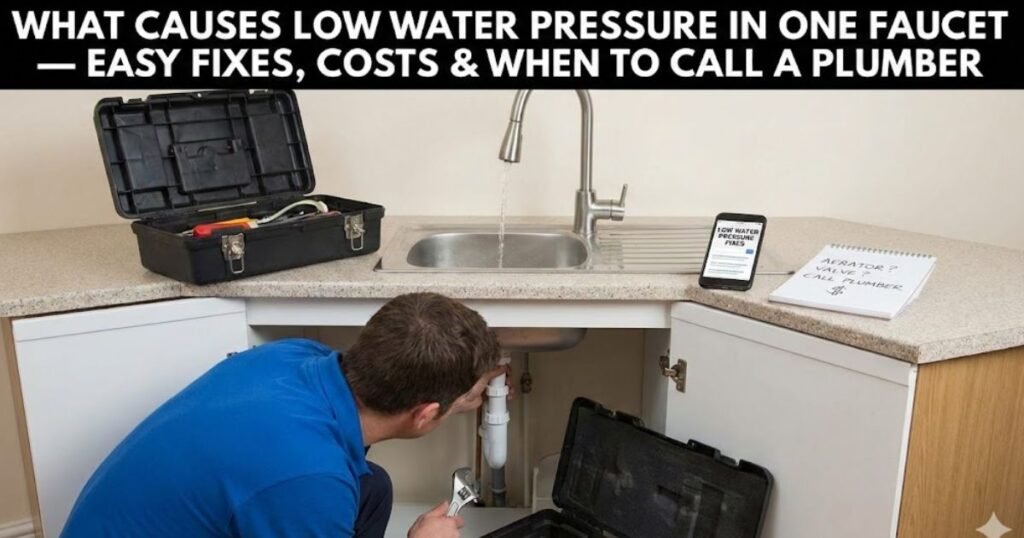
Quick checklist — 5 fast checks to try first
- Turn on a nearby faucet (bathroom/kitchen) does it have normal pressure?
- Remove and inspect the faucet aerator for debris/mineral scale.
- Check the shutoff valves under the sink are they fully open?
- Try both hot and cold is the problem only one side?
- Look for signs of leaks or corrosion under the sink (wet spots, rust, stains).
READ MORE: Fix Leaky Bathroom Faucet
How to diagnose Causes of Low Water Pressure in One Faucet — step-by-step
Work from simplest to hardest. Always shut off water at the fixture’s shutoff valves before disassembling plumbing. If you smell gas, or see active leaks or major corrosion, stop and call a licensed plumber.
Tools you’ll need (and approximate prices)
| Essential Tool | Professional Function | Retailer/Source | Price Range (Searched Feb 15, 2026) |
| Tongue & Groove Pliers (Check Product) | Removing aerators and tightening nuts | Lowe’s (Channellock) | See Price |
| Basin Wrench ( Check Product) | Accessing faucet mounting nuts in tight spaces | Lowe’s (Superior Tool) | See Price |
| Adjustable Wrench (Check Product) | Loosening supply line compression fittings | Home Depot (Husky/Kobalt) | See Price |
| Multi-Bit Screwdriver (Check Product) | Removing handle set screws and caps | Amazon (Craftsman/Kobalt) | See Price |
| Cartridge Puller (Check Product) | Extracting seized Moen/Delta cartridges | Home Depot (Everbilt/Danco) | See Price |
| Precision Screwdrivers (Check Product) | Accessing decorative set screws | Lowe’s (Craftsman) | See Price |
Step 1 — Check other fixtures
Turn on other faucets and the shower. If only one faucet is weak, the issue is almost certainly localized to that fixture or its supply branch (not the main or municipal feed).
Step 2 — Inspect the faucet aerator
- Unscrew the aerator at the spout tip (wrap with tape/pliers jaws with tape to protect finish).
- Inspect the screen and flow insert for sediment or white mineral scale.
- Soak parts in white vinegar 30 min–overnight; rinse and reinstall. (This is the single fastest fix for many single-faucet pressure problems.)
Compatible with Moen, Delta, Kohler, and your patience. Skip the hardware store headache with 15 included adapters. Check below-

Step 3 — Test supply shutoff valves
Under-sink shutoffs (angle stops) can be partially closed or seized. Turn them fully clockwise (off) then fully counterclockwise (open) to ensure they’re open. Operate gently if the valve feels fragile, don’t force it; call a plumber.
Step 4 — Check the faucet cartridge / valve stem
If cleaning the aerator and verifying shutoffs don’t help, the faucet’s internal cartridge or valve stem may be blocked or failing (common with single-handle faucets). Replacing the cartridge often restores flow. Many cartridges are inexpensive, but replacement requires identifying the faucet brand/model and following manufacturer steps.
Stop the Leak, Skip the Plumber. Get the complete Moen 1222 repair kit and fix it yourself in minutes. Check Product-

Step 5 — Look for localized pipe blockages / corrosion
If the faucet’s supply line (flex line) or the small branch piping to that fixture has mineral buildup, debris, or corrosion, flow can be reduced even though other fixtures are fine. Testing often means swapping flex lines or having a plumber check with inspection gear.
READ MORE: How to Find a Hidden Water Leak in Your Wall
Common causes of Low Water Pressure
1. Clogged aerator or screen
- Symptoms: Weak, thin, or irregular stream only at that faucet.
- How to test: Remove aerator; check for scale/debris; soak in vinegar.
- DIY difficulty: Easy.
- Typical cost (parts): $2.60–$20 for replacement inserts.
2. Partially closed shutoff valve (angle stop)
- Symptoms: Reduced flow only at that fixture; valve may feel stiff.
- How to test: Cycle the valve fully closed then open; check flow.
- DIY difficulty: Easy–Medium (if valve is stuck or corroded, don’t force).
- Typical cost (parts): Replacement angle stop $10–$40; labor may be needed.
Check this Angle Stop-

3. Faulty faucet cartridge / valve stem
- Symptoms: Weak flow, inconsistent hot/cold, or leaks; handle hard to move.
- How to test: Shut water, remove handle and cartridge, inspect for scale or broken seals.
- DIY difficulty: Medium (requires faucet disassembly and correct replacement part).
- Typical cost (parts): $15–$60 (example Moen cartridge $24.48 at Lowe’s; searched Feb 15, 2026).
4. Clogged supply line (debris / mineral buildup)
- Symptoms: Low flow at one fixture; new fixtures sometimes clogged by construction debris.
- How to test: Swap or temporarily bypass with a new flex line; if flow returns, supply line is the culprit.
- DIY difficulty: Medium (you can swap flexible supply lines yourself).
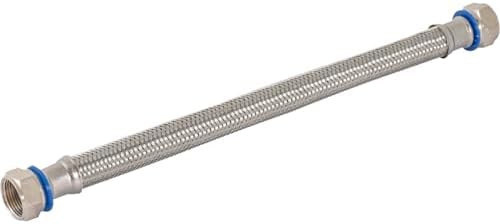
- Typical cost (parts): New braided flex line $5–$20; professional clearing $125–$300 depending on complexity.
Save $300. Check this braided flex line-
5. Corroded / damaged pipes in that branch
- Symptoms: Gradual decline in flow, visible corrosion, occasional leaks.
- How to test: Visual under-sink inspection; plumber inspection recommended.
- DIY difficulty: Hard — usually a pro job.
- Typical cost: Repair or re-piping costs vary widely: hundreds to thousands depending on accessibility.

6. Pressure-balancing / shared supply narrowing
- Symptoms: Another fixture (e.g., nearby sink) affects flow; one faucet may be on a narrowed branch.
- How to test: Run multiple fixtures and observe interactions; plumber diagnosis may be required.
- DIY difficulty: Hard.
- Typical cost: Variable; PRV or repiping work may be required (see pro labor rates below).

Comparison table
| Cause | How it shows (symptoms) | How to test | DIY difficulty | Typical parts needed (example + price; searched Feb 15, 2026) | Estimated labor cost (US national avg) |
| Clogged aerator | Weak/thin stream at spout | Remove & inspect aerator | Easy | Aerator insert $2.60–$20 (Home Depot). | $0–$75 (DIY vs quick pro visit) — pro service calls vary. |
| Partially closed shutoff | Low flow only at fixture | Cycle angle stop | Easy | Angle stop replacement $10–$40 (retail) | $75–$200 (often 0.5–1 hr labor) |
| Faulty cartridge | Low flow + handle issues/leak | Remove cartridge & inspect | Medium | Cartridge $15–$60 (Moen example $24.48 at Lowe’s). | $150–$400 (1–2 hrs labor typical). |
| Clogged supply line | Low flow persists after aerator/cartridge | Swap flex line / plumber snaking | Medium | Flex line $5–$20; flushing tools if pro | $125–$300 (clearing/clog service). |
| Corroded pipes | Gradual loss, stains, leaks | Visual inspection; plumber camera | Hard | Pipe repair materials — variable | $190–$1,500+ depending on access. |
| Shared supply narrowing | Flow affected by other fixtures | Run multiple fixtures & observe | Hard | PRV/test gauge or repiping parts | $200–$600+ (diagnosis & repair). |
READ MORE: No Hot Water in the House? How to Troubleshoot, Fix, and Budget for Repairs
Step-by-step DIY fixes of Low Water Pressure in One Faucet
How to clean an aerator (times & difficulty)
- Turn off faucet. (30 sec)
- Unscrew aerator by hand; if stuck, protect finish with tape and use pliers. (2–5 min)
- Disassemble and inspect — note order of pieces. (1 min)
- Soak parts in white vinegar 30 min–overnight to dissolve mineral deposits. (30 min–overnight)
- Scrub with old toothbrush, rinse, reassemble, reinstall, test. (5 min)
Total active time: 10–20 minutes (plus soaking). Difficulty: Easy. If aerator parts are corroded or snapped, replace with new insert ($2–$20).
How to check & fully open shutoff valves
- Locate the angle stop under the sink.
- Put a towel and bucket under the valve.
- Gently turn valve fully clockwise (off) then counterclockwise until it stops (open). If it resists, stop and call a pro forcing a corroded valve can break it and cause flooding. Difficulty: Easy–Medium.
How to replace a cartridge (types, steps, when to call a pro)
- Identify faucet brand/model or take the old cartridge to the store. Cartridges differ (Moen, Delta, Pfister, etc.).
- Steps (general): shut off water, remove handle/trim, pull cartridge, compare/replace, reassemble, test. Difficulty: Medium.
- When to call a pro: if you can’t identify the cartridge, water lines are corroded, or the job involves soldered connections. Parts often cost $15–$60; expect 1–2 hours labor if you hire a plumber.

- IP67 Waterproof: The circular dial is enclosed in a 304 stainless steel case for corrosion resistance. The PRV-Tex Vent …
- Wetted Materials: lead free brass, stainless steel, and food grade silicone sealing ring. Suit for measuring potable dri…
- Compatible with water pump, drip irrigation pressure regulator, RV tank, pipe tester, outdoor spigot, hose faucet, garde…
When to call a licensed plumber
- Visible corrosion or active leaks when you open access panels.
- Pressure drop plus unusual noises (hammering, gurgling).
- Multiple fixtures affected could be main, PRV, or municipal issue.
- You can’t identify or remove the cartridge/aerator without damaging the fixture.
- Complex repairs (re-piping, hidden leaks, water main issues).
Nationally, plumber rates vary widely: hourly rates often range $45–$200/hr with typical total service costs between $181–$497 or an average job cost around $339.
Costs — parts & labor
- Aerator inserts: $2.60–$20 (Home Depot; price examples include $2.60 and $5.61 items). (searched Feb 15, 2026).
- Replacement faucet cartridge: $15–$60 typical; Moen cartridge example $24.48 (Lowe’s). (searched Feb 15, 2026).
- Groove-joint pliers: $22–$25.
- Flex supply line: $5–$20 (typical retail). (searched Feb 15, 2026).
- Plumber service call / labor: $45–$200/hr; average total jobs commonly fall between $181–$497.
- Clearing clogged supply / minor line work: $125–$300 typical (service call + labor; InchCalculator / trade sites). (searched Feb 15, 2026).
Use these as national averages. Local rates vary always get a written estimate for jobs over a couple hundred dollars.
READ MORE: How to Plumb a Shower Valve (Step-by-Step DIY Guide)
Preventive maintenance tips
- Clean faucet aerators every 3–6 months (soak in vinegar if you have hard water).
- Replace old flexible supply lines every 7–10 years or if corroded.
- Keep shutoff valves exercised (open/close once a year).
- Consider a simple whole-house water softener if you have heavy mineral buildup it reduces scale in fixtures and pipes.
5 FAQs
How do I clean a clogged aerator?
Remove the aerator by hand or with protected pliers, disassemble, and soak the parts in white vinegar for 30 minutes to overnight to dissolve mineral scale. Scrub with an old toothbrush, rinse, and reinstall.
How much does it cost to replace a faucet cartridge?
Parts for a typical cartridge range from about $15–$60 for common brands; specialty cartridges can cost more. If you hire a plumber, expect labor plus parts many faucet repairs run between $150 and $400 depending on time and brand access.
Can a partially closed shutoff cause low pressure at one faucet?
Yes. Angle stop valves under sinks can be partially closed, stuck, or clogged with debris/minerals. Cycle the valve fully closed, then fully open to confirm.
When should I call a licensed plumber for single-faucet low pressure?
Call a licensed plumber if you find corrosion, persistent leaks, you can’t remove/identify the cartridge, multiple fixtures have issues, or if the fix requires cutting/soldering or repiping.
Conclusion
Most single-faucet low pressure problems are simple try the aerator and shutoff checks first. If the issue persists, call a licensed plumber for a safe diagnosis. Need a printable troubleshooting checklist for your handyman box? Call a local licensed plumber or reply “checklist” and I’ll create a one-page printable troubleshooting checklist for you.

