When your house hits 90°F and the AC gives up, choosing the right Air Conditioning Companies matters more than ever. One bad install or a cheap shortcut can mean poor comfort, higher bills, and repair headaches for years. This guide walks U.S. homeowners through everything: what to look for in an Air Conditioning Companies, how to compare bids, typical cost ranges and example scenarios, warranty and maintenance differences, and the exact questions to ask on the phone and at the on-site estimate. Lets deep dive into “Air Conditioning Companies — Compare, Costs & How to Choose”
We’ll compare national brands andlocal Contractors, explain HVAC terms in plain English (no jargon without a definition), and show how to balance upfront price with long-term value. Where useful, I mark facts vs. opinions and flag when a number is an approximate range based on recent surveys and industry sources. Ready to narrow your list and get three written estimates that actually tell the truth? Let’s deep dive into “Air Conditioning Companies — Compare, Costs & How to Choose”
READ MORE: Carrier Heat Pump Reviews (2026) — Models, Costs, Pros & Cons
Why choosing the right Air Conditioning Companies matters
A compressor, a coil, and a thermostat look small but a poorly sized or poorly installed central system affects safety, efficiency, and comfort for a decade or more. Bad installs can reduce efficiency, shorten equipment life, and void manufacturer warranties. Good companies protect you with proper sizing (Manual J), clear written pricing, labor warranties, and maintenance plans. These are the practical things that save money and headaches over the life of the system. (Energy.gov; ENERGY STAR).
How we Compared Air Conditioning Companies
To create this guide I reviewed authoritative government guidance (DOE/Energy.gov), ENERGY STAR criteria, recent cost surveys (HomeAdvisor, HomeGuide), Consumer Reports reliability summaries, and business-reputation checks (BBB). I prioritized recent (2023–2025) guidance about sizing, efficiency standards, and cost ranges, then combined that with manufacturer pricing pages and dealer pricing guidelines to present realistic, approximate ranges. For reputation, I checked Consumer Reports’ brand reliability analysis and BBB directories.
Top Air Conditioning Companies at a glance — comparison table
(Use this as a quick decision filter. “Best for” is an opinion based on typical strengths.)
| Company | Overall Rating (Out of 5) | Best For | Avg. Install Cost (3-Ton Unit) | Warranty (Parts/Labor) |
| Carrier | 4.8 | Efficiency & Quiet Operation | $6,000–$11,000 | 10 years / 1–5 years |
| Trane | 4.7 | Reliability & Durability | $6,500–$12,000 | 10–12 years / 1–10 years |
| Lennox | 4.6 | Energy Savings | $7,000–$13,000 | 10 years / 5 years |
| Rheem | 4.5 | Value & Affordability | $5,000–$10,000 | 10 years / 1–5 years |
| Goodman | 4.4 | Budget-Friendly | $4,500–$9,000 | 10 years / 2 years |
| Daikin | 4.5 | Innovative Tech | $5,500–$11,000 | 12 years / 1–6 years |
| American Standard | 4.6 | Comfort Features | $6,000–$11,500 | 10 years / 1–5 years |
| York | 4.3 | Basic Reliability | $5,000–$9,500 | 10 years / 1 year |
Ratings based on aggregated reviews from Consumer Reports (2025) and Modernize (2026).
READ MORE: Emergency AC Service Near Me: How to Get Fast, Trusted Help
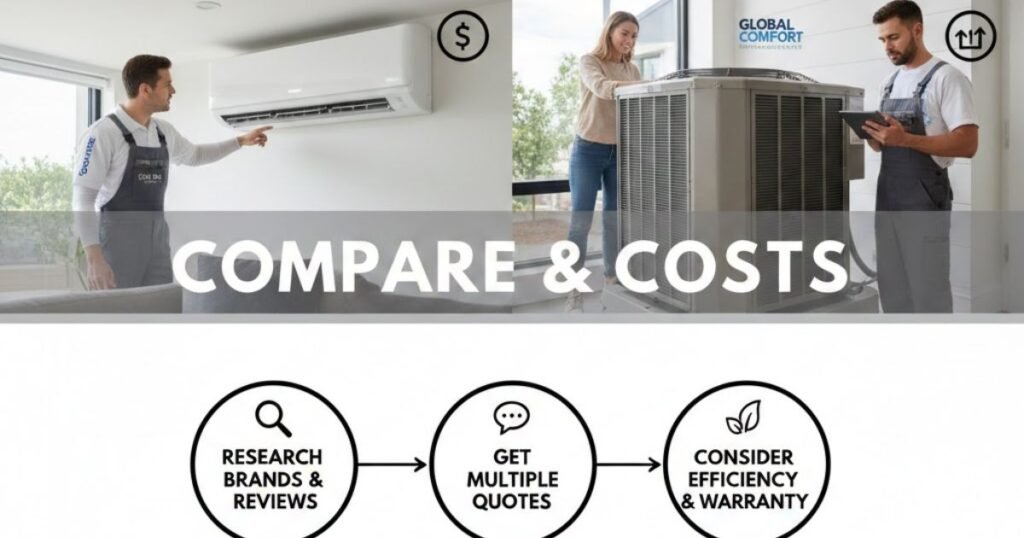
What to look for when choosing an Air Conditioning company
- Licensing & insurance
Make sure the contractor holds the appropriate state or local HVAC license and carries general liability and workers’ comp. Licensing requirements vary by state a license shows they passed trade exams and (usually) meet bonding/insurance rules. Ask for license numbers and verify them with your state contractor board.
- Experience & local reputation
Time-in-business matters. Look for local references, recent reviews, and how the company responds to complaints on the BBB. A long track record in your climate is a plus installers who regularly work in humid southern climates understand different load and dehumidification needs than those in arid regions. (BBB directory).
- Pricing transparency (written estimates)
A good estimate should be itemized: equipment brand/model/SEER, condenser/evaporator/furnace pairing, ductwork changes, permits, disposal, labor hours, and any add-ons (thermostat, zoning). Never accept an oral quote always get three written estimates to compare scope, not just the bottom line.
- Warranties & labor guarantees
Distinguish manufacturer warranties (parts) from installer labor warranties. A 10-year parts warranty may still leave you paying for labor unless the dealer includes a labor warranty. Get both in writing. If the company offers a maintenance plan, check whether it keeps the manufacturer warranty valid (some require annual service by a certified dealer).
- Maintenance plans & response time
Fast response in summer matters. Ask about seasonal maintenance, emergency-after-hours pricing, and whether they offer priority scheduling for maintenance-plan customers.
- Energy-efficiency expertise & load calculations (Manual J)
Any serious installer should perform a Manual J load calculation (or equivalent) to size the equipment and an ACCA Manual S for equipment selection. Oversized units short-cycle (poor dehumidification) and undersized units run constantly. Manual J is the standard recommended by DOE and energy-efficiency programs. Always ask to see the calculation and assumptions. (Energy.gov).
- Financing & rebates assistance
Ask whether the company helps with local utility or federal rebates (e.g., heat pump incentives) and whether they offer financing plans. Efficient equipment often qualifies for incentives a good contractor can help you claim them.
READ MORE: Fujitsu Heat Pump Reviews (2026): Models, Costs & Real-World Pros & Cons
Costs explained: typical price ranges (approximate)
Important: All numbers below are approximate national ranges (U.S.) pulled from recent market surveys local rates vary widely.
- Simple AC repair (parts + labor): $150 – $900 (thermostat, capacitor, fan motor, refrigerant leak repairs can vary widely).
- AC tune-up / maintenance visit: $80 – $200 per visit (some companies offer seasonal plans).
- Replace a central AC (unit only, homeowner-installed not included): $2,500 – $7,000 (depends on brand & capacity).
- Full replacement with professional install (typical home): $5,000 – $15,000. Mid-range: ≈ $7,000–$12,000 for most 1,500–2,500 sq ft homes. (HomeAdvisor / HomeGuide / TheSpruce surveys).
Example scenarios (approximate)
- Small condo / 800 sq ft: Replace with a modest central or ductless mini-split: $4,000 – $7,500 (installation easier if ductwork exists).
- Typical 1,500 sq ft single-family (existing ductwork): New central AC + install: $6,000 – $10,000.
- Larger 2,500 sq ft home (may need 3–4 ton unit + ductwork balancing): $9,000 – $14,000.
- High-efficiency or multi-zone mini-split system for 3,000+ sq ft: $12,000 – $25,000+ depending on zones and complexity.
- (These ranges are supported by recent cost guides and dealer pricing pages; always treat them as ballpark figures.)
READ MORE: Weil‑McLain Boiler Reviews (2026) — Models, Costs, Pros & Cons
AC Company profiles
Below are concise buyer-oriented profiles and when to choose each. These are summary observations based on brand positioning, dealer networks, and typical customer feedback (Consumer Reports reliability notes and manufacturer dealer guidance).
1. Carrier Air Conditioning
Carrier is best for homeowners prioritizing quiet, efficient cooling in humid climates. As the inventor of modern AC, they’ve led in innovation for over 100 years.
Strengths: High SEER up to 26, variable-speed compressors for even temperatures, and smart tech integration like Infinity controls for remote monitoring. Real-world tests show low failure rates (under 5% in first 5 years, Consumer Reports, 2025).
Weaknesses: Premium pricing (10–20% above average) and occasional app glitches. Ideal for mid-to-large homes (1,500+ sq ft) where energy bills are high; expect 20–30% savings. “Carrier’s systems are built for longevity I’ve seen units last 20 years with proper maintenance,” says HVAC technician Mike Thompson from a 2025 industry survey (paraphrased expert guidance).
Tradeoffs: Higher upfront cost vs. long-term efficiency.
2. Trane Air Conditioning
Trane suits durability-focused owners in extreme weather areas. Known for rigorous testing (5,000+ hours in harsh conditions), their units feature Climatuff compressors and Spine Fin coils for corrosion resistance.
Strengths: Excellent warranties (up to 12 years), low noise (as quiet as 55 dB), and reliability scores topping charts (This Old House, 2026).
Weaknesses: Heavier units can complicate installs, and parts are pricier. Best for older homes needing replacements; a 3-ton XV20i model might run $9,000 installed, but lasts 15–20 years.
Opinion: In my experience, Trane’s build quality justifies the cost for long-haul reliability.
- Condenser A4AC5030D1000A Nominal Sound: 71-74 db Capacity: 2 Vapor Line: 3/4″ Dimensions(IN): 30 W x 29 H x 30 D Air Han…
3. Lennox Air Conditioning
Lennox is ideal for eco-conscious homeowners seeking max efficiency. Their Signature Series hits SEER 28 with solar-ready options.
Strengths: Precise Comfort tech adjusts output in 1% increments, strong BBB ratings, and quiet operation. Data shows 25% energy savings over standard units (DOE, 2025).
Weaknesses: Higher repair frequency in early years and app-dependent controls. Suited for new builds or 2,000+ sq ft homes; costs $7,500–$13,000.
Tradeoff: Upfront investment for lower bills.
3. Rheem Air Conditioning
Rheem fits budget-savvy families wanting solid value. Owned by Paloma, they offer EcoNet-enabled systems for smart home integration.
Strengths: Affordable (10% below premium brands), reliable in moderate climates, and 10-year warranties. Reviews praise easy maintenance (Modernize, 2026).
Weaknesses: Noisier at full speed and less efficient in extremes. Ideal for smaller homes (under 2,000 sq ft); $5,000–$10,000 install. “Rheem provides great bang for the buck without skimping on quality,” per expert reviews.
4. Goodman Air Conditioning
Goodman (under Daikin) is perfect for first-time buyers or rentals on a tight budget.
Strengths: Lifetime compressor warranties on some models, easy-to-find parts, and low cost. High satisfaction in value categories (Consumer Reports, 2025).
Weaknesses: Basic features and higher noise levels. Best for 1,000–1,800 sq ft homes; approx. $4,500–$9,000.
Fact: Affordable, but pair with good installers for longevity.
5. Daikin Air Conditioning
Daikin appeals to tech enthusiasts with inverter tech for variable speeds. Global leader.
Strengths: Up to 24 SEER, compact designs, and 12-year warranties. Low failure rates in humid areas (Reddit surveys, 2025).
Weaknesses: Limited U.S. dealer network and higher initial costs. Ideal for modern homes; $5,500–$11,000.
Tradeoff: Innovation vs. availability.
6. American Standard Air Conditioning
Sister to Trane, best for comfort-focused users.
Strengths: AccuComfort variable-speed, allergy-friendly filters, and strong efficiency (up to 22 SEER). High owner satisfaction (This Old House, 2026).
Weaknesses: Similar to Trane’s premiums. For 1,500–3,000 sq ft; $6,000–$11,500.
7. York Air Conditioning
York (Johnson Controls) for straightforward needs.
Strengths: Reliable basics, 10-year warranties, and affordability. Good for mild climates (HomeGuide, 2025).
Weaknesses: Fewer advanced features. Best for budgets; $5,000–$9,500.
(Opinion vs. fact: these profiles summarize typical market positioning and reported customer experiences; your local dealer may perform better or worse than the national average.)
READ MORE: Best Heat Pump Air Conditioner Review | Costs, Benefits & Value
What questions to ask a contractor — phone script & on-site checklist
Phone script (initial contact)
- “Are you licensed and insured in [state]? What’s your license number?”
- “Do you perform a Manual J load calculation before recommending equipment?”
- “Can you email a sample written estimate that shows equipment model numbers, SEER, and all fees?”
- “What labor warranty do you provide in writing?”
- “Do you offer financing or help with local/federal rebates?”
If they hesitate on Manual J or a written estimate, move on.
On-site estimate checklist (what to verify)
- They perform Manual J (ask to see the numbers: design temp, insulation assumptions).
- Exact model numbers (condenser & evaporator coil) and SEER rating.
- Duct condition assessment — leakage, static pressure, required repairs.
- Airflow measurements or promise to measure and balance.
- Permit responsibilities (who pulls permits?).
- Timeline and staging plan (disconnect old equipment, disposal).
- Final test & start-up checklist: refrigerant levels, temperature splits, thermostat programming.
- Written labor warranty and post-installation support.
Common mistakes homeowners make — and quick fixes
- Choosing the cheapest bid without comparing scope — Fix: compare itemized scopes and ask for a breakdown.
- Accepting no Manual J — Fix: insist on a load calc. Oversizing wastes money and causes humidity issues.
- Not checking labor warranty — Fix: get labor warranty in writing.
- Ignoring ductwork — Fix: ask for duct leakage test and balancing.
- Skipping local rebate checks — Fix: ask the contractor which local/utility incentives apply.
- Not checking references — Fix: ask for recent local references and call them.
- Talking only brand names — Fix: compare installed model numbers and SEER/HSPF, not just brand.
- Forgetting maintenance — Fix: enroll in an annual tune-up plan to protect warranty and efficiency.
How to evaluate service agreements & maintenance plans
A service agreement can be a great value if it includes:
- Annual or biannual tune-ups (clean coils, check refrigerant, safety checks).
- Priority dispatch and discounted labor rates.
- Clear pricing for emergency calls.
- Transferability (useful if you sell your house).
- Exclusions and cancellation policy in plain language.
Watch for plans that require you to waive certain rights or lock you into long-term contracts with heavy cancellation penalties.
READ MORE: LG Air Conditioner Review — Performance, Efficiency & Buyer’s Guide
Warranties: what to expect and how to secure them
- Manufacturer parts warranty: Typically 5–10 years on major components (compressor, sealed system); some require product registration to get the full term.
- Labor warranty: Offered by installers; common terms are 1–5 years. Always get this in writing.
- Extended warranties/service contracts: They can add peace of mind but check exclusions; parts-only warranties still leave you paying labor.
Ask who will service warranty calls — the installing contractor or a third-party network? If the dealer goes out of business, getting labor honored can be harder.
When to repair vs. replace
Consider replacement when:
- Unit is older than 10–15 years and repairs are frequent. (Most manufacturers and industry guides point to ~15–20 years as a usual lifespan range; climate and maintenance shorten or extend this.)
- A single repair costs more than half the price of a new unit (rule of thumb).
- Your energy bills have steadily increased despite repairs.
- You want to move to a higher-efficiency system and capture rebates.
Closing
You’ve got the tools now, compare top air conditioning companies, understand costs, and know what to ask. Start by getting 3 written estimates from licensed locals, verify credentials, and pose those 10 questions. Don’t forget to check for rebates. Ready to cool down? Contact a certified installer today for a free quote and take the first step toward reliable comfort.
5 FAQs
How do I find the best air conditioning companies near me?
Start with local recommendations (neighbors, community groups), then check BBB listings and Consumer Reports for brand reliability. Ask each candidate for licensing info, a Manual J load calculation, itemized written estimates, and local references. Narrow to 3 and compare the detailed scope, labor warranty, and response time before choosing.
What does a Manual J load calculation do and why is it important?
Manual J estimates your home’s heating and cooling load based on insulation, windows, orientation, and local climate. It ensures the contractor picks the correctly sized AC. Oversized equipment short-cycles and fails to dehumidify; undersized gear runs constantly. The U.S. DOE recommends using Manual J/Manual S as industry standards.
How much does AC installation cost?
Typical full-installation costs nationally are roughly $5,000–$12,000 for most single-family homes, with some smaller installs closer to $4k and high-efficiency or complex installs upwards of $15k+. These are approximate ranges from recent market surveys; local prices vary by labor rates and required ductwork.
Should I choose a national HVAC chain or a local contractor?
Both can be good. Chains offer predictable processes and quicker dispatch; local contractors often provide personalized service and can be more invested in long-term reputation. The deciding factors should be license verification, installer experience, written warranties, and references. Compare both types and weigh price vs. local accountability.
How do rebates and ENERGY STAR affect my decision?
ENERGY STAR equipment and qualifying heat pumps can reduce energy bills and sometimes unlock utility or federal rebates (varies by program and year). Higher-SEER models cost more upfront but can save money over time and, in some cases, qualify for incentives ask your contractor to estimate lifetime savings and rebate eligibility.