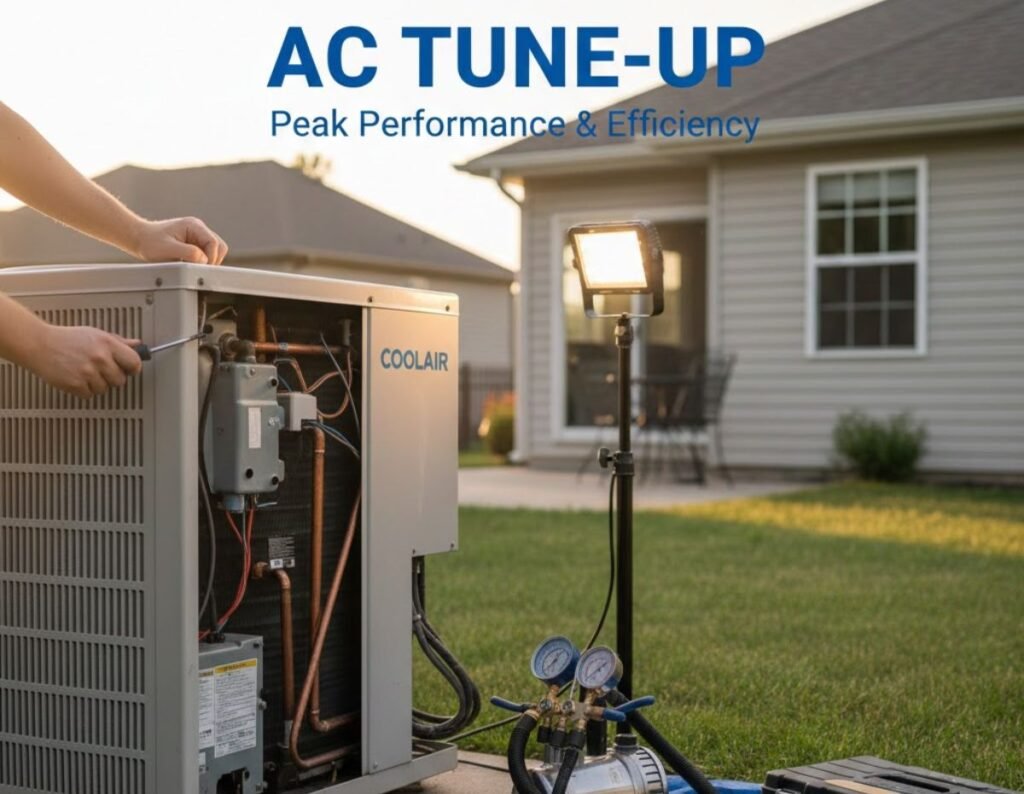
If you’re shopping for a room air conditioner and Frigidaire is on your shortlist, this guide walks you through everything that matters: the types Frigidaire sells, how to size a unit for a room, the features that actually affect comfort and operating cost, how Frigidaire stacks up against other brands, and practical buying, installation, and maintenance advice. I’ll also give a side-by-side comparison table with specific Frigidaire models and comparable offerings from LG, GE, Midea, and Friedrich so you can scan and decide fast. Lets deep dive into “Best Frigidaire Air Conditioners 2026: Reviews, Top Picks & Buying Guide “
Top three buyer questions answered up front
- Which Frigidaire type is best for my space? Window units for small medium rooms, portable for flexible/temporary cooling, and wall/built-in units when a semi-permanent option is needed.
- Are Frigidaire units energy-efficient? Many newer Frigidaire window and inverter portable models carry ENERGY STAR or higher-efficiency specs but check the model CEER/EER numbers when comparing.
- Should I DIY install? Window and portable units are often DIY-friendly; mini-splits or built-in systems and any electrical upgrade should be handled by a pro. (More detail below.)
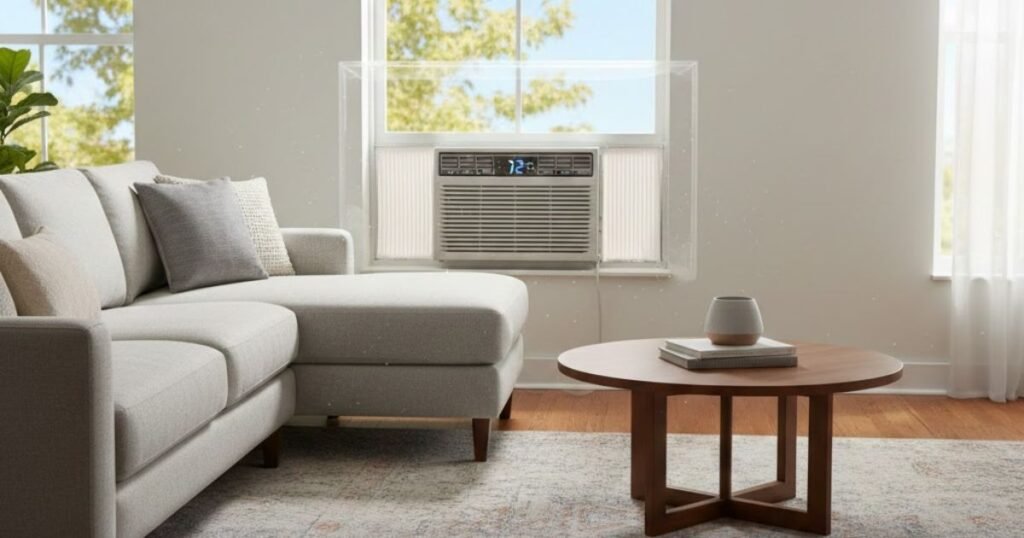
READ MORE: Goodman AC Unit Review: Performance, Costs & Which Model to Buy
Overview: Frigidaire as a brand
Frigidaire is one of the long-standing appliance names in the U.S., and in recent years the company has focused its room-air offerings on window, portable, and built-in/wall units with modern conveniences (Wi-Fi, inverter compressors, quieter operation). Their current product pages highlight connected features, inverter technology on selected models, and ENERGY STAR certified options.
Warranty and support:
Frigidaire’s standard limited warranty for room air conditioners is generally one year (parts and labor) for most room AC products, with some sealed-system components covered longer in certain product families but always read the warranty sheet that comes with a model and register your unit after purchase.
Manufacturer stat:
Frigidaire lists inverter window and connected portable models in their 2024–2025 lineup; many product pages show DOE/ASHRAE and noise specs directly on the product card, which is handy when comparing models.
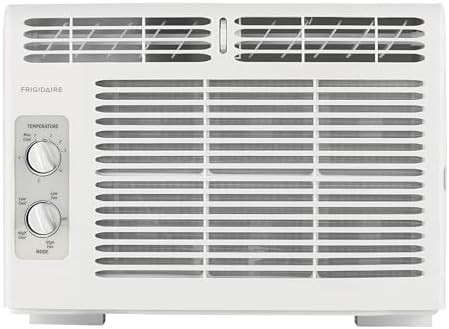
- Effortless Cooling: Achieve optimal comfort with customizable temperature settings and two fan speeds; Effortless Temper…
- Easy Maintenance: Keep your air conditioner running efficiently with the easy-to-clean washable filter, designed to capt…
- Undisturbed Comfort: Experience a peaceful home environment with a quiet performance at 52 dBA – ideal for bedrooms or s…
Types of Frigidaire air conditioners
Frigidaire’s common consumer room AC types:
1. Window (and through-wall) units
- Typical BTU range: ~8,000–12,000 BTU (room models vary).
- Pros: Usually best value per BTU, compact, good energy numbers on newer inverter designs, and increasingly smart/Wi-Fi enabled.
- Cons: Requires a compatible window or sleeve; installation can be awkward for tall windows or slippery sills.
- Ideal for: Bedrooms, small living rooms, apartments, renters who can reinstall when moving.
2. Portable room air conditioners
- Typical BTU range: ~8,000–14,000 (ASHRAE/DOE ratings differ always note DOE rating for real-world cooling).
- Pros: Move the unit from room to room; no window modification if you can vent the exhaust through a kit. Modern Frigidaire portable models add inverter tech and smart features.
- Cons: Slightly less efficient than comparable window units, must vent through a window kit, may produce more noise and floor footprint.
3. Built-in / wall units
- These are similar to window units but installed in a sleeve in an exterior wall. They’re more permanent and can be a good choice where window installation is impractical. Frigidaire offers built-in options targeted at homeowners wanting a more finished look.
4. Mini-splits (ductless) — note on Frigidaire
- Frigidaire’s consumer-facing product pages emphasize window/portable/built-in units; while ductless mini-split systems exist in the broader HVAC market, they are not a prominent Frigidaire room-AC consumer line the way they are for some HVAC brands. If you’re considering a mini-split, plan on professional sizing/installation and higher upfront cost with better whole-home efficiency.
READ MORE: New HVAC System Cost — What It Really Costs to Replace Your Heating & Cooling

- Extra Quiet Performance at 42dBA: Relax and enjoy home life without disruptions; this air conditioner performs 2 % quiet…
- More Consistent, Energy Efficient Cooling: Experience more consistent, energy efficient cooling with our inverter techno…
- ENERGY STAR Most Efficient: Winner of the ENERGY STAR Most Efficient award, this air conditioner offers up to 47% annual…
How to choose the right size (BTU & room square-footage guide)
Sizing is the single most important decision: too small = runs constantly and won’t keep up; too large = short cycles and poor dehumidification. The U.S. Department of Energy and consumer-facing experts use similar rules of thumb. A quick, conservative method:
- Measure the room square footage (length × width).
- Start with ~20 BTU per sq. ft. as a baseline for a typical U.S. room. For example, 250 sq. ft. × 20 ≈ 5,000 BTU (but round up to nearest standard model). ENERGY.gov and government guidance list common room AC ranges as approximately 5,500–14,000 BTU for room-air appliances.
Adjust for conditions:
- Sun-soaked rooms: +10% BTU.
- Shaded rooms: −10% BTU.
- High ceiling (over 8 ft): increase capacity or use multiple units.
- High occupancy (more than 2 people regularly): add ~600 BTU per extra person.
- Kitchens: add ~4,000 BTU due to appliance heat. (These are standard adjustments repeated by home-improvement sources.)
Quick sizing cheat-sheet (common ranges):
- 100–150 sq. ft. → 5,000–6,000 BTU
- 150–250 sq. ft. → 6,000–8,000 BTU
- 250–350 sq. ft. → 8,000–10,000 BTU
- 350–450 sq. ft. → 10,000–12,000 BTU
- 450–600 sq. ft. → 12,000–14,000 BTU
Common mistakes: choosing based on room area only (ignore sun/occupancy/ceiling height), and assuming higher BTUs always saves money oversized units cycle off before they remove humidity, leaving a clammy room. DOE/ENERGY STAR guidance emphasizes correct sizing for comfort and efficiency.
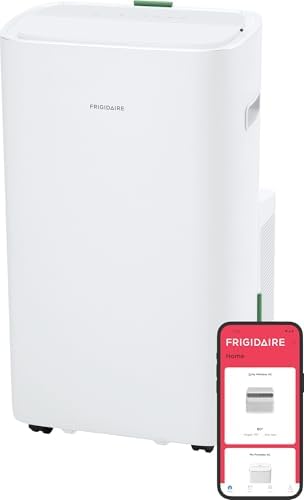
- Wi-Fi Enabled: Easily control your 3-in-1 portable air conditioner from anywhere with the Frigidaire app or connect it t…
- Customizable Cooling: Achieve optimal air circulation with the auto swing louver, custom temperature settings, and three…
- Energy-Efficient Performance: Sleep Mode gradually adjusts the temperature overnight for enhanced comfort, quiet operati…
Key features to compare (what affects comfort and cost)
When you compare Frigidaire models (or any brand), focus on:
Energy efficiency (EER/CEER / inverter tech)
- CEER and EER numbers tell you operating efficiency; higher = better. ENERGY STAR listings show which room ACs meet tougher efficiency benchmarks (new ENERGY STAR specifications took effect in recent years). Inverter compressors (variable-speed) significantly improve efficiency and reduce runtime compared with fixed-speed compressors.
Noise (decibels)
- Look for dB values (some Frigidaire inverter models advertise “ultra-quiet” operation in the low-40s dB or lower for portable/window models). Remember decibels are logarithmic — a 10 dB drop sounds roughly half as loud.
Smart features / Wi-Fi / app control
- Useful for scheduling and remote control. If you value energy savings, Wi-Fi plus scheduling can reduce runtime. Frigidaire models increasingly include app control and voice assistant compatibility.
Dehumidification & filters
- Many models include “dry” or dehumidifier modes helpful in humid climates. Check filter type: washable foam filters are common; some higher-end units support enhanced filtration (allergen/HEPA-style replacements) or “advanced filtration ready” features.
Installation flexibility
- Window vs. built-in sleeves vs. portable: consider window size, sash height, and whether you want a semi-permanent sleeve. Frigidaire sells tool-less window kits with some portables to simplify venting.
READ MORE: Carrier Heat Pump Reviews (2026) — Models, Costs, Pros & Cons
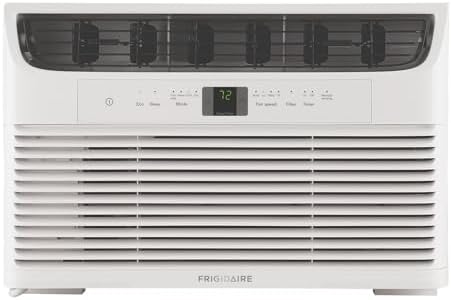
- Customizable Cooling: Achieve optimal comfort with custom temperature settings, 6-way directional airflow, and three dif…
- Easy Maintenance: Effortlessly adjust settings with the remote control and keep your AC unit working efficiently with Cl…
- Energy-Efficient Performance: Save energy with Eco Mode while maintaining a comfortable temperature and reduce energy co…
Frigidaire model comparison table
Below is a scannable table of popular Frigidaire models (consumer lineup) and a matched competitor model from LG, GE, Midea, and Friedrich. The specs and price ranges are given as ranges or typical MSRP at time of writing — always confirm with the retailer because prices and specs can change.
| Model | Type | BTU (cooling) | Recommended coverage (sq ft) | Energy rating / CEER (est.) | Noise (dB) | Smart features | Filter type | Warranty | Typical price (USD) | Best for | Pros / Cons |
| Frigidaire FHPC082AC1 | Portable | 8,000 ASHRAE / 5,500 DOE | ~150–350 (small rooms) | CEER ~6.3 (retailer spec) | ~>50 dB (operating) | No / basic remote | Washable filter | 1 year | See Price | Budget portable | + Cheap, lightweight; − Less efficient, noisier than window unit. |
| Frigidaire GHPC142AA1 (Gallery) | Portable (inverter) | 14,000 ASHRAE / 10,500 DOE | ~350–450 | Higher efficiency (inverter) | ~43 dB (claimed on some listings) | Wi-Fi, app, Alexa/Google | Washable / Advanced filtration ready | 1 year | See Price | Larger rooms, smart | + Quieter, inverter efficiency; − Higher upfront cost. |
| Frigidaire GHWW125TE1 (Gallery) | Window (inverter) | 12,000 | ~450 | ENERGY STAR certified (inverter) | Ultra quiet claims (~low-50s dB) | Wi-Fi, sensors | Multi-filter / washable | 1 year | See Price | Medium to large rooms | + Good balance of power & efficiency; − Window mounting required. |
| Frigidaire FHWW104WD1 | Window | 10,000 | ~350 | ENERGY STAR (select models) | ~54 dB (product listing) | Wi-Fi on select SKUs | Washable filter | 1 year | See Price | Typical bedroom / living room | + Affordable, connected option; − Can block windows. |
| LG LW1216ER (competitor) | Window | 12,000 | ~450–550 | Typical mid-range EER | N/A (listed 55 dB on some pages) | Basic remote | Washable | 1 yr | See Price | Established mainstream alternative | + Widely available & serviceable; − Not inverter on all models. |
| GE Profile PHNT10CC (competitor) | Window (inverter) | 10,300 | ~350–450 | ENERGY STAR inverter | Ultra-quiet marketing | Wi-Fi, ClearView design | Washable / improved filters | 1 yr | See Price | Tech-forward option | + Quiet, inverter efficiency; − Premium price. |
| Midea MAW10U1QWT (competitor) | Window (U-shaped) | 10,000 | ~350–450 | ENERGY STAR inverter | As low as 32 dB (U design) | Wi-Fi, app | Washable | 1 yr (manufacturer) | See Price | Innovative quiet/window-friendly | + Very quiet, window closes; − Recent recall issues for some U models. |
| Friedrich Kühl (select) (competitor) | Window | 12,000 | ~450 | High CEER / premium | Lower noise (QuietMaster tech) | Wi-Fi on some models | Upgraded filters | 1 yr | See Price | Buyers wanting premium quiet | + Built like a tank, very quiet; − Higher price. |
How to read the table: BTU values may be listed as ASHRAE or DOE ratings; DOE values are the standardized consumer numbers used by retailers. Noise and efficiency vary by mode “quiet” ratings usually apply to low-fan mode. Price ranges reflect typical MSRP/retailer prices at time of writing and will vary by retailer, sales, and region.
(Prices and CEER/EER specs change over model years, and “smart” feature availability often differs between SKUs always check the product spec sheet at purchase.)
READ MORE: Midea Air Conditioner

- Wi-Fi Connected with the Frigidaire App: Cool your room anywhere, anytime from your smart device with the Frigidaire app…
Frigidaire vs competitors — side-by-side analysis
Below I compare Frigidaire to the four competitors listed in the table on the most important practical points homeowners care about.
Reliability & build quality
- Frigidaire: solid mainstream reliability on window/portable lines with a long presence in the market and easy parts/accessories. Warranty is standard 1 year on most consumer models; sealed systems sometimes have extended coverage depending on model.
- LG & GE: also well-established with similar consumer warranties; LG is often praised for mainstream service networks, GE Profile aims for higher-end features and design.
- Friedrich: positioned as premium; models emphasize robust construction and low noise, with many buyers citing long life when used properly.
- Midea (branded models): offers very competitive pricing and innovations (U-shape), but note there was a large voluntary recall covering many U/U+ models in mid-2025 related to mold risk consumers should check recall lists before buying a U-style unit. That recall covered Midea-manufactured units sold under multiple brands.
Warranty & service network
- All four mainstream brands have national support and parts channels; Frigidaire, LG, and GE maintain wide retail and service networks. Friedrich has a strong niche following and specialty dealers. Read the warranty PDF on the exact model for covered parts (compressor vs. parts/labor).
Price / value
- Frigidaire often undercuts premium German-built Friedrich while matching or beating GE/LG on good entry and mid-tier models. Midea undercuts widely on price but factor in the recall history and verify the exact SKU and production date.
Energy efficiency & noise
- Inverter models (available from Frigidaire, GE Profile, Midea, and Friedrich) offer the best real-world efficiency and lower noise. If efficiency matters most, prioritize ENERGY STAR/inverter models and compare CEER/EER figures; small differences can add up over seasons. ENERGY STAR guidance and DOE resources explain how to compare actual CEER numbers rather than marketing claims.
Assumptions I used: MSRP ranges are approximations using major U.S. retailers and manufacturer sites at the time of writing; “coverage” sq ft is a general consumer guidance using DOE/ASHRAE conversion and retailer recommendations. Always confirm the DOE BTU rating and CEER/EER on the specific SKU before you buy.
READ MORE: Wall-Mount Air Conditioners (2026): The Smart Guide for U.S. Homeowners
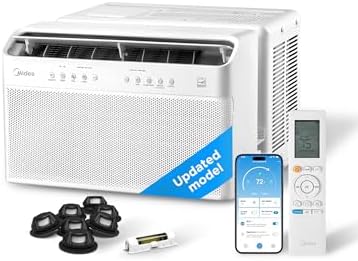
- ULTRA QUIET – The U-shape design of Midea U Smart Inverter air conditioner uses your window to block noise outside. The …
- MORE THAN 37% ENERGY SAVINGS – With the advanced DC Inverter technology, Midea U window air conditioner achieves over 35…
- SMART CONTROL – Midea U Smart Inverter air conditioner is Wi-Fi enabled and can be controlled from anywhere using the Sm…
Installation: DIY vs Professional
When DIY makes sense
- Portable units and most window units are commonly installed by homeowners. Frigidaire portable units often include a tool-less window vent kit and caster wheels that make a single-person installation doable. Frigidaire and major retailers provide step-by-step instructions.
Basic window-unit installation steps (overview)
- Measure the window opening and check clearances.
- Assemble the window mounting bracket or tool-less kit per instructions.
- Lift the unit into the window (get a helper for >60 lbs units).
- Secure the sash and fasten seals/screws; add insulation strips if supplied.
- Plug into a grounded outlet do not use an undersized extension cord.
Bob Vila and This Old House have practical step lists for safe positioning and bracing.
When you need a pro
- Through-wall sleeves requiring cutting into exterior wall.
- Any mini-split or wall-mounted heat-pump installation that requires refrigerant handling and electrical upgrades these must be performed by licensed HVAC techs.
- Electrical work: If the unit requires a 240V circuit (rare for room ACs but possible for larger capacity), use a licensed electrician.
- For warranty validation: some manufacturers require professional installation for certain warranty terms check the warranty.
Time & cost expectations
- DIY window unit: 30–90 minutes with one helper.
- Professional window install (if you pay): $75–$250 typical, depending on local labor and whether a sleeve is required.
- Through-wall or mini-split: $800–$3,500+ depending on complexity. (Regional variation is large get local quotes.)
READ MORE: AC Technician Near Me
Maintenance & troubleshooting
Every month (during heavy use)
- Clean or rinse the washable filter (most Frigidaire models use easy-clean foam or mesh filters). Dirty filters increase energy use and reduce airflow.
Seasonal tasks
- End of season: unplug, remove portable units to dry fully and store in a dry place. For window units, cover the exterior with a breathable cover or remove and store the unit indoors if winters are severe.
- Inspect the drain path & condensate tray (portable and window units) for blockages. If condensate can’t drain properly it can cause odors or mold. (Recall note below.)
Troubleshooting common problems
- Not cooling: check thermostat setting, clean filter, verify the outdoor grille is not blocked, and ensure the correct circuit is delivering power.
- Shuts off on own / trips breaker: try another outlet or check nameplate amperage vs circuit rating; call an electrician if breakers keep tripping.
- Excessive noise or vibration: check installation brackets and that the unit is level; refrigeration noises that are new may indicate compressor issues call a service tech.
Warranty claim tips
- Register your unit immediately (Frigidaire asks customers to register to access warranty docs). Keep purchase receipt, model and serial numbers. If you file a claim, be ready to describe symptoms and note exact model/serial. Ask for an RMA or service authorization before a paid repair if you believe it’s under warranty.
Safety note: the 2025 U-shaped unit recall (what to know)
In June 2025 the U.S. Consumer Product Safety Commission (CPSC) announced a voluntary recall of approximately 1.7 million Midea U and U+ window air conditioners (sold between 2020 and 2025) because water could fail to drain quickly enough and cause mold growth; that recall included some units sold under other brand labels. If you’re buying a U-shaped unit (or considering a used unit), check the CPSC recall page and the manufacturer recall guidance to confirm your model isn’t affected.
READ MORE: American Standard HVAC Systems: Complete Buyer’s Guide for U.S. Homeowners (2026)
FAQs
Are Frigidaire window units noisy?
Newer Frigidaire inverter-equipped window and portable models are marketed as “ultra-quiet” and show mid-40s to low-50s dB on spec sheets in low-fan modes comparable to other modern inverter models. Expect higher noise on high-fan mode.
Can I install a Frigidaire unit myself?
Yes — most window and portable units are designed for DIY installation; follow the manual and get help lifting heavier models. If cutting a sleeve into an exterior wall, or if you need new circuits, hire a pro.
How much do Frigidaire units cost to run?
Run cost depends on CEER/EER and local electricity rates. ENERGY-STAR or inverter models will save the most over seasons compared with basic fixed-speed units. The DOE provides calculators and example annual kWh comparisons for typical CEER bands.
Which filters do Frigidaire models use?
Most consumer Frigidaire room ACs use washable foam or mesh filters; some Gallery or higher models advertise “advanced filtration ready” or improved filter media. Replace or clean filters per manual to keep efficiency and indoor air quality up.
What is the warranty length for Frigidaire ACs?
Standard limited warranty is typically 1 year for parts and labor on room air conditioners; sealed systems may have different coverage. Always read the model’s warranty document.
Final recommendation & buying checklist
Short checklist before you buy a Frigidaire AC:
- Measure room square footage and use the 20 BTU/sq. ft. baseline; adjust for sun/ceiling height.
- Prioritize ENERGY STAR or inverter models if you’ll run the AC often they cost more up front but save energy.
- If noise matters (bedroom), choose inverter models with advertised low dB values and read user reviews for night-time experience.
- For portability or renters: choose Frigidaire portable with a tool-less kit (if you must move rooms). For the best efficiency per dollar: window/inverter window units.
Top picks (based on use case)
- Best value, small rooms: Frigidaire FHPC082AC1 (budget portable).
- Best for quiet, efficient operation: Frigidaire GHPC142AA1 or GHWW125TE1 (inverter/smart options).