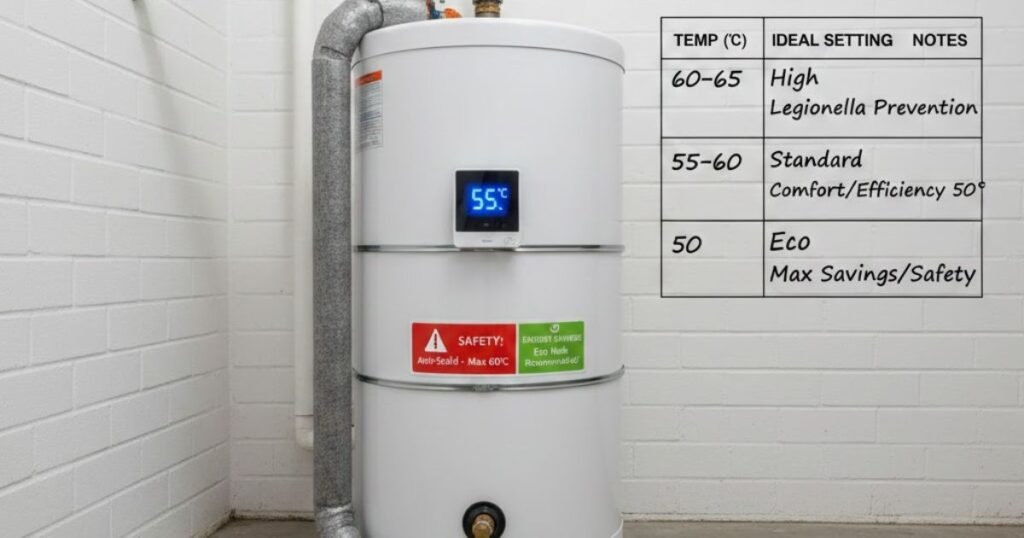
Setting the correct hot water cylinder temperature is a balance between safety, comfort, and energy efficiency. For most U.S. homes, 120°F (49°C) is the recommended setting it’s hot enough for daily tasks like showering and dishwashing while helping reduce energy costs and lowering the risk of scalding. Higher temperatures may be useful in specific situations, such as homes with high hot-water demand or dishwashers without internal heaters, but they should be paired with safety measures like mixing valves.
If your water heater is set too low, you may run out of hot water or risk bacterial growth; too high, and you could waste energy or create safety hazards. Checking and adjusting the temperature takes only a few minutes and can improve comfort, extend your water heater’s lifespan, and lower utility bills over time.
What is a “hot water cylinder”?
In U.S. residential plumbing, a hot water cylinder is simply a storage (tank) water heater a tank that stores hot water ready for use. In the U.K. the phrase commonly refers to the same idea but sometimes points to indirect systems (where the tank is heated by a boiler). A tankless (on-demand) water heater is different: no storage, heats water as it flows. Each approach has tradeoffs we cover below.
How to choose Hot Water Cylinder capacity & type
Sizing (quick rule-of-thumb)
- 1–2 people: 30–40 gallon.
- 3–4 people: 50 gallon (most common replacement).
- 5+ people or heavy simultaneous use (multiple showers + dishwasher): 65–80 gallon.
First-Hour Rating (FHR) explained
FHR = the number of gallons the tank can deliver in an hour starting fully heated. If you run 2 showers and the dishwasher at once, add those peak draws and pick a unit with an FHR above that peak. FHR is often shown on product pages or the DOE EnergyGuide label.
Which fuel/technology?
- Standard electric tank: low upfront cost, simple install (no venting), moderate running cost.
- Standard gas tank (natural gas/LP): cheaper to operate in many regions, needs venting and qualified gas hookup.
- Heat-pump (hybrid) hot water cylinder: much higher efficiency (high UEF), uses ambient air to heat water big operating savings in the right location; requires space and warmer ambient temperature.
- Condensing / high-efficiency gas tanks: for gas homes wanting high efficiency.
- Tankless (on-demand): smallest footprint, fewer standby losses, but higher upfront cost and potential complexity (venting, gas supply, or high electric ampacity).
READ MORE: Air to Water Heat Pump — Complete 2026 Buyer’s Guide (costs, brands, pros & cons)
Hot Water Cylinder Common fuel types & technologies
- Electric resistance storage — simple, inexpensive hardware, predictable performance.
- Gas storage (atmospheric / power vent / direct vent) — faster recovery, cheaper energy cost per BTU in many regions, requires safe venting and combustion air.
- Heat-pump (hybrid) hot water cylinder — electrically powered but far more efficient than resistance because it moves heat instead of creating it, best placed in a garage or utility room with ample air.
- Insulation & tank materials — glass-lined, porcelain-coated steel, or specialty non-metal tanks; anode rods (sacrificial) protect steel tanks from corrosion.
Comparison table — 5 brands (50-gal example prices & specs)
Table note: retail prices were checked on retailer/manufacturer pages on Feb 6, 2026 (retailer + retrieval date noted below the table). UEF / FHR and warranty info are paraphrased from the manufacturers/retailer specs. Prices vary by SKU, retailer, and region use the retailer pages shown in the footnote to confirm before you buy.
| Brand | Example model (50-gal) | Typical capacity(s) | Fuel / Type | Typical retail price (50-gal) | Typical warranty (tank & parts) | UEF / First-Hour (example) | Best-for |
| A. O. Smith | Voltex / FPTU-50 (Voltex hybrid) | 50 / 66 / 80 gal | Hybrid / Heat-pump | $2,120.81 (supply house listing; FPTU-50; retrieved Feb 6, 2026). | 6–10 yr (model dependent) | UEF up to very high heat-pump bin (model dep.); FHR ~65gph on some hybrid models. | High efficiency retrofit / energy-focused homes |
| Rheem | Performance (XE50M…) (electric) | 40 / 50 / 65 gal | Electric / Hybrid options | $509.00 (Rheem Performance 50 gal electric listing at Home Depot; retrieved Feb 6, 2026). | 6–9 yr typical (depends on model) | FHR varies by model (typical 55–63 gph), UEF varies. | Widely available replacement, good value |
| Bradford White | RE250T6-1NCWW / RG250… | 50 / 65 gal | Electric / Gas (contractor supply) | $894.42 (supply house listing, example RE250T6-1NCWW 50 gal electric; retrieved Feb 6, 2026). | 6–10 yr typical (residential series) | Strong FHR (model dep.); contractor grade reliability | Contractor-preferred, commercial-grade options |
| Reliance | 50-gal standard electric models | 50 gal | Electric / Gas | $1,015.01 – $1,035.26 (examples on Walmart / reseller listings; retrieved Feb 6, 2026). | 6 yr typical | Standard UEF / FHR varies | Budget replacement options sold via big-box & online |
| Ruud | Professional Achiever / RE50T2RU95 | 50 gal | Electric / Gas | ~$1,149.96 – $1,496.28 (reseller listings; retrieval Feb 6, 2026). | 6–10 yr typical | UEF up to ~0.93 on some electric models; FHR varies | Durable brand for full replacements |
Short buying tip: the same nominal “50-gal” can have different first-hour ratings and recovery rates depending on element sizing or burner BTU compare the FHR and recovery numbers, not just “50 gal.”
READ MORE: Heat Pump Installation Cost in 2026 (Real Prices, Examples & Savings)
Real prices & installed cost breakdown (unit cost, labor, permits, disposal)
Typical retail unit cost (examples):
- Basic electric 50-gal: $400–$700 (big-box retail models).
- Contractor / premium electric 50-gal: $700–$1,300 (brands with longer warranties or specialty tanks).
- Heat-pump (hybrid) 50-gal: $1,600–$3,500+ depending on model and features. (example: Rheem hybrid and A.O. Smith Voltex listings).
Installed cost (what homeowners often pay):
- Same-type replacement (electric → electric or gas → gas): $600–$2,000 total (unit + labor + disposal + permit).
- Swap to heat-pump / hybrid or change fuel type / move location: $1,500–$4,000+.
- High complexity (upgrade panel, long venting runs, structural work): can exceed $4,000–$6,000.
These ranges mirror independent replacement cost guides and industry averages (expect wide regional variation).
Line items to expect on an invoice: unit price, labor (plumber/electrician; often $50–$150/hr), permit fee, removal/disposal of old tank ($20–$200), new T&P valve / expansion tank / connectors / dielectric unions, venting materials for gas, electrical work (if changing elements or adding ampacity), and possibly extra charges for difficult access.
Pros & Cons of Hot Water Cylinder — by technology
Electric tank (resistance)
Pros: low upfront cost; no combustion/venting; simple install.
Cons: higher operating costs vs gas in many regions; standby losses (keeps tank hot 24/7).
Gas tank
Pros: typically lower operating cost per BTU; faster recovery (great for heavy simultaneous demand).
Cons: requires venting and combustion air; slightly higher install complexity.
Hybrid / heat-pump hot water cylinder
Pros: best operating efficiency for electric systems (much lower annual energy cost); often ENERGY STAR eligible.
Cons: higher upfront cost; needs space and warmer ambient air to perform efficiently; slightly more complex service.
Tankless (brief contrast)
Pros: endless hot water, smaller footprint; lower long-term energy use if sized correctly.
Cons: much higher upfront cost, peak-flow limitations, may require gas line/vent upgrades or heavy electric service.
Hot Water Cylinder Installation & code checklist
- Clearances / working space around the cylinder (manufacturers specify minimum service clearances).
- Temperature & Pressure Relief (T&P) valve installed and piped to safe drain location.
- Expansion tank for closed domestic water systems (most modern installations need one).
- Electrical panel ampacity for electric tanks or dedicated circuit for heat-pump units; subpanel upgrade if necessary.
- Gas line sizing & venting for gas tanks correct vent type (atmospheric vs power vent) and plumbing-code compliant termination.
- Seismic strapping in seismic zones (e.g., California) or other local code requirements.
- Permit & inspection — almost every municipal jurisdiction requires a permit for replacement; installer usually pulls the permit.
- Drainage for possible leaks and floor drain or tub pan when required.
Pro tip: ask for manufacturer-recommended clearances printed on the spec sheet; improper clearances can void some warranties.
Hot Water Cylinder Maintenance & troubleshooting
Routine maintenance (simple):
- Flush the tank once a year (or more in hard-water areas) to remove sediment helps maintain recovery and lifespan.
- Check the anode rod every 2–3 years (replace if heavily corroded) this is the single best preventative maintenance to extend tank life.
- Test the T&P valve once a year (briefly) and visually inspect for leaks.
- Keep the intake/area around heat-pump units clear so airflow isn’t restricted.
Common problems & signs:
- Not enough hot water: element/hot outlet problem, cross-connection, or undersized tank.
- Noise or banging: sediment buildup typically flushing helps.
- Discolored water: likely rust corroding the tank or anode rod failing consult a plumber.
- Leaks: age or corrosion; if you see a wet floor or pooling near the base, plan replacement do not ignore.
Typical lifespan: 8–12+ years for standard tanks; hybrids and premium tanks can vary. Warranty years give a reasonable yardstick but real life depends on water quality and maintenance.
READ MORE: Central Heating: Cost, Types & Buyer’s Guide for U.S. Homeowners
Warranties — how to read them
Manufacturers usually list tank warranty (covers the tank for water loss due to defects) and parts warranty (controls, electronics, heating elements, heat pump compressors). Typical residential warranties are 6–10 years for tanks; premium models sometimes offer longer or prorated coverage. Read exclusions: corrosion from hard water, failure due to poor installation, or external freezing may not be covered. Keep your receipt and register the unit many warranties require registration within a specified window.
Rebates & tax credits — how to find incentives
- Federal tax credits or energy incentives occasionally cover high-efficiency heat-pump water heaters; eligibility changes check the current IRS/DOE guidance and speak to the installer. (Some retailer pages advertise federal tax credit eligibility for heat-pump models.)
- State/local utility rebates — many utilities offer point-of-sale rebates for ENERGY STAR heat-pump units. Use your utility’s rebate search tool or call them. Don’t assume a rebate exists — confirm with the program before purchasing.
Short process: pick candidate models, check the manufacturer page for ENERGY STAR or rebate eligibility, then search your utility’s rebate center and the state energy office. Installer often helps with paperwork.
Practical buying & installation guidance (step-by-step)
- Decide fuel & tech: keep the same fuel type if budget & home layout favor it; switching from gas to electric often adds venting/electrical upgrade costs.
- Measure your space & compare dimensions: height and diameter matter a “tall 50” may not fit an old closet.
- Check FHR and UEF: if you run multiple showers, pick a model with higher FHR; for lower operating costs, prioritize higher UEF or heat-pump models.
- Get at least 2–3 installer quotes — include labor, permits, disposal, and any upgrades (expansion tank, connectors).
- Confirm warranty coverage & registration steps — ask whether labor/warranty service is regional.
- Ask about recyclables & disposal — some installers include haul away.
- Schedule in-season appropriately — installers can be busy in peak months; plan ahead.
FAQs
1) What is a hot water cylinder and how does it differ from a tankless water heater?
A hot water cylinder is a storage tank that keeps hot water ready for use; it’s what most Americans call a tank water heater. A tankless heater heats water on demand without storing it; tanks are simpler and better for simultaneous large draws, tankless units save space and can be more efficient for lower, steady usage. Choose tanks for predictable large-household peaks and tankless for continuous small-to-medium flows or limited space.
2) How much does a 50-gallon hot water cylinder cost (unit only) in the U.S.?
Retail prices for 50-gallon storage heaters vary widely: basic electric models often retail around $400–$700, contractor or premium electric/gas models $700–$1,300, and heat-pump/hybrid 50-gal models commonly start around $1,600 and above depending on features. Sample retailer price snapshots were verified on Feb 6, 2026.
3) What is the first-hour rating and why does it matter?
The first-hour rating (FHR) estimates how many gallons a fully heated tank can supply in one hour. It’s the best single metric to match a tank to your peak demand (showers + dishwasher + washing machine). If your peak usage is 70 gallons in an hour, choose a tank/FHR above that number.
4) Are heat-pump hot water cylinders worth the extra cost?
If you have the space (a warm mechanical room or garage) and plan to stay in the home more than a few years, heat-pump (hybrid) cylinders usually pay back through lower energy bills because they have far higher UEF values than resistance tanks. Upfront cost and local electricity rates are the deciding factors check utility rebates and federal incentives that may reduce net cost.
5) How long does installation take and what are typical additional costs?
A straight swap usually takes 2–4 hours; full replacement with upgrades (venting, panel changes, or moving the unit) can take a day or more. Typical extras include permit fees, disposal of old unit, new expansion tank, and minor plumbing/electrical work. Replacement project totals often fall between $600 and $2,000 for a like-for-like swap; more complex jobs cost more.
Common questions to ask your installer (short checklist)
- Is the quoted price all-in (permit, haul-away, materials)?
- What model number exactly will you install, and what is the UEF and FHR?
- Who handles the permit/inspection? (Installer usually does.)
- Are any panel, gas, venting, or structural upgrades needed? Costs?
- How will warranty service be handled (local service, travel fees)?
- Will you provide a written invoice showing parts/serial number and permit closure?
Final thoughts & “what to check before buying”
- Confirm first-hour rating and UEF for the exact SKU you’ll buy.
- Measure the installation space and verify clearances.
- Ask about local rebates and federal incentives for heat-pump models.
- Keep the installer’s license and ask for references for warranty claims.
- Budget for permit fees and minor electrical/gas upgrades.