Installing a water filtration system can safeguard your health, improve water taste, and protect plumbing and appliances from sediment and scale buildup. There are two primary approaches—point-of-entry (whole-house) and point-of-use (under-sink or countertop)—each serving different needs and budgets. Costs range from as little as $200 for simple under-sink units up to $6,500 for professionally installed whole-house systems, with average expenditures around $2,500 including parts and labor.
Proper installation demands careful planning: testing water quality, selecting certified equipment, locating an appropriate plumbing run near the main shutoff, and using appropriate mounting hardware and tools. Once installed, routine filter replacement every 3–12 months, periodic system sanitization, and leak inspections will keep performance optimal and extend the life of your investment. Lets deep dive into “Install Water Filtration System: Step by Step”

READ MORE: Water Filter System Installation Near Me
Understanding Water Filtration Systems
Water filtration systems remove physical debris, chemical contaminants, and microorganisms by channeling water through media such as activated carbon, reverse-osmosis membranes, or ultraviolet (UV) light chambers.
Types of Water Filters
Point-of-Use vs. Point-of-Entry
- Point-of-Use (POU): Installed at individual taps (e.g., under-sink units or countertop pitchers) to deliver purified water only where needed. POU systems are typically more affordable ($120–$300 labor) and ideal for improving drinking and cooking water.
- Point-of-Entry (POE) / Whole-House: Mounted on the main water line to treat all incoming water, protecting plumbing, fixtures, and appliances. Labor costs range from $200 to $600, while total installation (parts plus labor) can reach $2,500–$6,500.
Filtration Technologies
- Activated Carbon: Adsorbs chlorine, volatile organic compounds (VOCs), and improves taste and odor.
- Reverse Osmosis (RO): Forces water through a semipermeable membrane to remove dissolved solids and heavy metals, often paired with a carbon post-filter.
- Sediment Filters: Capture sand, rust, and silt to protect finer media downstream.
- UV Purification: Uses ultraviolet light to inactivate bacteria and viruses without chemicals.
- Specialty Media: Includes ion exchange resins for water softening and specialized cartridges for PFAS reduction, in response to new EPA limits on “forever chemicals”.

- 𝐂𝐥𝐞𝐚𝐧𝐞𝐫, 𝐇𝐞𝐚𝐥𝐭𝐡𝐢𝐞𝐫 𝐖𝐚𝐭𝐞𝐫 𝐟𝐫𝐨𝐦 𝐄𝐯𝐞𝐫𝐲 𝐓𝐚𝐩 𝐢𝐧 𝐘𝐨𝐮𝐫 𝐇𝐨𝐦𝐞: High-performance water filter system for great-tasting water, impr…
- 𝐀𝐝𝐯𝐚𝐧𝐜𝐞𝐝 𝐅𝐢𝐥𝐭𝐫𝐚𝐭𝐢𝐨𝐧 𝐓𝐞𝐜𝐡𝐧𝐨𝐥𝐨𝐠𝐲: Multi-stage system combines carbon, KDF, UV, and salt-free Scale Control Media to reduce…
- 𝐄𝐱𝐜𝐞𝐩𝐭𝐢𝐨𝐧𝐚𝐥 𝐕𝐚𝐥𝐮𝐞 & 𝐋𝐨𝐧𝐠𝐞𝐯𝐢𝐭𝐲: Enjoy filtered water for under $0.01 per gallon — saving you up to twice as much compared…
Assessing Your Water Quality and Needs
Testing Water for Contaminants
Before installation, conduct a comprehensive water test to identify contaminants and their concentrations. Home test kits cover basic parameters (pH, hardness, chlorine), while lab analyses detect heavy metals, nitrates, and PFAS.
Determining Appropriate Filtration System
Match your system choice to test results:
- Hard Water / Scale: Water softener or cation exchange resin system.
- Chlorine / Taste & Odor: Activated carbon filters.
- Total Dissolved Solids / Heavy Metals: Reverse osmosis.
- Microbial Concerns: UV purification or ultrafiltration membranes.
READ MORE: Best Whole House Water Softener System for Home (2026) — Top Picks & Buyer’s Guide
Planning and Preparation
Budgeting and Cost Considerations
Expect to spend:
- $200–$600 labor for POE systems; $120–$300 for POU labor.
- System hardware: $250–$4,000 depending on stages and technology.
- Ongoing filter replacements: $50–$200 annually.
Choosing a Certified System
Select units certified by NSF/ANSI standards:
- NSF 42/53: For aesthetic and health-related contaminant reduction.
- NSF 58: Reverse osmosis performance.
- NSF 244: Long-term chemical reduction claims.
Location and Plumbing Requirements
Install near the main shutoff valve on a horizontal pipe section. Ensure sufficient clearance for filter housing, mounting bracket, and service access.
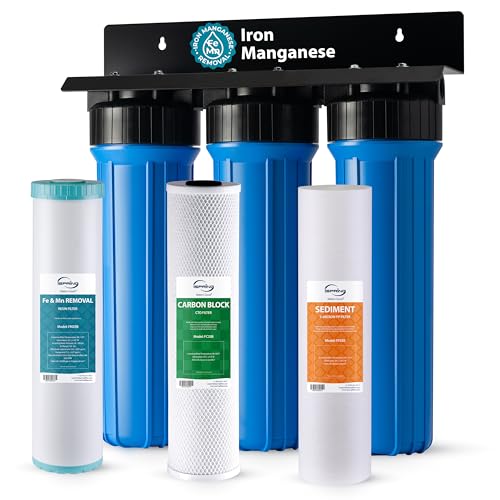
- Whole house water filter that protect your family and household appliance from iron, manganese and more: Our 3rd stage i…
- DIY installation and maintenance – refer to our manual and our helpful YouTube videos for easy DIY installation. With 1 …
- Top-notch quality – the first stage high capacity polypropylene sediment filter achieves filtration down to 5 microns. T…
Installation Process
Tools and Materials Needed
- Pipe cutter or tubing cutter
- Adjustable wrench / channel-lock pliers
- Teflon tape and pipe sealant
- Mounting bracket and screws
- Bypass valve kit (for whole-house units)
- Filters and cartridges.
Turning Off the Water Supply
Close the main shutoff valve and open a downstream faucet to relieve pressure. Place a bucket under the work area to catch residual water.
Installing a Whole-House (POE) System
- Cut the pipe at the chosen location.
- Attach the mounting bracket to a wall or joist.
- Install the inlet and outlet ports using compression fittings or sweat fittings.
- Bypass valve installation allows water flow when servicing the system.
- Mount the filter housing and insert filter cartridges.
- Re-open the shutoff valve, check for leaks, then flush the system according to the manufacturer’s instructions.
Installing an Under-Sink or Countertop (POU) System
- Mount the dedicated faucet through a drilled hole or existing hole in the sink or countertop.
- Connect the cold-water feed via a saddle valve or tee connection.
- Attach tubing from the feed to the filter, and from the filter outlet to the new faucet.
- Secure all connections with compression nuts and washers.
- Pressurize and flush the filter to purge air and manufacturing carbon fines.
READ MORE: How to Increase Hot Water Pressure in the Whole House
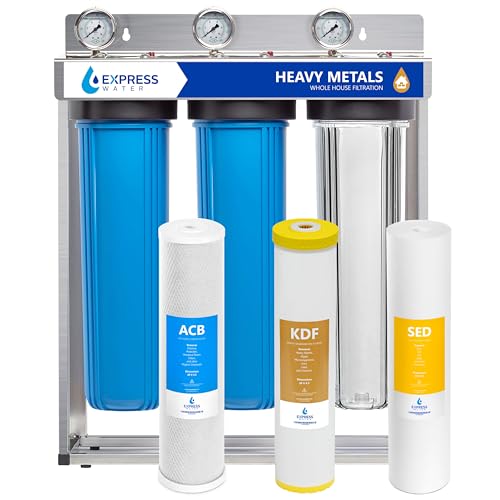
- WHOLE HOUSE WATER FILTRATION: Notice the difference immediately with our 3-stage water filtration process throughout you…
- COMPREHENSIVE FILTRATION SYSTEM: The HEAVY METAL system was specifically designed to significantly reduce heavy metals u…
- DELUXE WATER FILTER: With the Express Water Deluxe Series you get a heavy duty stainless steel bracket and free-stand fr…
Post-Installation Steps
Flushing and Sanitizing the System
Run water through each filter stage for several minutes to remove trapped air and loose media particles. For whole-house systems, activate a backwash cycle if available.
Checking for Leaks and Proper Operation
Inspect all joints and fittings under normal pressure. Monitor flow rate and water clarity; any reduction in flow may indicate misalignment or a clogged cartridge.
Maintenance and Upkeep
Regular Filter Replacement
Follow manufacturer schedules—typically every 3–12 months. Some systems include electronic indicators; manual reminders can prevent lapses.
System Sanitization
Annual disinfection with a diluted bleach solution helps control bacterial growth. Always consult your system manual for the correct procedure and contact time.
Monitoring Performance
Periodically test water quality post-filtration. Declines in contaminant reduction or aesthetic qualities signal filter fatigue or fouling.
Benefits of Installing a Water Filtration System
Health Benefits
Removes lead, chlorine, VOCs, and PFAS to meet new EPA limits, reducing risks of cancer, hormone disruption, and organ toxicity.
Financial and Environmental Advantages
Lower bottled-water expenses and reduced plastic waste support sustainability. Cleaner water prolongs appliance life and reduces scale-related maintenance.
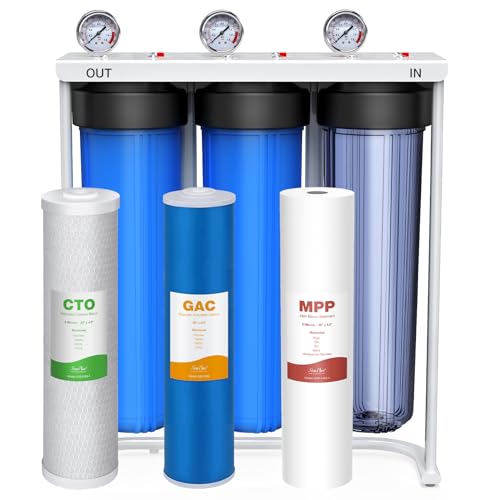
- 【Upgraded 3-Stage Filtration & High Efficiency Purification】SimPure 20”x4.5” whole house water filter system has 2×2 O-R…
- 【Visible Clear Housing】Our house water filter system for well water features two standard housing DB20P+clear filter hou…
- 【Water Appliance Protection】Our whole home water filtering system effectively filters out rust, sediment, and heavy meta…
READ MORE: Hard Water Impact on Water Heater Lifespan — Signs, Fixes, and Costs
Regulatory and Certification Standards
EPA Guidelines and WaterSense Program
The EPA’s WaterSense guide helps homeowners select systems that comply with the Safe Drinking Water Act (SDWA) and recommends certified products for 90 regulated contaminants.
NSF Certification Standards
Voluntary NSF/ANSI standards ensure performance and safety across multiple filter categories, providing independent verification of contaminant reduction claims.
When to Seek Professional Help
While many POU systems are DIY-friendly, whole-house installations often require advanced plumbing skills and may necessitate permits. Hire a licensed plumber if you encounter:
- Complex bypass valve configurations
- Unusual pipe materials (PEX, PVC, cast iron)
- Local code requirements
- Professional service calls average $75–$150, but can save time and prevent costly leaks.
Frequently Asked Questions
What’s the difference between point‑of‑use and whole‑house (point‑of‑entry) systems?
Point‑of‑use (POU) filters are installed at individual faucets such as under the kitchen sink or on the countertop to treat water only at that location, making them more affordable and easier to DIY. Whole‑house or point‑of‑entry (POE) systems connect at the main water line and treat all incoming water, protecting every fixture and appliance in the home, but usually require higher upfront costs and professional installation.
How do I choose the right Water filtration system for my home?
Start with a comprehensive water test—either a home test kit for basic parameters (pH, hardness, chlorine) or a lab analysis for heavy metals, nitrates, and PFAS—to pinpoint contaminants. Then match the technology: activated carbon or Specialty PFAS media for taste, odor, and emerging chemicals; reverse osmosis for dissolved solids and heavy metals; UV purification for bacteria and viruses; and sediment filters for particulates.
What does Water installation typically cost?
Under‑sink and countertop POU systems generally cost $120–$300 for labor plus $100–$250 for the unit. Whole‑house systems incur $200–$600 in labor and $500–$4,000 for equipment, with total project costs often falling between $2,500 and $6,500.
Will a certified system remove PFAS “forever chemicals”?
Not all filters target PFAS; look for NSF 244 or NSF 53 certification specifically listing PFOA/PFOS reduction. As of April 2024, NSF 244 is the benchmark for PFAS removal, ensuring the system reduces these emerging contaminants to below EPA advisory levels.
Does adding a filtration system reduce water pressure?
Properly sized and installed systems typically have minimal impact on pressure. However, undersized piping, clogged pre‑filters, or failing booster pumps in RO systems can reduce flow. Always follow manufacturer recommendations for line size and flush new systems thoroughly to prevent flow restrictions.
Where is the best location for a whole‑house system?
Install on a horizontal section of the main cold‑water line near the shutoff valve and before any branch lines. Ensure clearance for filter housing, mounting bracket, and future cartridge changes. A heated interior wall is ideal in cold climates to prevent freezing
Conclusion
Installing the right water filtration system revolutionizes your home water supply-safety, flavor, and equipment performance enhancement. Through water
testing, choosing certified filters, and strictly following installation and maintenance practices, you can enjoy clean water on every faucet, reducing environmental consequences and long-term costs.

