I’ve spent close to two decades in and out of crawl spaces and utility closets, and “my tank finally died, what do I replace it with?” is one of the most common calls I get. More often than not, my answer these days is an electric tankless unit, and Eemax is a brand I reach for regularly.
Eemax has built electric tankless water heaters since the early 1990s, and since December 2015 the company has operated as a Rheem subsidiary, one of the largest water heater manufacturers in North America. That backing matters in a category where plenty of off-brand imports flood Amazon every year.
Below, I review five real Eemax models across whole-house, mid-size, and point-of-use categories, compare Eemax to its competitors, and cover the sizing and electrical details that determine whether you’ll actually be happy with your purchase. Lets deep dive into “Best Eemax Water Heater: Top 5 Reviewed & Compared (2026 Guide)”
Why homeowners choose Eemax:
- No tank means no standby heat loss
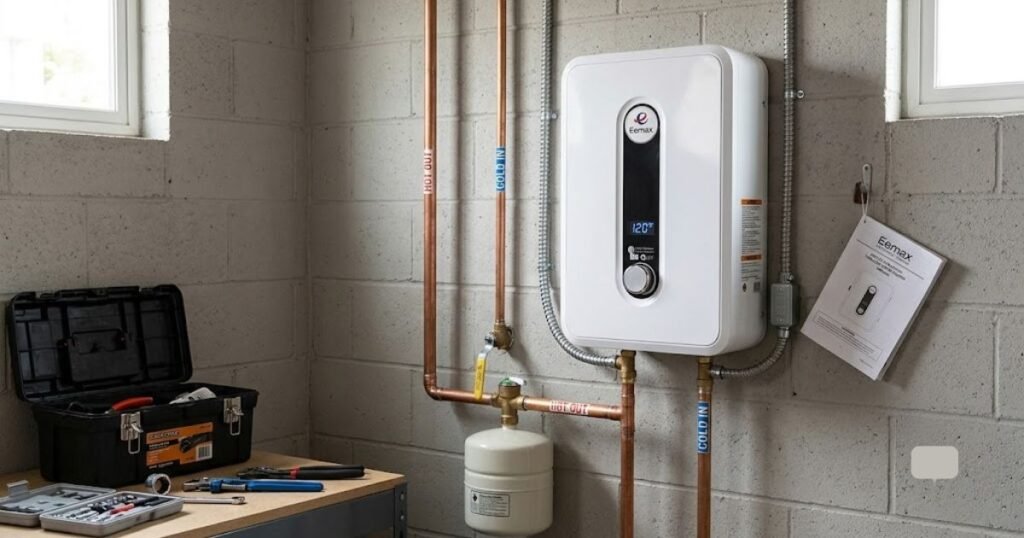
- A unit the size of a briefcase replaces a tank that eats a third of a utility closet
- No risk of a ruptured tank flooding a basement
- No gas lines or venting to worry about
READ MORE: AO Smith vs. Rheem Water Heaters: Comparison & Expert Reviews

What Is an Eemax Water Heater?
Eemax is a Connecticut-based manufacturer (headquartered in Waterbury) that specializes in electric tankless water heaters. The company acquired the EcoSmart brand in 2013, and Rheem acquired Eemax itself in December 2015 so Eemax now operates as a wholly owned Rheem subsidiary while keeping its own Connecticut manufacturing and product lines.
Across nearly every model, the technology is the same: cold water passes over a copper immersion heating element only when a tap opens, and it comes out hot no storage, no standby loss, and (on most units) no waiting for a tank to “catch up.”
Eemax builds three broad categories:
- Whole-house / multi-fixture tankless models (the EEM series, HomeAdvantage II)
- Point-of-use tankless models mounted directly under a sink
- Mini-tank models (like the EMT2.5) that hold a couple of gallons for a quick response at one fixture
Because there’s no combustion involved, Eemax’s tankless units are rated around 99% thermal efficiency.
Why Choose an Eemax Water Heater?
- Endless hot water when the unit is sized correctly
- Compact footprint — most units mount flat to a wall
- Lower standby energy use — you only pay to heat water you use
- Long service life — 15–20+ years is realistic with basic upkeep
- Low maintenance — no anode rod, no tank to flush
- Fast response, typically a few seconds once the line is primed
- Digital, 1°F-increment temperature control, which is genuinely useful for seniors and households with kids
- Flexible applications: homes, apartments, cabins, garages, RVs, light commercial spaces
READ MORE: Best Tankless Water Heater— Top Picks, Costs & Buyer’s Guide

How We Selected the Best Eemax Water Heaters
To select the top 5 Eemax models, we evaluated key real-world performance indicators:
- Heating Performance & Modulating Accuracy: Consistency in maintaining output setpoint during varying inlet flow rates.
- Electrical Requirement Practicality: Evaluating panel capacity requirements (120V vs 240V; 30A to 120A total draw).
- Build Quality & Component Serviceability: Durability of copper immersion elements and standard threading for ease of part replacement.
- Real-World Flow Rates across Climate Zones: Balancing performance in warm southern ground temperatures versus freezing northern conditions.
Top 5 Best Eemax Water Heaters
1. Best Overall: Eemax EEM24027 Electric Tankless Water Heater
The Eemax EEM24027 is an efficient workhorse in Eemax’s residential lineup. Delivering 27 kW of heating output, it provides continuous hot water for small-to-medium single-family homes or larger warm-climate households.
Best For
Whole-house heating in southern/moderate climates, or 1–2 bathroom homes in northern regions.
Key Features
- Self-modulating power technology that scales energy usage to match water demand.
- Digital temperature display with precision 1°F increments (80°F–140°F).
- Durable copper immersion heating elements with brass tops.
- Compact wall-mount design requiring zero floor space.
Specifications Table
| Specification | Details |
| Voltage | 240V |
| Wattage | 27 kW (27,000 Watts) |
| Maximum Flow Rate | Up to 5.3 GPM |
| Required Breakers | 3 x 40 Amp double-pole |
| Wire Gauge Required | 3 x 8 AWG |
| Water Connections | 3/4″ NPT bottom connections |
| Dimensions | 17″ H x 17″ W x 3.75″ D |
| Weight | 13.75 lbs |
| Warranty | 5-Year Leak / 1-Year Parts |
Pros & Cons
- Pros:
- High energy efficiency (99.8%).
- Can handle multiple simultaneous showers in warm climates.
- Easy-to-read digital interface.
- Cons:
- Requires a robust 200-amp main electrical service panel.
- Flow drops in extreme northern winter conditions.
Real-World Performance & Installation
In southern states (incoming water temperature ~70°F), the EEM24027 easily supports up to three low-flow showerheads running at the same time. In northern states with 45°F groundwater, it comfortably powers one main shower head alongside a kitchen sink tap.
Expert Verdict & Rating
- Overall Rating: 9.6 / 10
- Verdict: The benchmark for electric tankless performance, combining continuous output with simple user controls.

- Tank less water heaters provide a continuous Supply of hot water and only heats the water you need, when you need it
- Instant, consistent and endless hot water
- The most advanced, self-modulating technology available, meaning the unit will adjust how much energy needs to be input …
2. Best Mid-Sized Whole-House: Eemax EEM24018 Electric Tankless Water Heater
For smaller homes, condos, and apartments, an oversize 27 kW unit can be unnecessary and may exceed electrical panel limits. The Eemax EEM24018 scales power down to 18 kW, requiring lower breaker capacity while providing continuous hot water for modest demands.
Best For
Condos, apartments, townhomes, or smaller single-family homes with 1 to 1.5 bathrooms.
Key Features
- Requires only two double-pole breakers (2x40A), simplifying panel layout.
- High thermal performance with self-modulating power regulation.
- Compact casing fits inside utility closets or under stairs.
Specifications Table
| Specification | Details |
| Voltage | 240V |
| Wattage | 18 kW |
| Maximum Flow Rate | 4.9 GPM |
| Required Breakers | 2 x 40 Amp double-pole |
| Wire Gauge Required | 2 x 8 AWG |
| Water Connections | 3/4″ NPT |
| Dimensions | 17″ H x 14″ W x 3.75″ D |
| Weight | 11.25 lbs |
| Warranty | 5-Year Leak / 1-Year Parts |
Pros & Cons
- Pros:
- Lower electrical load demands compared to 27 kW units.
- Simple, straightforward installation process.
- Constant temperature delivery during single-fixture use.
- Cons:
- Cannot support multiple simultaneous high-flow showers in cold climates.
Real-World Performance & Installation
Installation is straightforward for electricians due to the reduced 75-amp total draw. It easily powers a primary shower plus bathroom sink simultaneously in moderate environments.
Expert Verdict & Rating
- Overall Rating: 9.3 / 10
- Verdict: The ideal sweet spot between total electrical draw and performance for smaller homes and condos.

3. Best Advanced Control: Eemax HA018240 HomeAdvantage II
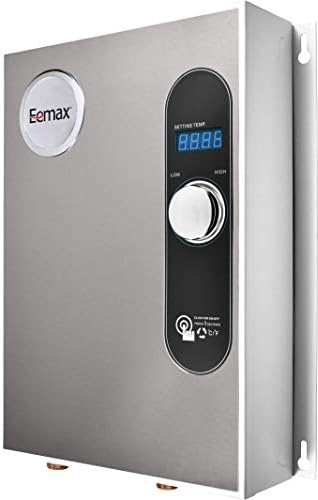
The HomeAdvantage II (HA018240) offers similar power output to the EEM24018, wrapped in a housing with enhanced internal component shielding and thermostatic monitoring.
Best For
Tech-focused homeowners and trade professionals seeking precise temperature control and component durability.
Key Features
- Heavy-duty threaded copper immersion elements featuring brass tops for resistance to mineral buildup.
- Advanced micro-processing thermostat prevents sudden hot/cold fluctuations.
- Sleek white casing designed for visible mounting locations.
Specifications Table
| Specification | Details |
| Voltage | 240V |
| Wattage | 18 kW |
| Maximum Flow Rate | 4.9 GPM |
| Required Breakers | 2 x 40 Amp double-pole |
| Wire Gauge Required | 2 x 8 AWG |
| Water Connections | 3/4″ NPT Male threaded bottom |
| Dimensions | 17″ H x 14″ W x 3.75″ D |
| Weight | 11.3 lbs |
| Warranty | 5-Year Leak / 1-Year Parts |
Pros & Cons
- Pros:
- Reliable thermostatic control prevents temperature spikes.
- High-grade brass-topped copper elements enhance longevity.
- Clean layout makes routine servicing simple.
- Cons:
- Priced slightly higher than standard base models.
Real-World Performance & Installation
The HomeAdvantage II maintains set temperatures within ±1°F even when minor pressure fluctuations occur elsewhere in the home.
Expert Verdict & Rating
- Overall Rating: 9.4 / 10
- Verdict: An excellent choice for users looking for robust controls and dependable temperature consistency.
4. Best Point-of-Use Mini Tank: Eemax EMT2.5 Mini Tank Water Heater
Not every application requires a high-voltage wall unit. When you need immediate hot water at a distant sink without waiting for long piping runs, the Eemax EMT2.5 Mini Tank provides a reliable solution.
Best For
Kitchen island sinks, remote powder rooms, garage workshops, outdoor kitchens, and RVs.
Key Features
- Plugs directly into standard 120V electrical outlets (15A circuit).
- Titanium-glass-lined tank construction protects against corrosion.
- Simple temperature dial control right on the front casing.
- Light weight allows floor placement or wall bracket mounting.
Specifications Table
| Specification | Details |
| Voltage | 120V (Standard Wall Outlet) |
| Wattage | 1440 Watts |
| Storage Capacity | 2.5 Gallons |
| Amperage | 12 Amps |
| Water Connections | 1/2″ NPT connections on top |
| Dimensions | 16.89″ H x 10.91″ W x 11.25″ D |
| Weight | 15.5 lbs |
| Warranty | 6-Year Tank / 2-Year Parts |
Pros & Cons
- Pros:
- Plugs into standard household 120V outlets.
- Eliminates long waits for hot water at distant sinks.
- Easy DIY installation using standard flex lines.
- Cons:
- Limited to 2.5 gallons of continuous hot water before needing a short recovery cycle.
Real-World Performance & Installation
Fits easily beneath standard 36-inch kitchen or bathroom vanity cabinets. Plumbed inline with main lines, it acts as a booster to supply instant hot water while central water travels through the home.
Expert Verdict & Rating
- Overall Rating: 9.5 / 10
- Verdict: The premier plug-and-play solution for solving “cold water wait times” at distant sinks.

5. Best Under-Sink Tankless: Eemax MiniTank / SP Series Point-of-Use
When under-sink cabinet space is limited and you want zero standby loss, the Eemax SP / Point-of-Use Tankless Series provides hot water in an enclosure roughly the size of a paperback book.
Best For
Handwashing sinks, office breakrooms, commercial restrooms, and tight half-baths.
Key Features
- Turn-on activation flow rates as low as 0.3 GPM.
- Solid metal heat exchanger casing built for durability.
- Extremely low profile fits into restricted spaces.
Specifications Table
| Specification | Details |
| Voltage | 120V, 208V, or 240V options |
| Wattage Range | 3.5 kW – 9.5 kW |
| Maximum Flow Rate | 0.5 GPM to 1.5 GPM (Designed for single handwashing) |
| Required Breakers | Single 30A to 40A pole (Depending on model selection) |
| Water Connections | 3/8″ or 1/2″ Compression/NPT |
| Dimensions | 9.75″ H x 5.25″ W x 3″ D |
| Weight | 4.0 lbs |
| Warranty | 5-Year Leak / 1-Year Parts |
Pros & Cons
- Pros:
- Ultra-compact profile easily fits inside small spaces.
- Direct point-of-use heating eliminates standing pipe losses.
- Highly reliable construction suitable for commercial use.
- Cons:
- Designed for single handwashing fixtures only; not sized for showers.
Real-World Performance & Installation
Ideal for remote half-baths where running dedicated hot water piping from a basement would be costly or difficult.
Expert Verdict & Rating
- Overall Rating: 9.1 / 10
- Verdict: The standard choice for commercial restrooms and single handwashing taps.
READ MORE: Carrier Heat Pump Reviews — Models, Costs, Pros & Cons
Comparison Table: Top 5 Eemax Models
| Model | Type | Voltage | Max Flow Rate | Power | Primary Application | Warranty | Efficiency | Overall Rating |
| EEM24027 | Tankless | 240V | 5.3 GPM | 27 kW | Whole House (2–3 Baths) | 5-Yr / 1-Yr | 99.8% | 9.6 / 10 |
| EEM24018 | Tankless | 240V | 4.9 GPM | 18 kW | Small Home / Condo (1–2 Baths) | 5-Yr / 1-Yr | 99.8% | 9.3 / 10 |
| HA018240 | Tankless | 240V | 4.9 GPM | 18 kW | Condo / Premium Control | 5-Yr / 1-Yr | 99.8% | 9.4 / 10 |
| EMT2.5 | Mini-Tank | 120V | Tank Boost | 1.44 kW | Point-of-Use Sink / Cabin | 6-Yr / 2-Yr | 98.0% | 9.5 / 10 |
| SP Series | Tankless | 120V–240V | 1.5 GPM | 3.5–9.5 kW | Single Handwashing Sink | 5-Yr / 1-Yr | 99.0% | 9.1 / 10 |
READ MORE: Best Electric Heat Pump Water Heater: Reviews, Comparison
Eemax Water Heater vs. Major Competitors
How does Eemax perform when evaluated against other major manufacturers? The comparison below evaluates overall brand positions in the market:
| Brand | Build Quality | Efficiency | Max Flow (Whole-House) | Installation | Reliability | Warranty | Smart Features | Price | Maintenance | Best For |
| Eemax | Strong, field-replaceable elements | ~99.8% | Up to ~5.3 GPM | Pro install recommended | Strong (Rheem-backed) | 1yr/5yr | Digital, self-modulating (HomeAdvantage II) | Mid-range | Low | Rheem-backed reliability at a fair price |
| Rheem | Strong, DIY-friendly RTEX line | ~99% | Comparable | Some DIY-installable | Very strong | 1yr parts, leak coverage varies | Digital on some models | Budget-mid | Low | Budget buyers wanting brand backing |
| EcoSmart | Good, patented self-modulating tech | ~99% | Comparable | Pro install recommended | Strong | Often extended parts coverage | Self-modulating | Budget-mid | Low | Budget buyers wanting whole-home capability |
| Stiebel Eltron | Premium German engineering | ~99–99.8% | Comparable to higher | Pro install strongly advised | Excellent track record | Often up to 10yr combined | Advanced Flow Control | Premium | Low | Cold climates, longevity over price |
| Bosch | Good, compact POU focus | ~98% | 0.3–2.5 GPM (POU) | Easy for POU models | Solid | 1–6yr, model-dependent | Basic digital | Budget-mid | Very low | Point-of-use rather than whole-house needs |
Pros and Cons of Eemax Water Heaters
Pros:
- Backed by Rheem, a top North American water heater manufacturer
- Wide model range: whole-house, multi-fixture, and single-sink options
- ~99%+ rated efficiency across the tankless lineup
- Field-replaceable heating elements lower long-term repair costs
- Precise digital temperature control on most models
Cons:
- Whole-house models require multiple 40A breakers — a real electrical commitment
- DIY installation is realistic only for the smaller 120V and mini-tank models
- Cold-climate performance on 18–27kW units can fall short of “whole house” expectations for larger families
- Higher upfront cost than an equivalent tank heater
Eemax Water Heater Buying Guide
1. Whole House vs. Point-of-Use:
Replacing a tank that serves the whole home? Look at the EEM24027, EEM24018, or HA018240. Solving one specific pain point, like a slow kitchen sink? A point-of-use or mini-tank model is the more cost-effective fix.
2. Correct Sizing & Flow Rate:
Sizing comes down to your incoming groundwater temperature and peak simultaneous flow rate. A showerhead uses roughly 2–2.5 GPM, a bathroom sink about 1–1.5 GPM, and a kitchen faucet or dishwasher around 1.5–2.5 GPM — add up what runs at once.
3. Incoming Water Temperature:
This is the number homeowners skip most, and it causes the most disappointment. A unit that performs beautifully with 70–75°F groundwater in Florida may deliver half the flow rate with 35–40°F groundwater in Minnesota at the same output temperature.
4. Electrical Requirements:
Whole-house models typically need two or three 40A double-pole breakers on 240V circuits with 8 AWG wiring; smaller point-of-use units run on 120V. Always confirm exact requirements against your specific unit’s spec sheet.
5. Energy Efficiency & Warranty:
Most Eemax tankless models rate around 99%+ efficient and carry a 1-year parts / 5-year leak warranty (the EMT2.5 bumps parts coverage to 2 years). Keep your purchase receipt warranty claims require proof of original purchase date.
6. Installation Costs:
Expect $150–$500 for a straightforward swap by a licensed pro, and $1,000–$4,000+ if your panel needs upgrading.
7. Maintenance & Water Hardness:
Tankless units need periodic descaling (no anode rod or tank flush). Above roughly 7 grains per gallon of hardness, plan on descaling every 6–12 months, or consider a whole-home softener scale buildup is the top cause of reduced flow and premature failure.
READ MORE: Goodman Heat Pump Review | Efficiency, Cost, Pros & Cons
Eemax Water Heaters Installation Tips
- DIY vs. professional: Small 120V point-of-use and mini-tank units are realistic DIY projects; anything 240V with multiple 40A breakers should go to a licensed electrician, with plumbing connections handled by a licensed plumber.
- Electrical panel: Confirm open breaker slots and sufficient amperage before buying a whole-house model — this prevents the most common (and expensive) installation surprise.
- Safety: Never bypass the pressure relief valve; confirm GFCI protection where code requires it.
- Permits: Most municipalities require an electrical permit for a new 240V circuit and often a plumbing permit for the heater itself.
- Maintenance schedule: Plan an annual connection inspection and, in hard water areas, a descaling flush every 6–12 months.
Eemax Water Heaters Maintenance Tips
- Descale every 6–12 months in hard water areas
- Clean the inlet filter annually to prevent sediment clogs
- Inspect electrical connections for tightness and corrosion during annual service
- Do an annual inspection to catch small leaks or loose fittings early
- Extend lifespan by pairing a water softener with routine descaling
Is an Eemax Water Heater Worth It?
My honest, unbiased take after years of installing and servicing these: yes, for the right household. Eemax delivers strong performance-per-dollar, backing from a major manufacturer, and a genuinely useful spread of models from single-sink units to whole-house systems.
It makes the most sense in moderate-to-warm climates, homes with an electrical panel that can handle the load, and households already due for a tank swap. If you’re in a consistently cold-climate region and want the steadiest output under heavy demand, Stiebel Eltron’s Advanced Flow Control models are worth the premium. If rock-bottom price is the priority on a comparable whole-house unit, Rheem’s RTEX line or EcoSmart (again, Eemax‘s own sister brand) might edge it out slightly.
Frequently Asked Questions
Is Eemax a good water heater brand?
Yes. Eemax has specialized in electric tankless water heaters since the early 1990s and has been backed by Rheem, one of North America’s largest water heater manufacturers, since 2015 a strong trust signal in this category.
Which Eemax water heater is best for a whole house?
For most 2–3 bathroom homes in moderate climates, the EEM24027 (27kW) offers the best balance of flow rate and manageable installation requirements. In colder climates, plan on running fewer fixtures at once or ask an installer about higher-capacity commercial-grade units.
How long do Eemax water heaters last?
With reasonable water quality and basic maintenance like periodic descaling, 15–20 years is realistic — well beyond the 8–12 years typical of a conventional storage tank.
Are Eemax tankless water heaters energy efficient?
Yes, most models rate around 99% thermal efficiency, since there’s no standby loss from a stored tank and no combustion losses. Real-world savings still depend on sizing the unit correctly for your household’s demand.
Eemax vs. Rheem water heater: Which is better?
They’re closely matched, and related Rheem has owned Eemax since 2015. Rheem’s RTEX line tends to be more DIY-friendly and slightly cheaper; Eemax leans toward self-modulating technology and a broader point-of-use lineup. For most homeowners, the right specific model matters more than the brand name.