Whether you’re tired of your old water heater clanking in the basement or you’re sick of being the last person in line for a shower only to find the water is ice cold, you’ve probably heard about tankless systems. Among the names that constantly pop up for USA homeowners, EcoSmart is often at the top of the list.
But is an EcoSmart tankless water heater actually the right move for your home?
The transition from a traditional “big tank” to a sleek, wall-mounted electric unit is a big step. It involves understanding your electrical panel, your local climate, and exactly how much hot water your family uses at peak times. In this guide, we’re going to break down everything you need to know from how these units work to a deep dive into the top six models to help you decide if EcoSmart is the solution to your hot water woes. Lets deep dive into “EcoSmart Tankless Water Heater: Reviews, Comparison & Buyer Guide”
READ MORE: AO Smith vs. Rheem Water Heaters: 2026 Comparison & Expert Reviews
What Is an EcoSmart Tankless Water Heater?
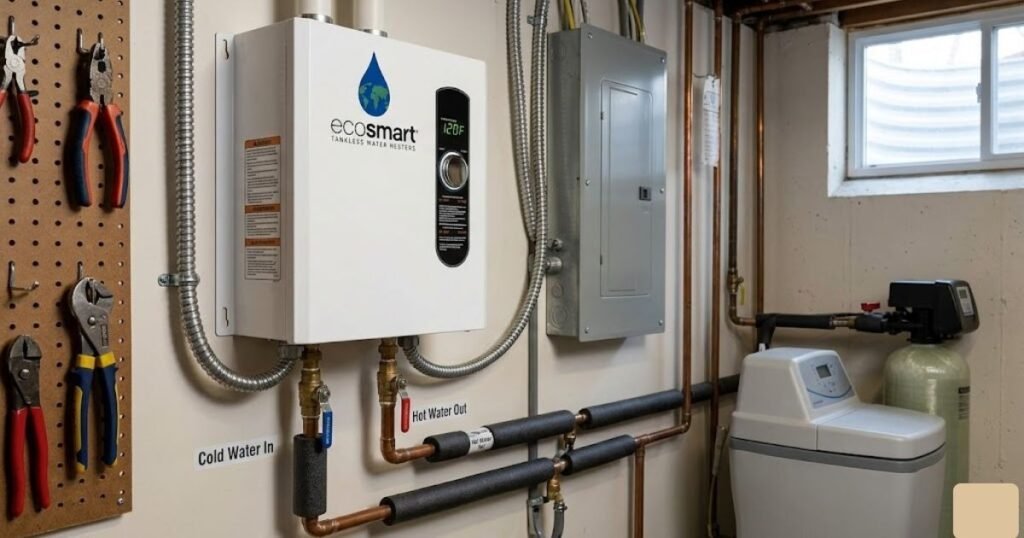
At its simplest, an EcoSmart tankless water heater is a device that heats water only when you turn on a faucet. Unlike traditional water heaters that keep 40 to 50 gallons of water hot 24/7 (which wastes a lot of energy), a tankless unit stays idle until it senses water flow.
When you turn on the hot water, the EcoSmart unit activates its heating elements. Water flows through a heat exchanger, gets up to temperature in seconds, and travels to your shower or sink. Because there is no tank to empty, you technically have a “limitless” supply of hot water. As long as the electricity is on and the water is flowing, the heat stays on.
How EcoSmart Differs from the Rest
Most EcoSmart models are electric. While some brands focus heavily on gas-powered units, EcoSmart has carved out a niche as the go-to for high-efficiency electric heating. They are famous for their “Self-Modulating Technology.” This is a fancy way of saying the unit only uses the exact amount of electricity needed to heat the water being pulled at that moment. If you’re just washing your hands, it uses a tiny bit of power. If you’re running two showers, it ramps up to full strength.
Why Homeowners Choose EcoSmart
If you are on the fence about switching to a tankless system, here are the main reasons USA homeowners are making the jump to EcoSmart:
- Energy Efficiency: You can save up to 50% on your water heating costs because you aren’t paying to keep a giant tank hot all night while you sleep.
- Space-Saving Design: These units are roughly the size of a large briefcase. You can mount them on a wall in a closet, crawlspace, or laundry room, freeing up valuable floor space.
- Continuous Hot Water: No more “running out” of water. If you have guests staying over and five people need to shower in a row, the fifth person gets the same temperature as the first.
- Durability: While traditional tanks last about 10–12 years, a well-maintained EcoSmart unit can last 20 years or more.
- Lower Maintenance: There’s no tank to rust or leak, which significantly reduces the risk of a flooded basement.
READ MORE: Best Rinnai Tankless Water Heater Reviews — Models, Specs & Prices
EcoSmart Tankless Water Heater Reviews
Choosing the right model is the most important part of this process. If you buy a unit that’s too small, you’ll get lukewarm showers. If you buy one that’s too big, you might need a massive (and expensive) electrical upgrade.
Here is a breakdown of the six most popular models for USA homes.
1. EcoSmart ECO 11 Electric Tankless Water Heater
The ECO 11 is one of the most popular “entry-level” whole-home units, but it has specific limitations depending on where you live.
- Best For: Small apartments in cold climates or a small home (1 bathroom) in warm climates.
- Main Features: 13kW power rating, digital temperature control in 1-degree increments, and a compact design.
- Pros: Very affordable; easy to fit in tight spaces; great for a “point-of-use” heater for a remote bathroom or cabin.
- Cons: Not powerful enough for a multi-bathroom home in the northern US.
- Ideal Homeowner: A single person or couple living in a condo or a warm state like Florida or Texas.
Final Opinion: It’s a workhorse for small spaces, but don’t expect it to run a shower and a washing machine at the same time if you live in a place where the ground water is very cold.

- Endless On-Demand Hot Water; Consistent hot water when you need it that never runs out; Continuously monitored water tem…
- Save Space; EcoSmart tankless electric water heaters are 90% smaller than traditional tank heaters; may be installed on …
- Save Energy; EcoSmart tankless electric water heaters are 99% thermal energy efficient; Only heats water when called unl…
2. EcoSmart ECO 18 Electric Tankless Water Heater
This is the “middle child” of the lineup and serves as a great bridge between small units and heavy-duty ones.
- Best For: Medium-sized homes or apartments with 1–2 bathrooms.
- Main Features: 18kW power; requires a 150-amp electrical panel; handles about 2.5 to 3.5 gallons per minute (GPM) depending on inlet temp.
- Pros: Perfect balance of power and price; compact enough for a laundry room wall.
- Cons: Might struggle in the dead of winter in states like Maine or Minnesota if you try to run two showers at once.
- Ideal Homeowner: Small families in moderate climates who want to replace a standard 40-gallon tank.
Final Opinion: The ECO 18 is a solid, reliable choice for the “average” small American household. It’s the “Goldilocks” of the EcoSmart family for many.
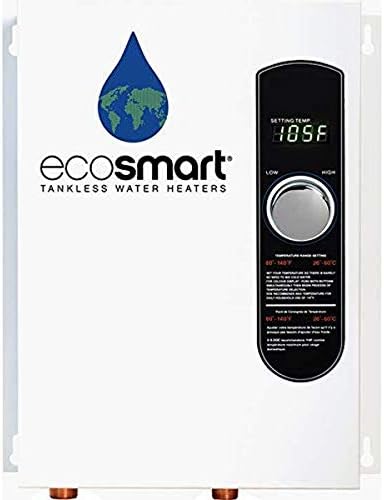
- Configured for climates where incoming water temperature is 62 degrees F and above.
- Capable of heating over 2.5 gpm.
- Digital temperature control allows temperature settings in 1 degree increments.
READ MORE: Best Tankless Electric Water Heaters 2026: Top 5 Models for U.S. Homes
3. EcoSmart ECO 27 Tankless Water Heater
The ECO 27 is a heavy hitter. It is one of the most widely installed electric tankless heaters in North America because it can actually handle a typical family’s needs.
- Best For: Large homes with high demand or medium homes in cold climates.
- Main Features: 27kW power; handles up to 6 GPM in warm climates (about 3 showers at once) or 3 GPM in cold climates (1–2 showers).
- Pros: Powerful enough for multiple simultaneous tasks; very high build quality.
- Cons: Requires a significant electrical setup (three 40-amp breakers).
- Ideal Homeowner: A family of four with two bathrooms who doesn’t want to worry about timing their showers.
Final Opinion: If you are serious about switching the whole house to electric tankless, this is usually the minimum model you should look at to ensure everyone stays happy and warm.
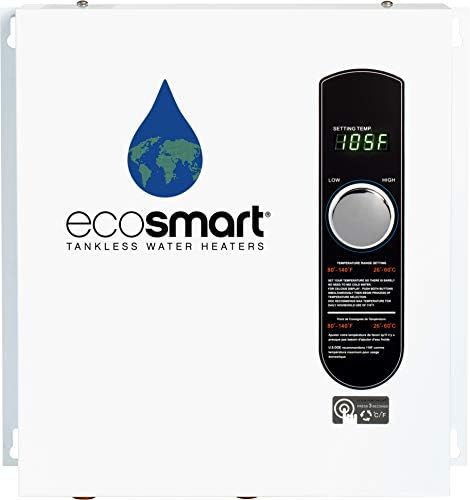
- Configured for climates where incoming water temperature can reach as low as 37 degrees.
- Capable of heating nearly 3 gpm.
- Digital temperature control allows temperature settings in 1 degree increments.
4. EcoSmart ECO 8 Tankless Water Heater
The ECO 8 is not designed to be a whole-house heater for most people. It’s a specialized tool for specific tasks.
- Best For: Point-of-use (like a single sink) or a very small tiny home/studio.
- Main Features: 8kW power; very small footprint; simple plug-and-play style installation (relatively speaking).
- Pros: Extremely energy efficient for single-sink applications; very low price point.
- Cons: Will not provide enough hot water for a standard shower in most of the US.
- Ideal Homeowner: Someone adding a wet bar, a workshop sink, or a small guest suite with minimal water needs.
Final Opinion: Don’t try to make this your main house heater. It’s perfect for a “booster” or a single sink, but that’s about it.
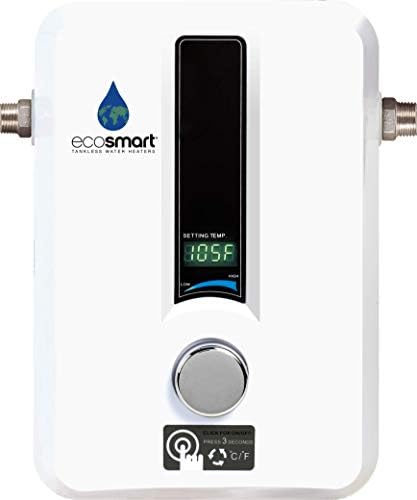
- The product is highly durable
- The product is easy to use
- Manufactured in China
READ MORE: Best Tankless Water Heater 2026 — Top Picks, Costs & Buyer’s Guide
5. EcoSmart ECO 24 Electric Tankless Water Heater
The ECO 24 sits right next to the 27 in terms of capability, offering a slightly lower electrical draw while still packing a punch.
- Best For: 3-bedroom, 2-bathroom homes in southern to mid-US climates.
- Main Features: 24kW power; requires 3 double-pole 40-amp breakers; digital display.
- Pros: More manageable electrical requirements than the ECO 27/36; very consistent temperature.
- Cons: If you live in the North, it might only handle one shower at a time during the winter.
- Ideal Homeowner: Homeowners in the middle of the country who want whole-home coverage without overtaxing their electrical panel.
Final Opinion: It’s a high-quality unit that fits that “sweet spot” for many suburban homes in states like Virginia, Carolinas, or California.
- Sleek and compact design with digital output temperature display
- ECOSMART tankless water heaters are 99.8-percent energy efficient
- Manufactured in United States
6. EcoSmart ECO 36 Electric Tankless Water Heater
This is the “Beast.” The ECO 36 is the most powerful electric tankless heater EcoSmart makes.
- Best For: Large households, homes with large soaking tubs, or homes in the coldest northern climates.
- Main Features: 36kW power; can provide over 8 GPM in warm weather; requires four 40-amp breakers (this is a lot of power!).
- Pros: Can easily run 4 showers at once in the South, or 2–3 showers simultaneously in the North.
- Cons: Expensive to install because of the heavy electrical requirements; needs a 200-amp main service panel.
- Ideal Homeowner: Large families with high hot water demand who live in cold climates.
Final Opinion: If you want the absolute best performance and your electrical panel can handle it, this is the one. It’s the closest you’ll get to the performance of a gas unit using electricity.
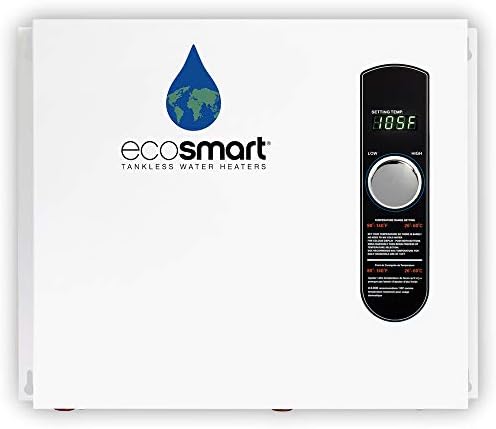
- Sleek and compact design with digital output temperature display
- ECOSMART tankless water heaters are 99.8-percent energy efficient
- Manufactured in United States
READ MORE: Best Navien Tankless Water Heaters 2026: Reviews & Pricing
EcoSmart Tankless Water Heater Comparison Table:
| Model name | Best for | Power/size level | Home size suitability | Main strengths | Main limitations | Overall value |
| EcoSmart ECO 8 | Point-of-use, very small demand | Small | Very small homes or single fixtures | Compact, affordable, simple | Limited capacity | Good for niche use |
| EcoSmart ECO 11 | Small homes, guest baths, light demand | Small-medium | Small homes | Space-saving, easy to fit | Not for heavy use | Good entry-level value |
| EcoSmart ECO 18 | Small-to-medium homes | Medium | 1–2 bathroom homes | Balanced performance | May be undersized for larger families | Strong middle option |
| EcoSmart ECO 24 | Moderate-to-higher demand | Medium-large | Medium to larger homes | Better output, still compact | Electrical needs can be significant | Very good value if sized right |
| EcoSmart ECO 27 | Larger households | Large | Larger homes | Strong whole-home potential | Higher installation demands | Good for high demand |
| EcoSmart ECO 36 | Heavy demand, large homes | Very large | Large households | Highest capacity here | May need electrical upgrades | Best for maximum output |
Which EcoSmart Model Is Best for Your Home?
Choosing the right model isn’t just about the size of your house; it’s about geography and lifestyle.
The “Southern” Rule
If you live in Florida, Texas, or Arizona, your “groundwater” is already pretty warm (maybe 70°F). Because the heater doesn’t have to work as hard to get that water to 105°F, an ECO 11 or 18 might be plenty for a standard home.
The “Northern” Rule
If you live in Chicago or Boston, your groundwater in the winter can be near freezing (35°F–40°F). The heater has to work incredibly hard. In these areas, you should almost always go with an ECO 27 or ECO 36 if you want to take a comfortable shower.
The “Lifestyle” Factor
- The “Empty Nester”: If it’s just two of you and you never run the dishwasher while showering, an ECO 18 is usually perfect.
- The “Busy Family”: If the kids are getting ready for school while the laundry is running, don’t settle for less than an ECO 27.
READ MORE: Best Whole House Water Softener System for Home (2026) — Top Picks & Buyer’s Guide
Things to Consider Before Buying
Before you click “buy” on that shiny new EcoSmart unit, walk through this checklist:
- Electrical Capacity: This is the #1 dealbreaker. Most EcoSmart units require multiple 40-amp or 60-amp breakers. Check your main panel. If you only have a 100-amp service for the whole house, you will likely need an expensive panel upgrade before installing a tankless heater.
- Flow Rate (GPM): Think about your “peak” usage. Do you run the shower, the dishwasher, and the sink at the same time? Add up the GPM of those fixtures to see if your chosen model can handle the total.
- Incoming Water Temp: As mentioned, your climate dictates your heater’s performance. Look at a “groundwater temperature map” for the USA to see what your starting temp is.
- Installation Costs: While the unit itself might cost $400–$700, professional electrical and plumbing installation can add $500–$1,500 depending on your home’s current setup.
EcoSmart Tankless Water Heater Pros and Cons
Pros
- Endless Hot Water: No more “first come, first served” showers.
- Energy Savings: Only heats water when needed.
- Lifetime Warranty: EcoSmart offers a limited lifetime warranty on the heat exchanger and electronics (if installed by a professional).
- Space Saver: Mounts on the wall, leaving more room for storage in your utility room.
Cons
- Upfront Cost: Higher initial investment than a cheap tank heater.
- Electrical Demand: Large units require a very robust electrical system.
- “Cold Sandwich” Effect: If you turn the water off and right back on quickly, you might get a tiny burst of cold water that was sitting in the pipes.
READ MORE: Best Heat Pump Hot Water System (2026) — Buyer’s Guide
Tankless Water Heater Installation and Maintenance Tips
To get the most out of your EcoSmart, follow these simple rules:
- Hire a Pro: We cannot stress this enough. Because these units involve high-voltage electricity and plumbing, a DIY job can be dangerous and will likely void your warranty.
- Check Your Breakers: Ensure your electrician uses the correct gauge wire. Using wire that is too thin is a fire hazard and will cause the unit to underperform.
- Flush the System: If you have “hard water” (lots of minerals), scale can build up inside the heating elements. Most experts recommend flushing the unit with a vinegar solution once a year to keep it running efficiently.
- Set the Temp Wisely: You don’t need your water at 140°F. Setting the unit to 110°F or 120°F is safer for your skin and saves even more money on your electric bill.
FAQs
Is EcoSmart a good tankless water heater?
Yes, EcoSmart is considered one of the most reliable and budget-friendly brands for electric tankless heating in the USA. They are known for their simple design and excellent self-modulating technology.
Which EcoSmart tankless water heater is best for a house?
For the average American home with 2–3 bedrooms and 2 bathrooms, the ECO 27 is generally the best all-around choice. However, if you live in a very warm climate, the ECO 18 may be sufficient.
How long does an EcoSmart tankless water heater last?
With proper maintenance (like annual flushing in hard water areas), an EcoSmart unit can last 20 to 25 years, which is double the lifespan of a traditional tank heater.
Does an EcoSmart tankless water heater save money?
Yes. Most homeowners see a 15% to 50% reduction in the water heating portion of their electric bill because the unit eliminates “standby heat loss.”
What size EcoSmart tankless water heater do I need?
It depends on your “temperature rise” (how cold your water starts) and your “flow rate” (how many faucets you use at once). Consult the EcoSmart sizing map to match your zip code with the right GPM requirements.
Conclusion:
Switching to an EcoSmart tankless water heater is a smart move for homeowners who value energy efficiency, space, and a never-ending supply of hot water. While the electrical requirements can be a hurdle for some older homes, the long-term savings and convenience are hard to beat.
- If you’re in a small apartment, look at the ECO 11.
- If you have a standard family home, the ECO 27 is your best bet.
- If you live in the frozen North and have a big family, go for the ECO 36.
By choosing the right model for your specific climate and household needs, you can finally say goodbye to cold showers and bulky tanks forever. Just remember: measure your electrical capacity first, hire a licensed pro for the install, and enjoy the luxury of endless hot water!


Pingback: How to Choose the Right Water Heater Size for Your Home - Plumbing Guider
Pingback: Best Ruud Water Heater Review 2026: Top Picks, Cost & Comparison - Plumbing Guider