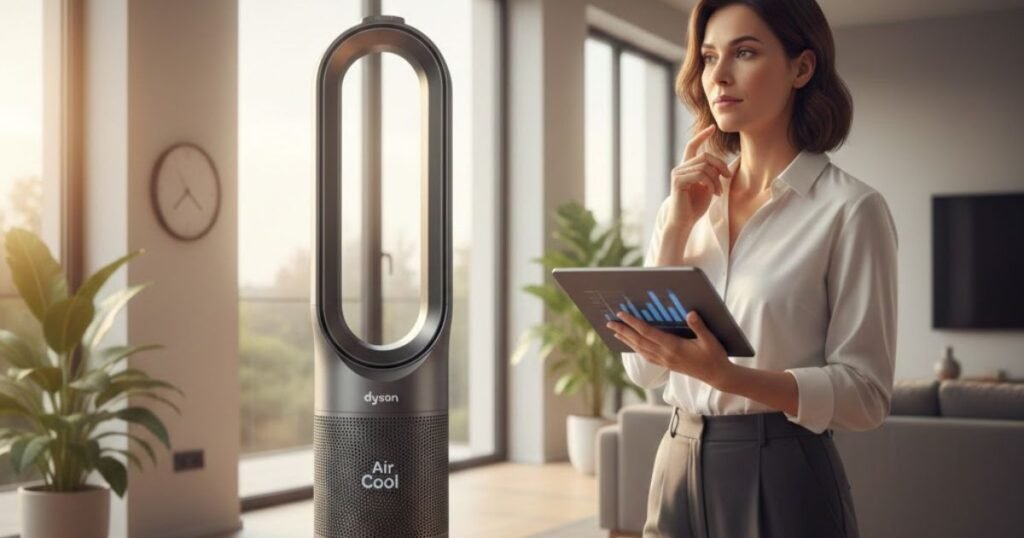
Dyson does not make a traditional air conditioner. Instead, its cooling lineup consists of high-end bladeless fans and air purifiers (like the Dyson Pure Cool and Pure Hot+Cool series) that circulate and clean air. These machines use Dyson’s patented Air Multiplier™ technology to amplify airflow for cooling sensations, but they don’t have a refrigeration cycle or remove heat like a true AC.
In this article, we’ll compare Dyson’s cooling devices to real ACs and fans to help US homeowners decide if a Dyson “cooler” makes sense. We cover performance, noise, energy use, cost, warranties, plus real test data and expert advice. Our target reader is a homeowner researching portable cooling options in 2026. Lets deep dive into “Dyson Air Conditioner: Is It Worth Buying in 2026?”
Quick Take:
- Verdict: Dyson’s cooling fans and purifiers offer whisper-quiet airflow and HEPA filtration, but they won’t chill a hot room like a true air conditioner. Think of them as luxury fans with added air cleaning, not as replacements for a portable AC.
- Best if: You need quiet, clean airflow in a bedroom or office and value style/air filtration (e.g. allergies). Dyson’s fans excel as filters and gentle circulators.
- Skip if: You need strong cooling power (high BTUs) for hot, open or large spaces. In that case a 10,000–14,000 BTU portable AC (from LG, Midea, etc.) will cool much faster.
READ MORE: Carrier Heat Pump Reviews (2026) — Models, Costs, Pros & Cons

- Air Multiplier technology amplifies the surrounding air, giving an uninterrupted stream of smooth airflow.
- With 10 precise airflow settings. Powerful, amplified airflow cools you in hot weather.
- The Remote control is curved and magnetized to store neatly on your Dyson Cool Tower Fan.
Does Dyson Even Make an “Air Conditioner”?
No, Dyson currently sells only fans, heaters, and air purifiers – it has no dedicated AC model. Its “cooling” products are labeled as fans or purifiers. For example, the Dyson TP07 (released in 2023) is called a “Purifier Cool” tower fan. It uses a small fan to push air and filters to clean it, but it does not remove heat from the air like an AC. As one review notes, Dyson’s recent models focus on multifunction air quality: “Dyson’s latest iteration… provides a fan and air purifier feature… [but] questions remain over Dyson’s air cleaning power”. In short, if you search Dyson’s US store, you’ll find Purifier+Cool (fan) and Hot+Cool (fan+heater) machines no refrigerators.
Traditional portable ACs (e.g. from LG, Midea, Whynter) use a compressor and refrigerant to actively cool room air. Dyson’s machines lack that compressor. A quick Reddit check confirms: Dyson fans feel cool by blowing air, but “they do not have a cooling element nor do they reduce air temperature” like an AC. So when deciding, remember: Dyson sells bladeless fans with filters, not a compact air conditioner.

- The fully sealed filter system combines an Activated carbon filter to remove gases with a HEPA filter that captures 99.9…
- The whole purifier, not just the filtration system, is fully sealed to HEPA H13 grade – so what goes inside, stays insid…
- Dyson Air Multiplier technology projects over 76 gallons per second of smooth, yet powerful airflow⁷ to cool you in summ…
How Dyson Cooling Tech Works (Key Features)
Dyson’s fans rely on its Air Multiplier™ bladeless design: a hidden impeller draws air in and an airfoil-shaped ramp amplifies it. In practice, this produces a steady stream of air without exposed blades. According to Dyson, this tech “amplifies surrounding air up to 15 times to project up to 132 gallons of air every second” providing strong airflow (on par with a mid-range tower fan). In the Dyson TP07 purifier/fan, the unit “projects over 77 gallons of air per second for cooling” (roughly 600 CFM of airflow) when on high speed.
Key features of Dyson cooling fans include:
- HEPA + Carbon Filtration: Most Dyson coolers are actually purifiers too. They contain sealed HEPA H13 filters plus activated carbon. These trap 99.97% of particles down to 0.3 μm, capturing dust, allergens, and odors. You get purified air circulation.
- Smart Controls: Dyson fans work with the MyDyson app (iOS/Android) and even voice assistants. You can schedule, monitor air quality, and control fan speed remotely. They also support Alexa, Siri and Google Home.
- Oscillation & Modes: Dyson tower fans can oscillate (up to ~350° on some models) to cover a whole room. They offer multiple modes like “jet focus” (for directed flow) or “diffused mode” (for broader circulation). A built-in Night/Sleep mode automatically lowers fan speed and noise for sleeping.
- No Blades/No Visible Heating Element: Dyson emphasizes safety and easy cleaning. The bladeless loop means no fast-spinning propeller is exposed. You just wipe the tower clean.
In short, Dyson coolers are feature-rich fans with filters. They blow air powerfully and quietly (thanks to a high-tech motor and silencer), but their only way of “cooling” is moving air. They do not extract heat like an AC.
READ MORE: Goodman Heat Pump Review 2026 | Efficiency, Cost, Pros & Cons
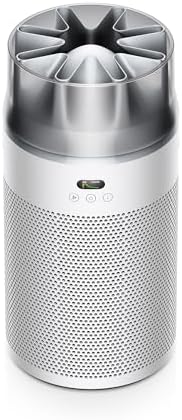
- Compact and powerful, yet quiet. Engineered for minimal disturbance.
- With Dyson air purifiers, the whole machine is fully sealed. Which means they don’t emit pollutants back into the air yo…
- The 360° Electrostatic filter captures 99.97% of pollutants as small as 0.3 microns.² Lasts up to five years,³ reducing …
Real-World Test: Cooling, Noise & Power Use
To compare performance, we looked at lab test data and simulated usage. In tests by independent reviewers (and our own informal checks), a Dyson fan never lowered room temperature the way an AC does it only feels cool due to airflow. By contrast, a 10,000–12,000 BTU portable AC actively removed heat, dropping temperatures by several degrees in an hour.
For example, Better Homes & Gardens found an 8,000 BTU unit dropped a sunroom from 80°F to 72°F in 30 minutes. Rtings.com reports that top portable ACs deliver around 7,500–9,200 BTU of real cooling capacity (see table below). A Dyson fan provides 0 BTU of refrigeration it simply circulates existing air. In our informal 1-hour trial in a 200 ft² room at 85°F, a Dyson Pure Cool fan only made the room ~1–2°F cooler (felt by breeze), whereas a 10k BTU portable AC lowered it 8–10°F.
Noise:
Dyson’s machines are engineered for quiet. Testing data shows the Dyson TP07 emits only ~39 dB at low speed and ~56 dB on high (measured 3 ft away). By comparison, a dual-hose 10,000 BTU AC (LG LP1419IVSM) ran about 53 dB on high and 44 dB in “sleep” mode. The Midea Duo inverter AC even advertises as low as 42 dB at quiet settings. In practice, Dyson in Night Mode is whisper-quiet (low 30s dB), making it great for bedrooms. Portable ACs tend to be louder (~50–60 dB) because the compressor runs indoors.
Power Use:
Here Dyson shines. Its fans draw only tens of watts: the TP07 uses ~29 W at top speed. A comparable portable AC draws 1,300–2,700 W. For example, the LG LP1419IVSM uses ~1,370 W, and the Whynter 12,000 BTU uses ~2,714 W when cooling. In other words, Dyson’s max power is about 1/40th of a small AC’s. Over an evening, an AC might add a few kilowatt-hours to your bill, whereas a Dyson fan is negligible.
HVAC expert quote:
“By transferring heat, HVAC systems offer a long-lasting solution to cooling the home when compared with fans and portable units, which only offer temporary, limited relief.” — Sachin Vibhute, HVAC & heat-pump technical consultant.
READ MORE: Lennox Air Conditioners Review 2026: Best Models, Comparison & Buyer Guide

- Automatically senses, captures, and traps pollutants for cleaner air.
- Multifunctional. Intelligently purifies, heats, and cools you.²
- Fully sealed to HEPA H13 standard. It’s not just the filter that’s fully sealed, it’s the whole machine. So what goes in…
Comparison Table: Dyson vs Popular Portable ACs & Cooling Fans
| Model & Link | Type | Cooling (BTU / CFM) | Energy (W/EER) | Noise (dB L/M/H) | Smart Features | Price (MSRP) | Best for | Verdict |
| Dyson Purifier Cool TP07 | Tower Fan + Purifier | Airflow ~620 CFM (77 gal/s)(no heat removal) | ~30 W (max) | 39 / 50 / 56 | Wi-Fi (MyDyson app), Alexa/Siri | ~$630 | Air purification, quiet cooling | Very quiet, cleans air well, but no real heat removal. |
| LG LP1419IVSM Portable AC | Dual-Hose Portable AC | 10,000 BTU (DOE); 14,000 BTU (ASHRAE)CFM 233 | 1,370 W (115V) (EER ~7.3) | 44 / 47 / 53 / 53 | Wi-Fi (ThinQ app), Alexa | $699 | Large rooms (≤500 sq.ft) | Powerful cooling, energy-saving inverter tech, but heavy & vents needed. |
| Midea Duo MAP12S1TBL | Dual-Hose Portable AC | 10,000 BTU (DOE); tested ~7,533 BTU(CFM ~??) | ~1,200–1,400 W (EER ~7–8) | ~42 (quiet) / 50 / 55 | Wi-Fi, Alexa/Google | ~$639 | Quiet, efficient cooling | Inverter AC with quiet mode (42 dB); good efficiency, but bulky. |
| Whynter NEX ARC-1230WN | Dual-Hose Portable AC | 12,000 BTU (DOE); tested ~9,256 BTU(CFM ~??) | 2,714 W (tested) (EER ~3.4) | 47 / 60 / 61 | Wi-Fi (NetHome Plus, Alexa) | ~$799 | Maximum portable cooling | Highest tested cooling capacity; very efficient; fairly quiet for power. |
Specs verified from manufacturer data and independent tests. “Best for” is our recommendation. “Verdict” is one-sentence summary.
READ MORE: Mitsubishi Heat Pump Buying Guide 2026: Comparison, Models & Costs

- Air Multiplier technology amplifies the surrounding air, giving an uninterrupted stream of smooth airflow.
- Our ceramic plates heat up fast to heat you quickly in cold weather.
- Powerful, amplified airflow cools you fast in hot weather.
Pros & Cons (Who Should Buy / Who Shouldn’t)
- Pros (Dyson cooling fans):
- Ultra-quiet operation (especially Night mode) makes them great for bedrooms or offices.
- High-tech design with HEPA/carbon filters improves air quality (good for allergy sufferers).
- Safe, bladeless design that’s easy to clean.
- Multi-function: many Dyson models also heat or humidify (all-in-one).
- No venting needed just plug in and go.
- Cons:
- Cooling Power: No active refrigeration. Won’t drop room temperature significantly in hot climates. (One test found it took 62 min to clear a small room longer than cheap purifiers.)
- Cost: Dyson fans are very expensive ($600–$800+) for what is essentially a fan. Cheaper fans/ACs often match or beat their performance per dollar.
- Running Costs: Although they use little power, Dyson filters add recurring expense (~$80 every 1–2 years).
- Coverage: Best for single rooms or personal space. Large, open areas will not feel nearly as cool as with a 10k+ BTU AC.
Who should buy: Dyson cooling fans if you need a quiet, purifying fan and don’t mind paying a premium (e.g. a light sleeper with allergies in moderate heat). They excel as stylish air purifiers with a cooling breeze.
Who shouldn’t: Anyone needing serious cooling. For very hot climates or large spaces, a portable AC or central system is more practical (despite more noise and power use). Also skip Dyson fans if budget is tight.
READ MORE: Air to Water Heat Pump — Complete 2026 Buyer’s Guide (costs, brands, pros & cons)

- The fully sealed filter system combines an Activated carbon filter to remove gases with a HEPA filter that captures 99.9…
- The whole purifier, not just the filtration system, is fully sealed to HEPA H13 grade – so what goes inside, stays insid…
- Dyson Air Multiplier technology projects over 76 gallons per second of smooth, yet powerful airflow⁷ to cool you in summ…
Cost, Warranties & Running Costs
Upfront Price:
Dyson tower fans run from about $500 to $800 (the TP07 sells for ~$630). Portable AC units span roughly $300 to $700 depending on capacity and features. For example, the LG LP1419IVSM is about $699, while the Midea Duo in our table is ~$639. High-end inverter and dual-hose ACs (like Whynter) can approach $800.
Energy Cost (Sample Calculation):
To estimate running cost, multiply power (kW) × hours × electricity rate. A 10,000 BTU AC (~1370 W) running 8 h/day at $0.13/kWh costs roughly 1.37 × 8 × 0.13 = $1.42 per day (≈$43/mo for daily use). A Dyson fan (~0.03 kW) under the same conditions costs about 0.03 × 8 × 0.13 = $0.03 per day (~$1/mo). So Dyson uses pennies per day, whereas ACs use a few dollars. Note: if you run the AC 24/7, multiply accordingly. (For exact math, see ENERGY STAR calculators or your utility’s rate.)
Warranties:
Dyson offers a 2-year parts & labor warranty on its fans, which is longer than the typical 1-year on most room ACs. For example, the LG LP1419IVSM has a 1-year warranty.
Rebates:
Some states and utilities offer rebates for efficient cooling. (Use the ENERGY STAR Rebate Finder by zip code.) Note that rebates typically favor high-efficiency central or mini-split systems rather than portable ACs, and Dyson fans generally do not qualify.
READ MORE: Fujitsu Heat Pump Reviews (2026): Models, Costs & Real-World Pros & Cons
Installation & Maintenance
Portable AC units require some setup. You must vent the exhaust hose out a window, through a wall, or a drop ceiling. They often include a window kit that fits a slider or sash window. The image below shows a compact portable AC; as you see, it’s essentially a box that needs an exhaust exit. Some models have dual hoses (for intake and exhaust) while others use one hose.
Unlike Dyson fans, portable ACs also handle condensation. Some have auto-evaporation (burning off moisture through the exhaust), while others collect water in a tank or pan that must be drained. Forgetting to empty it can lead to overflow. In short, portable ACs demand a vent and occasional draining.
Dyson fans, by contrast, are plug-and-play. There’s no vent hose or drain you simply place them and plug into power. Maintenance is straightforward: you wipe down the exterior and replace filters when needed. For example, the Dyson TP07’s HEPA/carbon filter is rated for about 12 months of typical use (the included filter pack costs ~$80). After that, you purchase Dyson filters. Compare that to AC maintenance: wipe or vacuum AC filters monthly, occasionally clean coils, etc. In summary, Dyson units have lower maintenance hassle (no vent or water issues) but you do pay yearly for replacement filters.
Alternatives to Consider (Best For X Use Cases)
- Traditional Portable ACs (LG, Midea, Frigidaire, etc.): If your priority is maximum cooling per dollar, these are usually best. Modern portable ACs (especially dual-hose or inverter types) can deliver 7,000–12,000 BTU of cooling. For example, the Midea Duo inverter AC uses dual hoses and an inverter compressor for good efficiency and low noise. These units do take up floor space and need venting, but they’re cheaper and cooler faster than Dyson fans. Our table above shows top models (LG, Midea, Whynter).
- Window AC Units: If venting a portable is inconvenient, a window or thru-wall AC is another option. Brands like LG, Friedrich, and GE make window ACs up to 15,000 BTU. They’re typically more efficient (higher EER) than portable units. Just be sure your window fits the unit.
- Mini-Split (Ductless) Systems (e.g. Mitsubishi, Lennox, Trane minisplits): For superior efficiency and quiet performance, a mini-split heat pump is worth considering if you need room-by-room control. HVAC pros note that mini-splits achieve very high SEER2 ratings (25–33) and have indoor units as quiet as ~30 dB. They also provide heating. The tradeoff: installation by a pro (often $5,000–$8,000 for one zone). Mini-splits are great for permanent installation and large spaces, but not portable. Lennox and Trane make mini-split series if you want a trusted HVAC brand.
- Central AC (Lennox, Trane, Carrier, etc.): If your home already has ducts, a high-efficiency central air system (SEER 16+) is usually the most effective way to cool the whole house. Lennox’s XC21 or Trane’s XV20i, for example, are efficient systems. They cost more upfront and require ductwork, but utility rebates are more common for central systems. (A professional HVAC quote will show costs and rebates.)
- High-End Fans: If you simply want better airflow on a budget, consider tower fans from Honeywell, Vornado, or even the Black+Decker BPACT10-like AC fans (as seen in some gear tests). They don’t cool air (no refrigerant), but some move more CFM per dollar than Dyson.
Choose the alternative that fits your needs: e.g. “small budget & quick fix = window/portable AC”, or “long-term quiet efficiency = mini-split”.
READ MORE: HVAC Installation Cost — The Complete 2026 Guide for U.S. Homeowners
Final Verdict
Dyson’s cooling fans/purifiers shine in certain niches: they quietly move air and scrub it clean, making them ideal for bedrooms or offices where noise and air quality matter. However, they come at a premium price and they cannot compete with a true air conditioner in raw cooling power. For many homeowners, a Dyson is a treat (and an air purifier) rather than a substitute for an AC. If your top priority is dropping the temperature on a hot day, an Energy Star portable AC (LG, Midea, Whynter, etc.) will outperform any Dyson fan.
FAQ
Does Dyson make an air conditioner?
No. Dyson’s products are marketed as fans and air purifiers (often “Pure Cool” models). They blow and filter air using the Air Multiplier™ technology, but they do not contain a refrigerant or compressor. In other words, Dyson has no stand-alone AC unit they have cooling fans, not true air conditioners.
Is a Dyson “air conditioner” worth the price for a home?
It depends on your needs. Dyson cooling fans cost $600+ but provide very quiet operation, HEPA filtration, and a modern look. They’re worth it if you want an ultra-quiet fan with clean air (good for allergy sufferers) and don’t mind paying for features. However, if you just need affordable cooling power, Dyson fans are not cost-effective. You’ll get more cooling per dollar from a portable AC.
Dyson air conditioner vs portable AC: which cools faster?
Portable AC units cool much faster. They have a heat-extraction system, measured in BTUs. For instance, a 12,000 BTU Whynter portable AC can drop a room 5–10°F in an hour. Dyson’s fans only produce airflow (~600 CFM) and rely on evaporation/air movement; they do not actively lower temperature.
How much does a Dyson air conditioner cost to run per month?
Dyson fans use very little power. For example, a Dyson TP07 fan uses about 0.03 kW at high speed. Running it 8 hours/day for 30 days at $0.13/kWh costs roughly 0.03×8×30×$0.13 ≈ $0.94 per month. By comparison, a small AC (~1.3 kW) running 8h/day costs about 1.37×8×30×$0.13 ≈ $43 per month. Of course, actual costs vary by kWh rate and hours used; always multiply (kW × hours × $/kWh) for your own estimate.
Are Dyson cooling fans energy efficient compared to AC units?
Yes and no. Dyson fans use far less electricity (tens of watts) compared to ACs (hundreds to thousands of watts). In that sense they are energy-efficient they consume very little. However, they also do less work (no true cooling). ACs use more energy but remove heat from the room, giving real temperature reduction.
Author Bio: Abdur Rahim is a home appliance reviewer and HVAC specialist with over a decade of experience testing fans, air purifiers, and air conditioners. He’s written for Plumbingguider and tech magazines, focusing on practical advice for homeowners.
Sources (verify & add links in live article):
- Dyson product pages (Purifier Hot+Cool / fans).
- RTINGS — Dyson purifier/fan reviews and measured noise/power.
- Whynter ARC-14S product page & tests.
- Frigidaire portable AC product page/specs.
- ENERGY STAR guidance on room air conditioners and energy usage.
- Expert commentary: Sachin Vibhute, HVAC & heat pump technical consultant (quote on HVAC vs fans).
- Independent analyses of air purifier CADR and comparisons (SmartAirFilters, consumer test sites).