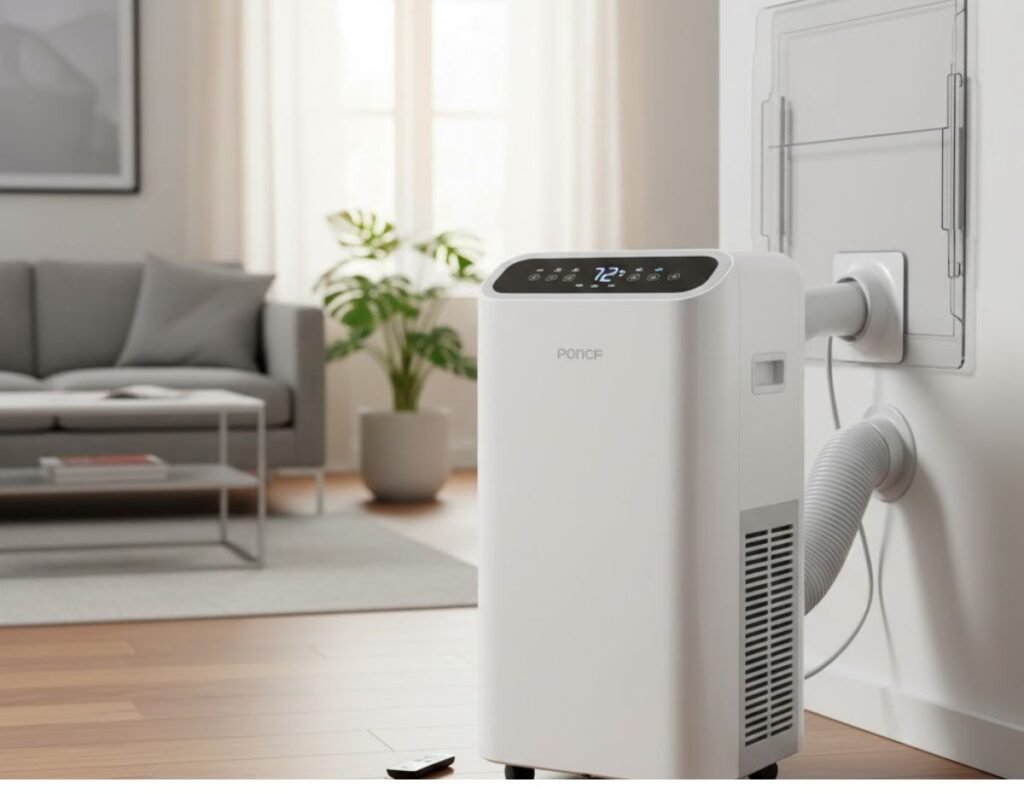
Portable air conditioners have become a go-to solution for homeowners who want an easy and flexible cooling option without committing to complicated installation or permanent changes in their home. A portable AC unit is exactly what it sounds like an air conditioner that you can move from room to room, plug into a standard outlet, and start enjoying cool air within minutes. These units are especially popular in apartments, rentals, dorm rooms, and older homes that lack ductwork.
Their biggest strength? Convenience. You don’t need professional installation, and you don’t have to lift a heavy machine into a window. If you want cooling on demand without hassle, a portable AC is one of the easiest systems to rely on. Lets deep dive into “Best Portable AC Unit Review: Comparison, Top Picks & Buying Guide”
READ MORE: Carrier Heat Pump Reviews (2026) — Models, Costs, Pros & Cons
How a Portable Air Conditioner Works
A portable AC works much like any traditional air conditioner: it pulls warm air from the room, cools it down using refrigerant, and pushes the cooled air back out. The heat removed from the air must be exhausted outside through a hose that usually connects to a window kit. This process is simple, but it’s surprisingly effective for small spaces. Most units also remove moisture from the air, making rooms feel even cooler. While portable ACs aren’t as powerful as central systems or ductless mini-splits, they offer the unique advantage of mobility—you can roll them anywhere, plug them in, and start cooling instantly.

- 𝐏𝐨𝐰𝐞𝐫𝐟𝐮𝐥 𝟖,𝟎𝟎𝟎 𝐁𝐓𝐔 𝐂𝐨𝐨𝐥𝐢𝐧𝐠 𝐟𝐨𝐫 𝐔𝐩 𝐭𝐨 𝟑𝟓𝟎 𝐒𝐪. 𝐅𝐭.: EUHOMY portable air conditioner delivers strong and fast cooling with …
- 𝟒-𝐢𝐧-𝟏 𝐌𝐮𝐥𝐭𝐢𝐟𝐮𝐧𝐜𝐭𝐢𝐨𝐧 – 𝐂𝐨𝐨𝐥, 𝐃𝐞𝐡𝐮𝐦𝐢𝐝𝐢𝐟𝐲, 𝐅𝐚𝐧 & 𝐒𝐥𝐞𝐞𝐩 𝐌𝐨𝐝𝐞: This portable ac unit combines cooling, dehumidifying, fan, a…
- 𝐄𝐚𝐬𝐲 𝐈𝐧𝐬𝐭𝐚𝐥𝐥𝐚𝐭𝐢𝐨𝐧 𝐰𝐢𝐭𝐡 𝐖𝐢𝐝𝐞 𝐖𝐢𝐧𝐝𝐨𝐰 𝐂𝐨𝐦𝐩𝐚𝐭𝐢𝐛𝐢𝐥𝐢𝐭𝐲 (𝟐𝟎–𝟓𝟎 𝐢𝐧.): Designed for hassle-free setup, this air conditioner porta…
Types of Portable AC Units
Not all portable AC units work the same way. Here are the three main types you’ll encounter:
1. Single-Hose Portable AC
This is the most common and affordable option. It uses one hose to bring in and exhaust air. It’s simple, but it can create slight negative pressure, which may affect efficiency.
2. Dual-Hose Portable AC
This type has one hose that brings in fresh air from outside and another that exhausts warm air. It cools faster and more efficiently, making it ideal for larger rooms.
3. Self-Evaporating Units
These models automatically evaporate moisture, meaning you don’t have to empty the water tank frequently. They’re low-maintenance and ideal for humid areas.

- [Efficient and Powerful Cooling] This14,000 BTU(ASHRAE) / 10,000 BTU(SACC), New gas: R32, 115V/60Hz, ETL certified porta…
- [Multiple Smart Functions] This air conditioner combines multiple smart functions for auto swing, 24-hour timer, sleep m…
- [Simple and Convenient] The portable ac is compactly designed with casters for easy mobility. In addition, a removable a…
Single Hose vs. Dual Hose: The Great Debate
| Feature | Single Hose | Dual Hose |
| Efficiency | Lower (creates negative pressure) | Higher (recycles air better) |
| Cooling Speed | Slower | Faster |
| Price | Generally more affordable | More of an investment |
| Best For | Small rooms/occasional use | Larger spaces/primary cooling |
READ MORE: Weil‑McLain Boiler Reviews (2026) — Models, Costs, Pros & Cons

- 【OUTSTANDING COOLING ABILITY】- Shinco powerful ac unit owns a cooling capacity of 8,000 BTU(ASHRAE) / 4,550 BTU(SACC), m…
- 【3-in-1 FUNCTION】- This portable ac unit is designed with a 3-in-1 function that allows you to choose between cool, fan,…
- 【QUICK INSTALLATION】- Installation is quick and easy with the included exhaust hose and window sealing kit, no extra too…
AC Comparison Table: Portable ac vs Window ac vs Split ac vs Ducted ac
The table below provides a side-by-side comparison of the most popular HVAC systems available today.
| Feature | Portable AC | Window AC | Split AC | Ducted AC (Central) |
| Installation | DIY (No permanent install) | Moderate (Requires window) | Professional required | Complex (Needs ductwork) |
| Energy Efficiency | Low | Moderate | High | Very High (For large areas) |
| Noise Level | High (All-in-one unit) | Moderate to High | Low (Quiet indoor unit) | Silent (Unit is external) |
| Portability | High (Wheels) | Low (Semi-permanent) | None | None |
| Cooling Capacity | Small rooms | Small to medium rooms | Medium to large rooms | Entire buildings/homes |
| Upfront Cost | $- Low | $ – Low | $$- Moderate | – High |
| Aesthetics | Bulky; takes floor space | Blocks window view | Sleek wall-mount | Invisible (Vents only) |

- 𝗨𝗹𝘁𝗿𝗮 𝗣𝗼𝘄𝗲𝗿𝗳𝘂𝗹 𝗜𝗰𝗲𝗖𝗼𝗼𝗹 𝗦𝘆𝘀𝘁𝗲𝗺: Increase coverage up to 14 ft. away with this 8000 BTU ASHRAE (5000 BTU SACC) portable ai…
- 𝟯-𝗶𝗻-𝟭 𝗩𝗲𝗿𝘀𝗮𝘁𝗶𝗹𝗲 𝗔𝗖 𝘂𝗻𝗶𝘁: You can not only choose from Cool/Fan/Dry modes, but the AC318S also has three functions to co…
- 𝗗𝗥𝗘𝗢’𝘀 𝗣𝗮𝘁𝗲𝗻𝘁𝗲𝗱 𝗡𝗼𝗶𝘀𝗲 𝗜𝘀𝗼𝗹𝗮𝘁𝗶𝗼𝗻 𝗦𝘆𝘀𝘁𝗲𝗺: reduces the standing ac compressor and turbulence noise to just 45dB, ideal for …
Energy Efficiency of Portable AC Units
Portable AC units generally consume more energy than window ACs or mini-splits, but recent models are becoming more efficient thanks to inverter technology and eco-friendly refrigerants. Look for units with a high CEER (Combined Energy Efficiency Ratio), which indicates better performance and lower operating costs. While portable ACs may not be the most energy-efficient option on the market, they offer unbeatable flexibility, which balances the trade-off for many homeowners.
READ MORE: Air to Water Heat Pump — Complete 2026 Buyer’s Guide (costs, brands, pros & cons)
Key Benefits: Why Choose a Portable Air Conditioner?
When the heat index climbs, you need a solution that doesn’t require a construction crew. Portable air conditioners have surged in popularity because they offer flexibility that traditional HVAC systems simply can’t match. Here’s why a mobile cooling unit might be your best defense against summer:
- Renter-Friendly & HOA Compliant: If your lease forbids window units or your HOA has strict rules about “unsightly” exterior equipment, a portable AC is your loophole. It sits entirely inside, with only a discreet vent visible from the outside.
- True “Plug-and-Play” Setup: Unlike window units that risk falling out of a second-story frame, portable ACs are remarkably easy to install. Most units come with a universal window kit that snaps into place in minutes without permanent drilling or professional help.
- Mobility on Demand: Equipped with heavy-duty casters, these units can follow you from your home office during the day to your bedroom at night. You aren’t paying to cool the whole house—just the room you’re actually using.
- Versatile Year-Round Use: Many modern models are “4-in-1” appliances. They don’t just cool; they act as high-capacity dehumidifiers, fans, and even heaters during the winter months, saving you closet space and money.
- Strategic Supplemental Cooling: If your central air has a “dead zone” (like a sunroom or a converted garage), a portable unit provides targeted relief without the multi-thousand-dollar cost of ductwork expansion.
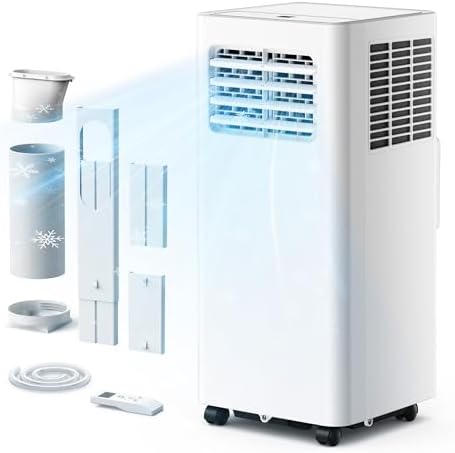
- 𝐒𝐭𝐫𝐨𝐧𝐠 𝟏𝟎,𝟎𝟎𝟎 𝐁𝐓𝐔 𝐂𝐨𝐨𝐥𝐢𝐧𝐠 𝐟𝐨𝐫 𝐋𝐚𝐫𝐠𝐞𝐫 𝐑𝐨𝐨𝐦𝐬: Powered by 10,000 BTUs and 400 CFM airflow, this EUHOMY portable air conditi…
- 𝟒-𝐢𝐧-𝟏 𝐃𝐞𝐬𝐢𝐠𝐧 𝐟𝐨𝐫 𝐂𝐨𝐨𝐥𝐢𝐧𝐠, 𝐃𝐫𝐲𝐢𝐧𝐠 & 𝐐𝐮𝐢𝐞𝐭 𝐒𝐥𝐞𝐞𝐩: This portable AC unit functions as an air conditioner, dehumidifier, fa…
- 𝐓𝐨𝐨𝐥-𝐅𝐫𝐞𝐞 𝐈𝐧𝐬𝐭𝐚𝐥𝐥𝐚𝐭𝐢𝐨𝐧 𝐰𝐢𝐭𝐡 𝐔𝐧𝐢𝐯𝐞𝐫𝐬𝐚𝐥 𝐖𝐢𝐧𝐝𝐨𝐰 𝐊𝐢𝐭: Set up in minutes with the included window kit designed for 20–50 inch…
The “Cool” Checklist: What to Look for Before Buying
Not all portable ACs are created equal. To avoid “buyer’s remorse” when the temperature hits 90°F, keep this checklist handy to ensure you’re getting an energy-efficient portable AC that actually performs.
1. Decoding BTUs (SACC vs. ASHRAE)
Don’t get fooled by high numbers. Traditionally, units were rated by ASHRAE standards, but the new SACC (Seasonally Adjusted Cooling Capacity) is a more accurate reflection of real-world performance.
- Small Rooms (up to 250 sq. ft.): Look for 7,000 – 10,000 ASHRAE (approx. 5,000 SACC).
- Medium Rooms (up to 450 sq. ft.): Look for 12,000 ASHRAE (approx. 7,000 – 8,000 SACC).
- Large Rooms (500+ sq. ft.): Look for 14,000 ASHRAE (approx. 10,000 SACC).
2. Noise Levels (Decibels)
Since the compressor is located inside the room, noise is a factor. Look for units with a “Sleep Mode” or those rated under 52 dB if you’re a light sleeper or planning to use it in a nursery.
3. Maintenance: Drainage Style
Portable ACs pull moisture from the air. You have three main choices for how that water is handled:
- Fully Self-Evaporating: The “Gold Standard.” It vents the moisture out through the hose so you rarely, if ever, have to drain it.
- Gravity Drain: Uses a small hose to empty water into a floor drain or bucket.
- Manual Tank: The unit shuts off when full, and you must manually empty a tray (can be tedious in humid climates).
4. Energy Efficiency Ratio (EER)
To keep your utility bills from skyrocketing, check the EER rating. A higher EER means better efficiency. Look for units with programmable timers and smart Wi-Fi connectivity, allowing you to turn the unit on 20 minutes before you get home rather than running it all day.
5. Quality of the Window Kit
Check user reviews for the “exhaust kit.” A cheap, flimsy plastic slider will leak cool air. Look for kits that offer a secure seal or plan to use weather stripping to maximize your cooling efficiency.
READ MORE: Goodman Heat Pump Review 2026 | Efficiency, Cost, Pros & Cons

- Powerful 12000 BTU Rapid Cooling: Transform your living space with the SNOCOD high-performance portable ac unit for room…
- 5-in-1 Multifunctional Portable Air Conditioners: Meet all your seasonal needs with one device! Features customized Cool…
- Smart Wifi & App Control: Experience the ultimate convenience of a smart AC. Remotely control your portable air conditio…
Ideal Places to Use a Portable AC
The beauty of portable ACs is that they work almost anywhere with an outlet. They’re especially useful in rental apartments where you cannot install permanent cooling systems. They’re perfect for home offices, small bedrooms, garages, dorm rooms, cabins, and basements. Many people use them as backup cooling during heatwaves or to cool specific areas that central AC doesn’t reach well. Their mobility makes them a great fit for anyone who wants cooling wherever it’s needed most.
Portable AC Installation & Maintenance
Buying the right unit is only half the battle; how you set it up determines whether you’ll be shivering in bliss or sweating over your electric bill. Proper portable AC installation and routine upkeep are the secrets to a long-lasting, frost-filled relationship with your device.
Pro Installation Tips
- The “Short and Straight” Rule: Your exhaust hose is the lifeline of the unit. Keep it as short and straight as possible. Kinks or extra-long extensions trap heat inside the hose, forcing the compressor to work double-time and reducing its lifespan.
- Seal the Deal: Most window vent kits are “one size fits most,” which usually means “one size fits none perfectly.” Use weather stripping or foam tape around the edges of the window slider to prevent hot air from leaking back inside.
- Clear the Airflow: Give your unit some breathing room. Aim for at least 20 inches of clearance from walls or furniture to ensure the intake sensors aren’t blocked, which can lead to “short-cycling” (turning on and off too quickly).
The Maintenance Checklist
To keep your energy-efficient portable AC running like new, follow this simple schedule:
- Clean the Filters (Every 2 Weeks): Dust is the enemy of efficiency. Most units have washable pre-filters. Rinse them with warm water, let them air dry completely, and pop them back in to maintain high airflow.
- Check the Drain: If you live in a high-humidity area, even “self-evaporating” units might struggle. Periodically check the internal reservoir or hook up a continuous drain hose if you’re tired of the unit shutting off mid-nap.
- End-of-Season Deep Clean: Before storing it for winter, run the unit in “Fan Only” mode for a few hours to dry out the internal coils. This prevents mold and that “musty AC smell” when you turn it back on next year.
READ MORE: Fujitsu Heat Pump Reviews (2026): Models, Costs & Real-World Pros & Cons
Potential Drawbacks: Is a Portable AC Right for You?
While we love the convenience, a portable air conditioner isn’t a magic wand. There are a few trade-offs you should consider to ensure it fits your lifestyle and your floor plan.
- The “Footprint” Factor: Unlike a window unit that hangs outside, a portable AC lives entirely in your room. If you’re in a tiny studio apartment, losing 2 to 3 square feet of floor space to a plastic tower might feel like a major sacrifice.
- The Noise Reality: Let’s be candid: the compressor—the loudest part of an AC—is inside the room with you. While many modern units are designed for quiet operation, they will always be louder than central air or a window unit where the “vroom” stays outside. Expect a consistent hum (around 50–60 dB).
- Lower Overall Efficiency: Because the unit generates heat while it’s trying to cool (and the exhaust hose itself radiates a bit of warmth back into the room), portable ACs are generally less efficient than window-mounted alternatives. You might see a slightly higher jump in your utility bill compared to a dedicated window unit of the same BTU.
- The “Heavy” in Portable: Most units weigh between 50 and 80 pounds. While they have wheels for moving across flat hardwood or tile, dragging one up a flight of stairs to a second-story bedroom is a workout you might not have signed up for.
- Negative Pressure: Single-hose units can sometimes pull small amounts of warm air from other rooms (or through cracks in doors) to replace the air they’re venting out. This “negative pressure” can make cooling take a little longer in poorly insulated spaces.
READ MORE: Best Cold Climate Heat Pump Review 2026: Top Picks & Buying Guide
Portable AC Cost Breakdown
When budgeting for a portable air conditioner in 2026, it’s important to look beyond the price tag on the box. You need to consider the “total cost of ownership,” which includes the initial purchase, monthly electricity impact, and long-term maintenance.
1. Initial Purchase Price Tiers
In 2026, prices have stabilized as inverter technology becomes the standard. Here is what you can expect to pay based on performance:
- Budget ($300 – $450): Typically 8,000 – 10,000 ASHRAE units. These are perfect for small home offices or dorms and usually feature basic manual controls and single-hose designs.
- Mid-Range ($500 – $750): This is the “sweet spot” for most buyers. These units often feature smart Wi-Fi connectivity, dual-hose systems for better efficiency, and SACC ratings suitable for medium-sized living rooms.
- Premium ($800 – $1,200+): High-end models now feature AI-driven cooling and ultra-quiet inverter compressors. These units often double as powerful heaters for year-round use and have the highest energy efficiency ratings.
2. Monthly Operating Costs
The biggest question on every buyer’s mind is: “How much will this hit my electric bill?”
On average, running a portable AC in 2026 costs between $0.15 and $0.25 per hour, depending on your local utility rates.
- Monthly Estimate: If you run your unit for 8 hours a day, expect an increase of $35 – $55 per month on your electricity bill.
- The Inverter Advantage: Investing in a Variable Speed Inverter model can reduce these operating costs by up to 40% compared to older, “on/off” compressor models.
3. Maintenance & Hidden Costs
To ensure your energy-efficient portable AC doesn’t become a money pit, keep these secondary costs in mind:
- Replacement Filters: While most pre-filters are washable, high-end units with HEPA or Carbon filters require replacements every 6–12 months ($20 – $50).
- Window Insulation Kits: If the included plastic slider doesn’t fit your unique window, a custom fabric seal or plexiglass insert may cost an extra $25 – $60.
- Drainage Accessories: If you don’t want to empty the tank manually, a $15 internal-diameter hose for continuous drainage is a small but essential investment.
4. Long-Term Value vs. Other Systems
| AC Type | Upfront Cost | Installation Cost | Lifespan |
| Portable AC | Low-Mid | $0 (DIY) | 5–8 Years |
| Window Unit | Low | $0 – $50 (DIY) | 8–10 Years |
| Mini-Split | High | $1,500+ (Professional) | 15–20 Years |
READ MORE: Heat Pump vs AC: Which Is Better for U.S. Homeowners?
How to Choose the Right Size (BTUs)
Choosing the correct BTU rating is essential for efficient cooling. Here’s a quick guide:
- Up to 200 sq ft: 8,000 BTUs
- 200–400 sq ft: 10,000–12,000 BTUs
- 400–600 sq ft: 14,000 BTUs
Selecting the right size ensures your room cools quickly without wasting energy.
Is a Portable AC Unit Worth It?
If you need a flexible, affordable, and easy-to-install cooling solution, then yes—a portable AC unit is definitely worth it. These units are convenient, effective for small to medium spaces, and perfect for renters or homeowners who need targeted cooling. While they may not be the most energy-efficient option, their ease of use and portability make them a strong contender for spot cooling and temporary climate control.
READ MORE: HVAC Near Me
Conclusion
A portable AC unit is one of the most convenient cooling options for homes, apartments, and offices. Whether you’re dealing with summer heat, poor airflow, or an AC system that doesn’t quite reach every room, a portable air conditioner gives you instant relief with minimal effort. From easy installation to flexible mobility and useful features, these units offer a practical solution for many cooling needs. If you want comfort without the complications of traditional systems, a portable AC may be the perfect match.
FAQs
Do portable AC units use a lot of electricity?
They use more energy than window units but less than many older AC systems.
Can a portable AC cool multiple rooms?
They work best in a single room, as cool air doesn’t travel well through hallways.
Do portable ACs need to be vented?
Yes, they must exhaust hot air through a window or door.
How long does a portable AC last?
Most units last 5–10 years with proper care.
Are portable ACs loud?
Most produce noticeable noise, but newer models are much quieter than older ones.