Your home’s HVAC ductwork acts as the circulatory system for your heating and cooling equipment. Whether you are retrofitting central air into an older home, expanding your living space, or replacing a crumbling, leaky network of air ducts, understanding the true financial investment is essential.
When air ducts are properly designed, sized, sealed, and insulated, your HVAC system runs efficiently, your monthly utility bills stay manageable, and every room maintains an even, comfortable temperature. Conversely, damaged or poorly installed ducts can waste up to 30% of conditioned air, forcing your furnace and air conditioner to work overtime.
The total cost to install HVAC ductwork varies considerably based on several critical factors, including your home’s square footage, layout complexity, accessibility, chosen duct material, local labor rates, and whether you are undertaking a brand-new installation or a complete system replacement. Lets deep dive into “Cost to Install HVAC Ductwork: 2026 Guide”
READ MORE: Affordable HVAC Installation Near Me USA
How Much Does It Cost to Install HVAC Ductwork?
When evaluating contractor bids, it helps to understand how different project scopes change pricing benchmarks. According to current data from leading home service networks like Angi and HomeGuide, project costs span several distinct categories:
| Project Type | Published Cost Benchmark | What It Typically Covers |
| New Ductwork Installation (Existing Home) | Approximately 2,400–6,600 | Retrofitting an un-ducted home or adding a complete network of supply and return runs. |
| Broader New Installation Range | Approximately 2,000–7,500 | Materials, labor, standard fittings, and basic connections for average single-family layouts. |
| Ductwork Replacement | Approximately 1,400–5,600 | Removing old, deteriorated ducts and installing new runs in houses of comparable size. |
| Complete HVAC Installation with New Ducts | Approximately 7,000–16,000 | Full package including the furnace/heat pump, air conditioner, evaporator coil, and complete new duct network. |
It is important to distinguish between materials-only pricing, labor-inclusive estimates, replacement costs, and full system makeovers. Contractors quoting materials-only figures leave out the intensive labor required to run ducts through tight crawl spaces and attics. Always verify whether a quote includes old duct disposal, permit fees, and balancing.
HVAC Ductwork Cost Per Square Foot and Linear Foot
Contractors generally calculate estimates using one of two primary measuring systems: square footage of conditioned space or linear footage of duct runs.
Cost Per Square Foot
Home size dictates how many supply registers and return-air pathways your home requires. While square footage is a helpful preliminary planning metric, it should never be used as a standalone substitute for a detailed room-by-room Manual D load calculation.
| Home Size (Square Feet) | Approximate Duct Length | Estimated Cost Range (New Installation) |
| 1,000 – 1,500 sq. ft. | 80 – 130 linear feet | $2,000 – $3,400 |
| 1,500 – 2,000 sq. ft. | 120 – 170 linear feet | $2,100 – $4,500 |
| 2,000 – 2,500 sq. ft. | 150 – 220 linear feet | $2,800 – $5,600 |
| 2,500 – 3,000 sq. ft. | 200 – 275 linear feet | $3,500 – $6,700 |
| 3,000 sq. ft. and above | 300+ linear feet | $4,200 – $9,000+ |
Cost Per Linear Foot
For residential ductwork installation, contractors frequently quote between $40 and $65 per linear foot for new installations in existing homes, while standard HVAC duct replacement cost ranges from $25 to $55 per linear foot (inclusive of materials and labor). A linear foot measurement tracks the actual physical length of tubing, trunk lines, and elbows installed across your framing. Ensure your written estimate specifies whether the per-linear-foot rate includes insulation jackets, hanging straps, ceiling boots, and plenum boxes.
READ MORE: American Standard HVAC Systems: Complete Buyer’s Guide
HVAC Ductwork Installation Cost by Duct Material
Selecting the right material balances upfront budget constraints against long-term energy efficiency, durability, and acoustic performance.
| Duct Material Type | Installed Cost (Per Linear Foot) | Durability | Airflow & Efficiency | Primary Advantages | Main Disadvantages |
| Flexible Ductwork | $12 – $25 | 15 – 20 Years | Moderate; prone to restriction if kinked | Affordable, highly versatile for tight turns | Easily punctured, sags over time |
| Sheet Metal Ductwork | $20 – $40 | 25 – 30+ Years | Excellent; smooth interior minimizes resistance | Long-lasting, pest-proof, minimal air leakage | Higher cost, noisier without internal liner |
| Fiberglass-Lined Ducts | $17 – $35 | 15 – 25 Years | Good; dampens equipment noise | Excellent acoustic dampening, built-in thermal insulation | Can trap dust/moisture if damaged |
| Fiberboard Ducts | $15 – $30 | 10 – 15 Years | Moderate | Inexpensive, acts as its own insulation | Degrades in high humidity, shorter lifespan |
While flexible ductwork offers an economical solution for complex residential layouts, sheet metal remains the gold standard for durability and airflow efficiency. Choosing the cheapest material often results in higher utility bills and premature system failure.
What Factors Affect HVAC Ductwork Installation Costs?
Beyond basic square footage, several structural and logistical variables influence the final project billing.
Home Layout and Accessibility
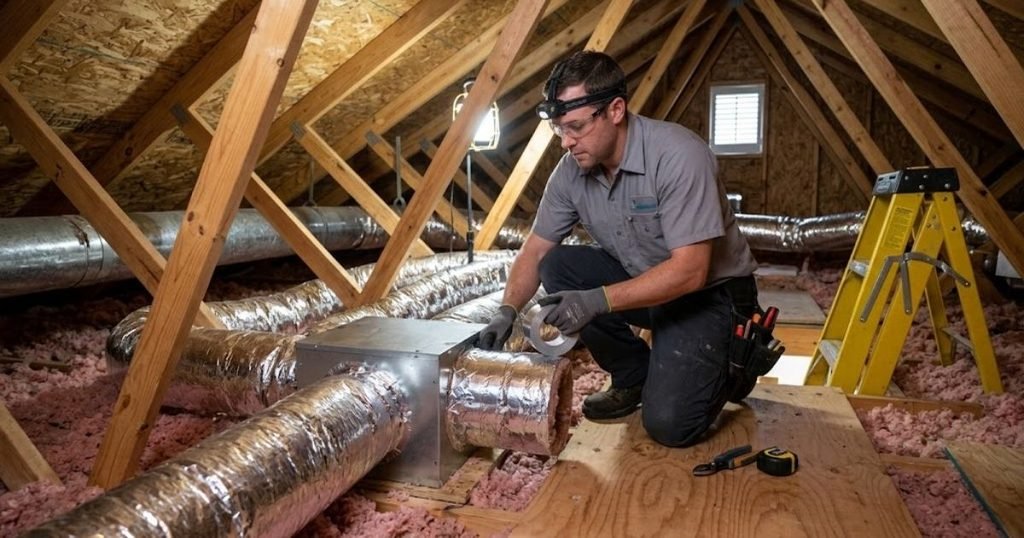
Retrofitting an occupied home requires routing ducts through finished walls, narrow crawl spaces, and tight attic trusses. Accessible basements and open-web floor joists reduce labor hours, whereas cramped, low-clearance attics increase labor time by 20% to 40%.
Labor and Contractor Rates
Ductwork labor cost typically accounts for 50% to 60% of the total project expense. Licensed HVAC technicians charge between $75 and $150 per hour, depending on regional cost-of-living differences and local labor markets.
Duct Size and Number of Vents
Every supply register, return grille, plenum transition, and branching tee adds to material costs and installation complexity. Homes requiring customized zoning dampers or complex multi-level layouts will see higher totals.
Insulation and Air Sealing
Properly insulating ducts with R-8 insulation (especially in unconditioned attics or crawl spaces) prevents thermal loss. Sealing joints with mastic paste and UL-rated foil tape ensures compliance with modern energy conservation standards.
Permits, Inspections, and Code Requirements
Municipalities across the United States typically require mechanical permits for new or altered duct systems. Permit and inspection fees generally range from $50 to $300, safeguarding compliance with local building codes.
Old Duct Removal and Structural Repairs
Removing contaminated or asbestos-laced old ductwork incurs disposal fees. Furthermore, cutting access holes through drywall or subflooring requires professional patching and painting.
READ MORE: Carrier Heat Pump Reviews — Models, Costs, Pros & Cons
Cost to Install Ductwork in an Existing House vs. New Construction
| Project Scenario | Average Cost Range | Key Installation Characteristics |
| New Construction | $2,000 – $4,500 | Open stud bays and uninstalled drywall allow straight, efficient runs with minimal labor overhead. |
| Existing Home Retrofit | $2,400 – $7,500 | Requires navigating finished surfaces, boxing in chases, fishing flex ducts, and repairing drywall. |
Installing ducts during new construction is significantly faster and less expensive because framing is exposed. In contrast, retrofitting an existing home demands careful carpentry, strategic chase building, and meticulous patching.
New HVAC Ductwork vs. Ductwork Replacement or Repair
Not every airflow issue demands a wholesale tear-out. Knowing when to repair versus replace saves homeowners thousands of dollars.
- Sealing Accessible Leaks: Costs $150 to $500 for mastic sealing of loose joints in basements or utility rooms.
- Section Repair: Replacing a crushed flexible duct run or a rusted metal elbow costs $400 to $1,500.
- Full Replacement: Recommended when ductwork exceeds 20–25 years of age, suffers from widespread mold contamination, or has collapsed insulation.
Additional Costs Homeowners Should Budget For
When planning your remodeling budget, account for these potential ancillary expenses:
- Indoor Air Quality Add-ons: Whole-home air scrubbers, UV germicidal lights, or upgraded MERV filters.
- Home Energy Audits: Blower door tests ranging from $200 to $500 to pinpoint envelope and duct leakage.
- Asbestos or Mold Testing: Essential for homes built before 1980, costing $250 to $700.
- Zoning Controls: Motorized dampers and secondary thermostats adding $1,500 to $3,500.
How to Save Money on HVAC Ductwork Installation
- Obtain Multiple Bids: Collect at least three itemized contractor estimates comparing scope, not just bottom-line totals.
- Bundle Projects: Combine your duct installation with a furnace or heat pump replacement to eliminate duplicate setup fees.
- Retain Sound Runs: Ask your technician if undamaged metal trunk lines can be cleaned and retained while only flex branches are replaced.
- Schedule Off-Season: Book work during spring or fall shoulder seasons when HVAC contractors offer flexible scheduling.
- Prioritize Sealing: Insist on mastic-sealed joints to prevent conditioned air loss.
READ MORE: American Standard Heat Pump: Models, Costs & Buying Guide
Is Professional HVAC Ductwork Installation Worth It?
Correct duct sizing and static pressure balancing dictate whether your HVAC equipment reaches its rated efficiency. DIY duct installation frequently leads to sharp kinks, undersized returns, air starvation, and noisy operation. Hiring a licensed professional following Air Conditioning Contractors of America (ACCA) Manual D guidelines ensures balanced airflow, optimal indoor air quality, and manufacturer warranty protection.
How to Choose the Right HVAC Ductwork Contractor
- Licensing and Insurance: Verify active state contracting licenses and general liability insurance.
- Demonstrated Experience: Look for contractors specializing in residential retrofits and Manual D duct design.
- Detailed Written Scope: Ensure quotes itemize materials, insulation values, permit responsibilities, and disposal fees.
- Workmanship Warranties: Reputable companies stand behind their labor with multi-year guarantees.
- Testing Equipment: Confirm the contractor measures static pressure and tests airflow upon completion.
Frequently Asked Questions
How much does it cost to install HVAC ductwork in a 2,000-square-foot house?
For a typical 2,000-square-foot home, installing new ductwork ranges from $2,800 to $5,600 for a replacement project, and up to $6,600+ for a complex retrofit in a home without prior ductwork. Final pricing depends heavily on attic accessibility, local labor rates, and whether you choose flexible or rigid sheet metal ducts.
How much does HVAC ductwork cost per linear foot?
New residential ductwork installation averages $40 to $65 per linear foot, while direct replacement runs between $25 and $55 per linear foot. This all-inclusive rate covers materials, hangers, fittings, and technician labor.
Is it cheaper to repair or replace HVAC ductwork?
Targeted repairs—such as sealing joint leaks with mastic or replacing a single damaged branch run—cost between $200 and $1,500, making them far cheaper than a full system replacement. However, if your duct network is over 25 years old or exhibits widespread deterioration, full replacement is more cost-effective long-term.
How long does it take to install new HVAC ductwork?
A standard residential ductwork installation or complete replacement typically takes 1 to 3 days, depending on home size, crew size, attic accessibility, and whether drywall cutting is required.
Does installing new HVAC ductwork increase home value?
While real estate appraisals vary, modern, clean, and efficient ductwork improves home inspection results, indoor air quality, and system reliability, making your property more attractive to prospective buyers.
Final Thoughts
Investing in new HVAC ductwork is a major home improvement project that directly impacts your daily comfort and energy expenses. Although upfront costs can be substantial, prioritizing proper duct sizing, superior materials like sheet metal or R-8 insulated flex, and meticulous professional installation pays dividends for decades. Always obtain multiple itemized estimates from certified local contractors, verify that all municipal permits are pulled, and ensure your system is tested for optimal airflow before signing off on the completed job.

