Rheem is one of the most recognizable names in residential plumbing, and their line of electric tankless models promises to free up space while delivering hot water precisely when you need it. However, deciding to go tankless is only the first step. The right model for your home depends heavily on your household’s daily hot-water demand, your local incoming groundwater temperature, your desired hot-water temperature, your current electrical capacity, and your overall installation budget.
In this comprehensive guide, we will break down exactly what you need to know. You will find in-depth Rheem electric tankless water heater reviews covering six of their most popular models, alongside a detailed comparison table. We will walk you through sizing advice, essential installation considerations, operating costs, and the common drawbacks you need to know before making a purchase. Lets deep dive into “Best Rheem Electric Tankless Water Heater: Reviews, Cost & Comparison”
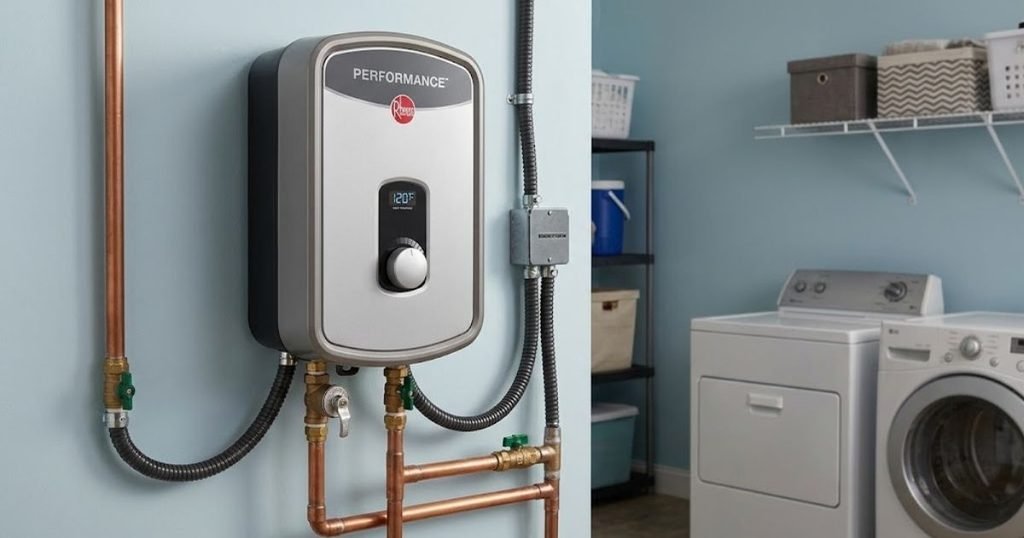
What Is a Rheem Electric Tankless Water Heater?
A Rheem electric tankless water heater is a compact, wall-mounted appliance designed to heat water strictly on demand. Instead of heating and reheating 50 to 80 gallons of water in a large storage tank all day and night, an electric tankless unit sits idle until you open a hot-water fixture.
Here is what happens when you turn on the tap:
- Cold water begins flowing through the internal piping of the unit.
- A flow sensor detects the water movement and signals the control board.
- Heavy-duty electric heating elements rapidly activate, raising the water temperature as it passes through the heating chambers.
- The heater adjusts its power output according to demand, ensuring the water reaches your desired set temperature.
Because the system does not store a large volume of hot water, you never experience the standby heat loss associated with traditional tanks.
READ MORE: AO Smith vs. Rheem Water Heaters: Comparison & Expert Reviews
6 Best Rheem Electric Tankless Water Heaters
To help you find the best Rheem electric tankless water heater for your specific situation, we have detailed six distinct models. Remember that your home’s actual flow rate will depend heavily on the temperature rise required and your local incoming water temperature.
1. Rheem RTEX-24 24kW 240V Electric Tankless Water Heater
Product Overview:
When it comes to a balance of whole-home capability and manageable electrical needs, the Rheem RTEX-24 review often highlights it as a sweet spot for medium-sized households. This unit features a sleek digital display and robust internal components designed to provide continuous hot water to multiple fixtures.
Heating Capacity and Electrical Requirements:
The RTEX-24 boasts a 24 kW heating capacity powered by a 240V electrical supply. It utilizes a three-heating-chamber configuration. To install this unit safely, it generally requires three separate 40-amp double-pole breakers and three sets of 8 AWG copper wiring running from your electrical panel to the heater.
Suitable Household Size:
This model is highly suitable for smaller to medium-sized homes, townhouses, or condos. In warmer southern climates, it can easily handle two showers running simultaneously. In northern climates with colder groundwater, it is best suited for one shower and a low-flow sink running at the same time.
Strengths and Limitations:
Its primary strength is its self-modulating power control, which ensures energy is not wasted on small heating tasks. It features precise digital temperature adjustments. The limitation, however, is heavily tied to climate. During deep winter in colder states, you must carefully monitor your available flow rate so you don’t overtax the system.
Installation Considerations:
Because it requires three 40-amp breakers (drawing up to 100 amps total), your home needs at least a 200-amp main electrical service panel. Attempting to install this on a 150-amp panel is usually a code violation and a recipe for constantly tripped main breakers.
Who Should Consider Buying It:
Homeowners in moderate climates with 2-to-3 bathrooms and a 200-amp electrical panel who want a reliable, energy-efficient replacement for a 50-gallon tank.
Who Should Avoid It:
Homeowners with limited electrical capacity or large families in freezing climates who take simultaneous morning showers.
Buying Verdict:
The Rheem RTEX-24 represents an excellent, practical balance between heating capacity and installation complexity, making it one of the most popular mid-to-high-capacity choices on the market.

2. Rheem 18kW 240V Tankless Electric Water Heater
Product Overview:
Often listed officially as the Rheem RTEX-18, this 18kW tankless water heater is a scaled-down version of the larger whole-home units. It shares the same attractive digital display, durable copper immersion heating elements, and self-modulating technology, but it requires significantly less infrastructure to operate.
Heating Capacity and Electrical Requirements:
Providing an 18 kW heating capacity on a 240V supply, this model utilizes two heating chambers instead of three or four. Because it has a lower total power draw, it requires only two 40-amp double-pole breakers and two sets of 8 AWG wire. It has a maximum draw of roughly 75 amps.
Suitable Household Size:
The 18kW model is ideal for smaller households, apartments, cabins, or single-bathroom homes with moderate fixture demand.
Strengths and Limitations:
The great strength of the RTEX-18 is its less demanding electrical footprint. Upgrading a panel is expensive, and an 18kW model can often squeeze into an existing 150-amp or 200-amp panel where larger models cannot. The limitation is that incoming water temperature drastically affects shower performance. If your groundwater is 40°F, this unit may only produce enough hot water for one low-flow showerhead at a time.
Installation Considerations:
Verifying your existing panel space is still critical, but running two electrical circuits is noticeably cheaper and easier for an electrician than running three or four.
Who Should Consider Buying It:
Couples or individuals living in smaller homes, or homeowners in the Sunbelt states who have warm incoming groundwater and only need to supply one or two bathrooms.
Who Should Avoid It:
Anyone expecting to run a washing machine, dishwasher, and shower at the exact same time, especially in cold weather regions.
Buying Verdict:
The Rheem 18kW tankless water heater is a fantastic compromise. It offers a much easier installation path than the massive units while still providing enough on-demand hot water for a modest household acting mindfully about simultaneous fixture use.

3. Rheem RTEX-36 36kW Electric Tankless Water Heater
Product Overview:
Any comprehensive Rheem RTEX-36 review must start with a warning: this unit is an absolute powerhouse. As the highest-capacity model in this six-product selection, it is built to replace large 80-gallon traditional tanks and supply substantial hot-water volume to expansive, multi-bathroom homes.
Heating Capacity and Electrical Requirements:
With a massive 36 kW heating capacity and a 240V supply, the RTEX-36 uses four heavy-duty heating chambers. Consequently, its electrical requirements are staggering. It requires four 40-amp double-pole breakers and four sets of 8 AWG wire. When running at full tilt, it draws a massive 150 amps all by itself.
Suitable Household Size:
This is for larger homes with heavy, simultaneous hot-water demand. Under favorable conditions, it can supply three to four showers at once in warm climates, or two simultaneous showers in very cold climates.
Strengths and Limitations:
The sheer volume of hot water is its greatest strength. It boasts high published flow rates, reaching up to 7.0 GPM or more under moderate temperature-rise conditions. The limitation is entirely based on your home’s infrastructure.
Installation Considerations:
You absolutely must have a licensed electrician verify your service capacity before purchasing. A standard 200-amp home panel will likely be overloaded by a 150-amp appliance if the AC or oven is also running. Installing this unit often requires a 300-amp or 320-amp dual-panel electrical service upgrade, which can cost thousands of dollars.
Who Should Consider Buying It:
Owners of large homes in northern climates who refuse to compromise on simultaneous hot-water flow, provided they already have upgraded electrical service.
Who Should Avoid It:
Homeowners with older 100-amp or standard 200-amp electrical panels who do not want to pay for a costly utility service upgrade.
Buying Verdict:
The RTEX-36 is the ultimate electric tankless solution for high demand, but its extreme electrical thirst means it may be unnecessarily expensive or entirely impractical for a typical mid-sized home.

4. Rheem RTEX-27 240V 3 Heating Chambers Residential Tankless Water Heater
Product Overview:
The Rheem RTEX-27 review places this unit in a slightly awkward, but highly useful, middle ground. It offers a noticeable bump in power over the 24kW model, giving cold-climate homeowners a little extra breathing room without stepping up to the gargantuan electrical needs of the 36kW model.
Heating Capacity and Electrical Requirements:
This unit features a 27 kW heating capacity powered by a 240V supply and utilizes a three-heating-chamber configuration. Despite the jump in wattage over the RTEX-24, it typically uses the same breaker arrangement: three 40-amp double-pole breakers and three sets of 8 AWG wire. However, it pushes those breakers closer to their limit, pulling up to 112.5 amps.
Suitable Household Size:
This model fits well in a medium-to-large home. It is an excellent choice for northern households that need a bit more capacity than an 18kW or 24kW unit can provide, ensuring a steady, hot shower even when winter groundwater temperatures plummet.
Strengths and Limitations:
The primary advantage is gaining 3 extra kilowatts of heating power without needing to add a fourth electrical circuit (like the 36kW requires). The limitation is that you must ensure your overall electrical panel load calculation can handle that continuous 112.5-amp draw.
Installation Considerations:
Like the RTEX-24, a 200-amp main panel is the absolute minimum requirement. The installation checks are rigorous, and proper wire sizing and tightening of electrical terminals are critical to prevent overheating.
Who Should Consider Buying It:
Homeowners who calculate that a 24kW heater leaves them just slightly short of their desired winter flow rate, and who want an extra buffer of heating power.
Who Should Avoid It:
Homeowners in warm climates where an RTEX-18 or 24 would easily suffice, making the extra energy draw of the 27kW unnecessary.
Buying Verdict:
Model selection should always be based on a sizing calculation rather than just buying the highest wattage you can afford. If your math dictates you need just a little more punch than the RTEX-24, the RTEX-27 is a highly capable alternative.

5. Rheem 11kW Multi Fixture Tankless Electric Water Heater – 240V
Product Overview:
Stepping away from the whole-house models, a Rheem 11kW electric tankless water heater review requires a shift in perspective. Typically listed under Rheem’s RTEX-11 or Performance line, this is a multi-fixture or point-of-use unit designed for targeted applications rather than entire homes.
Heating Capacity and Electrical Requirements:
With an 11 kW heating capacity and a 240V electrical supply, this unit has a relatively modest output compared with the larger RTEX models. It usually operates on a single 60-amp double-pole breaker and requires one set of heavier 6 AWG wire.
Suitable Household Size:
This is not for an entire household. It is highly suitable for a limited group of fixtures for example, a single bathroom suite, an isolated breakroom sink, or a remote guest house with a low-flow showerhead.
Strengths and Limitations:
The greatest strength is its ultra-compact size and the fact that it only requires a single electrical circuit. The limitation is its capacity. There is a vast difference between serving several low-flow handwashing sinks and supplying multiple high-demand fixtures like a modern shower tower.
Installation Considerations:
Because it only needs one 60-amp breaker, installation flexibility is high. You can often install it directly under a counter or in a nearby closet to provide instantaneous hot water, eliminating the long wait for water to travel from a distant main tank.
Who Should Consider Buying It:
Homeowners building an addition, finishing a basement bathroom, or setting up a detached workshop who need a dedicated, localized hot-water source.
Who Should Avoid It:
Anyone looking to replace their primary 50-gallon whole-house water heater. Cold-climate homeowners will also experience highly restrictive flow rates for showering.
Buying Verdict:
An 11 kW heater is incredibly useful for targeted, multi-fixture point-of-use applications, but it should never automatically be recommended as a whole-house replacement.

6. Rheem 8kW Multi Fixture Tankless Electric Water Heater – 240V
Product Overview:
The Rheem 8kW electric tankless water heater (often found as the RTEX-08) is the smallest-capacity 240-volt product in this six-product lineup. It is a dedicated point-of-use appliance engineered to solve very specific, localized plumbing challenges.
Heating Capacity and Electrical Requirements:
It features an 8 kW heating capacity on a 240V supply. Because of its low output, it generally only requires a single 40-amp double-pole breaker and one set of 8 AWG wire.
Suitable Household Size:
Like the 11kW, this is not a household water heater. It is designed for a single nearby sink or a very small group of strictly low-flow fixtures, subject to the manufacturer’s precise sizing guidance.
Strengths and Limitations:
Its incredibly compact form factor means it can hide easily under almost any sink vanity. However, its heating output is quite low. In northern states, the effects of cold incoming water on usable hot-water flow are severe. At 8kW, trying to take a comfortable shower when the groundwater is 40°F will likely result in a frustrating trickle of water.
Installation Considerations:
The electrical requirements are very manageable for most homes, allowing it to be added to an existing 150-amp or 200-amp panel without much fuss. Always ensure it is installed near the fixture it serves to minimize the wait time for hot water.
Who Should Consider Buying It:
Homeowners who have a distant kitchen sink or powder room that takes two minutes to get hot water from the main tank, and want instant hot water precisely at that location.
Who Should Avoid It:
Anyone intending to use it for a primary shower or a high-fill-rate bathtub, regardless of their climate.
Buying Verdict:
The 8kW unit is highly appropriate for limited, low-flow demand situations like remote sinks, but it fundamentally lacks the raw heating power to satisfy typical full-bathroom or whole-house hot-water needs.
READ MORE: Best Tankless Electric Water Heaters: Top 5 Models for U.S. Homes
Rheem Electric Tankless Water Heater Comparison Table
| Product | Heating Capacity | Voltage | Heating Chambers | Electrical Requirements | Relative Capacity | Best Potential Use |
| 1. Rheem RTEX-24 | 24 kW | 240V | 3 | 3 x 40A double-pole breakers (3 x 8 AWG wire) | Mid-to-High | Medium homes, 2-3 bathrooms in warm/moderate climates. |
| 2. Rheem RTEX-18 | 18 kW | 240V | 2 | 2 x 40A double-pole breakers (2 x 8 AWG wire) | Moderate | Smaller homes, apartments, or 1-2 baths in warm climates. |
| 3. Rheem RTEX-36 | 36 kW | 240V | 4 | 4 x 40A double-pole breakers (4 x 8 AWG wire) | Very High | Large homes needing simultaneous multi-shower use. |
| 4. Rheem RTEX-27 | 27 kW | 240V | 3 | 3 x 40A double-pole breakers (3 x 8 AWG wire) | High | Medium/Large homes in colder climates needing extra boost. |
| 5. Rheem RTEX-11 | 11 kW | 240V | 1 | 1 x 60A double-pole breaker (1 x 6 AWG wire) | Low (Multi-fixture) | Single bathroom suite, basement addition, remote sinks. |
| 6. Rheem RTEX-08 | 8 kW | 240V | 1 | 1 x 40A double-pole breaker (1 x 8 AWG wire) | Minimal (Point-of-Use) | Single remote sink, powder room, or breakroom. |
Note: Breaker sizes and AWG wire gauges are based on manufacturer specifications for typical residential installations. “Confirm with manufacturer” and your local building codes prior to any electrical rough-in.
Analysis:
Looking closely at the table, the RTEX-36 and RTEX-27 clearly offer the greatest heating capacity for whole-home use, but they demand a massive electrical infrastructure that many older homes simply lack. The 8kW and 11kW models are strictly intended for limited, targeted demand where a full whole-house system isn’t necessary. The highest-wattage model is not automatically the best choice; overbuying means spending thousands of unnecessary dollars on electrical panel upgrades when an RTEX-18 or RTEX-24 might perfectly handle your family’s routine.
READ MORE: Best 7 Small Electric Tankless Water Heater | Review, Cost & Comparison
Which Rheem Electric Tankless Water Heater Is Best for Your Home?
Matching a model to your needs is a balancing act. Use this practical starting point to evaluate your situation:
| Homeowner Situation | Models to Evaluate | Important Consideration |
| Smaller household with limited hot-water demand | 8 kW or 11 kW | Check temperature rise and exact fixture demand; best for sinks, not main showers. |
| Household needing moderate capacity | 18 kW or 24 kW | Confirm winter flow requirements; avoid running appliances during morning showers. |
| Household requiring more electric heating capacity | 27 kW or 36 kW | Verify electrical service and simultaneous demand; may require a 300A+ home panel. |
| Home with limited electrical capacity | Evaluate smaller models or alternatives | Have an electrician assess feasibility before buying anything. |
| Cold-climate home with multiple simultaneous showers | Compare higher-capacity systems and alternatives | Cold inlet water can sharply reduce electric tankless flow; gas tankless might be necessary. |
Disclaimer: These are starting points for evaluation, not definitive sizing recommendations. Always calculate your exact GPM and temperature rise.
How to Size a Rheem Electric Tankless Water Heater
Choosing the right Rheem electric tankless water heater sizing requires a bit of basic math. You cannot simply guess based on the square footage of your home. You must determine two factors: your required flow rate and your required temperature rise.
Calculate Your Household’s Hot-Water Demand
Gallons per minute (GPM) is the measurement of how much water is flowing out of your fixtures. To size your heater, add up the GPM of all the fixtures you realistically expect to run at the exact same time.
- Standard Showerhead: ~2.0 GPM
- Bathroom Sink Faucet: ~1.0 GPM
- Kitchen Faucet: ~1.5 GPM
Illustrative Example: If you expect two people to shower at the exact same time in the morning, your simultaneous demand is 4.0 GPM (2.0 + 2.0). If someone also runs the bathroom sink to shave, your demand jumps to 5.0 GPM. Actual fixture flow varies by product and local plumbing conditions.
Calculate Temperature Rise
Temperature rise is how hard the heater has to work. Use this simple formula:
Required temperature rise = Desired hot-water temperature − Incoming water temperature
For example: If your incoming groundwater in the winter is 50°F, and you want a comfortable shower output of 105°F, the heater must raise the water temperature by 55°F.
This is critical because colder groundwater directly reduces the amount of hot water a given electric heater can deliver. An RTEX-24 can provide much more water flow at a 30°F rise in Florida than it can at a 60°F rise in Maine.
Check the Manufacturer’s Flow-Rate Chart
Once you know your GPM demand and your required temperature rise, use the current, model-specific Rheem flow-rate chart. Locate your temperature rise on the axis, and see how many GPMs the model can produce. Do not compare GPM ratings that use different temperature-rise assumptions as though they are equivalent.
READ MORE: Best Energy-Efficient Tankless Water Heaters
Rheem Electric Tankless Water Heater Installation Requirements
Rheem tankless water heater electric installation is not a beginner DIY project. Homeowners must understand the substantial infrastructure requirements before making a purchase.
- 240V Electrical Supply: All six models specified require a 240V electrical connection.
- Breakers and Wiring: Larger models require multiple independent circuits. For instance, the RTEX-24 needs three 40-amp double-pole breakers and three sets of properly gauged 8 AWG wire.
- Panel Capacity: An available electrical panel and overall service capacity are paramount. A 200-amp main panel is the typical minimum for whole-house models.
- Plumbing: You will need appropriate water connections, dedicated hot and cold shutoff valves, and service isolation valves to allow for future descaling and maintenance.
- Code Compliance: Local plumbing and electrical permits are almost universally required for this level of high-voltage appliance installation.
You must follow applicable local codes and manufacturer installation instructions. Never install an oversized breaker on undersized wiring to stop it from tripping, and do not substitute undersized wiring to save money. High-voltage electrical work is dangerous; always hire a licensed electrician and a qualified plumber to handle the installation, commissioning, and testing of your system.
How Much Does a Rheem Electric Tankless Water Heater Cost?
When budgeting for a Rheem electric tankless water heater cost, you must clearly separate the equipment purchase price from the total installed cost.
- Equipment Price: The units themselves are relatively affordable, typically ranging from a few hundred dollars for smaller point-of-use units to roughly 500–800 for larger whole-house models (subject to current retail pricing).
- Professional Labor: Plumbers and electricians charge by the hour, and retrofitting a tankless unit takes time.
- Electrical Wiring: Heavy-gauge copper wire (like 8 AWG or 6 AWG) is expensive. Running three or four new sets of this wire across your basement to the heater will add up quickly.
- Panel Upgrades: If your home requires an electrical panel upgrade from 100 amps to 200 amps (or 200 to 300 amps), expect to add anywhere from $1,500 to $3,500+ to your total bill.
- Plumbing Modifications: Adapting old copper or PEX lines to the new wall-mounted unit, plus adding service valves.
- Permits: Local municipal fees for inspections.
Because local labor rates vary wildly, your best strategy is to create a checklist of your needs and request comparable quotes from at least two or three qualified contractors in your area.
READ MORE: Best Rheem Tankless Gas Water Heater: Review, Cost & Comparison
Rheem Electric Tankless Water Heater Operating Costs
A common misconception is that electric tankless heaters are incredibly cheap to run. In reality, operating costs depend on the wattage of your unit, your actual hot-water usage, local electricity rates, your incoming water temperature, and the total volume of water heated.
Use this basic formula to estimate:
Electricity cost = Energy consumed in kWh × Electricity price per kWh
For example, if you run a 24 kW heater at absolute maximum, full-rated power for 15 minutes (0.25 hours), it would consume 6 kWh of energy (24 x 0.25). If your local electricity rate is $0.15 per kWh, that 15-minute shower costs $0.90 in electricity. Make clear that this is an illustrative full-power calculation, not a prediction of everyday usage.
Fortunately, self-modulating operation means the heater rarely runs at full capacity unless maxed out. While you save money by eliminating standby heat losses, avoid assuming that a higher-wattage model automatically costs drastically more to operate; it simply heats water faster but modulates down when less heat is required.
Pros and Cons of Rheem Electric Tankless Water Heaters
To summarize, here is a balanced look at the pros and cons of Rheem electric tankless water heaters:
| Feature/Category | Pros | Cons |
| Space Requirements | Ultra-compact; mounts to a wall, freeing up closet or utility room floor space. | None; they are superior to tanks in space savings. |
| Hot-Water Availability | Endless hot water as long as you stay within the unit’s GPM flow limits. | Flow rate drops significantly if incoming winter water is very cold. |
| Energy Use | Zero standby heat loss; self-modulating elements only draw power when needed. | Requires a massive burst of high-amperage electricity when running. |
| Installation Complexity | No gas lines required; no venting or roof penetrations needed. | Requires heavy-duty wiring and multiple dedicated 240V circuits. |
| Electrical Service | Fits well into modern homes with robust 200A or 300A electrical panels. | Often requires an expensive main electrical panel upgrade for older homes. |
| Maintenance | Generally long lifespan if maintained; easy digital diagnostic displays. | Still requires periodic internal descaling in areas with hard water. |
| Simultaneous Use | High-capacity units (27kW, 36kW) handle multiple showers well in warm states. | Smaller units will struggle to run a shower and a sink simultaneously in winter. |
Maintenance Tips for Rheem Electric Tankless Water Heaters
To protect your investment, routine maintenance is essential.
- Follow the Schedule: Adhere to the exact maintenance schedule outlined in your specific model’s owner’s manual.
- Check the Filter Screen: Periodically turn off the water, unscrew the inlet filter screen, and clean out debris and sediment that can restrict flow.
- Descale the Unit: Ask a qualified professional whether annual descaling (flushing the unit with white vinegar) is necessary based on your local water hardness. Scale buildup ruins heating elements.
- Inspect Connections: Visually check the water connections periodically for any signs of slow drips or corrosion.
- Ensure Clear Access: Keep the area around the wall-mounted unit clear of boxes and clutter so it can be easily serviced.
- Retain Documentation: Keep your installation paperwork, model information, and warranty documentation in a safe place.
Do not attempt to open energized equipment or perform dangerous electrical work yourself. If you suspect an electrical fault, turn off the breakers and call an electrician.
Final Verdict:
Rheem electric tankless water heaters offer a sleek, space-saving, and energy-conscious alternative to bulky traditional tanks. Their self-modulating technology and robust digital controls make them a premium choice for modern homes. However, choosing the right model requires carefully matching your family’s hot-water demand to your local incoming-water temperature, the heater’s kW capacity, and, most importantly, your available electrical service.
An RTEX-24 or RTEX-27 can provide luxurious, endless hot water for a moderate household, but only if your electrical panel can safely handle the immense amperage. If you live in a cold climate or have an older 100-amp electrical panel, the required upgrades might make the project cost-prohibitive.
FAQs
Is a Rheem electric tankless water heater good for a whole house?
Yes, a Rheem electric tankless water heater can effectively supply a whole house, but its suitability depends entirely on the model’s kW capacity, your local climate, incoming-water temperature, and your family’s simultaneous hot-water demand. Larger models like the RTEX-27 or RTEX-36 are usually required for whole-home applications in moderate to cold climates.
What size Rheem electric tankless water heater do I need?
To determine the right size, you must estimate your household’s peak gallons per minute (GPM) demand and calculate the required temperature rise (desired hot water temp minus cold incoming groundwater temp). Crucially, your home’s electrical service panel must also have the available capacity to support the heater’s required amperage.
How much does it cost to install a Rheem electric tankless water heater?
The total cost varies significantly. While the equipment cost may range from $500 to $800 for whole-home models, total installation costs often run between $1,500 and $4,000+. This includes heavy-gauge wiring, potential main electrical panel upgrades, plumbing modifications, and professional labor. Always request local quotes rather than relying on universal pricing.
Does a Rheem electric tankless water heater save electricity?
Yes, it can save electricity by eliminating the standby heat loss associated with traditional tanks holding hot water 24/7. However, actual savings depend on your household usage patterns, local electricity prices, and installation conditions. Be wary of promises of specific percentage savings without factoring in your personal home habits.
What is the difference between the Rheem RTEX-24 and RTEX-36?
The main difference is capacity and electrical demand. The RTEX-24 uses 24 kW of heating power and requires three 40-amp breakers. The RTEX-36 uses 36 kW and requires four 40-amp breakers. While the RTEX-36 offers significantly higher flow capabilities under comparable conditions, it requires substantially more electrical capacity to install.
Sources and Disclaimer
Information in this article is based on publicly available U.S. product documentation from Rheem Manufacturing Company, including current installation manuals and technical specifications for the RTEX and Performance series electric tankless water heaters. Sizing guidance is informed by the U.S. Department of Energy resources on tankless and electric water heating. Electrical requirements (such as breaker size, voltage, and AWG wire sizing) are intended for illustrative comparison only. Always consult a licensed plumber, a licensed electrician, and your local municipal building codes before purchasing or installing high-voltage electrical plumbing appliances. The publisher makes no guarantees regarding actual performance, flow rates, or energy savings, which vary by individual installation conditions.