Turning on the kitchen faucet in the morning only to hear a dry sputter or worse, complete silence is a frustrating wake-up call for any homeowner on a private well. When your household relies on groundwater, everything from showering and washing dishes to flushing toilets and running laundry depends on one piece of equipment working reliably behind the scenes.
Understanding the basics of well pump repair puts you in a much better position when something goes wrong. Many water interruptions turn out to be straightforward electrical or pressure-control faults rather than a completely dead pump. At the same time, ignoring early warning signs can turn a minor part replacement into an expensive emergency pull-and-replace job.
In this guide, we will walk through how residential well systems work, the warning signs of trouble, safe checks you can perform yourself, realistic US repair costs, and how to decide between repairing or replacing your unit. Lets deep dive into “Well Pump Repair: Problems, Troubleshooting & Costs”
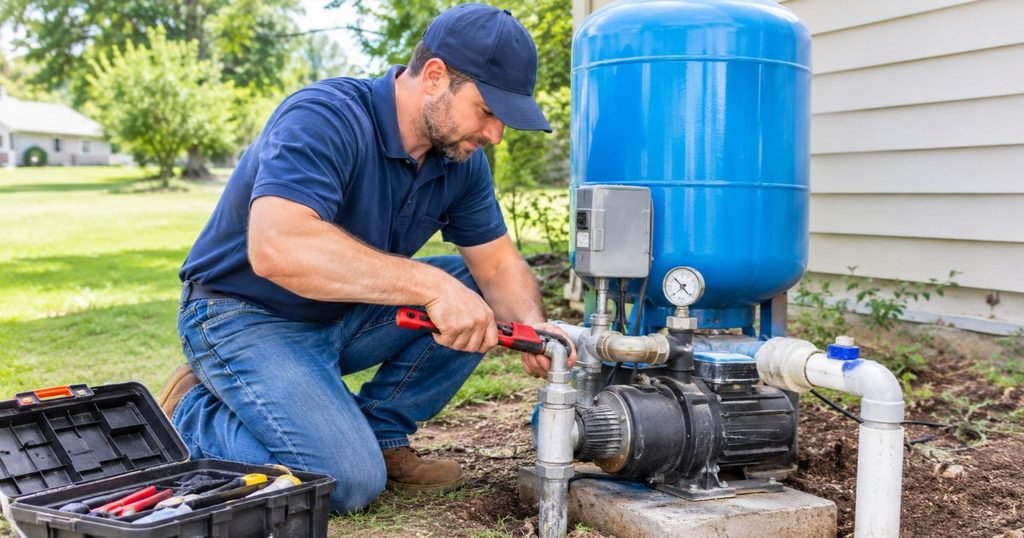
What Is a Well Pump and How Does It Work?
A residential well pump moves groundwater from an underground aquifer up into your home’s plumbing network at a usable, steady pressure. Unlike municipal water customers whose water arrives pre-pressurized from a city main, private well owners operate their own self-contained water utility.
To deliver water consistently without running the pump every single time you wash your hands, a standard private well setup relies on several components working together:
- The Well Pump: Either submerged deep inside the well casing or mounted above ground, the pump draws water from the well and pushes it toward the house.
- Drop Pipe and Service Line: The vertical pipe inside the well carries water to the surface, where an underground waterline routes it through the foundation wall into your home.
- Check Valve: A one-way valve prevents water in the pipes from draining back down into the well when the pump shuts off.
- Pressure Tank: Inside this tank is a rubber diaphragm or bladder separating compressed air from incoming water. As the pump fills the tank, the trapped air compresses, storing pressurized water for immediate use.
- Pressure Switch: This small electrical control monitors system water pressure. When household demand drops pressure to a preset minimum (typically 30 or 40 psi), the switch closes its electrical contacts to start the pump. Once the tank reaches the cutoff threshold (typically 50 or 60 psi), the switch opens and shuts the pump off.
Because these parts operate as an interconnected loop, a symptom that feels like a failing pump can easily originate in the pressure switch, pressure tank, wiring, or underground piping.
READ MORE: Sump Pump Running Continuously but No Water in the Pit: Cause & Fix
Different Types of Well Pumps
Before diagnosing a problem or estimating repair costs, it helps to know which type of pump serves your home. Residential systems in the United States generally fall into three categories based on well depth and installation location.
1. Submersible Well Pumps
Submersible pumps are cylindrical units sealed inside watertight stainless-steel or corrosion-resistant housings. They hang from the drop pipe deep below the static water level inside the well casing often anywhere from 50 feet to more than 400 feet underground.
Because they sit underwater, submersible pumps push water upward rather than pulling it via suction, making them quiet, energy-efficient, and capable of serving deep wells. However, any mechanical repair inside the pump itself requires pulling the entire assembly out of the well.
2. Shallow Well Jet Pumps
Shallow well jet pumps sit above ground usually in a basement, utility room, crawl space, or insulated pump house and draw water through a single suction pipe. Because atmospheric pressure limits suction lift, these pumps are designed for wells where the water level stays within roughly 25 feet of the pump.
They are easier to reach for routine maintenance and shallow well pump repair, though they are noticeably louder indoors and can lose their prime if air enters the suction line.
3. Deep Well Jet Pumps
Deep well jet pumps also mount above ground, but they use a two-pipe configuration connected to a jet assembly (ejector) installed down inside the well below the water level. One pipe sends pressurized water down to the jet assembly to create suction, while the second pipe returns water to the surface.
They are typically used in wells between 25 and 110 feet deep. While they avoid pulling a motor from the well, troubleshooting them requires checking both the above-ground motor and the downhole jet assembly.
| Pump Type | Typical Installation | Best Well Depth | Common Problems | Repair Considerations |
| Submersible Well Pump | Submerged inside well casing below water line | 50 to 400+ feet | Worn impellers, failed motor, chafed downhole wiring, stuck check valve | Requires specialized hoist/rig to pull drop pipe; high labor component |
| Shallow Well Jet Pump | Above ground (basement, utility room, pump house) | Up to ~25 feet | Loss of prime, clogged nozzle/venturi, worn shaft seal, air leaks in suction line | Easily accessible; often repaired on-site without disturbing the well |
| Deep Well Jet Pump | Motor above ground; ejector assembly inside well | 25 to ~110 feet | Loss of prime, worn impeller, clogged downhole ejector, leaking foot valve | Above-ground motor is easy to reach, but ejector repairs require pulling pipes |
READ MORE: Sump Pump Installation Cost
Common Signs Your Well Pump Needs Repair
Well systems rarely fail without leaving clues first. Catching these symptoms early often saves both the pump motor and your budget:
- No Water Coming From Faucets: A complete loss of flow typically points to a tripped circuit breaker, a failed pressure switch, a burned-out pump motor, a broken drop pipe, or a well whose water level has temporarily dropped below the intake.
- Low or Inconsistent Water Pressure: Weak flow at showers and faucets can stem from a failing pump unable to build full head pressure, a waterlogged pressure tank, clogged sediment filters, or mineral scale narrowing your pipes.
- Pump Constantly Running: If you hear your jet pump humming nonstop or notice your electric meter spinning continuously, the pump may be struggling to reach its cutoff pressure due to worn impellers, a leak in the underground service line, a faulty pressure switch, or a receding water table.
- Pump Frequently Turning On and Off (Short-Cycling): Rapid clicking every few seconds when water is running usually signals a waterlogged pressure tank that has lost its air charge, though a leaking check valve or plumbing leak can also trigger frequent cycling.
- Strange Humming, Clicking, or Grinding Noises: Rapid clicking at the pressure switch indicates short-cycling or low voltage. A loud hum without water movement suggests a seized motor or failed start capacitor, while grinding points to worn bearings or sand abrasion inside the pump.
- Air Sputtering From Faucets: Spitting air alongside water indicates air entering the system often from a cracked drop pipe, a failing pressure tank bladder, a suction leak on a jet pump, or a well pumping air because the water level has dropped too low.
- Dirty, Cloudy, or Discolored Well Water: Sudden sand, silt, or rust-colored water can happen when a failing pump disturbs sediment at the bottom of the well, a well screen deteriorates, or high groundwater runoff enters an improperly sealed casing.
- Unexpected Increases in Electricity Usage: A well pump that runs continuously or short-cycles dozens of times an hour draws substantial power, often showing up as an unexplained spike on your monthly utility bill.
Common Well Pump Problems and Their Causes
Pinpointing why a system is misbehaving requires separating electrical controls, water storage components, and the pump itself. Here is what typically lies behind the six most common complaints homeowners call about.
Well Pump Won’t Turn On
When a well pump not working leaves the house dry, power interruption is the first suspect. A tripped double-pole breaker in the main electrical panel, a blown fuse, or loose wiring connections can cut voltage completely.
If power reaches the system, the pressure switch is the next culprit; ants, moisture, or electrical arcing can pit or foul the contact points so power never passes through to the pump. On three-wire submersible setups, a failed start capacitor or relay inside the wall-mounted control box will prevent the motor from starting. In older systems, internal thermal overload switches or burned-out motor windings may be to blame.
Well Pump Runs but No Water Comes Out
Hearing a jet pump run or confirming a submersible pump is drawing amperage without getting water at the tap usually means the pump cannot move water up the column.
For above-ground jet pumps, the most common issue is a lost prime caused by air leaking into the suction line or a failing foot valve at the bottom of the well. For submersible pumps, deep well pump problems like a split or disconnected drop pipe, a broken pump shaft, stripped impellers, or a seasonal drop in the aquifer level below the pump intake will prevent water from reaching the house.
Well Pump Keeps Running
When a well pump keeps running without shutting off, it is failing to hit the upper cutoff pressure set on the pressure switch. Common reasons include:
- Worn Pump Impellers: Over years of pumping fine sand or hard water, internal impellers wear down and lose the hydraulic efficiency needed to push water up to 50 or 60 psi.
- Underground Pipe Leaks: A pinhole leak in the service line between the wellhead and the house bleeds pressure continuously, forcing the pump to run nonstop.
- Faulty Pressure Switch or Blocked Sensing Tube: If sediment clogs the small nipple connecting the pressure switch to the water line, the switch cannot sense rising pressure and never tells the pump to shut off.
- Dropping Water Level: If groundwater falls near the pump intake, the pump draws a mix of air and water and cannot build full pressure.
Well Pump Frequently Cycles On and Off
Rapid cycling turning on and off every few seconds while a faucet is open places extreme heat stress on the pump motor and quickly burns out pressure switch contacts.
Nine times out of ten, short-cycling is a well pressure tank repair issue rather than a pump failure. Inside a captive-air tank, the internal rubber diaphragm can rupture over time, allowing water to fill the entire tank. Because water cannot compress, opening a tap for even a quart of water drops system pressure immediately, triggering the pump, which then spikes pressure back to cutoff within two seconds. A stuck-open check valve or a toilet flapper constantly leaking inside the house can also cause cycling when no one is actively using water.
Low Well Water Pressure
Well pump pressure problems often build gradually until showers feel weak and washing machines take forever to fill. Before blaming the pump, check whether the drop happens everywhere or only at certain fixtures.
Whole-house pressure drops frequently trace back to a clogged whole-house sediment filter, a fouled iron or water softener media bed, or an improperly adjusted pressure switch. If filtration is clear, low pressure can indicate a failing pump motor, a partially obstructed well intake screen, or seasonal drought reducing well yield.
Unusual Noises Coming From the Well Pump
Above-ground jet pumps naturally make steady mechanical noise, while submersible pumps should be virtually silent indoors aside from a soft click from the pressure switch.
A loud humming or buzzing noise accompanied by a tripped breaker points to a locked rotor or a failed start capacitor. Metallic rattling or grinding inside a jet pump usually signals worn motor bearings or cavitation caused by a restricted suction line. Inside the house, banging pipes (water hammer) when the pump shuts off often points to a failing check valve slamming shut.
READ MORE: Dishwasher Not Draining? Causes, Fixes & When to Call Pro
Well Pump Troubleshooting: What Homeowners Can Safely Check
Before calling for service, you can perform a few safe, non-invasive checks. Having clear observations ready will also help a technician diagnose your system faster and avoid unnecessary parts swaps.
- Check Whether Other Faucets Have Water: Test both cold and hot taps in different rooms, as well as an outdoor hose bib located before your water softener or filtration system. If cold water works before the filter, your issue is a clogged filter or water heater problem—not the well pump.
- Look at the Pressure Gauge: Find the pressure gauge near your pressure tank. Note whether it reads zero, sits stuck at a middle number, or bounces rapidly while water is running. (Keep in mind that old gauges occasionally stick, so verify against actual faucet flow.)
- Check the Circuit Breaker Visually: Open your main electrical panel and look for the two-pole breaker labeled “Well Pump.” If it is tripped to the middle position, switch it firmly off and back on once. If it trips again immediately, stop resetting it—repeatedly resetting a tripping breaker risks electrical fire or severe motor damage.
- Inspect Accessible Plumbing for Visible Leaks: Walk around the pressure tank, water treatment equipment, and basement piping looking for puddles, damp insulation, or dripping valves. Outdoors, check the ground between the wellhead and the house for unexplained soggy spots.
- Check Accessible Water Filters for Clogging: If you have a spin-down sediment filter or cartridge housing with a bypass valve, place the filter on bypass briefly to see if household pressure returns to normal.
- Listen for Unusual Pump Noises: Stand quietly near the pressure tank and utility area while someone opens a faucet. Listen for rapid clicking at the pressure switch, continuous humming, or water rushing backward through the pipes after the pump stops.
- Observe Whether the Pump Cycles Normally: Watch the pressure gauge as a faucet runs. Normally, pressure should drop steadily to the cut-in point (e.g., 40 psi), then climb smoothly over 30 to 60 seconds to the cutoff point (e.g., 60 psi) before shutting off.
Important Safety Warning: Keep your troubleshooting strictly visual and auditory. Never remove the cover from a live pressure switch or control box, handle exposed electrical wiring, attempt to pull a submersible pump yourself, or enter a well pit or confined space. Pressurized tanks, 240-volt circuits, and heavy drop pipes pose serious electrocution, crushing, and asphyxiation hazards that require trained professionals.
READ MORE: Main Sewage Line Clogged: Signs, Causes & Solutions
Well Pump Repair Cost in the USA
Residential well pump repair cost varies widely across the United States depending on what failed, how deep your well is, and local labor rates. A simple above-ground electrical fix may cost a few hundred dollars, while pulling a deep submersible pump requires a service truck, hoist rig, and two technicians.
The table below outlines realistic national cost ranges for common residential well repairs. Keep in mind that parts-only prices reflect retail component costs, while total installed costs include professional labor, travel, diagnostic testing, and standard fittings.
| Repair or Service Type | Estimated Parts-Only Cost | Estimated Total Installed Cost (USA) | Key Cost Factors |
| Service Call / Diagnostic Fee | N/A | $100 – $250 | Travel distance, after-hours rates, diagnostic equipment |
| Pressure Switch Replacement | $30 – $90 | $150 – $350 | Switch amperage rating, corroded nipple/gauge replacement |
| Control Box / Capacitor Repair | $50 – $250 | $200 – $550 | Pump horsepower, brand-specific control box assembly |
| Pressure Tank Replacement | $300 – $900 | $650 – $1,800+ | Tank gallon capacity (20 to 80+ gal), manifold/valve upgrades |
| Shallow / Deep Jet Pump Repair | $50 – $300 | $250 – $750 | Seal/impeller kit vs. motor rebuild, accessibility |
| Submersible Pump Pulling & Repair | $100 – $600 | $800 – $2,200+ | Well depth (100 vs. 400 ft), drop pipe type (PVC vs. poly vs. galvanized) |
| Full Submersible Pump Replacement | $500 – $1,500+ | $1,500 – $3,800+ | Horsepower (½ HP to 2+ HP), well depth, new wire/drop pipe |
| Emergency / After-Hours Service | N/A | +$150 – $400 surcharge | Nights, weekends, holidays, urgent dispatch |
Factors That Influence Your Final Bill
- Well Depth and Pipe Material: Pulling a pump set at 80 feet on flexible polyethylene pipe takes a fraction of the time required to pull a pump set at 420 feet on threaded steel pipe.
- Local Labor Rates: Contractors in metropolitan areas or regions with high demand (such as parts of the Northeast, Pacific Northwest, and Mountain West) generally charge higher hourly rates than rural Midwest markets.
- Hidden Downhole Issues: Once a submersible pump is pulled, technicians inspect the submersible cable, safety rope, torque arrestors, and drop pipe. Replacing chafed wire or brittle piping adds to the total but prevents pulling the well a second time.
Note: These figures represent broad US market estimates for educational planning, not guaranteed quotes. Accurate pricing requires an on-site inspection of your specific well system.
READ MORE: Complete Guide to Dual Fuel Heat Pump Installation: Costs & Process
Well Pump Repair vs. Replacement: Which Is Better?
When facing a significant repair bill, homeowners naturally wonder whether fixing the current pump makes sense or if putting that money toward a brand-new unit is smarter.
Because labor accounts for a large share of submersible pump service, paying $1,000 in labor to pull a 14-year-old pump just to replace a worn check valve or frayed wire splice rarely makes financial sense. While the pump is already out of the ground, installing a new unit resets the clock on its lifespan. On the other hand, if a 3-year-old jet pump only needs a new pressure switch or shaft seal, repairing it is an easy win.
| Decision Factor | Repair Makes More Sense When… | Replacement Makes More Sense When… |
| Age of the Pump | The pump is under 7–8 years old (submersible) or under 5–6 years old (jet pump). | The pump is approaching or past 10–15 years of service. |
| Repair vs. Replace Cost | Total repair cost is less than 40%–50% of a new installed pump. | Repair cost exceeds 50% of replacement, especially if pulling the well is required. |
| Repair History | This is the first isolated issue (e.g., a failed switch or capacitor). | You have called for multiple repairs over the past 12–18 months. |
| Type of Damage | Fault is external: pressure switch, control box, pressure tank, or above-ground leak. | Motor windings are burned out, housing is corroded, or impellers are severely sand-worn. |
| Household Demand | Current flow rate (GPM) easily meets your household’s needs. | You have added bathrooms, irrigation, or filtration that require higher capacity. |
How to Prevent Future Well Pump Problems
While no mechanical pump lasts forever, consistent preventive habits can add years to your equipment’s service life and prevent sudden breakdowns:
- Schedule Routine Well System Inspections: Have a qualified well technician inspect your system every 1 to 2 years to check pump amp draw, pressure switch contacts, and tank air charge.
- Monitor Water Pressure Periodically: Glance at your pressure gauge once a month to confirm the pump cuts in and out at its normal settings without rapid cycling.
- Address Plumbing Leaks Promptly: A silently running toilet or dripping outdoor spigot can force your pump to cycle hundreds of extra times each week.
- Maintain Water Filters on Schedule: Replace clogged sediment cartridges before restricted flow puts extra backpressure on your pump.
- Protect Exposed Pipes and Pump Houses From Freezing: Insulate above-ground jet pumps, pressure tanks, and exposed wellhead pipes before winter freezes hit.
- Keep the Well Cap and Area Secure: Ensure your sanitary well cap is tightly sealed, intact, and at least 12 inches above grade. Keep fertilizers, pesticides, fuel, and pet waste well away from the wellhead.
- Maintain a Well System Log: Keep a folder near your pressure tank recording the pump model, horsepower, depth setting, static water level, and dates of all repairs.
- Test Private Well Water Regularly: Following guidance from the EPA and CDC, test your well water annually for total coliform bacteria, nitrates, total dissolved solids, and pH levels and test more often if you notice changes in taste, odor, or clarity.
READ MORE: Rusty Water From Hot Water Heater: Causes, Fixes & Replacement
When Should You Call an Emergency Well Pump Repair Service?
Some well issues can wait until regular business hours, while others pose safety hazards or risk destroying expensive equipment. Contact an emergency well pump repair service and shut off the dedicated well breaker immediately if you experience any of the following:
- Repeated Electrical Breaker Trips: A breaker that trips every time you reset it indicates a dead short or locked motor that can overheat wiring.
- Burning Smells, Smoke, or Melted Wiring: Any electrical odor near the pressure switch, control box, or breaker panel requires immediate power shutoff.
- Pump Running Continuously Without Building Pressure: Letting a pump run dry or deadhead against a closed valve generates intense heat that can melt PVC drop pipes and ruin the motor within minutes.
- Flooding Around the Wellhead or Burst Indoor Piping: Uncontrolled water leaks can flood basements or allow surface runoff to contaminate your aquifer.
- Complete Loss of Water With Urgent Household Needs: Households with infants, elderly family members, medical needs, or livestock cannot safely go days without water.
- Sudden Changes in Water Color, Odor, or Taste: Abrupt cloudiness, sewage-like odors, or chemical tastes can signal a compromised well casing or contamination event; stop drinking the water until it is inspected and tested.
Frequently Asked Questions
How much does it cost to repair a well pump?
In the United States, minor above-ground repairs like replacing a pressure switch or control box typically cost $150 to $550 installed. Replacing a failed pressure tank averages $650 to $1,800. Pulling and repairing or replacing a submersible well pump usually ranges from $800 to $3,800+, depending heavily on well depth, pump horsepower, and local labor rates.
What are the signs that a well pump is going bad?
Common warning signs include a sudden drop in household water pressure, the pump running nonstop without shutting off, rapid short-cycling every few seconds, air sputtering from faucets, muddy or sandy water, strange humming or grinding noises, and an unexplained spike in your monthly electric bill.
Can I repair my well pump myself?
Homeowners can safely perform basic checks—such as inspecting the circuit breaker, checking the pressure gauge, replacing clogged sediment filters, and looking for visible leaks. However, electrical repairs involving 240-volt controls, pressure tank calibration, and pulling deep submersible pumps involve serious electrical, pressure, and structural risks that should be handled by a licensed well professional.
Why is my well pump running but not producing water?
When a pump runs without delivering water, common causes include a lost prime (especially on above-ground jet pumps), a leak or break in the underground drop pipe, worn-out pump impellers that can no longer lift water, a stuck check valve, or a seasonal drop in the groundwater level below the pump intake.
How many years does a residential well pump last?
A quality submersible well pump typically lasts 10 to 15 years, and sometimes up to 20 years in clean, low-sediment water. Above-ground jet pumps generally last 8 to 12 years. Lifespan depends heavily on water chemistry, sand or mineral content, proper pressure tank maintenance, and how frequently the pump cycles on and off.
Final Thoughts
Most residential water interruptions trace back to a handful of identifiable causes whether a worn pressure switch, a waterlogged pressure tank, a wiring fault, or a pump reaching the end of its service life. Paying attention to early changes in water pressure, pump cycling, and strange noises gives you the best chance to catch small issues before they turn into full system failures.
Because well systems combine high-voltage electricity, pressurized vessels, and deep underground equipment, accurate diagnosis matters just as much as the repair itself. If you are dealing with erratic water pressure, a pump that won’t shut off, or a sudden loss of water, schedule an inspection with a licensed local well pump repair service to pinpoint the exact cause and restore reliable water to your home.
- Sources & Technical References:
- U.S. Environmental Protection Agency (EPA) – Private Drinking Water Wells: Care and Maintenance
- Centers for Disease Control and Prevention (CDC) – Private Ground Water Wells & Well Testing Guidelines
- National Ground Water Association (NGWA) – Wellowner.org: Pumping Systems and Maintenance
- Penn State Extension & University of Minnesota Extension – Private Water Systems and Well Pump Troubleshooting
- Franklin Electric & Goulds Water Technology – Residential Water Systems Application & Installation Manuals
- Disclaimer: This article is for informational purposes only. Private well systems involve high-voltage electrical components, pressurized tanks, and heavy downhole equipment. Always turn off power at the main breaker before performing visual inspections, and hire a licensed well contractor or qualified electrician for mechanical, electrical, or downhole repairs.

