Few homeowner headaches are quite as frustrating as walking out into your yard after a heavy rainstorm only to find a soggy swamp where your lawn used to be or worse, heading down to the basement and spotting water seeping along the base of the concrete walls.
Whether you are dealing with persistent standing water in the lawn, a damp crawl space, soil washing away near your home’s perimeter, or water pooling right against the foundation, poor drainage can quietly threaten both your property value and your home’s structural integrity.
If you have started researching solutions, you have almost certainly come across French drains. Lets deep dive into “French Drain Installation Cost (2026): Pricing & Guide”
How Much Does French Drain Installation Cost?
When budgeting for a drainage project, it helps to look at both national averages and realistic project brackets. According to 2026 residential construction and home improvement data, the average cost to install a French drain falls between $5,000 and $9,250, with the French drain cost per linear foot generally running from $10 to $100.
Why is that range so wide? Because installing a shallow 50-foot gravel trench to dry out a soggy corner of a backyard is a completely different job from jackhammering 120 linear feet of concrete inside a finished basement and tying the pipe into a new sump pump pit.
French Drain Cost Overview
| Project Scope / Category | Estimated Cost Per Linear Foot | Estimated Total Project Cost | Typical Application |
| Low-End Project (Shallow Exterior) | $10 – $25 | $1,000 – $3,500 | Short yard trench or shallow curtain drain in accessible soil |
| Mid-Range Project (Standard Yard / Perimeter) | $25 – $55 | $3,500 – $9,250 | Longer yard runs, deeper exterior perimeter drains, or downspout tie-ins |
| High-End Project (Interior Basement / Complex) | $55 – $100+ | $9,500 – $18,000+ | Full-perimeter basement drainage, concrete cutting, sump pump, and restoration |
Note: These figures represent national planning estimates compiled from industry cost benchmarks, not guaranteed contractor quotes. Your final price will depend on local market rates and site-specific property conditions.
Why Interior and Exterior Costs Differ So Dramatically
The single biggest dividing line in pricing is location. Exterior French drain cost is generally lower because crews work outdoors in soil using trenchers or mini-excavators. Once the pipe and gravel are in place, they backfill the trench with soil or sod.
Interior French drain cost, by contrast, is labor-intensive from start to finish. Contractors must saw-cut and break up the concrete floor along the interior basement perimeter, haul out heavy chunks of broken concrete by hand or bucket, excavate soil beneath the slab, install the drain system, connect it to a sump basin, and pour fresh concrete over the trench.
READ MORE: Dishwasher Not Draining? Causes, Fixes & When to Call Pro
French Drain Installation Cost Per Linear Foot
Most drainage specialists quote projects by the linear foot, factoring in trench depth, pipe diameter, aggregate volume, and crew hours. On average, homeowners pay $10 to $50 per linear foot for exterior drains and $40 to $100 per linear foot for interior basement drains.
When a contractor calculates your French drain cost per foot, they bundle several core components into that rate:
- Excavation and trench preparation: Digging a trench that maintains a consistent downward slope (typically at least 1/8 inch per foot, or a 1% grade) so gravity moves water reliably toward the discharge point.
- Materials: Non-woven geotextile filter fabric, washed drainage gravel, perforated drainage pipe, couplers, and discharge outlets.
- Crew labor and equipment: Operating trenchers, mini-excavators, or jackhammers, plus hand-digging around tree roots, fences, and underground utility lines.
- Site accessibility: Tight side yards where machinery cannot fit require manual digging, which slows production and raises per-foot labor charges.
Estimated French Drain Cost by System Length
| Total Drain Length | Exterior Yard Drain ($15 – $45 / lin. ft.) | Deep Exterior Perimeter Drain ($35 – $80 / lin. ft.) | Interior Basement Drain ($45 – $95 / lin. ft.) |
| 25 Linear Feet | $500 – $1,125 | $1,000 – $2,000 | $1,500 – $2,375 |
| 50 Linear Feet | $750 – $2,250 | $1,750 – $4,000 | $2,250 – $4,750 |
| 100 Linear Feet | $1,500 – $4,500 | $3,500 – $8,000 | $4,500 – $9,500 |
| 150 Linear Feet | $2,250 – $6,750 | $5,250 – $12,000 | $6,750 – $14,250 |
| 200 Linear Feet | $3,000 – $9,000 | $7,000 – $16,000 | $9,000 – $19,000 |
Note: Shorter runs (under 50 feet) often carry minimum mobilization charges from contractors, meaning the effective cost per foot on a 25-foot job may sit higher than on a 150-foot job.
READ MORE: Emergency Drain Cleaning Service: Expert Guide & Costs
French Drain Installation Cost by Type
Not all French drains are built the same way. Depending on whether water is pooling on top of your lawn, flowing down a hillside, or pushing up through your basement floor, a specialist will recommend a specific configuration.
Exterior French Drain Installation Cost
An exterior French drain is installed outside the home either in the yard or along the exterior foundation wall to intercept surface runoff and shallow subsurface water before it causes damage.
- Typical Cost: $1,000 – $10,000 ($10 – $50 per linear foot).
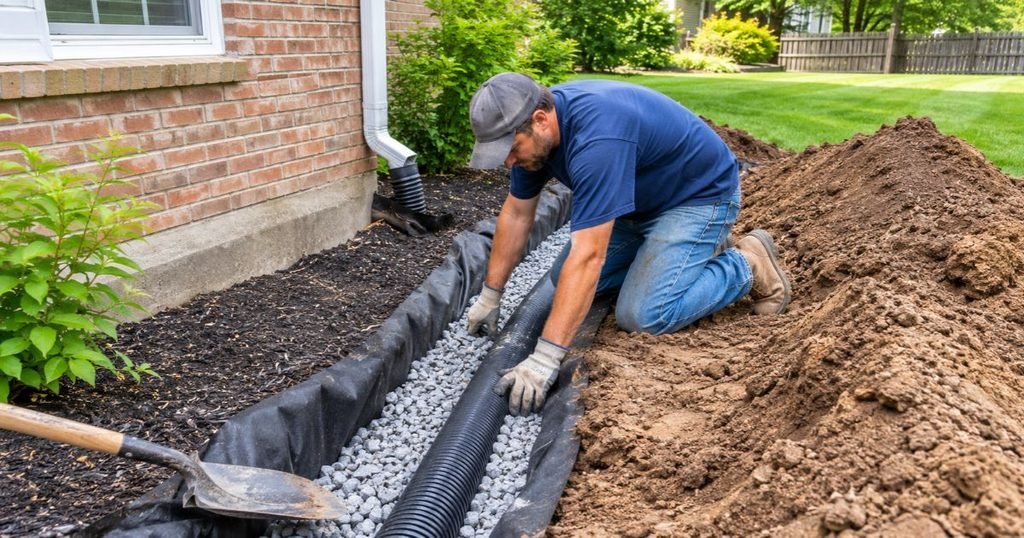
- Installation Process: A trench is dug 18 to 24 inches deep (or deeper near footings), lined with filter fabric, bedded with washed stone, fitted with a perforated pipe, and backfilled.
- Common Applications: Redirecting groundwater away from the house, drying out wet side yards, and relieving moisture around patios.
- Main Advantages: Stops water outside the structure before it ever touches foundation walls; usually relies on natural gravity rather than mechanical pumps.
- Cost Escalators: Hard clay or rocky soil, dense tree roots, decks or concrete walkways blocking the path, and long distances to a legal discharge point.
Interior French Drain Installation Cost
Installed inside the home beneath the concrete slab, an interior French drain captures groundwater rising from beneath the floor or seeping through the cove joint where the wall meets the footing.
- Typical Cost: $5,000 – $18,000 ($40 – $100 per linear foot).
- Installation Process: Contractors cut a 12-to-18-inch channel around the inside perimeter of the slab, excavate down to the footing, install perforated pipe in washed gravel, route the water to a sump basin, and re-pour concrete.
- Common Applications: Chronic basement seepage, hydrostatic pressure under slabs, and homes where exterior excavation is blocked by porches, additions, or zero-lot-line property boundaries.
- Main Advantages: Works year-round regardless of frozen ground outside; avoids tearing up mature outdoor landscaping and hardscapes.
- Cost Escalators: Thick reinforced concrete slabs, finished basement drywall or flooring removal, battery backup sump pump systems, and asbestos or old tile remediation.
Basement French Drain Cost
While technically a form of interior drainage, basement French drain installation cost specifically refers to full- or partial-perimeter sub-slab systems engineered to keep below-grade living spaces dry.
- Typical Cost: $4,500 – $17,000 ($60 – $70 per linear foot on average, ranging from $40 – $100).
- Installation Process: Includes concrete demolition, trenching beside the footing, installing a weeping tile system or engineered drainage channel, connecting a vapor barrier along the wall, and tying into a sump pump.
- Common Applications: Wet basements with efflorescence (white chalky mineral deposits), damp carpets, or recurring puddles after heavy storms.
- Main Advantages: Relieves hydrostatic water pressure directly beneath the slab and channels water to a controlled discharge pump.
- Cost Escalators: Older stone or brick foundations requiring specialized footing care, multiple sump pits, and extensive concrete haul-away.
Yard French Drain Installation Cost
If your lawn stays squishy days after a storm, French drain installation cost in yard settings targets saturated turf and low-lying swales.
- Typical Cost: $2,000 – $10,000 ($20 – $50 per linear foot; up to $90/ft for deep or multi-basin designs).
- Installation Process: Crews slice and remove turf, dig a sloped trench across the wet zone, wrap gravel and perforated pipe in geotextile fabric, and top with soil and sod or decorative river rock.
- Common Applications: Low spots in backyards, soggy play areas, and yards with heavy clay soil that drains slowly.
- Main Advantages: Virtually invisible once grass grows back over the trench; eliminates mosquito breeding puddles and mud.
- Cost Escalators: Adding surface catch basins, tying in roof downspouts, extensive regrading, and sod replacement.
Crawl Space French Drain Cost
Crawl spaces are notorious for trapping ground moisture, leading to musty odors, wood rot, and mold. A crawl space French drain sits inside the perimeter wall in the dirt floor.
- Typical Cost: $2,000 – $8,000 ($20 – $40 per linear foot).
- Installation Process: Workers dig a shallow trench along the inside footing of the crawl space, lay perforated pipe and gravel, and pitch it toward a crawl space sump pump or daylight outlet.
- Common Applications: Dirt-floor crawl spaces experiencing seasonal water intrusion or high humidity.
- Main Advantages: Pairs seamlessly with crawl space encapsulation vapor barriers to keep the under-home environment dry.
- Cost Escalators: Low vertical clearance (tight crawl spaces force crews to dig with short-handled hand tools), rocky subsoils, and adding dehumidifiers or encapsulation.
Curtain Drain Installation Cost
A curtain drain is a shallow, uphill trench designed to intercept surface water and shallow subsurface runoff flowing down a slope toward your house or patio.
- Typical Cost: $1,000 – $5,000 ($10 – $35 per linear foot).
- Installation Process: Dug roughly 18 to 24 inches deep across the slope (perpendicular to water flow), filled with gravel and perforated pipe, and often left exposed with decorative stone on top.
- Common Applications: Sloped yards where rainwater sheets down from a hill or neighboring elevation toward your home.
- Main Advantages: One of the most affordable exterior options because trenches are relatively shallow and straightforward to dig.
- Cost Escalators: Steep terrain that limits machinery access, long discharge runs around the property, and decorative river rock finishes.
Deep French Drain Installation Cost
When shallow trenches aren’t enough to intercept high groundwater tables or protect deep foundation walls, contractors install deep French drains.
- Typical Cost: $3,000 – $12,000+ ($30 – $90 per linear foot).
- Installation Process: Excavated anywhere from 3 to 8 feet deep (often down to the home’s footing level), requiring shoring for safety, substantial gravel tonnage, and heavy-duty rigid pipe.
- Common Applications: Deep foundation protection, high water tables, and behind tall retaining walls to prevent hydrostatic wall failure.
- Main Advantages: Captures deep subsurface groundwater that shallow yard drains completely miss.
- Cost Escalators: Trench safety shoring, massive dirt haul-away volumes, multiple tons of washed aggregate, and proximity to utility lines.
French Drain Around House Cost
Also called an exterior perimeter drain or weeping tile system, a French drain around the house wraps partially or completely around the home’s footprint at footing depth.
- Typical Cost: $4,500 – $22,500 ($50 – $80+ per linear foot for full-depth perimeter excavation).
- Installation Process: Excavators dig all the way down to the bottom of the foundation wall, clean and waterproof the exterior wall, lay perforated pipe beside the footing, cover with gravel and filter fabric, and backfill.
- Common Applications: Homes with chronic foundation leaks, older houses whose original clay weeping tiles have collapsed, and major foundation waterproofing projects.
- Main Advantages: Offers the most comprehensive exterior protection by stopping water before it can penetrate foundation walls.
- Cost Escalators: Removing and rebuilding decks, porches, driveways, AC condenser pads, and mature foundation plantings.
Comparison of French Drain Types
| French Drain Type | Typical Cost / Lin. Ft. | Average Total Cost | Typical Depth | Primary Purpose |
| Exterior French Drain | $10 – $50 | $1,000 – $10,000 | 1.5 – 4 ft | General outdoor water diversion |
| Interior French Drain | $40 – $100 | $5,000 – $18,000 | Sub-slab | Capturing basement seepage |
| Basement French Drain | $40 – $100 | $4,500 – $17,000 | Sub-slab | Perimeter basement water control |
| Yard French Drain | $20 – $50 | $2,000 – $10,000 | 1.5 – 2.5 ft | Eliminating soggy lawn spots |
| Crawl Space Drain | $20 – $40 | $2,000 – $8,000 | 1 – 2 ft | Controlling under-home moisture |
| Curtain Drain | $10 – $35 | $1,000 – $5,000 | 1.5 – 2 ft | Intercepting hillside runoff |
| Deep French Drain | $30 – $90 | $3,000 – $12,000+ | 3 – 8 ft | High water tables & retaining walls |
| Around House (Perimeter) | $50 – $80+ | $4,500 – $22,500 | Footing depth | Full exterior foundation protection |
READ MORE: Plumber for Clogged Shower Drain: When to Call & Cost
What Factors Affect French Drain Installation Cost?
Homeowners are often surprised when a neighbor pays $3,200 for a drainage system while their own quote comes back at $8,800. Even when two houses sit on the same street and need similar pipe lengths, a dozen site-specific variables can shift the final price:
- Drain Length and Total Project Size: Longer runs require more pipe, more cubic yards of stone, more filter fabric, and more excavation hours. Furthermore, water must be carried all the way to a safe, legal discharge point—not simply dumped ten feet away.
- Soil Type: Loamy, sandy soil digs quickly and cleanly. Dense, heavy clay clings to shovel blades and trencher teeth, slowing down crews. Rocky soil or subterranean ledge may require hydraulic breakers or specialized excavation attachments, driving up equipment and labor bills.
- Excavation Depth and Trench Width: Doubling the depth of a trench doesn’t just double the dirt it dramatically increases the volume of gravel required to fill it and often demands wider trench profiles to prevent cave-ins.
- Labor Rates and Contractor Experience: Specialized drainage contractors and waterproofing companies typically charge $50 to $150 per hour per crew member. Experienced specialists cost more upfront than general handymen, but they engineer proper pitch, cleanouts, and discharge outlets so the system doesn’t clog in three years.
- Drainage Pipe Quality and Materials: Thin, single-wall corrugated plastic pipe is inexpensive, whereas heavy-duty dual-wall HDPE or rigid Schedule 40 PVC pipe costs more per foot but resists crushing under soil weight and lawn equipment.
- Gravel and Landscape Fabric: A true French drain relies on clean, washed angular stone (such as #57 stone) wrapped in a non-woven geotextile fabric envelope. Skipping fabric or using unwashed stone saves a few hundred dollars initially but invites silt to clog the drain prematurely.
- Accessibility Around the Property: If a crew can drive a compact excavator and skid steer straight into your backyard, the job moves fast. Narrow side gates, steep banks, fences, or septic fields force crews to haul stone by wheelbarrow and dig by hand.
- Existing Landscaping, Trees, and Concrete Surfaces: Tunneling beneath a concrete sidewalk or driveway, navigating around mature tree roots, or carefully lifting and replanting ornamental garden beds adds significant time and restoration expense.
- Property Slope and Grading Requirements: Water flows downhill. If your yard is dead flat or slopes toward the house, the contractor must dig progressively deeper along the run to maintain proper pitch, or regrade sections of the lawn.
- Geographic Location and Local Labor Costs: Construction wages, aggregate quarry fees, and dump disposal rates are noticeably higher in major metropolitan areas of the Northeast, West Coast, and upper Midwest than in smaller rural markets.
- Permits and Inspections: Depending on your municipality, tying into a storm sewer or altering runoff patterns may require a local permit ($50 to $300+) and municipal inspection.
- Water Discharge Requirements: If natural gravity cannot carry water to daylight (an open downhill slope or curb outlet), your system will need a sump pump basin, a dry well, or a pop-up emitter to disperse water legally without flooding a neighbor’s yard.
French Drain Material Costs
In a typical professional installation, materials account for roughly 25% to 40% of the total project bill, while labor and equipment make up the rest. Understanding what goes into the trench helps you evaluate contractor quotes and spot corners that shouldn’t be cut.
- Perforated Drainage Pipes ($1 – $5 per linear foot): Holes or slots along the pipe allow groundwater to enter from the surrounding gravel bed.
- PVC vs. Corrugated Pipe: Rigid PVC (Schedule 40 or SDR-35) offers smooth interior walls that maximize water flow, resist crushing, and can be snaked cleanly with drain-cleaning augers. Dual-wall corrugated HDPE has a corrugated exterior for flexibility and a smooth interior wall, making it great for gentle curves. Single-wall corrugated pipe is the cheapest option, but its ridges trap sediment and collapse easily under heavy loads most pros avoid it for permanent residential drains.
- Washed Drainage Gravel ($30 – $65 per ton / cubic yard): Clean, washed 3/4-inch to 1.5-inch crushed stone (#57 stone or river rock) creates large void spaces for water to collect and flow. Avoid limestone screenings or unwashed gravel containing fine dust, which turns into concrete-like sludge and clogs the pipe.
- Geotextile Landscape Fabric ($0.20 – $0.90 per square foot): Non-woven needle-punched geotextile fabric lines the trench like a burrito wrapper around the gravel and pipe, letting water pass through while blocking surrounding soil and silt.
- Drain Fittings and Connectors ($2 – $15 each): Wyes, tees, couplers, end caps, and vertical cleanout risers allow you to inspect and flush the system over time.
- Drain Outlets and Catch Basins ($25 – $500 each): Surface catch basins collect fast-moving surface water from low spots, while pop-up emitters or critter-guard daylight outlets release water safely at the end of the line.
- Sump Pumps ($150 – $600 for the unit; $500 – $2,000 installed): Required for interior basement systems and flat yards where gravity alone cannot discharge the collected water.
Estimated French Drain Material Costs
| Material Component | Typical 2026 Unit Cost | Notes & Durability Impact |
| Single-Wall Corrugated Pipe (4″) | $0.75 – $1.50 / lin. ft. | Budget option; prone to crushing and sediment buildup |
| Dual-Wall HDPE or Rigid PVC Pipe (4″) | $2.00 – $5.00 / lin. ft. | Recommended for longevity, crush resistance, and easy cleaning |
| Washed Drainage Gravel (#57 Stone) | $35 – $65 / ton or cu. yd. | Must be clean/washed; delivery fees (100–200) often apply |
| Non-Woven Geotextile Fabric | $0.20 – $0.90 / sq. ft. | Essential for preventing soil migration and silt clogs |
| Pipe Fittings, Couplers & Cleanouts | $2 – $15 per piece | Cleanout ports make future maintenance dramatically easier |
| Catch Basins & Pop-Up Emitters | $25 – $500 each | Varies by size, grate material, and basin depth |
| Sump Pump & Basin (Equipment Only) | $200 – $700+ | Cast-iron pumps with battery backups cost more but last longer |
READ MORE: High Pressure Hydro Jetting for Kitchen Drains
French Drain Labor and Installation Costs
Labor and heavy equipment typically account for 60% to 75% of your total French drain installation estimate. When you hire a professional crew, you aren’t just paying someone to dig a ditch, you are paying for laser-level grading, utility protection, rock hauling, and site restoration.
- Drainage Contractor and Landscaper Labor: Standard hourly rates run $50 to $150 per hour per worker, depending on the region and whether you hire a landscape contractor or a dedicated foundation waterproofing specialist. A typical 100-foot exterior yard drain takes a 2-to-3-person crew one to two full days.
- Trenching and Excavation Equipment: Contractors factor in daily operating costs for walk-behind trenchers, compact excavators, and mini skid steers to move tons of dirt and gravel efficiently.
- Concrete Cutting and Demolition (Interior Systems): Inside a basement, crews use wet diamond-blade concrete saws and electric jackhammers to cut a clean perimeter channel, followed by hauling heavy concrete rubble out of the basement.
- Backfilling and Landscape Restoration: After testing the line with water to verify flow, crews backfill the trench, compact the soil to prevent future sinking, and relay cut sod or seed the disturbed strip.
Why Interior Installations Cost More in Labor
Interior basement drainage requires roughly double to triple the labor hours per linear foot compared to an exterior yard drain. Crews work in confined indoor spaces where heavy excavation equipment cannot fit, meaning every bucket of broken concrete, excavated clay, and washed gravel must be carried in and out manually or via conveyor. Dust containment, plumbing a discharge line through the rim joist, wiring a dedicated GFCI outlet for the sump pump, and finishing new concrete all add skilled trade hours.
DIY French Drain Installation Cost vs. Professional Installation
If you are handy, physically fit, and dealing with a straightforward shallow yard drain, tackling the project yourself can cut your out-of-pocket costs by 50% to 70%. For a 50- to 100-foot exterior yard drain, DIY French drain installation cost typically lands between $500 and $2,000 for materials and tool rentals, compared to $1,500 to $5,000+ for a professional crew.
DIY vs. Professional Installation Comparison (100-Foot Yard Drain)
| Cost & Project Factor | DIY Installation | Professional Installation |
| Materials (Pipe, Gravel, Fabric, Emitter) | $450 – $1,100 | Included ($600 – $1,400 value) |
| Equipment Rental (Trencher, Sod Cutter, Laser) | $150 – $450 / day | Included in contractor bid |
| Labor Cost | $0 (Your own sweat equity) | $1,200 – $3,500+ |
| Estimated Total Cost | $600 – $1,550 | $1,800 – $4,900+ |
| Typical Time Required | 2 – 4 full weekends / days | 1 – 2 days |
| Workmanship Warranty | None | Typically 5 – 25 years (varies by company) |
Safety First: Always Call 811 Before Digging
Before a single shovel or trencher blade touches your yard, call 811 (or submit an online ticket through your state’s One-Call center) at least two to three business days ahead of time. Utility companies will mark buried gas lines, electric cables, water mains, and fiber-optic lines for free. Hitting a gas or primary power line is life-threatening and carries steep repair fines.
When You Should Hire a Professional
Skip the DIY route and call a licensed drainage or waterproofing contractor whenever the project involves digging next to your home’s foundation footings, cutting basement concrete, installing a sump pump system, working around retaining walls, or navigating steep slopes and dense utility corridors.
READ MORE: Best drain snake for home use — buyer’s guide for U.S. homeowners
French Drain vs. Other Drainage Solutions: Cost Comparison
Before committing to a French drain, compare it against six other residential drainage fixes to make sure you are matching the right tool to your specific water problem.
| Drainage Solution | Estimated 2026 Cost | Best Application | Main Advantage |
| French Drain | $1,000 – 18,000(10 – $100/ft) | Subsurface groundwater, soggy lawns, wet basements | Hidden underground; handles high volumes of subsurface water |
| Trench / Channel Drain | $2,500 – 8,000(30 – $70/ft) | Driveways, pool decks, patios, garage aprons | Open metal/polymer grate captures fast surface sheet runoff immediately |
| Surface Drain / Catch Basin | $600 – $2,500 (per basin run) | Distinct low depressions where puddles form | Quickly drains concentrated surface puddles into a solid discharge pipe |
| Dry Well | $1,300 – $5,100 (installed) | Yards with no downhill slope or street curb outlet | Stores runoff underground and disperses it slowly into permeable soil |
| Yard Regrading / Swale | $800 – $3,000 | Negative slope draining toward the house foundation | Uses natural soil contours with zero pipes or mechanical parts to clog |
| Gutter Downspout Extensions | $150 – $350 per downspout | Roof runoff pooling right against foundation walls | Lowest-cost first step for eliminating roof-water intrusion |
| Sump Pump System | $500 – $2,000 (installed) | Basement or crawl space water collection pits | Actively pumps water up and away when gravity drainage is impossible |
How to Get an Accurate French Drain Installation Estimate
Getting a fair, apples-to-apples French drain installation estimate starts before you ever pick up the phone. Follow this step-by-step approach:
- Observe Where Water Comes From and Where It Collects: Walk your property during a steady rainstorm. Note whether water is pouring from a downspout, sheeting off a neighbor’s hill, or seeping up from the ground.
- Measure the Approximate Path: Pace off or measure the distance from the wet zone all the way to a viable discharge point (such as a lower street curb, drainage ditch, or dry well location).
- Request at Least Three Written Estimates: Contact three reputable local drainage specialists, landscape contractors, or waterproofing firms for on-site evaluations.
- Compare Itemized Line Items: Make sure every bid specifies trench depth and width, pipe type (ask for rigid PVC or dual-wall HDPE), gravel type, geotextile fabric use, cleanout ports, discharge method, and whether sod/dirt haul-away is included.
- Verify Licensing, Bonding, and Insurance: Confirm the contractor carries active general liability insurance and workers’ compensation coverage, plus any state or local contractor licenses required in your area.
- Check Reviews and Past Projects: Look for consistent feedback on drainage longevity—anyone can dig a trench that works on day one, but good contractors build systems that still flow five years later.
- Clarify Warranties and Local Discharge Rules: Ask what their workmanship warranty covers and confirm that your discharge outlet complies with local municipal codes (most towns prohibit pointing discharge pipes directly onto a neighbor’s property or public sidewalk).
Key Questions to Ask Before Hiring a Contractor
- “What type and diameter of pipe will you install, and will you wrap the gravel trench in non-woven geotextile fabric?”
- “How will you ensure a continuous downward slope, and where exactly will the water discharge?”
- “Will you install cleanout ports so the drain can be flushed in the future?”
- “Does this quote include utility marking, excess soil haul-away, and lawn/concrete restoration?”
READ MORE: Best drain snake for home use — buyer’s guide for U.S. homeowners
How to Save Money on French Drain Installation
Cutting corners on pipe quality or skipping filter fabric will only force you to pay twice when the drain clogs. Instead, use these practical ways to keep your costs down without sacrificing performance:
- Compare Multiple Quotes: Pricing between contractors for the exact same scope frequently varies by 20% to 35%.
- Match the Drain to the Problem: Don’t pay for an 8-foot deep perimeter foundation drain if a 20-inch shallow curtain drain uphill will intercept the runoff before it reaches your house.
- Fix Simple Roof Runoff First: Extending downspouts 10 feet away from your foundation and cleaning clogged gutters often reduces water volume enough to shorten the French drain you need.
- Address Drainage Early: Fixing a soggy yard early prevents foundation cracks, bowed walls, and ruined basement flooring down the road.
- Bundle Excavation Projects: If you are already renting an excavator or hiring a crew to install a patio, retaining wall, or irrigation line, adding a French drain at the same time eliminates duplicate mobilization fees.
- Handle Surface Prep and Restoration Yourself: Removing patio furniture, relocating garden border stones, and seeding or laying sod yourself after the contractor backfills the trench can trim hundreds of dollars off your invoice.
- Maintain Existing Systems: Flushing cleanout ports with a garden hose once a year and keeping pop-up emitters clear of grass clippings prevents expensive clogs.
Signs You May Need a French Drain
Not sure whether your property needs a full French drain or minor grading? Watch for these telltale warning signs:
- Standing Water After Rainfall: Puddles that remain on your lawn more than 24 to 48 hours after a storm stops.
- Repeated Basement Water Intrusion: Damp spots along the bottom of basement walls, water seeping through floor cracks, or puddles appearing after heavy rain.
- Waterlogged, Spongy Lawn Areas: Turf that squishes underfoot, grows moss or algae, or kills grass roots from oversaturation.
- Wet or Musty Crawl Spaces: Standing water, damp soil, high humidity, or condensation on floor joists beneath the home.
- Soil Erosion Around the Foundation: Mulch washing away, exposed concrete footings, or soil settling and sloping inward toward your house.
- Water Accumulating Behind Retaining Walls: Water weeping through wall joints or bulging walls caused by saturated soil pressure.
- Persistent Pooling Near Downspouts: Areas where roof runoff overwhelms the surrounding soil’s ability to absorb water.
If you notice horizontal foundation cracks, bowing basement walls, or recurring indoor flooding, contact a qualified residential drainage specialist or structural foundation professional promptly for an on-site evaluation.
Frequently Asked Questions
How much does it cost to install a French drain per foot?
In 2027, the average French drain cost per linear foot is $10 to $50 for exterior yard and shallow perimeter drains, and $40 to $100 per linear foot for interior basement drains. Prices vary based on trench depth, rocky or clay soil, pipe materials, and whether concrete cutting or a sump pump is required.
How much does a 100-foot French drain cost?
A 100-foot exterior yard French drain typically costs $1,500 to $4,500 installed, while a deeper exterior foundation perimeter drain of the same length runs $3,500 to $8,000. An interior 100-foot basement French drain generally costs $4,500 to $9,500, including concrete demolition, gravel, piping, and basic restoration.
Is an interior or exterior French drain more expensive?
An interior French drain is typically more expensive per linear foot ($40 to $100/ft) than an exterior French drain ($10 to $50/ft). Interior installations require saw-cutting and jackhammering concrete basement slabs, hauling heavy rubble out by hand, excavating beneath the floor, repouring concrete, and installing a sump pump system.
Can I install a French drain myself to save money?
Yes, installing a shallow exterior yard French drain yourself typically costs $500 to $2,000 in materials and equipment rentals, saving 50% or more on labor. However, you must maintain a consistent downward slope, use non-woven geotextile fabric and washed gravel, and call 811 before digging. Leave deep foundation and interior basement drains to professionals.
How long does a French drain last?
A properly installed French drain built with rigid PVC or dual-wall HDPE pipe, clean washed stone, and non-woven geotextile filter fabric typically lasts 20 to 40 years. Systems built with thin single-wall corrugated pipe or installed without filter fabric can clog with silt or collapse in as little as 5 to 10 years.
Conclusion
Understanding French drain installation cost comes down to matching the right drainage design to the specific way water moves across or beneath your property. While national averages sit between $5,000 and $9,250, a simple exterior yard trench may cost as little as $1,000 to $3,500, whereas a full-perimeter interior basement system with a sump pump can reach $10,000 to $18,000+.
Because soil conditions, trench depth, accessibility, and local discharge regulations vary widely from one neighborhood to the next, per-foot national averages are only a starting point. Take the time to walk your property during a rainstorm, identify where water originates, and gather at least three detailed, itemized estimates from licensed local drainage professionals. Comparing thorough bids will help you choose a durable, code-compliant solution that protects your yard and foundation without paying for unnecessary extras.

