Tankless water heaters (aka on-demand heaters) have gone mainstream for U.S. homeowners who want endless hot water, a smaller footprint, and better long-term efficiency than standard storage tanks. They also bring tradeoffs: higher up-front equipment and installation costs, more complex venting/electrical needs, and installer-dependent performance. This brief “Best Tankless Water Heater 2026 — Top Picks, Costs & Buyer’s Guide” It focuses on sizing, installation realities, realistic costs, energy and rebate notes, and five top picks with current example prices.
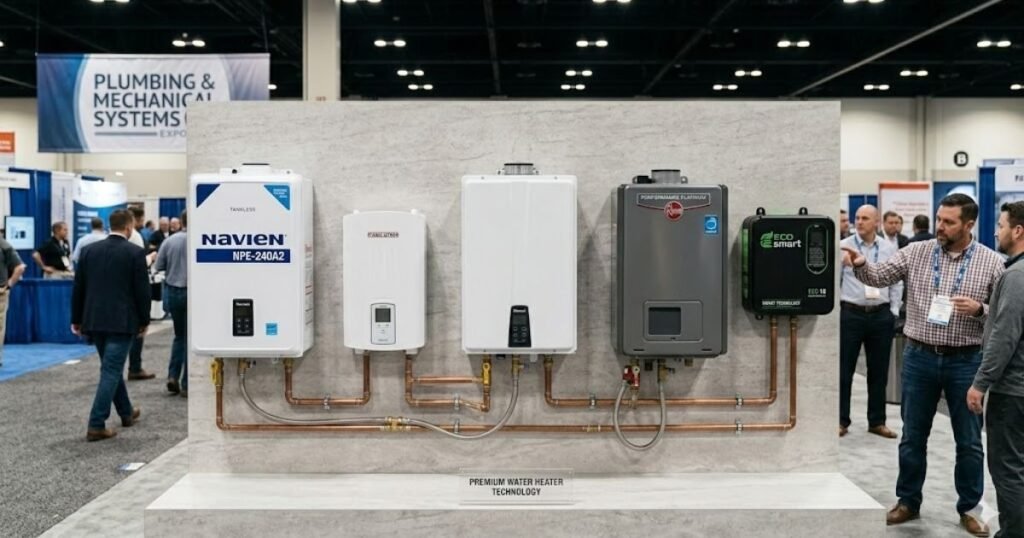
Methodology — How We Chose the Best Tankless Water Heater
Choosing the best tankless water heater isn’t about picking the most expensive model or the one with the highest advertised GPM. It’s about matching real-world performance, efficiency, installation practicality, and long-term ownership costs to the needs of U.S. homeowners.
Here’s exactly how we evaluated and selected the five models featured in this guide.
1. Real-World Performance (GPM at Temperature Rise)
We reviewed official manufacturer flow charts and compared GPM output at realistic temperature rises (50°F–70°F) — not just maximum advertised numbers. This ensures the units can handle simultaneous showers in colder U.S. climates.
2. Energy Efficiency (UEF Ratings)
Gas models were evaluated by Uniform Energy Factor (UEF), prioritizing high-efficiency condensing units (typically 0.90–0.95+ UEF). Electric models were assessed for self-modulating technology and stable temperature control.
3. Installation Practicality
We analyzed real installation factors that impact total tankless water heater cost, including:
- Venting requirements (condensing vs non-condensing)
- Gas line capacity
- Electrical panel upgrades (for 27 kW–36 kW units)
- Permit and code considerations
Models that deliver strong performance without excessive retrofit costs ranked higher.
4. Verified Retail Pricing (Current Market Rates)
We reviewed current U.S. retailer listings (as of March 2026) to confirm real purchase pricing not just MSRP. Our recommendations include value, mid-range, and premium options.
5. Brand Reputation & Warranty
We favored manufacturers with:
- Established U.S. service networks
- Readily available replacement parts
- Strong heat-exchanger warranties
- Clear maintenance requirements
6. Long-Term Ownership Value
We considered maintenance needs (annual flushing), water-hardness sensitivity, and overall durability to ensure each unit performs well beyond the first year.
READ MORE: Takagi Tankless Water Heater Reviews — Which Model Is Best for Your Home?
How Tankless Water Heaters Work
A tankless water heater heats water on demand with a heat exchanger rather than storing heated water in a large tank. When a hot tap opens, a flow sensor activates the burner or electric element and the exchanger raises water to the set temperature while it passes through the unit. This avoids standby heat loss that storage tanks suffer.
Key technical contrasts:
- Gas (natural gas / propane): burns to heat a stainless or copper heat exchanger. Requires gas line capacity, proper venting (direct vent, concentric, or power-vent), and often a condensate drain for condensing models.
- Electric: uses one or more high-kW heating elements (e.g., 27 kW or 36 kW). No venting required but needs heavy electrical service (multiple 40 A double-pole breakers or a 200 A service upgrade for larger units).
- Condensing vs non-condensing: Condensing gas units extract extra heat from exhaust by condensing water vapor; they reach higher UEFs (closer to 0.90–0.98) but need corrosion-resistant venting and a condensate drain. Non-condensing are simpler but slightly less efficient.
- Flow rate (GPM) and temperature rise: Tankless capacity is quoted in GPM at a given temperature rise. Example: if incoming groundwater is 50°F and you want 120°F, the rise is 70°F. Each model’s flow chart shows achievable GPM for specific rises.
Sizing checklist (quick bullets)
- Household size and peak simultaneous fixtures (showers, dishwasher, laundry).
- Desired output temp (e.g., 120°F).
- Local incoming groundwater temp (search “groundwater temp by city/state” or ask installer).
- Aim to match peak-use GPM with unit flow chart + small safety margin.
READ MORE: Noritz Tankless Water Heater Buying Guide
How to Choose Best Whole House Tankless Water Heater
Choosing the best whole house tankless system requires matching the unit’s capacity to your “Peak Demand.” You don’t size these units by gallons, but by Gallons Per Minute (GPM) and Temperature Rise.
1. Fuel type & availability
Choose gas if your home has ample gas capacity and you want higher GPM for multiple simultaneous fixtures. Choose electric where gas is unavailable, or for simpler installs in homes with strong electrical service.
2. Venting & location
Condensing gas models need corrosion-rated PVC/CPVC or stainless venting and a condensate drain; non-condensing may require stainless or special venting for higher temps. Outdoor models avoid indoor venting costs but have freeze protection concerns in cold climates.
3. Electrical service needs (for electric units)
A 27 kW unit typically needs three 40 A double-pole breakers or equivalent; 36 kW may require even more. Many older homes need a panel upgrade.
4. Installation complexity
Conversion from tank to tankless, moving the unit, adding recirc loops, or upgrading gas/electrical service raises labor and permit costs. Expect a site visit and load calculations from an installer.
5. Warranty & service network
Check heat-exchanger warranty length and what voids it (e.g., improper hard-water maintenance). Prefer brands with wide installer networks and OEM replacement parts.
6. Local codes & permits
Installer must pull permits in most jurisdictions. Some cities also require licensed-only installs for gas equipment.
7. Rebates & tax credits
Check state utility rebates, federal incentives (when available), and manufacturer promotions these can materially affect payback.
Calculate Your Flow Rate (GPM)
Add up the fixtures you expect to run simultaneously:
- Low-flow Showerhead: 1.5 – 2.0 GPM
- Standard Showerhead: 2.5 GPM
- Kitchen Sink: 1.0 – 1.5 GPM
- Washing Machine/Dishwasher: 1.5 – 2.0 GPM
Determine Temperature Rise
This is the difference between your desired output (usually 120°F) and your incoming groundwater temperature.
- Southern U.S.: 70°F water needs a 50°F rise.
- Northern U.S.: 40°F water needs an 80°F rise.
The colder the incoming water, the slower the flow rate. A unit that provides 11 GPM in Texas might only provide 5 GPM in Maine.
Mini GPM Guide (Family of 4, 2 Simultaneous Showers)
| Incoming Water Temp | Required Temp Rise | Target GPM for 2 Showers |
| 70°F (South) | 50°F | 5.0 – 6.0 GPM |
| 50°F (Midwest) | 70°F | 7.0 – 8.5 GPM |
| 40°F (North) | 80°F | 9.0 – 11.0 GPM |
Mini sizing example (calculator)
- Family of 4, two showers simultaneously, incoming temp 40°F → target flow ~7–9 GPM.
- Typical shower head at 2.5 GPM × 2 = 5.0 GPM; add 1–2 GPM for faucet/dishwasher overlap = 6–7 GPM. With a 40°F inlet and 105°F outlet, that’s a ≈65°F rise — check the unit’s flow chart to confirm GPM at 65°F rise.
READ MORE: Is a Tankless Water Heater Better?
Tankless Water Heater Real costs explained
Costs split into: unit price, installation & venting, electrical/gas upgrades, and maintenance.
The Breakdown
- Unit Price: $600 (Electric) to $2,000 (Premium Gas).
- Installation Labor: $700 to $2,500. Gas units are more expensive because of venting and gas line requirements.
- Gas Line Upgrades: Many older homes have 1/2-inch gas lines. Tankless units often require 3/4-inch lines to handle the high BTU demand. This can add $400–$800.
- Venting: Condensing units can often use inexpensive PVC venting, whereas non-condensing units require costly stainless steel.
- Electrical: For electric tankless, you may need a panel upgrade ($1,000–$2,000) if your home doesn’t have 200–300 amp service.
- Maintenance: Annual tankless flush for mineral scaling: $75–$250 if done by pro (DIY kits exist but follow warranty conditions). Condensing models may require more careful service intervals. Factor spare part availability and service network into lifetime cost.
Pro-Tip from Installers: “Always ask for a ‘service valve kit’ to be included in the quote. It makes the annual descaling flush much easier and saves you money on future service calls.”
In Depth Tankless Water Heater Reviews
1. Rinnai RX199iN (High-efficiency)
Best for: Large households and cold-weather climates.
The Rinnai RX199iN is often cited as the gold standard for gas tankless systems. As part of the high efficiency condensing series, it features a stainless steel heat exchanger that resists corrosion better than copper. It is a condensing unit, meaning it is incredibly efficient and can be vented with easy-to-install PVC.
- Fuel: Natural Gas or Propane
- BTU: 199,000
- Max Flow: Up to 11.1 GPM
- UEF: 0.98 energy efficiency rating
- Smart Features: Bluetooth setup, WiFi compatible with Control-R module (sold separately)
- Warranty: 15-year heat exchanger, 5-year parts, 1-year labor.
- Retail Price: $1650
Pros: Extremely durable; quiet operation; compact design; Wi-Fi monitoring capable.
Cons: High upfront cost; requires professional installation to maintain warranty.
Recommendation: If you live in the North and have a 3+ bathroom home, this is your best bet for never running out of hot water.
Check Today’s Discount Heater (Before Price goes up):

- One Model, Anywhere: This Rinnai tankless water heater is installable indoors or outdoors thanks to our new Versa Vent a…
- Never Run Out of Hot Water with this Compact Tankless Gas Water Heater: This condensing propane and natural gas tankless…
- Smart, Efficient Design: This water heater’s modern design includes an easy-to-use interface, Quick Flush feature for si…
2. Navien NPE-240A2
Best for: Homes that want instant hot water without the “cold water sandwich.”
Navien’s “A” stands for “Advanced,” referring to its built-in recirculation pump and 0.5-gallon buffer tank. This solves the common tankless complaint where water takes a minute to get hot at the tap.
- Fuel: Gas (Condensing)
- BTU: 199,900
- Max Flow: 11.2 GPM
- UEF: 0.95
- Warranty: 15-year heat exchanger, 5-year parts.
- Retail Price: ~$1,779
Pros: Eliminates the wait for hot water; dual stainless steel exchangers; easy-to-read digital display.
Cons: One of the most expensive units on the market; larger footprint than some competitors.
Recommendation: Choose the Navien if your bathrooms are far from the water heater and you value immediate hot water.
3. Rheem RTGH-95DVELN-3 Super High Efficiency Condensing
Best for: Homeowners seeking a balance of reliability and wide service availability.
Rheem is a household name, and their RTGH series is widely praised by contractors for being easy to service. This model provides plenty of power for a 3-4 bath home and features a water-saving setting that can reduce flow until the water reaches the target temperature.
- Fuel: Gas (Condensing)
- BTU: 11,000 – 199,900
- Max Flow: 9.5 GPM
- UEF: 0.94
- Warranty: 12-year heat exchanger, 5-year parts.
- Retail Price: ~$1,669 – $1,906
Pros: Excellent parts availability; LEED point eligible; includes a remote control.
Cons: Slightly lower GPM than the Rinnai/Navien top-tier models.
Recommendation: A solid, reliable “middle-of-the-road” pick that most local plumbers will be very comfortable installing.
Check Today’s Discount Heater (Before Price goes up):

- Delivers up to 9.5 GPM and 199,900 BTUs, supporting large homes with 3–4 bathrooms for simultaneous showers and applianc…
- Energy-efficient condensing design (.93 UEF) saves up to 52% more energy than a standard 50-gallon tank, reducing utilit…
- Powered by natural gas with 199,900 BTUs, this durable tankless unit ensures fast, reliable hot water—even during peak h…
4. Stiebel Eltron Tempra 36 Plus
Best for: Whole-house electric conversion.
German-engineered, the Tempra 36 Plus is the most sophisticated electric tankless unit available. Its “Advanced Flow Control” automatically adjusts the water flow if the demand exceeds the heating capacity, ensuring the temperature never drops—even if you’re showering in a blizzard.
- Fuel: Electric (36 kW)
- Amps Required: 150A (Requires 3 x 50A double-pole breakers)
- Max Flow: Up to 8.0 GPM (in warm climates)
- Efficiency: 99%
- Warranty: 7-year leakage, 3-year parts.
- Retail Price: $899 – $1,099
Pros: No venting needed; silent operation; very precise digital temperature control.
Cons: Requires massive electrical capacity (300-amp home service recommended).
Recommendation: The best choice for homeowners who want to move away from gas but need enough power for two simultaneous showers.
Check Today’s Discount Heater (Before Price goes up):
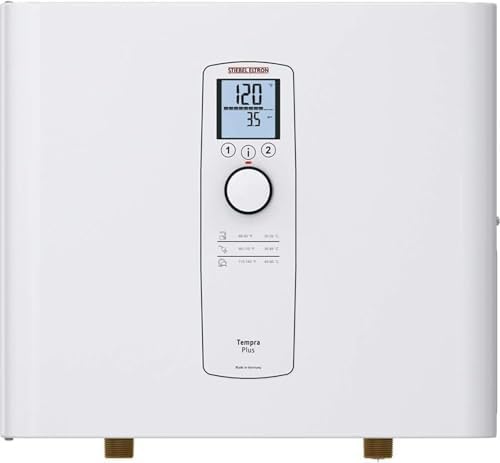
- Exclusive Advanced Flow Control
- Provides continuous hot water on demand
- Saves energy with auto-modulation
5. EcoSmart ECO 27
Best for: Value-conscious buyers in moderate to warm climates.
The ECO 27 is one of the most popular electric models in the U.S. due to its aggressive pricing and “Lifetime Warranty” on the heating elements. It is compact and simple to operate, though it lacks the advanced flow regulation found in the Stiebel Eltron.
- Fuel: Electric (27 kW)
- Amps Required: 112.5A (Requires 3 x 40A double-pole breakers)
- Max Flow: ~6.5 GPM (in warm climates)
- Efficiency: 99.8%
- Warranty: Limited Lifetime (on electronics, exchanger, and element).
- Retail Price: ~$606
Pros: Most affordable whole-house option; very easy to fit in tight closets; simple DIY-friendly maintenance.
Cons: Significant drop in flow in cold climates; basic features compared to premium models.
Recommendation: Perfect for a 2-bath home in the Southern U.S. or as a secondary unit for a guest house.
Check Today’s Discount Heater (Before Price goes up):
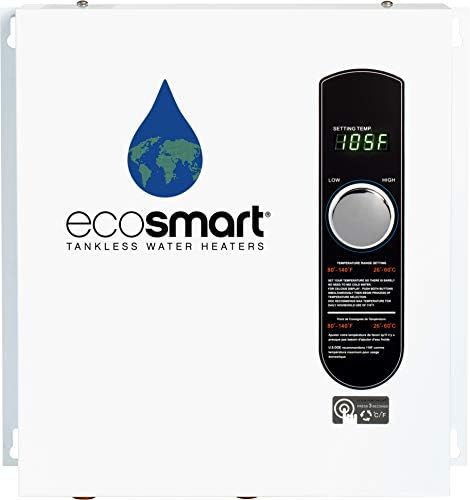
- Configured for climates where incoming water temperature can reach as low as 37 degrees.
- Capable of heating nearly 3 gpm.
- Digital temperature control allows temperature settings in 1 degree increments.
Tankless Water Heater Detailed Comparison Table
| Feature | Rinnai RX199iN | Navien NPE-240A2 | Rheem RTGH-95 | Stiebel Tempra 36 | EcoSmart ECO 27 |
| Fuel | Gas | Gas | Gas | Electric | Electric |
| Max GPM | 11.1 | 11.2 | 9.5 | 8.0 | 6.5 |
| Efficiency | 0.98 UEF | 0.95 UEF | 0.94 UEF | 99% | 99.8% |
| Venting | PVC/PP | PVC/PP | PVC/PP | None | None |
| Best Climate | Any | Any | Any | Moderate/Warm | Warm |
| Price | $1,250+ | $1,779 | $1,469+ | $849 | $606 |
READ MORE: How Big of a Tankless Water Heater Do I Need
Pros & Cons of Tankless Water Heater
General Benefits
- Energy Savings: Since they don’t heat water standby, you can save 20% to 30% on water heating costs.
- Space: They are about the size of a carry-on suitcase and mount to the wall.
- Longevity: Tankless units typically last 20+ years, compared to 10–12 for a tank.
General Drawbacks
- Upfront Cost: Higher unit price and significantly higher installation cost.
- Performance sensitive to inlet water temp and correct sizing.
- Require annual maintenance in hard-water areas to avoid scaling.
Tankless Water Heater Installation & Maintenance Checklist
What to expect on install day:
- Installer arrives with permit paperwork, inspects existing gas, venting, and electrical.
- If converting from tank, expect removal of old tank, routing of new venting and/or condensate lines, and gas/electrical hookups.
- Installer will run combustion and venting tests (gas) and ensure proper wiring and breaker sizing (electric). Expect 4–8 hours for straight installs; longer for upgrades.
Permit checklist & code items
- Local plumbing/mechanical permits typically required. Manufacturer installation instructions often needed for permit approval.
- Vent termination clearances and condensate disposal must meet code.
Water quality & maintenance
- Hard water requires more frequent descaling or a whole-house water softener to protect the heat exchanger.
- Annual or bi-annual flush with vinegar or citric acid is standard; in very hard water areas pro service may be required every 6 months.
Warranty pitfalls
- Many warranties require proof of annual maintenance and use of approved water-treatment. Check OEM terms and retain service receipts.
Recommended service plan
- Annual inspection + flush; every 3–5 years heat-exchanger check; keep a local licensed technician on file.
READ MORE: How to Flush a Tankless Water Heater (Step-by-Step Guide)
Tankless Water Heater Energy & Rebate Section:
Because tankless water heaters are highly efficient, they often qualify for significant financial incentives.
Federal Tax Credit (Section 25C)
Under the Energy Efficient Home Improvement Credit, homeowners can claim 30% of the project cost, including labor, up to $600 for qualifying high-efficiency gas tankless units installed through 2032.
Local Rebates
Many utility companies (like SoCalGas, ConEd, or Duke Energy) offer instant rebates ranging from $200 to $1,000. Always check the ENERGY STAR product finder before you buy to ensure your specific model is eligible for your local zip code’s incentives.
What is the best tankless water heater for a family of 4?
For most families of four, a condensing gas unit rated for ~7–9 GPM (depending on inlet temp) is ideal. Models like the Rinnai Rx199 or Navien NPE-240A provide high GPM and efficiency. If your home is electric-only, the Stiebel Tempra 36 or EcoSmart ECO-27 may work if your panel supports the electrical load.
How much does it cost to install a tankless water heater?
Typical installs range from $700–$3,500+ depending on complexity. Simple replacements on like-for-like systems sit at lower end; adding new venting, gas line upgrades, or electrical panel work pushes costs higher. Always get at least two licensed quotes and a written scope.
Tankless vs tank water heater — which is cheaper long term?
Tankless units often save energy via no standby loss and can last longer, but they cost more up front. Long-term savings depend on usage, energy rates, and model UEF. High-use households and areas with high energy costs often see better long-term savings with tankless.
How many GPM do I need for a 3-bath home?
For a 3-bath home with likely simultaneous use, target 8–11 GPM based on showers (2.0–2.5 GPM each) plus dishwasher/laundry overlap. Use your local inlet temp and model flow charts to pick the right unit.
Are electric tankless water heaters worth it?
Electric tankless units are worth it where gas isn’t available or when you prefer a ventless installation. They require heavy electrical service and can be costly to operate where electricity rates are high. For condos, townhomes, or smaller households, electric models can be a compact, low-maintenance choice.
Final Verdict
Check your home’s peak hot-water GPM needs, verify inlet groundwater temperature for accurate sizing, and confirm gas or electrical service capacity before buying. Always get at least two licensed installer quotes with permit details and a clear scope (venting, condensate, panel/gas upgrades). Verify current prices and manufacturer flow charts on OEM and major retailer pages at publish time prices above are illustrative as of March 3, 2026. Call a licensed contractor for a site visit before purchase.