If you live in a part of the country where winters are long and heating bills are even longer, you have probably looked into every possible way to keep your home warm without breaking the bank. You’ve seen the standard options: natural gas, propane, and heat pumps. But there is a different player in the game that is gaining ground in the U.S., especially in rural areas: the biomass boiler.
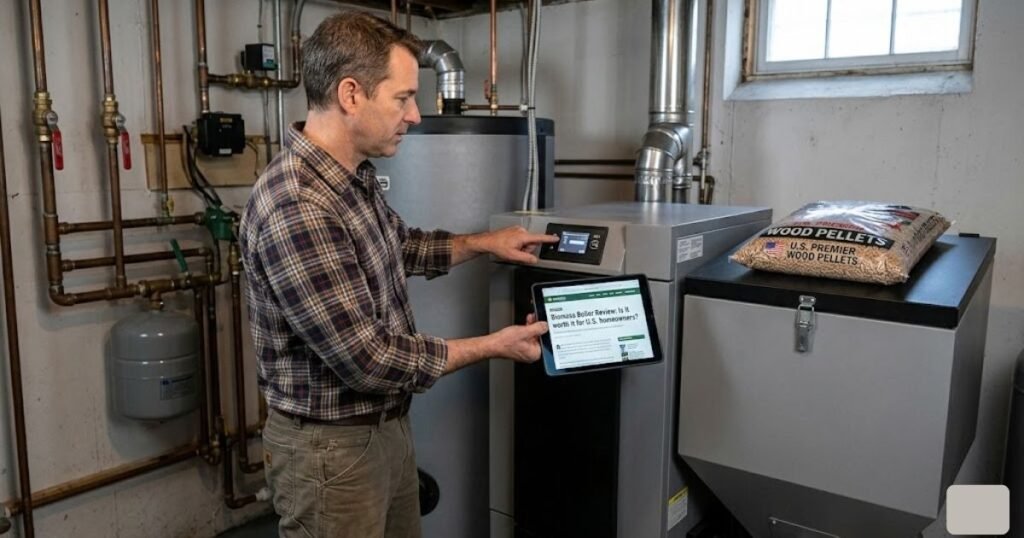
But what exactly is a biomass boiler? In the simplest terms, it is a central heating system that burns organic materials, usually wood pellets, wood chips, or logs to heat your home and your water. Instead of relying on a utility company for gas or electricity, you are essentially running a high-tech wood stove that connects to your radiators or baseboard heaters.
So, who is this for? It is best for homeowners who live “off the gas grid,” have plenty of storage space, and want a carbon-neutral way to stay warm. But is it actually worth the investment for the average American homeowner today? Let’s dive into the details. Lets deep dive into “Biomass Boiler Review: Is It Worth It for Homeowners?”
READ MORE: Weil‑McLain Boiler Reviews (2026) — Models, Costs, Pros & Cons
What Is a Biomass Boiler? A Deep Dive Review
When we talk about a biomass heating system, we aren’t talking about an old-fashioned fireplace. These are sophisticated machines. They are designed to sit in a basement, a utility room, or even an outdoor shed.
How They Work
At its core, a biomass boiler works much like a conventional gas boiler. The main difference is the fuel source.
- The Fuel Feed: For most modern residential systems, you use wood pellets. These are fed from a storage bin (a hopper) into the combustion chamber via an automated screw called an “auger.”
- Combustion: The boiler ignites the pellets. A fan controls the airflow to ensure the fire burns at the perfect temperature.
- Heat Exchange: The heat from the fire passes through a heat exchanger. This is where the magic happens—the heat is transferred to the water in your central heating system.
- Distribution: That hot water is pumped through your home to your radiators, underfloor heating, or a hot water tank.
Practicality for U.S. Homes
In the United States, biomass boilers are most practical in the Northeast, the Midwest, and the Pacific Northwest. Why? Because these regions have easy access to wood pellets and logs. If you live in a suburban neighborhood in Florida, a biomass boiler makes almost no sense. But if you are in a 3,000-square-foot farmhouse in Maine or Vermont, it could be a life-changer.
One of the biggest hurdles for U.S. homeowners is the infrastructure. Most American homes are built for forced-air heating (ductwork). Biomass boilers are hydronic (they use water). If your home already has radiators or baseboards, a biomass boiler is a natural fit. If you have ducts, you would need a “biomass furnace” instead, which is a similar concept but blows hot air.
READ MORE: Viessmann Boiler Review 2026 | Efficiency, Models, Pros & Cons
Biomass Boiler Pros and Cons
Before you drop thousands of dollars on a new system, you need the honest truth. No heating system is perfect, and biomass comes with a unique set of trade-offs.
The Pros
- Lower Running Costs: If you are switching from propane, oil, or electric baseboard heat, you will likely save a lot of money. Wood pellets are historically more stable in price than fossil fuels.
- Carbon Neutrality: Trees absorb carbon as they grow and release it when they burn. As long as the wood is sourced sustainably, you aren’t adding “new” carbon to the atmosphere.
- High Efficiency: Modern biomass boilers often achieve over 90% efficiency. This is far better than an old wood stove.
- Energy Independence: You aren’t at the mercy of the local gas company or global oil markets. You can buy fuel from local suppliers.
- Comfort: Biomass systems provide a very consistent, “deep” heat that many people prefer over the “lukewarm” feel of some air-source heat pumps.
The Cons
- High Upfront Cost: These systems are expensive to buy and install. We’re talking significantly more than a standard gas furnace.
- Space Requirements: You need room for the boiler itself and a large, dry place to store your fuel (pellets or wood).
- Maintenance: You can’t just “set it and forget it.” You have to empty ash bins and perform regular cleanings.
- Fuel Deliveries: You have to manage your fuel supply. If you run out of pellets and the delivery truck can’t get through the snow, you’re in trouble.
Pricing: What Does a Biomass Boiler Cost?
Let’s talk numbers. This is usually the part where homeowners take a deep breath. A biomass boiler cost is much higher than a traditional system, but the long-term savings are the goal.
Equipment and Installation Costs (2026 Estimates)
| Model Tier | Estimated Equipment Cost | Total Installed Cost |
| Entry-Level (Manual Log/Basic Pellet) | $8,000 – $12,000 | $12,000 – $18,000 |
| Mid-Range (Semi-Automatic Pellet) | $13,000 – $18,000 | $18,000 – $25,000 |
| High-End (Fully Automated/Condensing) | $20,000 – $30,000 | $28,000 – $45,000 |
Note: Prices vary by region and the complexity of your home’s plumbing.
Fuel Costs
- Wood Pellets: In 2026, pellets typically cost between $350 and $450 per ton when bought in bulk. An average home might use 3 to 6 tons per winter.
- Logs: If you have your own land and “free” wood, your fuel cost is essentially zero just your time and labor.
Tax Credits and Incentives
Fortunately, the U.S. federal government offers help. Under the Section 25C tax credit, homeowners can often claim 30% of the cost of a biomass boiler, capped at $2,000 per year. Some states (like New York and Vermont) offer additional rebates that can take thousands more off the price.
READ MORE: Carrier Heat Pump Reviews (2026) — Models, Costs, Pros & Cons
Comparison: Biomass vs. The Competition
How does the best biomass boiler stack up against what your neighbors are using?
| Feature | Biomass Boiler | Natural Gas Boiler | Propane Boiler | Electric Boiler | Heat Pump (Air) |
| Fuel Type | Wood Pellets/Logs | Natural Gas | Propane | Electricity | Electricity |
| Upfront Cost | $15k – $30k+ | $4k – $10k | $3k – $9k | $2.5k – $6k | $10k – $20k |
| Operating Cost | Low | Low | High | Very High | Low to Medium |
| Maintenance | Monthly/Annual | Annual | Annual | Minimal | Minimal |
| Best For | Rural / High-Heat Needs | Urban / Grid-Access | Rural Homes | Tiny Homes | Moderate Climates |
| Main Drawback | Manual Upkeep | Not always available | Price Volatility | Monthly Bill | Struggles in Deep Cold |
Biomass Boiler Buying Guide: Is It Right for You?
Choosing a biomass heating system is a big commitment. Use this checklist to see if your home is ready.
1. Home Size and Heating Needs
Biomass boilers love to work. They are most efficient when they are heating a larger space or a home with high hot water demand. If you have a small 800-square-foot cottage, a simple pellet stove might be better than a full boiler.
2. Fuel Storage Space
This is the dealbreaker for many. You need a dry space to store at least 2 to 3 tons of pellets. This usually means a dedicated “silo” or a section of your garage. If pellets get wet, they turn into sawdust and ruin your boiler.
3. Local Fuel Availability
Check your local area. Are there pellet mills nearby? Can you get bulk delivery (where a truck blows pellets into your silo)? If you have to haul 40-pound bags from a big-box store every week, you will grow tired of the system very quickly.
4. Installation Complexity
Does your home have radiators? If so, the switch is easier. If you have a furnace and ducts, you’ll need a biomass furnace or a “water-to-air” heat exchanger added to your ductwork. This adds cost.
5. Maintenance Appetite
Are you okay with spending 10 minutes a week cleaning out ash? Are you okay with a professional visit once a year? If you want a “hands-off” experience, you need to spend more on a fully automated model that cleans itself.
READ MORE: Lennox Heat Pump Review: 2026 Prices, Pros, Cons & Comparison
Biomass Boiler Performance and Efficiency
When you read a biomass boiler review, you’ll see a lot of talk about efficiency. But what does that mean in your living room?
- Heating Performance: Unlike some heat pumps that struggle when it’s -10°F outside, a biomass boiler doesn’t care. It burns wood to create fire. It provides a high-intensity heat that can keep a drafty old house toasty all winter long.
- Efficiency: Look for boilers with a thermal efficiency rating of at least 75% (often 85-90% in reality). This ensures you aren’t just sending heat up the chimney.
- Ash Removal: Even the best systems produce ash. On a mid-range system, you’ll empty an ash drawer every 2–4 weeks. High-end systems compress the ash so you only empty it twice a season.
- Noise Level: The boiler itself is relatively quiet. You’ll hear the occasional “hum” of the fans or the “clinking” of pellets moving through the auger. It’s usually quieter than an old oil furnace.
Biomass Boiler Installation and Maintenance:
You cannot install a biomass boiler yourself. It requires a specialized technician who understands both plumbing and solid-fuel combustion.
Venting and Chimney Needs
You can’t just stick a pipe out a window. You need a stainless-steel, double-walled chimney liner. This ensures the smoke (which is minimal in modern units) and gases exit the home safely.
Cleaning and Upkeep
The heat exchanger tubes inside the boiler can get coated in soot. This acts like insulation and it stops the heat from reaching your water. Many modern units have a lever you pull once a week to “shake” the soot off, or they do it automatically.
Common Mistakes to Avoid
- Buying the Wrong Size: If the boiler is too big, it will “cycle” (turn on and off) too much, which wastes fuel and wears out parts.
- Using Poor Quality Pellets: “Economy” pellets often have more bark and sand, which creates “clinkers”—hard chunks that can jam your burner. Stick to Premium Grade pellets.
- Ignoring the Ash: If the ash builds up, it chokes the fire. Don’t wait until the boiler shuts down to empty the bin.
READ MORE: Air to Water Heat Pump — Complete 2026 Buyer’s Guide (costs, brands, pros & cons)
Biomass Boiler Best Use Cases:
Consider a Biomass Boiler IF:
- You currently heat with propane or heating oil.
- You live in a rural area with no natural gas line.
- You have a large home (2,500+ sq. ft.) that is expensive to heat.
- You have a dry basement or outbuilding for fuel storage.
- You want to reduce your carbon footprint significantly.
Avoid a Biomass Boiler IF:
- You have access to cheap natural gas.
- You live in a warm climate where you only need heat a few weeks a year.
- You live in a tight suburban lot with no room for a fuel silo.
- You have physical limitations that make handling even small amounts of ash or fuel difficult.
- You are on a very tight upfront budget.
FAQ: Common Questions About Biomass Boilers
How does a biomass boiler work?
It works by burning organic materials like wood pellets in a controlled chamber. The heat generated is transferred to water through a heat exchanger, and that water is then pumped through your home’s heating system (radiators or underfloor pipes).
Is a biomass boiler worth it for a home?
It depends on your current fuel. If you are replacing an expensive system like propane or oil, the savings on your monthly bill can pay for the boiler in 7 to 12 years. If you have natural gas, it is rarely a financial “win,” but it may be worth it for environmental reasons.
How much does a biomass boiler cost?
For a standard U.S. home, expect to pay between $15,000 and $25,000 for a fully installed, semi-automated system. High-end, fully automated systems can exceed $30,000.
Are biomass boilers efficient?
Yes! Modern biomass boilers are incredibly efficient, typically ranging from 85% to 95% efficiency. They are much more effective at converting fuel to heat than a standard wood stove or an older furnace.
What is the downside of a biomass boiler?
The main downsides are the high initial cost, the need for dry fuel storage, and the manual maintenance required (like emptying ash bins). They are also physically larger than gas or electric boilers.
READ MORE: Fujitsu Heat Pump Reviews (2026): Models, Costs & Real-World Pros & Cons
Final Thoughts: Is It Worth It?
The biomass boiler for home use is a specialized solution. It isn’t a “one-size-fits-all” product. If you are a U.S. homeowner with a large property and a high heating bill, it is one of the most rewarding upgrades you can make. It offers a unique combination of extreme warmth, environmental responsibility, and long-term fuel savings.
However, if you are looking for a “set it and forget it” system and you don’t want to think about fuel deliveries or ash, you might be happier with a high-efficiency heat pump or a gas boiler. But for those who want to take control of their own energy and stay incredibly warm while doing it the biomass boiler is definitely worth a look.