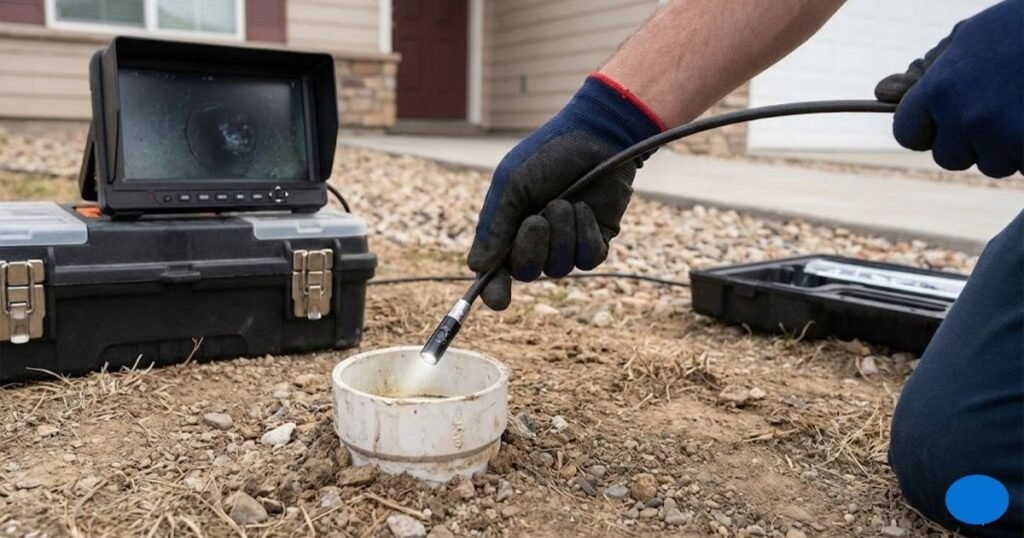
You notice the slow drain in the bathtub won’t clear and there’s a faint sewer smell in the yard. Those small, everyday clues can point to a much bigger problem hiding underground a collapsed joint, nasty root intrusion, or a build-up that’s slowly choking your sewer lateral. Instead of guessing or tearing up your lawn, plumbers use CCTV (sewer camera) inspections to see what’s actually inside the pipe before committing to a repair.
A good CCTV inspection pinpoints the problem, tells you its depth and exact position, and often saves thousands by preventing unnecessary digging. This guide walks you through what a CCTV (sewer camera) inspection is, when you need one, what to expect on the job, realistic U.S. price ranges, how to interpret the report, and how that information steers the right repair choice DIY or hire a pro. Lets deep dive into “CCTV Drain Inspection to Find Underground Sewer Blockage — Costs, Process & Fixes”
Try this CCTV Sewer Camera-
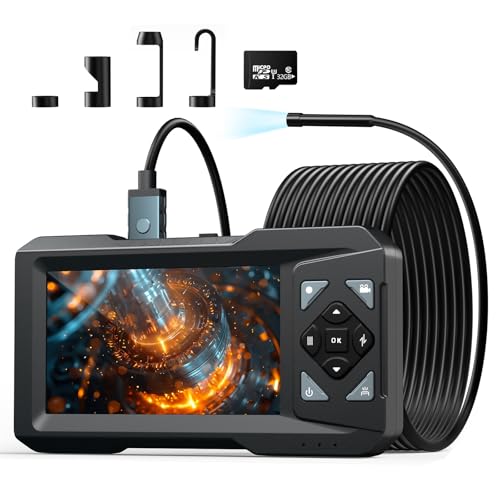
- 【Clear Visuals & LED Lights】 Capture sharp HD images/videos with the borescope camera with light and illuminate dark spa…
- 【Semi-Rigid Cable & Multi-Scene Versatility】Featuring a semi-rigid cable that retains its shape, the borescope easily na…
- 【Dual Compatibility: PC & Android Devices】Connect this endoscope seamlessly to Windows PCs (via USB) for data transfer/a…
What is a CCTV Sewer Camera Inspection?
A CCTV (Closed-Circuit Television) sewer inspection uses a waterproof video camera attached to a flexible cable or a motorized crawler to travel inside pipes and record high-definition footage. The operator watches a live monitor, records the run, and marks defects with time stamps and distance meters. There are two common types:
- Push-rod (push cam) — a compact camera on a semi-rigid rod pushed from a cleanout or fixture. Best for shorter house laterals and indoor runs.
- Crawler (tractor) — a motorized unit used in larger mains and long runs; it can carry pan-tilt cameras, lights, and sonde transmitters for precise locating.
Many professional reports also include a locator/sonde reading (a small radio beacon inside the camera) so the operator can mark the horizontal location and depth of the defect on the surface invaluable when planning trenchless repairs or excavation. Professional crews often code defects using standards (so defects are described consistently) and deliver a video file plus a written report with screenshots and distance markers. NASSCO, the industry body for pipeline assessment endorses CCTV as the primary tool for assessing pipeline condition and provides guidance on standardized inspection and reporting.
For homeowners that means: instead of a plumber guessing where to dig, you get a recorded video that shows whether the line has root intrusion, offset joints, fractures, scale buildup, or total collapse and where exactly it’s located.
Quick glossary:
- Cleanout — an access plug in the yard or basement used to reach the sewer.
- Sonde/locator — a tiny transmitter that lets the crew map the camera’s location aboveground.
- CIPP (cured-in-place pipe) — a trenchless lining method used after inspection if the pipe can be relined.
- Hydro-jetting — high-pressure water cleaning often used after a camera run to clear grease or roots.
Try this CCTV Sewer Camera-

- Extended Reach with 50ft Sewer Camera Cable: The semi-rigid 50-foot plumbing camera snake cable allows you to insert the…
- Innovative 1080P HD Triple Lens System: Transform your inspection tasks with our cutting-edge triple lens borescope came…
- Stunning Clarity in Every Detail: The 5-inch IPS screen delivers vibrant colors and sharp images, ensuring every detail …
READ MORE: Tree roots in sewer line — removal & repair cost
Common Signs of Underground Sewer Blockage
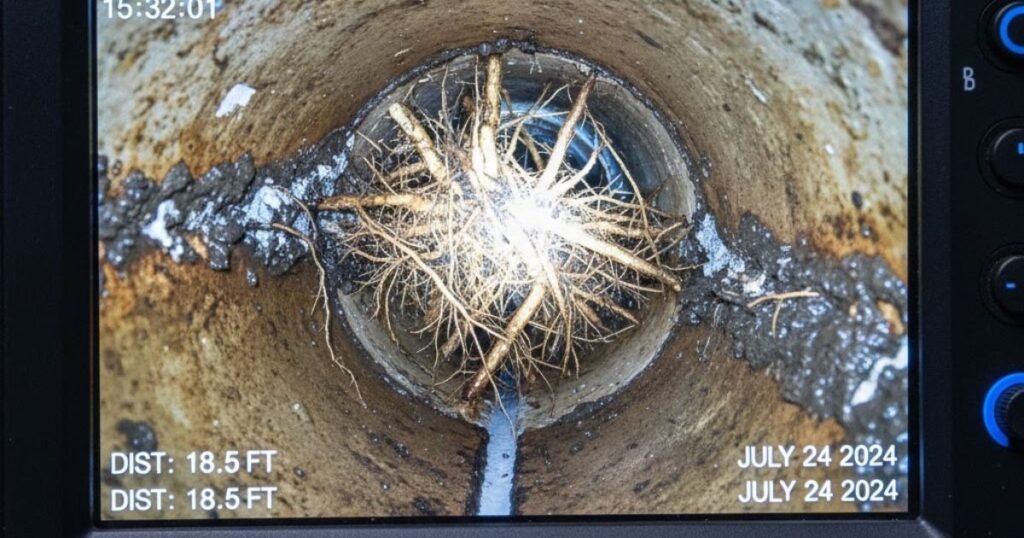
CCTV inspections are not for every clogged sink but when problems point to the main sewer lateral or when symptoms are persistent, a scope pays off fast. Watch for these signs:
- Multiple slow drains at once (toilet, tub, kitchen) — suggests a mainline issue rather than a single trap.
- Toilet backflow or sewage smell in yard — urgent; could be a partial collapse or severe root ball.
- Gurgling drains or bubbling in toilets when other fixtures are used indicates trapped air from a blocked line.
- Soggy or unusually green patches in the yard near where your lateral runs — possible leaking/soak-through of sewage.
- Old pipes, high-tree neighborhoods, or previous repairs — clay, cast iron and older materials are prone to root intrusion and cracks.
- Pre-purchase concerns — many home inspectors recommend a sewer scope for older properties or homes surrounded by mature trees.
| Symptom | Description | Urgency | Underlying Pathological Cause |
| Multi-Fixture Slow Drains | Sinks, tubs, and toilets all drain slowly. | High | Mainline blockage (Grease, Roots, or Scale) |
| Gurgling Sounds | Bubbling from toilets when other fixtures run. | Medium | Trapped air from partial obstruction |
| Persistent Sewer Odor | Smell of rotten eggs inside or outside the home. | High | Pipe crack, failed vent, or sewer gas leak |
| Localized Lush Grass | One area of the lawn is greener/faster growing. | Medium | Underground leak providing “fertilizer” to roots |
| Soggy Yard Patches | Standing water or soft ground without rain. | Critical | Pipe collapse or major joint separation |
| Pest Infestations | Sudden increase in rodents or drain flies. | Medium | Structural breach allowing entry from sewer main |
Check this CCTV Sewer Camera & Get Discount here-
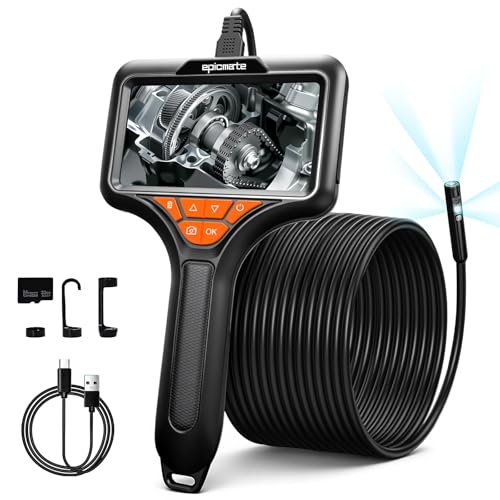
- Triple Lens Endoscope with 5″ Haandhelld Screen: Equipped with a 1080P HD triple-lens borescope, this borescope inspecti…
- 50FT Semi-Rigid Waterproof Cable: This industrial endoscope camera features a 50ft semi-rigid cable that bends to reach …
- Photo and Video Recording with 32GB Card: Unlike basic borescopes, this upgraded snake camera supports both photo captur…
READ MORE: The Modern Solution: Trenchless Sewer Line Replacement
Step-by-step Professional CCTV Inspection
The BSDI Standard: A New Era for Residential Inspections
Launched in February 2025, the NASSCO Building Sewer and Drain Inspection (BSDI) certification was created to address the historical lack of standardization in residential lateral inspections. Previously, homeowners often received inconsistent videos of varying quality. The BSDI standard provides a unified coding system that plumbers and drain cleaners use to identify conditions from the interior cleanout to the municipal main. This ensures that when an expert conducts a CCTV inspection, the resulting data is scientifically sound and can be used for asset management and repair planning.
The Step-by-Step Diagnostic Walkthrough
A professional sewer camera inspection generally follows a five-step protocol to ensure no defects are overlooked.
- Access Point Selection: The technician first identifies the optimal entry point. Modern homes typically have a “cleanout”—a vertical pipe with a threaded cap. If no cleanout exists, the technician may remove a toilet to use the drain as an access point, though this adds labor costs and time.
- Equipment Insertion and Navigation: The camera is carefully fed into the line. Professional technicians will often run water from a sink during the process. This “flow test” helps identify “bellies” or sags where water stagnates even after the flow stops.
- Real-Time Monitoring and Coding: As the camera travels, the technician views the live feed on a high-definition monitor. They look for specific “pathologies,” such as root intrusion, offset joints (where pipe sections have shifted), and “channeling” (erosion of the bottom of the pipe).
- Localization and Marking: When a defect is identified, the technician engages the sonde transmitter. Using a locator on the surface, they mark the exact spot and depth of the issue with paint or flags.
- Documentation and Reporting: The final deliverable is a digital recording of the inspection, often with a written report detailing the distance, depth, and severity of each finding. This report is essential for securing repair quotes or providing proof of condition to insurance providers.
The Real Cost of CCTV Sewer Diagnostics
Understanding the pricing of CCTV drain inspections requires an analysis of geographic labor markets, equipment depreciation, and the complexity of the specific infrastructure being surveyed. National averages typically fall between $100 and $1,000, with most homeowners paying in the $250 to $500 range for a standard residential run.
Check this CCTV Sewer Camera & Get Discount here-

- LARGE SCREEN ENDOSCOPE CAMERA WITH LIGHT: This borescope (inspection camera with light) features a 5-inch LCD with 170°–…
- DUAL-LENS BORESCOPE CAMERA WITH LIGHT: Switch between front/side views using the dual-lens endoscope camera, paired with…
- 16.4FT SNAKE CAMERA WITH LIGHT: The flexible camera probe with light includes adjustable LEDs and a 16.4ft IP67 waterpro…
Geographic Pricing Variations
Market analysis from 2025 and early 2026 shows that regional income levels and urban density are the primary drivers of price variance. In high-cost-of-living metropolitan areas like New York or Seattle, costs are frequently 20% to 30% higher than the national average.
| Metropolitan Market | Estimated Inspection Cost | Key Factors |
| New York City / New Jersey | $450 – $900 | High labor rates, complex older infrastructure |
| Seattle / Los Angeles | $430 – $1,600 | Strict environmental codes, deep sewer lines |
| Orlando / Southeast | $155 – $515 | Sandy soil (easier access), lower labor costs |
| Chicago / Midwest | $280 – $500 | Standard suburban pricing, varying pipe depths |
| Rural Areas | $100 – $300 | Lower overhead, though travel fees may apply |
Cost Drivers and Add-On Fees
The final invoice is rarely just a flat fee for the camera run. Several factors can increase the project cost:
- Access Point Difficulty: If a plumber must pull and reinstall a toilet to access the line, the cost increases by $150 to $250.
- Distance of the Run: Standard residential inspections cover 50-100 feet. Large properties with runs exceeding 100 feet may incur per-foot charges or require higher-end coiler systems.
- Reporting and Video: While some basic spot-checks include a live view only, a recorded HD video file with a written NASSCO-compliant report typically adds $50 to $150.
- Emergency Service: Same-day or weekend call-outs can carry a premium of 20% to 50% over standard rates.
DIY vs Professional: When to hire a pro
Consider DIY if: you have a very short run, good technical skills, the problem is clearly under a single fixture, and you’re renting a consumer sewer camera for a one-day check. Rental and consumer cameras can handle short lines and simple blockages; they’re the lowest cost option for a confident DIYer.
Hire a pro if any of the following apply:
- You suspect the problem is in the main lateral or under a paved area.
- You want precise depth/location data (for trenchless repair).
- Your home is older (cast iron/clay) or has history of repeated backups.
- You want a NASSCO-style coded report, recorded video, and warranty options.
- You’re buying/selling a home and need an authoritative inspection for closing.
Professionals bring the experience to interpret complex footage correctly and the equipment (locators, crawlers) needed for long runs. They also coordinate repair actions (hydro-jetting, lining) and can provide warranties on repair work something DIY simply can’t match. For many homeowners, the slight extra cost is worth avoiding misdiagnosis that leads to unnecessary digging or failed repairs.
Check this CCTV Sewer Camera & Get Discount here-
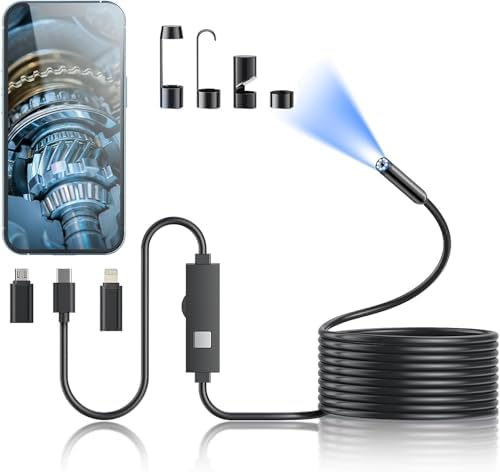
- 1920P HD Resolution: Sewer camera with 7.9mm probe can inspect hard-to-reach places effortlessly. The 2.0MP HD endoscope…
- Easy Connection: This borescope inspection camera can easily and quickly connect with IOS 9.0+ Android 7+ system devices…
- Semi-Rigid Cable & Waterproof Probe: Snake Camera can bend freely and remain semi-rigid. The 16.4ft semi-rigid cable unr…
READ MORE: Best drain snake for home use
Inspection Options Comparison Table
| Inspection option | Typical cost (USA) | Best for | What you get | Pros | Cons |
| Basic spot CCTV (short run) | $100–$300 | Single fixture blockage suspicion | Short camera run, live view | Fast, low cost | May not inspect full lateral |
| Full-line sewer camera | $250–$1,000+ | Whole-home sewer evaluation | Full run, locating, video file & report | Comprehensive, locates problem exactly | Higher cost if long run/complicated |
| CCTV + locator + grade map | $300–$1,200 | Planning excavation/trenchless repair | Precise depth/location data | Minimizes digging, speeds repair | Additional equipment/time |
| Camera with video + written report | $300–$900 | Home inspection / real estate | Recorded video, report, time stamps | Good for sellers/buyers | More costly than spot checks |
| DIY rental & camera | $100–$300/day rental | Very small runs, cost-sensitive DIYers | Equipment only, no expert interpretation | Lower upfront cost | Hard to interpret, risk of missed issues |
(See the “Real price snapshot” section for up-to-date national ranges and sources.
How a CCTV report helps you choose a repair method
Once the camera shows the problem, repair choices typically fall into these buckets:
- Hydro-jetting / mechanical root cutting — best when the main issue is roots, heavy grease, or deposit build-up but the pipe structure is intact. Costs vary but are usually cheaper than structural repairs.
- Spot repair (excavate small section) — if footage shows a localized break or collapsed joint, an excavation just over that section can be cost-effective.
- Cured-in-Place Pipe (CIPP) lining (trenchless lining) — when the pipe has multiple joints failing but the host pipe is mostly continuous, a liner creates a new pipe inside the old. Good middle ground between cost and disruption.
- Full replacement (open cut) — used for severe collapse, offset/broken runs, or extremely degraded materials. Most expensive and disruptive.
A good CCTV report will help you choose by showing: the type of defect (root intrusion vs crack vs collapse), its length and severity, and the exact location & depth (if locating was used). For example, footage that shows roots but structurally sound pipe usually leads to hydro-jetting followed by chemical root treatment and regular maintenance. Footage showing multiple collapsed joints or sagging suggests lining or replacement. The camera also lets contractors estimate repair lengths and plan whether trenchless methods are possible which could dramatically reduce landscaping and driveway damage.
High-level cost tiers (illustrative):
- Hydro-jet & root cutting: $300–$1,000+ depending on severity.
- Spot excavation & repair: $800–$4,000+ depending on line depth and surface restoration.
- CIPP lining (trenchless): $2,000–$8,000+ for typical residential laterals depending on length.
- Full replacement: $5,000–$20,000+ depending on length, depth, and surface restoration (driveway, landscaping).
The CCTV report reduces the “surprise” factor and often helps homeowners choose the least-invasive option that still fixes the root cause.
READ MORE: Why Does My Laundry Room Smell Like Sewage Gas?
The Future of Subsurface Surveillance: AI and Automated Defect Recognition
The industry is currently witnessing a paradigm shift toward Automated Defect Recognition (ADR). This technology utilizes artificial intelligence and machine learning algorithms to analyze CCTV video frames in real-time. ADR can automatically spot and classify defects such as cracks, corrosion, and root intrusion with higher consistency than human operators, who may suffer from fatigue during long inspection cycles.
Furthermore, 1080p Full HD is rapidly becoming the minimum standard for professional reports, with 4K UHD emerging in high-end systems. These advancements, combined with nitrogen-purged camera heads to prevent internal fogging and wireless cloud-based streaming for real-time collaboration with engineers, ensure that the “guesswork” of 20th-century plumbing is becoming a relic of the past.
How much does a CCTV drain inspection cost?
Typical U.S. costs range roughly from $100 for short spot inspections up to $1,000+ for full sewer-line diagnostics; many homeowners see $150–$450 for routine jobs. Complexity, access, depth locating, and recording/reporting add cost.
Can a sewer camera find tree roots or cracks underground?
Yes. CCTV cameras visually identify root intrusion, cracks, offsets, collapsed sections and grease/debris. When paired with a sonde/locator, the crew can also mark depth and horizontal position for accurate repairs.
How long does a sewer camera inspection take?
Most residential camera runs take 30–90 minutes depending on access and pipe length; full diagnostic jobs with locating and a written, coded report may take longer. If pre-cleaning is needed, add time and cost.
Will a camera inspection damage my pipes?
No — professional CCTV cameras are designed to be non-invasive and pose very little risk when used correctly. DIY mistakes (forcing equipment in fragile pipes) can cause problems; hire a pro for older or fragile systems.
Should I get a camera inspection before buying a house?
Yes — a pre-purchase sewer scope can reveal hidden issues that may cost thousands to fix later. It’s a smart contingency, especially for older homes or properties surrounded by mature trees. Many inspectors offer add-on sewer scopes for buyers.
Conclusion
A CCTV drain inspection gives you sight where guessing used to be the rule. It’s non-destructive, clarifies cost-effective repairs, and can save thousands in unnecessary digging. If you have multiple slow drains, a backup, or you’re buying a home, schedule a camera inspection with a licensed plumber (ask for recorded video, locator data, and a NASSCO-style report). Call a local licensed plumbing pro today.

