If your hot water runs out too fast, most homeowners are dealing with one of three things: sediment reducing tank capacity, a broken dip tube letting cold water mix in, or simply too-small capacity for household demand. Troubleshoot (age, noises, single-tap test) → try low-cost fixes (flush tank, repair elements/dip tube) → replace if unit is old, leaking, or repeatedly failing.

Why Does Hot Water Run Out Quickly: Quick Summary
- Common Culprits: Sediment buildup, a broken dip tube, or an undersized tank are the primary reasons hot water vanishes mid-shower.
- The Three-Step Action Plan: Perform a visual and acoustic diagnostic (Check age and noise) — Attempt low-cost maintenance (Flush the tank) Evaluate for replacement if the unit is over 10 years old.
- Economic Strategy: Minor repairs typically range from $150 to $500, while new high-efficiency installations in 2026 can range from $1,200 to $5,000+ depending on the technology.
| Feature | Sediment Buildup | Broken Dip Tube | Undersized Tank |
| Symptom Onset | Gradual decline | Sudden / Rapid | Constant / Usage-based |
| Diagnostic Clue | Rumbling/Popping sounds | Plastic bits in aerators | Insufficient for family size |
| Primary Fix | Tank Flush ($110–$200) | Tube Replacement ($150–$300) | Upgrade/Replace ($900–$2,500) |
READ MORE: Why Is My Water Heater Temperature Fluctuating? Causes & Fixes
Why Your Hot Water Runs Out Fast: Top Causes
Below are the usual suspects. Each subsection explains how that problem shortens usable hot water.
1. Sediment buildup
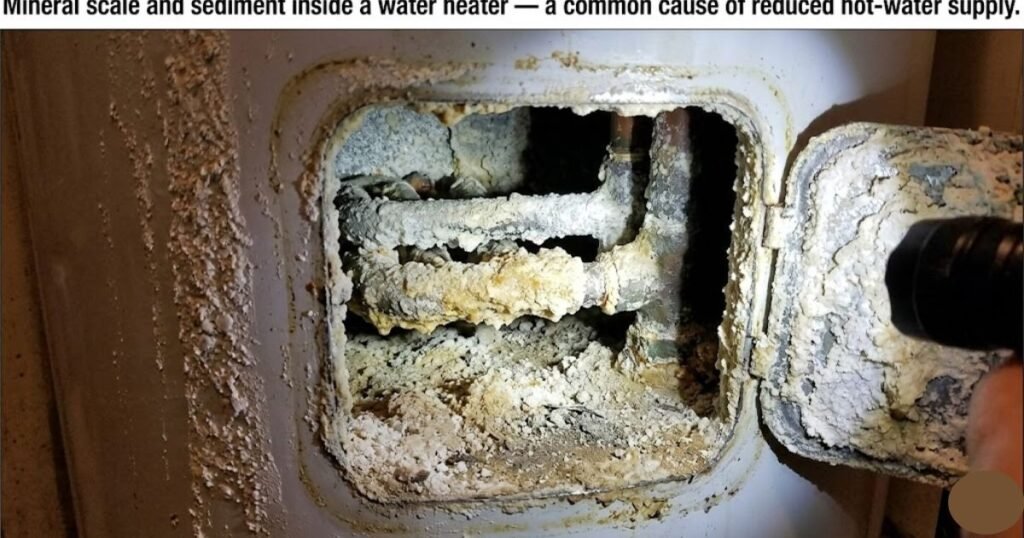
Mineral scale and sand settle on the tank bottom over time. That eats into usable capacity and insulates heating elements, so the heater has to run longer to reach temperature and you get less hot water at the tap.
2. Broken dip tube
The dip tube sends incoming cold water to the bottom of the tank so hot water at the top stays hot. If it cracks or breaks, cold water mixes with hot at the outlet and your supply gets chilly fast.
3. Undersized tank or household demand
If your household added a dishwasher, shower, or laundry routine changed, the original tank may simply be too small. Families with multiple simultaneous showers commonly outgrow small tanks.
4. Faulty thermostats or heating elements (electric) / weak pilot or gas valve (gas)
If an electric heater’s element or thermostat is failing, the tank can’t heat properly and you’ll run out sooner. On gas models, a weak pilot or malfunctioning gas valve reduces burner output.
5. Cross-connections (hot/cold plumbing miswiring)
Sometimes incorrect plumbing or a failed mixing valve lets cold water bleed into the hot line, reducing apparent hot capacity.
6. Partially failed thermostat, scale, or heating element inefficiency
Low-level failures (partial element burnout, heavy scale) can linger and slowly reduce hot water availability.
Expert note: “According to experienced plumbers, the most common first fix is a professional flush it restores capacity for many homeowners,” says a licensed plumber with 15+ years servicing U.S. homes. Industry data shows routine maintenance extends life and performance.
READ MORE: How to Clean Sediment from a Water Heater
Short Hot Showers: Quick DIY Checks
Before touching anything, cut power (electric) or shut gas to the unit and close the cold-water supply if you’re opening valves. If you’re not confident, call a pro.
- Verify the Unit’s Age: Most conventional tank-style heaters have a service life of 8 to 12 years. If the serial number indicates the unit is over a decade old, internal components like the dip tube or the tank liner itself may be nearing failure.
- Acoustic Diagnostic: Listen to the unit during a heating cycle. Popping or rumbling sounds, often compared to “kettle boiling,” indicate that water is being trapped under layers of sediment and turning to steam.
- The Single-Tap Test: Run a single hot water faucet at a moderate flow. If the water stays hot for a long period but runs out quickly when multiple fixtures are used, the tank is likely undersized for the demand.
- Visual Inspection for Corrosion: Check the base of the tank and the top connections for rust streaks or moisture. Rust-colored water at the tap suggests internal tank corrosion or a failing anode rod.
- Temperature Verification: Ensure the thermostat is set between 120°F and 130°F. Settings below this range may not provide enough thermal reserve for back-to-back usage.
Safety Warning: Always shut off the circuit breaker (for electric units) or the gas control valve (for gas units) before inspecting internal panels. Do not attempt to replace pressurized valves or electrical elements if you are unfamiliar with high-voltage or gas plumbing protocols.
READ MORE: Why My Tankless Water Heater Shuts Off During Shower — Fixes & Costs
How to Fix Hot Water Running Out: DIY Quick fixes
Maintenance is often the most cost-effective path to restoring hot water performance.
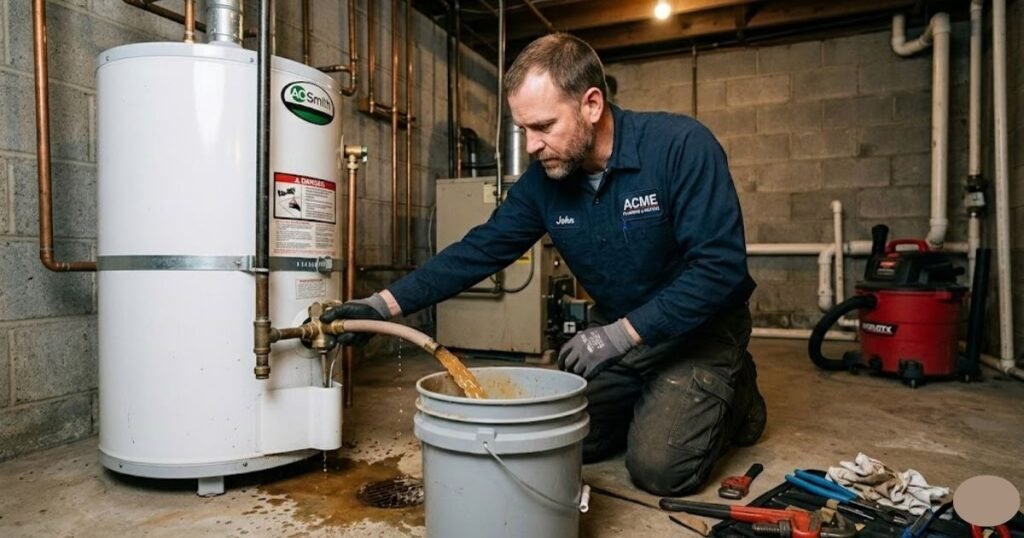
- Flush the Tank: To remove loose sediment, attach a garden hose to the drain valve at the bottom of the tank and run it to a floor drain or outside. Open the valve and allow the water to flow until it runs clear. This process typically takes 20 to 30 minutes and should be performed annually.
- Inspect and Replace the Dip Tube: If plastic fragments are found in faucets, the dip tube must be replaced. This involves disconnecting the cold water inlet and pulling the old tube out from the top.
- Reset the Electric High-Limit Switch: If an electric heater provides no hot water at all, the “red button” reset on the upper thermostat may have tripped due to an element surge or overheating. However, if it trips repeatedly, a professional diagnostic is required.
- Lowering Temperature vs. Increasing Tank Size: While increasing the thermostat temperature can slightly extend the available hot water by mixing in more cold at the tap, it increases the risk of scalding and accelerates mineral precipitation. A better long-term solution is adding a mixing valve, which allows the tank to be stored at 140°F while delivering a safe 120°F to the fixtures.
READ MORE: How Often to Flush a Water Heater
Flush Water Heater Cost
The financial implications of restoring hot water depend on whether the system requires a minor component fix or a full infrastructural upgrade. In 2026, labor rates for licensed plumbers typically range from $50 to $150 per hour.
Common Repair and Maintenance Costs
- Professional Tank Flush / Descaling: $110–$200. This service is essential for maintaining efficiency and is often required by manufacturers to keep warranties valid.
- Heating Element Replacement (Electric): $200–$300 (parts and labor typical). While the part is inexpensive, the tank must be partially drained to access the element.
- Thermostat Replacement (Electric): $150–$200. Professionals typically replace both the upper and lower thermostats simultaneously to ensure system harmony.
- Dip Tube Replacement: $150–$300. The cost depends heavily on the clearance above the unit and the condition of the existing plumbing connections.
Full System Replacement Costs
- Standard Tank-Style (Gas or Electric): $600–$2,500. Lower-end choices for small apartments may start near $600, while $1,200 to $2,500 is the typical installed average for a 50-gallon family unit.
- Tankless Water Heater: $1,400–$5,000+. Units themselves are more expensive, and installation often requires upgrading gas lines or electrical panels. National averages for a complete conversion are often near $2,600.
- Hybrid Heat Pump Water Heater: $1,200–$3,500. These are significantly more efficient than standard electric tanks and qualify for federal tax credits, but they require specific airflow and drainage conditions.
Cost Snapshot (Prices checked on March 1, 2026):
- Standard 50-Gallon Tank Install: $1,000–$2,200
- Tankless Conversion: $2,500–$5,000+
- Anode Rod Replacement: $200–$500
- Sources: National home-service cost guides and industry pricing data.
READ MORE: How to Test a Water Heater Element
Pros & Cons of Common Solutions
1. Flushing the tank
- Pros: Restores capacity, low cost, fast.
- Cons: May not fix mechanical failures or severe scale.
2. Replacing dip tube
- Pros: Restores hot-water distribution.
- Cons: Labor varies with access; won’t help if tank is failing.
3. Replacing heating elements/thermostat
- Pros: Inexpensive relative to full replacement, restores heat.
- Cons: If more parts fail, repairs become recurring.
4. Replacing with same-sized tank
- Pros: Lower upfront cost; familiar hardware.
- Cons: Stored-water standby loss; limited lifespan (~8–12 years).
5. Upgrading to tankless
- Pros: Continuous hot water, energy savings for many households, longer lifespan.
- Cons: Higher upfront cost; may need multiple units or upgrades; installation complexity.
6. Installing a heat-pump/hybrid unit
- Pros: Much higher efficiency in moderate climates.
- Cons: Higher price, needs space and proper climate conditions.
READ MORE: No Hot Water in the House? How to Troubleshoot, Fix, and Budget for Repairs
Comparison Table: 2026 Water Heater Solutions
| Solution | Typical Installed Cost (US) | Pros | Cons | Typical Lifespan | Energy Efficiency |
| Tank Flush (Pro) | $110–$200 | Low cost; restores capacity | No mechanical fix | N/A | Restores baseline |
| Small Parts Repair | $150–$500 | Avoids replacement | May be recurring | 2–5 years | No change |
| Replace Dip Tube | $150–$300 | Instant fix for cold mix | Labor intensive | Life of tank | No change |
| Standard New Tank | $600–$2,500 | Low upfront cost | Standby heat loss | 8–12 years | Baseline |
| Upgrade to Tankless | $1,400–$5,000+ | Endless hot water | High upfront cost | 15–20+ years | 25–35% higher |
| Heat Pump (Hybrid) | $1,200–$3,500 | Huge energy savings | Noise; space needs | 10–15 years | 2x–3x higher |
Prices checked on March 1, 2026. Sources: National home-service cost guides.
Maintenance Plan to Avoid Running Out of Hot Water
An ounce of prevention can prevent a cold morning shower. Industry experts suggest a 3-item annual maintenance protocol.
- Annual Flush: Drain the tank to remove mineral scale and sediment that steals volume.
- Anode Rod Check: Every 2 to 3 years, have the sacrificial anode rod inspected. This rod attracts corrosive minerals to itself, protecting the steel tank liner. If the rod is spent, the tank will begin to rust internally.
- TPR Valve Test: Twice a year, lift the lever on the Temperature and Pressure (TPR) Relief valve. It should release a burst of water and snap back into place. If it leaks or remains stuck, it must be replaced to prevent a dangerous pressure buildup.
Signs It’s Time to Replace
According to experienced plumbers, the “Repair vs. Replace” decision often comes down to the age of the unit and the location of the failure.
- Age: If the tank is over 10 years old, repairs are often just “band-aids” on a failing system.
- Leaking Tank: If water is pooling at the base of the tank due to a hole in the steel liner, repair is impossible. The unit must be replaced immediately to avoid home flooding.
- Rusty Water: Rust in the hot water line only indicates that the tank’s internal lining is disintegrating.
- Frequency of Repair: If you have spent more than $500 on repairs in the last 18 months, the 50% rule suggests that a new, efficient unit is the more economical path.
READ MORE: How to Test a Water Heater Thermostat
Decision Flow: Repair vs. Replace
- Repair if: Unit < 8 years old; minor part failure (element, thermostat, valve); total cost < 50% of new unit.
- Replace if: Unit > 10 years old; the tank is leaking; repair costs exceed 50% of a new unit; household demand has outgrown the tank.
When to call a pro
- You smell gas, see a leak, or find rust at the base — call immediately.
- The unit is older than 10 years or has had multiple recent repairs.
- You’re uncomfortable shutting off gas/electric or working on plumbing.
- You need a fuel type change (electric↔gas) or major venting/electrical upgrades.
Safety tips: Always shut off power at the breaker and follow gas-safety rules. Don’t try to relight pilots or modify gas lines let a licensed pro handle it.
Why does my hot water run out so fast?
Common causes are sediment, a broken dip tube, undersized tank or high household demand, and failing heating parts. Quick diagnostic: check unit age, do a single-tap test, and flush the tank if it hasn’t been maintained.
Can flushing my water heater fix short hot showers?
Often yes — flushing removes sediment and can restore usable capacity. If you still run out after a proper flush, check the dip tube or heating elements. Typical professional flush cost: $110–$200 (national average, prices checked on Mar 1, 2026).
How much does it cost to fix a water heater that runs out of hot water?
Small part repairs are usually $150–$500; a professional flush is $110–$200; full replacement ranges widely (see table above). For tankless upgrades expect $1,400–$5,000+ installed.
Is a tankless water heater the solution if hot water runs out too fast?
Tankless gives continuous hot water and can eliminate “running out” but has higher upfront costs and may require multiple units for large homes. Consider fuel availability, installation cost, and peak flow requirements before switching.
How long should my water heater last before replacement?
Typical tank models last about 8–12 years; tankless often last 15–20+ years with maintenance. Use age as a key factor in repair vs replace decisions.
Final Verdict
Running out of hot water is more than an inconvenience; it’s a signal that your home’s most hardworking appliance is struggling. Start by performing the safe quick checks mentioned above listen for noise, check the unit’s age, and try the single-tap test. If a simple tank flush doesn’t restore your hot water, it’s likely time for a professional diagnostic. Don’t wait for a small leak to turn into a major flood; if you’re unsure, call a licensed plumber and ask for a written estimate on the repairs or a modern, energy-efficient replacement.

