This comprehensive guide is designed specifically for U.S. homeowners, apartment renters, seniors, and families who are looking to navigate the complex market of supplemental heating with confidence and technical clarity. As residential electricity rates continue to fluctuate and central heating costs rise, the strategic implementation of a small electric heater can offer significant savings and personalized comfort, provided the user understands the critical balance between wattage, room volume, and safety certifications. By the conclusion of this analysis, readers will possess an expert-level understanding of thermal technologies ranging from ceramic and infrared to oil-filled and fan-forced systems allowing them to select the most efficient unit for their specific needs while adhering to the highest safety standards mandated by national testing laboratories.
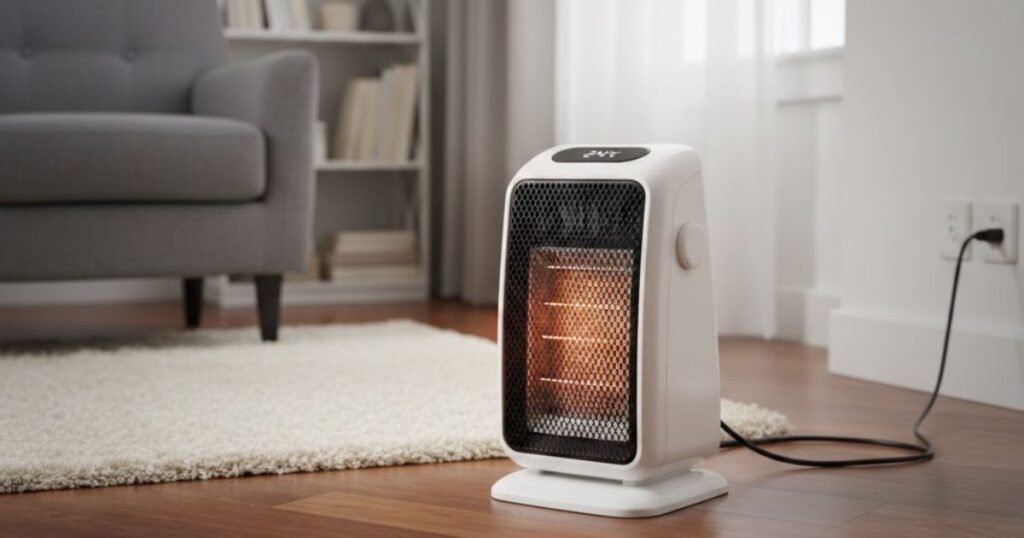
Small Electric Heater Quick take
For those seeking an immediate recommendation based on rigorous testing and current 2026 market data, the following three models represent the pinnacle of their respective categories in terms of performance, safety, and economic value.
- Best Overall Small Electric Heater: The Dr. Infrared Heater Portable (DR-968) stands as the most reliable choice for medium-to-large living spaces, utilizing a unique dual-heating system that combines the instant warmth of infrared quartz with the consistent air circulation of PTC ceramic elements to maintain a steady environment without drying out the air.
- Best for Small Rooms and Offices: The Dreo Solaris Slim H3 is the premier selection for compact areas like home offices or bedrooms, offering a sophisticated “ObliqueAirflow” system that delivers near-instant heat while operating at a whisper-quiet 37.5 decibels, ensuring minimal disruption during work or sleep.
- Best for Budget-Conscious Homeowners: The Lasko Oscillating Ceramic Heater provides a highly effective and affordable solution for renters or those needing a temporary warmth boost, featuring a reliable set of basic safety shut-offs and a wide-angle oscillation that distributes heat evenly across a 300-square-foot radius for a fraction of the cost of premium units.
How small electric heaters work — quick plain explanation
Most small electric heaters use one of these methods:
- Ceramic / PTC (positive temperature coefficient) heaters: Electricity heats ceramic elements; a fan pushes warm air into the room. Fast heat-up, compact, common in personal/desk heaters. (Good for bedrooms, offices.)
- Infrared (radiant) heaters: Emit infrared waves that warm objects and people directly rather than the air. Works quickly for a person sitting nearby; good for targeted spot heat.
- Oil-filled (radiator) heaters: Electricity warms an internal oil reservoir; the oil radiates heat for a long, even output. Slower to warm but very quiet and stable great for overnight bedroom use.
- Fan-forced (resistive) heaters: Resistive element gets hot and a fan distributes warm air. Often louder than PTC/ceramic but cheaper.
READ MORE: 40 Gallon Water Heater Buying Guide
Safety basics every U.S. homeowner must know
- UL / ETL certification: Always buy heaters listed by a nationally recognized lab (UL, ETL). Certified units meet basic electrical and fire-safety tests.
- Tip-over protection & overheat cut-out: Modern heaters should shut off if tipped or if internal temps exceed safe thresholds. This is essential for bedrooms and households with kids or pets.
- Bathrooms & GFCI: Only use heaters rated for damp locations in bathrooms, and plug them into a GFCI-protected outlet. Many compact ceramic heaters warn “not for humid environments.” Read the label.
- 120V circuit limits: A 1500 W heater draws ~12.5 A on a 120 V circuit. Don’t run multiple high-wattage appliances (space heater + microwave) on the same 15 A circuit; you’ll trip the breaker.
What to look for when buying Small Electric Heater
Key factors
- Size & coverage: Match heater size (W) to room square footage. Small desk or 100 sq ft bedroom = compact 600–1500 W heater; larger rooms need higher capacity or multiple units.
- Wattage: Most small heaters are 750–1500 W. 1500 W is the common max for 120V household circuits.
- Noise: Ceramic + fan models vary if you need quiet (bedroom), prefer oil-filled radiators or fan models advertised as “quiet.”
- Thermostat type: Mechanical thermostats are simple and cheap; digital thermostats + programmable timers give better control and can lower runtime.
- Timers & energy modes: Timers and ECO modes help avoid wasting electricity.
- Certifications: ETL/UL listing and ALCI or humidity-safe plugs for bathroom use.
- Safety features: tip-over switch, cool-touch housing, child lock.
- Warranty & brand reputation: Longer warranty and good customer support matter for long-term reliability.
Buyer’s Inspection Checklist
| Feature | Importance | What to Verify |
| Safety Certification | Mandatory | Look for the UL or ETL listed mark on the unit. |
| Wattage | High | Ensure it matches your room size (10W per sq. ft.). |
| Thermostat | High | Prefer digital over manual for precision and efficiency. |
| Tip-Over/Overheat | Mandatory | Confirm these auto-shutoff sensors are built-in. |
| Noise Level | Variable | Check for decibel ratings under 45dB for bedrooms. |
| Cord Length | Medium | Should be 6–8 feet to reach outlets without an extension cord. |
| Eco Mode | Medium | Look for units that cycle wattage to save on electricity. |
READ MORE: Best Under Sink Hot Water Heater 2026 — Mini-Tank & Tankless Buyer’s Guide & Prices
Small Electric Heater Comparison table
The following table provides a side-by-side comparison of the top-performing small electric heaters in the U.S. market as of early 2026, categorized by their primary heating technology and ideal use case.
| Brand & Model | Type | Best for | Heating power (W) & Room size guideline (sq ft) | Key features | Real price (checked Feb 15, 2026) | Warranty (years) | Pros | Cons |
| Dr. Infrared DR-968 | Hybrid (Infrared/PTC) | Bedroom / Living Room | 1500W / Up to 1,000 sq. ft. | Digital thermostat, 12h timer, remote, lifetime filter | Home Depot — $112.99 (checked Feb 15, 2026) | 3 | Exceptional reliability; does not dry out air | Heavy at 24 lbs; slow startup |
| Dreo Solaris Slim H3 | Ceramic (PTC) | Office / Small Room | 1500W / 200–300 sq. ft. | 70° oscillation, 12h timer, remote, ECO mode | Dreo Store — $74.99 (checked Feb 15, 2026) | 1 | Ultra-quiet (37.5 dB); rapid 2s heating | Limited coverage for very drafty rooms |
| Pelonis NY1507-14A | Oil-filled | Bedroom / Nursery | 1500W / 100–150 sq. ft. | 3 heat settings, 10h timer, remote, ECO mode | Home Depot — $89.99 (checked Feb 15, 2026) | 1 | Completely silent; long heat retention | Surface gets hot; slow to warm up |
| Lasko CD08200 | Ceramic (PTC) | Bathroom | 1500W / 225 sq. ft. | ALCI safety plug, 1h timer, simple controls | Walmart — $42.10 (checked Feb 15, 2026) | 3 | Safe for high-humidity areas; compact | Lacks a digital thermostat |
| Vornado Velocity 5 | Fan-forced | Garage / Whole Room | 1500W / 250 sq. ft. | Auto-climate, touch controls, timer, cool-touch | Vornado.com — $114.99 (checked Feb 15, 2026) | 5 | Excellent air throw; long warranty | Higher price; higher noise on max |
Small Electric Heater In-depth reviews
1. Dr. Infrared Heater Portable (DR-968)
The DR-968 has earned its reputation as the most reliable portable infrared zone heater on the market. It utilizes a sophisticated dual-heating system consisting of an infrared quartz tube and a PTC ceramic element, which allows it to generate up to 60% more heat than standard 1,500W heaters while maintaining a superior comfort level by not stripping moisture from the air.
- Features: It includes an accurate electronic thermostat (50°F–85°F), a 12-hour automatic shut-off timer, and an IR remote control.
- Best for: U.S. homeowners with large bedrooms or living areas who want a consistent, long-term heating solution that doesn’t require constant adjustment.
- Pros: The quiet ball-bearing blower operates at only 39 dB, and the wood cabinet stays entirely cool to the touch.
- Cons: At 24 pounds, it is significantly heavier than ceramic tower heaters and uses caster wheels for mobility rather than being easily carryable.
- Real Price: Home Depot — $112.99 (checked Feb 15, 2026).
- Warranty: 3-year limited component warranty.
- Verdict: A premium, durable investment for those who prioritize long-term thermal comfort and air quality over rapid, directional spot-heating.
2. Dreo Solaris Slim H3
The Dreo Solaris Slim H3 is a masterclass in modern, efficient design, offering a sleek gold or silver finish that fits perfectly into contemporary home offices. It is powered by a high-speed DC motor and “ObliqueAirflow” technology, which enables it to warm a 200-square-foot space within seconds.
- Features: 70-degree oscillation, five quiet modes (including ECO and Fan-only), and a programmable 41°F–95°F thermostat.
- Best for: Professionals working from home or apartment renters who need a quiet, space-saving unit for daytime use.
- Pros: Extremely lightweight (under 5 lbs) and incredibly quiet at 37.5–38 dB.
- Cons: The 1-year warranty is shorter than that of legacy brands like Lasko or Vornado.
- Real Price: Dreo Store — $74.99 (checked Feb 15, 2026).
- Warranty: 1-year hassle-free warranty.
- Verdict: The best performance-to-size ratio in the ceramic category, combining advanced smart features with a very competitive price point.
3. Pelonis Digital Oil-Filled Radiator (NY1507-14A)
For those who find the sound of a fan distracting, the Pelonis NY1507-14A offers the gold standard for silent, convection-based warmth. Unlike fan heaters that provide a “blast” of heat, this radiator warms the air slowly and consistently, creating a stable environment that lasts for hours.
- Features: Three heat settings (600W/900W/1500W), a digital LED display, and a 10-hour auto-timer.
- Best for: Seniors and families who need overnight heating in bedrooms or nurseries where silence and stability are paramount.
- Pros: Completely silent operation and excellent energy efficiency when used in ECO mode.
- Cons: The metal fins can become hot to the touch, and it lacks the rapid-heating capability of ceramic units.
- Real Price: Home Depot — $89.99 (checked Feb 15, 2026).
- Warranty: 1-year limited warranty.
- Verdict: A tried-and-true technology updated with digital controls, perfect for long-duration heating in well-insulated rooms.
4. Lasko Bathroom Space Heater (CD08200)
The Lasko CD08200 is a specialized tool designed to solve the common problem of icy bathrooms on winter mornings. It is specifically engineered to handle the higher humidity levels of a bathroom environment while providing the highest level of ground-fault protection.
- Features: ALCI safety plug, “Simple Heat” 1-hour timer button, and two heat settings.
- Best for: Homeowners looking to add warmth to a cold master bath without the expense of installing radiant floor heating.
- Pros: The most safety-compliant portable heater for bathroom use; very compact and easy to store.
- Cons: The controls are manual and lack the precision of a digital thermostat.
- Real Price: Walmart — $42.10 (checked Feb 15, 2026).
- Warranty: 3-year limited warranty.
- Verdict: An essential, affordable addition to any home’s winter arsenal, providing peace of mind and comfort in the most challenging room to heat.
5. Velocity 5 Whole Room Heater
Vornado has long been the leader in air circulation, and the Velocity 5 applies their “vortex” technology to supplemental heating, moving air faster and further than traditional designs. It doesn’t just heat a small cone in front of the unit; it creates a consistent temperature throughout the entire room.
- Features: Auto-climate control, touch-sensitive controls, 12-hour timer, and bedtime mode (which dims the lights).
- Best for: Families heating living rooms or garages with “cold pockets” where standard heaters fail to circulate air effectively.
- Pros: Backed by an industry-leading 5-year warranty; exterior stays remarkably cool.
- Cons: Can be louder than competitors on its highest fan setting; more expensive than basic ceramic towers.
- Real Price: Vornado.com — $114.99 (checked Feb 15, 2026).
- Warranty: 5-year manufacturer’s warranty.
- Verdict: The top choice for those who want whole-room performance and the security of a long-term manufacturer commitment.
READ MORE: Cheapest 50-Gallon Electric Water Heater — Quick Buyer’s Guide (2026)
How much do small electric heaters cost to run?
Estimating the operational cost of a small electric heater is a critical exercise in household budgeting, especially given that residential electricity rates in the U.S. are projected to average $0.1623 to $0.1805 per kWh in 2025 and 2026. To calculate the hourly cost, use the following formula:
Use this method: kW × hours used × $/kWh = cost
- Convert watts to kilowatts: 1500 W = 1.5 kW; 1200 W = 1.2 kW.
- Example electricity rate (U.S. residential average for many areas) = $0.16 / kWh (use your local bill for exact rate).
1) 1500 W heater running 4 hours:
1.5 kW × 4 hours = 6.0 kWh → 6.0 × $0.16 = $0.96 per day.
2) 1500 W heater running 8 hours (all evening):
1.5 × 8 = 12.0 kWh → 12 × $0.16 = $1.92 per day.
3) 1200 W heater running 6 hours:
1.2 × 6 = 7.2 kWh → 7.2 × $0.16 = $1.15 per day.
The cost of operation varies dramatically based on geographic location in the U.S., as shown in the table below.
| State / Region | 2026 Forecasted Rate (¢/kWh) | Cost for 8 Hours (1500W) |
| National Average | 18.05 | $2.17 |
| Louisiana (Lowest) | 12.44 | $1.49 |
| California (High) | 33.75 | $4.05 |
| Massachusetts (High) | 31.51 | $3.78 |
| Washington (Hydro) | 14.12 | $1.69 |
Homeowners can significantly mitigate these costs by utilizing “ECO modes,” which use internal thermistors to cycle the unit on and off once the target temperature is reached, effectively reducing the average wattage consumed over time.
READ MORE: Gas Water Heater Replacement Cost (2026) — What Homeowners Pay & Why
Best heaters by use case
Bedroom Use
The primary requirements for a bedroom heater are silent operation and the absence of light that could disrupt the circadian rhythm. Oil-filled radiators like the Pelonis NY1507-14A are the superior choice here, as they have no fan and emit zero light. For those who prefer a ceramic unit, the Dreo Solaris Slim H3 offers a “Night Mode” that dims all LED displays and operates at a very low 37.5 dB, making it barely audible over typical ambient house noise.
Bathroom Use
Bathrooms are uniquely hazardous due to the proximity of water and humidity. The Lasko CD08200 is specifically designed with an ALCI safety plug that protects against electrical faults in these conditions. No other type of space heater should be used in a bathroom unless it is hardwired into a GFCI-protected circuit and carries an appropriate UL rating for wet locations.
Office Use
Offices often require “directed” heat—meaning you want the warmth focused on you while you sit at a desk, rather than heating the whole room. Small ceramic desktop units or tower heaters with oscillation, like the Dreo Solaris series, are ideal because they provide instant, focused warmth.
Garage Use
Garages are typically drafty and poorly insulated. Infrared heaters, such as the Dr. Infrared DR-238 or the Heat Storm Phoenix, are the most effective here because they heat the person directly rather than attempting to warm the large volume of cold, uninsulated air. For larger shops, a 240V hardwired utility heater is often necessary.
Tiny Apartment Use
In small apartments or dorms, floor space is at a premium. Wall-mounted infrared or convection panels (like the Heat Storm Phoenix or DeLonghi Mica panels) are the best solution as they can be mounted securely to the wall, keeping the floor clear and providing safe, whole-room warmth.
Installation & placement tips
- Clearance: Keep at least 3 feet of clearance from walls, curtains, bedding and papers. Don’t place on unstable chairs.
- Outlets & cords: Plug heater directly into a wall outlet. Do not use cheap extension cords or power strips — if you must, use a heavy-duty cord rated for the heater’s amperage (look for 14 AWG or thicker and 15 A rating), but the safest choice is direct plug-in. (If a model’s manual explicitly forbids extension cords, follow the manual.)
- Outlets on same circuit: Avoid running a heater on the same circuit as other heavy loads (toaster, hair dryer). Heaters draw ~12.5 A at 1500 W.
- Floor placement: For oil radiators place on a flat surface; for fan heaters place where airflow is unobstructed.
- Never place heaters on carpets, beds, or furniture that can block vents or create fire hazards.
READ MORE: Best Heat Pump Hot Water System (2026) — Comprehensive Buyer’s Guide and Industry Analysis
Maintenance and lifespan
- Cleaning: Unplug first. Wipe surfaces with a damp cloth; use compressed air for fan inlets. Don’t vacuum inside sealed heaters.
- Storage: Store dry in a cool place; coil cord loosely. For oil radiators no draining required.
- When to replace: frequent tripping, odd smells after cool-down, persistent noise, or repeated safety shut-offs replace rather than repair for low-cost units. Typical lifespan for small electric heaters: 3–8 years depending on use and quality.
Troubleshooting common problems
Most common heater issues can be resolved with basic troubleshooting before seeking professional repair or replacement.
- No heat or unit won’t turn on: First, check if the circuit breaker has tripped. If the unit itself has a “reset” button or if the thermal fuse has been triggered by overheating, unplug the unit for 30 minutes to allow it to cool down completely before restarting.
- Tripping the circuit breaker: This usually occurs because the circuit is overloaded. If you are running a 1,500W heater on a 15-amp circuit, ensure no other large appliances are plugged into the same line. Move the heater to a different outlet on a separate circuit if the problem persists.
- Burning smell on first use: This is typically just dust or manufacturing oils burning off the heating element. It is normal for the first hour of use after storage; however, if the smell persists for several days or is accompanied by smoke, unplug the unit immediately.
- Noisy fan or rattling: This often indicates that dust has built up on the fan blades, causing them to become unbalanced. Cleaning the unit with compressed air or a vacuum often resolves this.
Final verdict & 5-point buying checklist
The ideal small electric heater for 2026 is one that matches your specific room size while providing the highest level of certified safety and energy efficiency. For most U.S. homeowners, a hybrid infrared/ceramic unit like the Dr. Infrared DR-968 provides the most reliable whole-room comfort, while a modern tower like the Dreo Solaris Slim H3 offers the best performance for small, quiet spaces.
Final 5-Point Actionable Checklist:
- Verify Room Size: Calculate 10W per square foot to ensure your heater has enough power.
- Check for UL/ETL Mark: Never purchase a heater that lacks a registered testing laboratory stamp.
- Confirm Safety Features: Ensure the unit has both tip-over and overheat auto-shutoff sensors.
- Evaluate Noise Tolerance: Opt for an oil-filled radiator for total silence or a DC-motor ceramic tower for quiet fan use.
- Plan Your Electrical Load: Ensure you have a dedicated outlet and will never need to use an extension cord.
5 Google search FAQs
What type of space heater is most energy-efficient for 2026?
While all electric heaters are highly efficient at converting power to heat, infrared heaters are the most efficient for “spot heating” people directly, whereas oil-filled radiators with digital thermostats are best for maintaining a steady, low-energy temperature in a room over several hours.
Are ceramic heaters safer than other types for homes with pets?
Yes, ceramic heaters are often considered safer because they reach a self-regulating temperature and usually feature “cool-touch” exteriors. Many also include tip-over sensors that cut power instantly if a pet knocks the unit over, which is a critical protection for active households.
How many watts do I need to heat a 12×12 bedroom?
A 12×12 room is 144 square feet. Following the 10W-per-square-foot rule, you would need a 1,440-watt heater. A standard 1,500W small electric heater is the perfect size for this room and will effectively maintain a comfortable temperature.
Do ceramic heaters work better than oil-filled radiators?
It depends on the goal. Ceramic heaters provide near-instant heat and are great for warming a room quickly. Oil-filled radiators take longer to heat up but provide more consistent warmth and are completely silent, making them better for overnight use in bedrooms.
Can a portable heater reduce my overall home heating costs?
Yes, but only if you use “zone heating.” By lowering your central thermostat to 62°F and only using a 1,500W heater in the room you are currently occupying, you can save significantly on your monthly energy bill.
Sources & Citations:
- Forbes — Best Space Heaters 2026 (Oct 2025)
- U.S. Energy Information Administration (EIA) — Electricity Rates 2025-2026
- Energy.gov — Small Space Heaters Safety and Sizing Guide (2025)
- Walmart/Home Depot — Product Specifications and Pricing (Checked Feb 15, 2026)
- Consumer Product Safety Commission (CPSC) — Residential Heating Safety Trends (2024-2025)
- Intertek/UL — Standards for Portable Electric Heaters (UL 1278)