Water damage is a quiet nightmare for any homeowner. A small drip under the sink or a cracked hose behind the washing machine can lead to thousands of dollars in repairs. Installing the top leak detector for your house gives you peace of mind and saves your hard-earned savings. Lets deep dive into “Top Leak Detectors for House: Best Water Leak Detectors 2026”
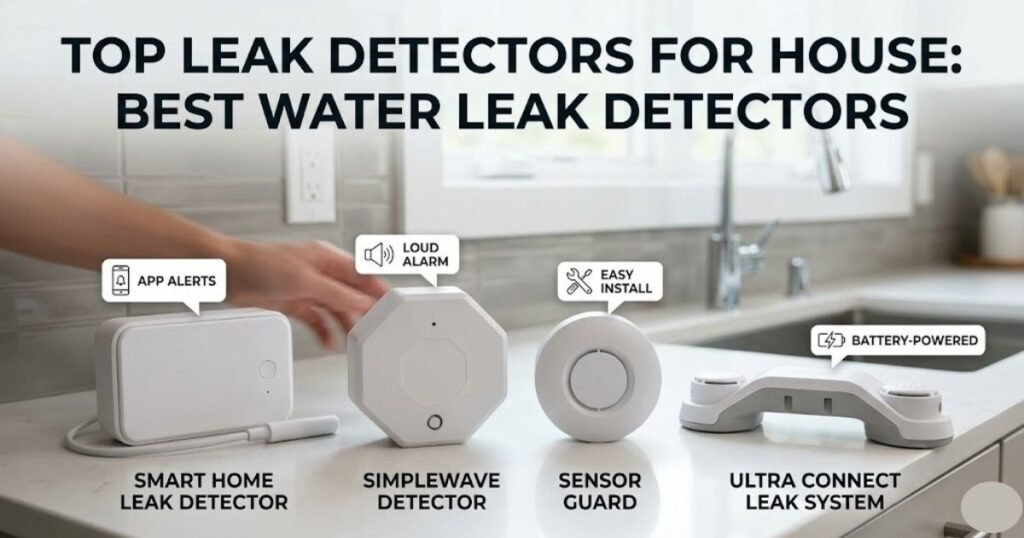
Quick Buyer Snapshot
Every home has different needs when it comes to plumbing protection. You might just want a loud noise to wake you up, or you might want a text message while you are on vacation. Finding the right fit depends on your tech comfort level and your budget.
- The Budget Conscious: Look for local “siren-only” alarms that don’t require Wi-Fi or monthly fees.
- The Tech Savvy: Opt for Wi-Fi-enabled sensors that send alerts directly to your smartphone via an app.
- The Whole-House Planner: Choose sensors that can integrate with a main water shut-off valve for total security.
READ MORE: Why is my water bill so high but no visible leaks (Cause, Fix & Costs)
Top Leak Detectors for House: Best Water Leak Detectors 2026
1. Govee Wi-Fi Water Sensor (Multi-packs)
The Govee Wi-Fi Water Sensor is a reliable and affordable way to monitor multiple rooms at once. These sensors are small enough to tuck under a dishwasher or behind a toilet. They connect to a central gateway that plugs into your wall outlet.
- Key Features:
- Wi-Fi connectivity with instant smartphone app alerts.
- Adjustable 100dB onboard alarm to alert people inside the house.
- Energy-efficient battery design for long-term placement.
- Pros:
- Very affordable when bought in multi-packs.
- Loud alarm can be heard through closed doors.
- Easy setup process through the Govee Home app.
- Cons:
- Requires the Govee gateway for any remote or phone alerts.
- Only works on 2.4GHz Wi-Fi bands, which can be tricky for some modern routers.
Installation difficulty: Easy.
Best for: Homeowners who want smart alerts on a budget. See Price & Product Below-

2. Zircon Leak Alert
The Zircon Leak Alert is a simple, battery-powered alarm that doesn’t need Wi-Fi or apps. Just set it down and forget it. If it touches water, it lets out a loud screech that will wake you up. Since it floats and doesn’t need the internet, it’s a rugged solution perfect for signal-dead zones like crawlspaces or garages.
- Key Features:
- Completely battery-powered with no wiring or internet needed.
- Loud, 85dB onboard alarm that sounds like a smoke detector.
- Unique floating design to keep the alarm audible during a flood.
- Pros:
- Extremely affordable for any budget.
- No complicated apps or accounts to set up.
- Works in dead zones where Wi-Fi cannot reach.
- Cons:
- No remote notifications; you must be home to hear it.
- Very basic feature set with no history or status logs.
Installation difficulty: Easy.
Best for: Garages, sump pits, closets, or as cheap backups. See Price & Product Below-

3. Moen Flo Smart Leak Detector
The Moen Flo is a premium, sleek sensor that fits into tight gaps using its 48-inch remote sensing disc. It delivers fast app alerts and detailed water data through the Moen network. Most importantly, it can trigger a Moen Flo shutoff valve to kill your main water line automatically the moment it gets wet. It’s the ultimate choice for proactive plumbing protection.
- Key Features:
- Integrates with the Moen Smart Water Network and app.
- Includes a 48-inch remote sensing disc for hard-to-reach areas.
- Available in single units or multi-packs for whole-home coverage.
- Pros:
- Built specifically for plumbing-heavy environments.
- Excellent app interface with clear instructions.
- Small footprint allows for placement in very tight spots.
- Cons:
- Needs the Moen app to access most of its helpful features.
- Single units are more expensive than basic alarm-only sensors.
Installation difficulty: Easy.
Best for: Homeowners who want smart sensors that can integrate into a larger water-management system. See Price & Product Below-

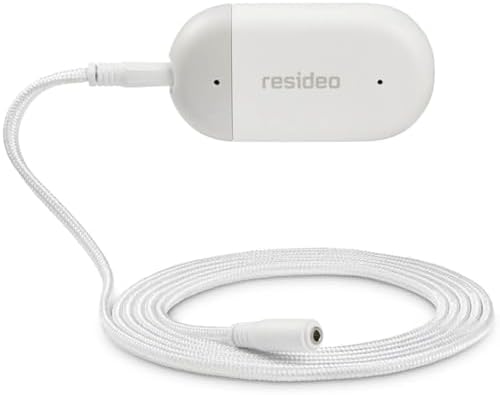
4. Resideo (Honeywell) Lyric Wi-Fi Water Leak & Freeze Detector
The Resideo Lyric is a heavy-duty sensor that monitors water, temperature, and humidity. It’s a lifesaver in cold climates since it alerts you before pipes freeze. With its long, water-sensitive cable and direct Wi-Fi connection, it provides professional-grade coverage without needing a separate hub.
- Key Features:
- Direct Wi-Fi alerts via text, email, or the Resideo app.
- Built-in temperature and humidity sensors to prevent frozen pipes.
- Optional 4-foot sensing cable for expanded floor coverage.
- Pros:
- Very robust feature set for complete environmental monitoring.
- Ideal for seasonal homes or cold-weather regions.
- Reliable brand name with a long history in home safety.
- Cons:
- Can have limited availability or be listed as discontinued in some stores.
- Price is higher than basic water-only sensors.
Installation difficulty: Moderate (due to cable placement).
Best for: Multi-room coverage and those wanting temperature/humidity plus water sensing. See Price & Product Below-
5. D-Link DCH-S161 Mydlink Wi-Fi Water Sensor
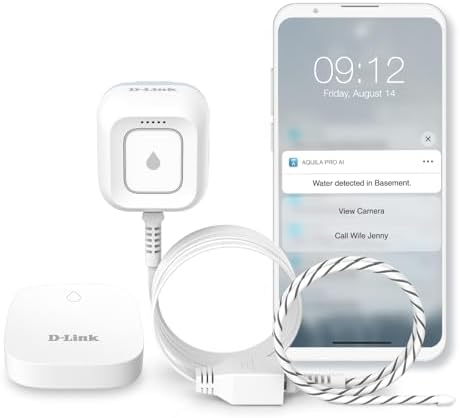
The D-Link DCH-S161 is built for the connected home, working seamlessly with Alexa and Google Assistant. It runs on standard AA batteries and features a long probe cable. This clever design lets you mount the main unit high on the wall, keeping the electronics safe even if the floor floods.
- Key Features:
- Real-time Mydlink app alerts and 90dB built-in siren.
- Battery-powered with AA batteries for easy maintenance.
- Compatible with Google Assistant, Alexa, and IFTTT for smart automation.
- Pros:
- Great for people who want their smart home devices to talk to each other.
- Flexible placement thanks to the long probe cable.
- Trusted networking brand ensures a stable Wi-Fi connection.
- Cons:
- The list price can be quite high compared to similar sensors.
- The app experience can feel a bit technical for some users.
Installation difficulty: Easy.
Best for: Smart home owners who want integration with other smart devices. See Price & Product Below-
READ MORE: How to Find a Hidden Water Leak in Your Wall: Step by Step DIY Guide
Top Leak Detectors Comparison Table
| Product | Type | Typical Price (Mar 2026) | Key Feature | Best For |
| Govee Wi-Fi Water Sensor | Smart sensor (Wi-Fi/app) | ~$40–$90 | Loud alarm + app alerts | Budget smart alerts |
| Zircon Leak Alert | Local alarm (battery) | ~$17–$25 | Simple, no Wi-Fi needed | Cheap backups / closets |
| Moen Flo Smart Leak Detector | Smart sensor (app; Flo ecosystem) | ≈$54.87 (single) | Remote sensing disc; app | Plumbing-centric smart setup |
| Resideo (Lyric) Wi-Fi Leak Detector | Smart sensor (Wi-Fi) | ≈$75–$85 | Temp + humidity + cable | Freeze + multi-room sensing |
| D-Link DCH-S161 | Smart sensor (Wi-Fi) | ~$60–$100 | Mydlink + Alexa/Google | Smart-home integrators |
Buyer’s Guide: What to Look for in a Leak Detector
Choosing the right sensor is about more than just the price. You need to think about where you live and how you use your home. Here are the most important things to consider before you buy.
Sensor Type: Spot vs. Cable
A spot sensor is a small puck. It only detects water that touches its base. These are great for under a sink. A cable sensor uses a long wire that detects water anywhere along its length. These are better for wrapping around a basement perimeter or a water heater.
Smart vs. Local Alarms
A local alarm just makes noise. If you are at work, you won’t hear it. A smart sensor sends a message to your phone. If you travel often, a smart sensor is a much safer bet. If you just want to know if the washing machine is overflowing while you are in the living room, a local alarm is fine.
Battery Life and Power
Most sensors use batteries. Look for models that claim at least one year of life. Some smart sensors will tell you in the app when the battery is low. This is a huge help. You don’t want a dead sensor when a pipe finally bursts.
App and Notifications
Check the app reviews before you buy. You want an app that is fast and reliable. Some apps allow you to add “emergency contacts.” This means if you don’t answer the alert, it will text your spouse or a neighbor.
Smart Home Integration
Do you use Alexa or Google Home? If so, look for a sensor that integrates with them. You can create “routines” where your smart speakers announce, “Water detected in the kitchen!” This is much more helpful than a random beep.
READ MORE: Signs Your Pipes Need Replacing — When to Repair vs. Replace, Costs, and What Homeowners Should Know
Leak Detectors Installation Tips
Installing a basic sensor is usually a five-minute job. Installing a whole-home monitor takes a bit more effort. Follow these steps to get it right.
Basic Sensor Installation
- Step 1: Open the battery compartment and pull the plastic tab to activate the battery.
- Step 2: Download the manufacturer’s app and pair the device to your Wi-Fi.
- Step 3: Clean the floor where the sensor will sit. Dust and dirt can interfere with the probes.
- Step 4: Place the sensor on the lowest point of the floor near the appliance.
- Step 5: Pour a tiny drop of water on the floor to touch the probes and ensure it triggers.
Whole-Home Monitor Placement
- Step 1: Identify the main water line entering your home.
- Step 2: Ensure there is a power outlet nearby if the unit requires a plug.
- Step 3: If you are using a smart shutoff valve, you may need a plumber to cut into the pipe.
- Step 4: Place individual sensors near every “high-risk” appliance (dishwasher, fridge, laundry).
- Step 5: Link all sensors to the main hub in the app.
READ MORE: How to Repair a Burst Water Pipe
Leak Detectors Maintenance & Testing Checklist
A leak detector is only good if it works when you need it. You should treat it like a smoke detector. Perform these checks regularly.
- Test Batteries Monthly: Open your app to check battery levels. If it is a local alarm, press the “test” button.
- The Wet Towel Test: Once a month, touch a damp paper towel to the sensor probes. Ensure the alarm sounds and the app sends a notification.
- Keep it Dry: After testing, dry the metal probes completely. If they stay damp, the alarm will keep going or the probes might corrode.
- Update Software: If you have a smart sensor, keep the app and the device firmware updated to the latest version.
- Check Placement: Make sure the sensor hasn’t been kicked or moved by a pet. It needs to be flat on the floor.
Pros & Cons: Simple Sensors vs. Whole-Home Monitors
Simple/Wireless Sensors
- Pros: Very cheap to buy; no professional installation needed; can be moved easily.
- Cons: They cannot stop a leak; they only tell you it is happening; they rely on batteries.
Whole-Home Monitors
- Pros: Can automatically shut off the water; provides deep data on water usage; protects the entire house.
- Cons: Expensive up-front cost; usually requires a plumber for installation; requires a constant Wi-Fi connection.
Comparison considerations — where sensors help most
Short bullets with everyday examples.
- Kitchen: under-sink leaks and dishwasher overflows. Put a sensor under the sink and one at the dishwasher toe-kick.
- Laundry: place one under the washing machine or on the floor at the drain pan.
- Water heater: sensor next to the heater near the drain valve. Even a slow weep can cause big damage.
- Basement: low point and sump pump pit. Cables work well here.
- Crawlspace: use cable sensors since leaks spread along the floor.
READ MORE: Best drain snake for home use — buyer’s guide for U.S. homeowners
Frequently Asked Questions
Are water leak detectors worth it for a house?
Yes, they are absolutely worth the small investment. A basic water leak detector costs less than $20, but it can prevent a $10,000 insurance claim. A common example is a washing machine hose that cracks while you are asleep. A sensor will alert you immediately, allowing you to turn off the water before it ruins your drywall and flooring. Peace of mind alone makes them a home essential.
Where should I place water leak detectors in my home?
You should place a water leak detector in the six most common “splash zones.” Put one under the kitchen sink and one behind the dishwasher. Place another near the base of the water heater and one under the washing machine. If you have a basement, place one near the sump pump and another at the lowest point of the floor where water naturally pools.
Do smart leak detectors need Wi-Fi?
Most smart water leak detector models require Wi-Fi to send notifications to your smartphone. Without Wi-Fi, they may only sound a local alarm that you have to be home to hear. Keep in mind that most of these devices only work on 2.4GHz Wi-Fi networks. If your router is only set to 5GHz, you may have trouble connecting your smart sensors during the initial setup process.
Can leak detectors shut off the water?
Simple sensors cannot shut off the water; they only sound an alarm or send a text. However, whole-home systems like the Moen Flo or Phyn can be paired with an automatic shut-off valve. These systems are great because they stop the flood even if you aren’t home. The downside is they are more expensive and usually require a professional plumber to install the valve on your main line.
How many leak detectors do I need for a house?
At a minimum, most homes need 3 to 4 detectors to cover the high-risk areas: the water heater, the laundry room, the basement, and the kitchen. If you have a large home with multiple bathrooms or a refrigerator with an ice maker, you may want 6 to 8 sensors. It is best to allocate your sensors according to the risk level and the value of the flooring in that area.
Conclusion
Protecting your home doesn’t have to be complicated or expensive. Whether you choose a high-tech Moen system or a simple Zircon alarm, you are taking a huge step toward avoiding a disaster. Water damage is sneaky, but with the right sensors, you can catch it before it catches you.

