Circuit breaker issues are common and often fixable, but they can signal dangerous conditions. This guide explains what breakers do, common warning signs, safe (non-actionable) troubleshooting you can do, what repairs and replacements typically involve, expected costs and permits, and when to call a licensed electrician. Use this to make informed decisions not to perform live electrical work.
Circuit breaker problems are one of the most common electrical issues homeowners face. Sometimes the fix is a simple replacement of one part; other times a breaker problem points to an outdated panel or wiring that needs a professional repair or upgrade. Safety is the top priority: this guide explains signs, safe checks you can make, rough costs and timelines, permit basics, and how to hire a licensed electrician for hands-on work. Use this to plan and act safely not to do live electrical repairs yourself.
What a Circuit Breaker Is?
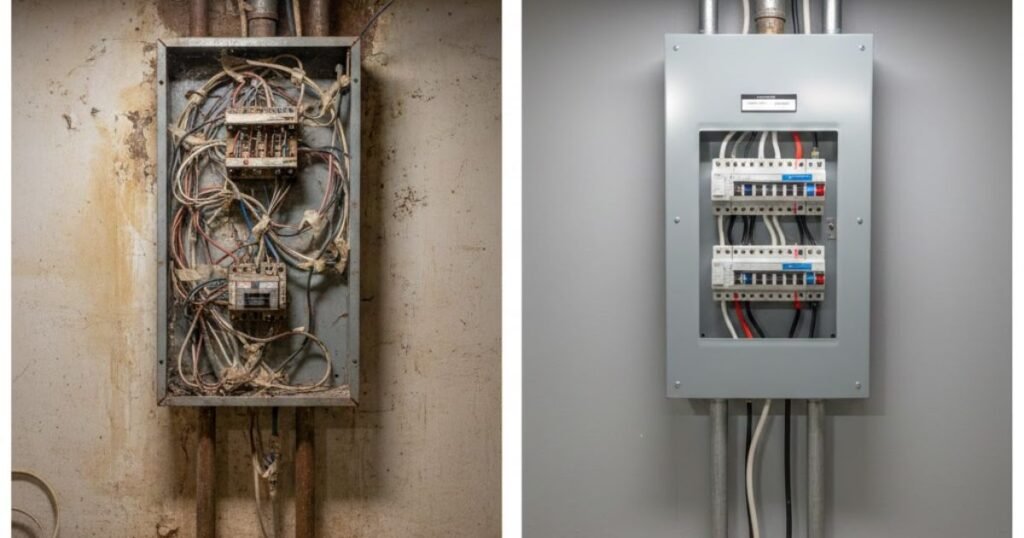
A circuit breaker is the safety device in your home’s electrical service panel that automatically stops the flow of electricity when a circuit is overloaded or a fault occurs. Think of it as a reusable version of a fuse: instead of melting and being thrown away, a breaker is designed to open (trip) when it detects abnormal current and then be reset or replaced. Breakers protect wiring and appliances by interrupting current flow before it can cause overheating or fire.
Panels contain many individual branch-circuit breakers plus a main breaker that controls the whole panel. Modern panels also may contain specialized protective devices for example, GFCI (ground-fault circuit interrupter) protection for wet areas and AFCI (arc-fault circuit interrupter) protection to prevent fires caused by arcing faults.
Breakers are rated by amperage (e.g., 15 A, 20 A, 50 A) and are matched to the wiring and the loads they protect. When a breaker ages, becomes damaged, or is the wrong type for an application, it can fail to protect the circuit properly which is why signs of trouble should be treated seriously.
Types of breakers
- Thermal-magnetic (standard): Most common residential breakers; respond to overloads and short circuits.
- GFCI (ground-fault circuit interrupter): Protects against electrical shock in damp locations (kitchens, baths).
- AFCI (arc-fault circuit interrupter): Detects dangerous arc patterns that can start fires (now required in many living spaces by code). (NEC/AFCI guidance).
- Main breaker: The big shutoff inside the panel that controls the entire service.
Common Signs a Breaker Needs Repair or Replacement
Breakers don’t always fail suddenly often there are clear warning signs that something is wrong. Watch for these non-technical red flags (this list describes signs, not troubleshooting steps):
- Frequent tripping: A breaker that trips repeatedly for the same load can indicate a failing breaker, an overloaded circuit, or wiring trouble.
- Burning or “fishy” smell: Any burning, acrid, or “fishy” odor near the panel, outlets, or switches is an urgent sign of overheating insulation or arcing. Treat it as an emergency.
- Buzzing, humming, or crackling sounds: Unusual noises from the breaker panel often mean loose connections or internal component failure both fire risks.
- Visible damage or discoloration: Scorch marks, melted plastic, or rust inside the panel or on receptacles indicate heat damage or moisture intrusion.
- Hot panel or outlets: A panel or outlet that feels warm to the touch is not normal and should be evaluated.
- Loss of power to a circuit or a partial outage: If one area of the home loses power while others remain on, the responsible breaker or connection may be failing.
- Age of the panel or obsolete equipment: Panels and breakers wear out. Many breakers last decades, but panels from certain manufacturers (e.g., known problem panels) or very old equipment are candidates for replacement. (See “Repair vs Replacement” later.)
- Inability to reset or repeatedly trips immediately after reset: This suggests an unresolved fault or a defective breaker.
If you see any of these signs, do not attempt live repairs. These are warning signals actions that involve opening the panel, handling conductors, or working around live parts should be left to licensed professionals.
READ MORE: Electrician Near Me
Safe Troubleshooting (short, non-actionable)
Homeowners can do a few visual and non-invasive checks to gather information before calling a pro without opening the panel or touching live parts. These checks are about observation and safety; they are not repair instructions.
Safe, allowed checks:
- Look (from a safe distance) for scorch marks, melted plastic, or discolored insulation around the panel or visible outlets.
- Smell: determine whether a burning smell seems to be coming from the electrical panel or another appliance. If it is, treat it as a high-priority problem.
- Listen: note any buzzing or crackling sounds near the panel (do not put your ear close to electrical equipment).
- Record behavior: keep a simple log of when trips occur (time of day, what appliances were operating). This helps the electrician diagnose root causes.
- Check labels and documentation: glance at the panel directory (the list of circuits) to understand which circuits serve which areas but do not remove the panel cover or touch breakers.
Important safety boundary: Do not open the panel, remove insulation, touch breaker terminals, or attempt voltage tests or repairs. These actions require training, tools, and protective equipment. If your observations show burning smells, visible damage, hot surfaces, or repeated trips, call a licensed electrician immediately.
Emergency safety callout (read this aloud and keep it visible):
“If you smell burning, see sparks, or breakers trip repeatedly, turn off affected circuits at the main and call a licensed electrician immediately.”
(If there is visible fire, call 911 first do not try to fight an electrical fire yourself.)
Repair vs Replacement vs Panel Upgrade
Deciding whether a breaker needs repair, an individual breaker needs replacement, or an entire panel requires upgrading depends on several factors: the specific symptom, the age and condition of the panel and breakers, the type of equipment installed, and whether the existing equipment meets modern code and load needs.
Typical repair scenarios (what usually can be fixed)
- Single-breaker failure: Sometimes a single breaker module is faulty and can be replaced. This is common when one circuit behaves abnormally while others are fine. Replacing an individual breaker is a straightforward job for a licensed electrician. (Note: homeowners should not replace breakers themselves.)
- Loose connections or corrosion: An electrician may find and tighten a loose lug, replace a corroded bus or terminal, or swap a bad breaker all done behind the panel cover with proper safety.
- Accessory or component replacement: Replacing a GFCI or AFCI breaker, or upgrading to a tamper-resistant outlet on a dedicated circuit, are examples of targeted work.
When replacement of a single breaker is recommended
- Breaker trips repeatedly only on that circuit and the panel otherwise appears sound.
- The breaker fails physically (won’t stay closed, shows internal damage).
- The breaker type is available and compatible with the panel bus and enclosure.
Typical single-breaker replacement is often the least expensive fix, but it must be done by a licensed electrician to ensure correct compatibility and a safe installation. Costs for single-breaker work are discussed below.
READ MORE: Electrician Cost Per Hour: How Much Homeowners Pay in the U.S.
When a full panel replacement or service upgrade is recommended
- Obsolete or risky panels: Certain panels and brands have long-standing reliability and safety concerns (for example, Federal Pacific “Stab-Lok” and some older Zinsco designs). Even if they seem to work, many electricians recommend replacing them because they may fail to trip properly. (CPSC investigation history noted.)
- Age and wear: Panels older than 25–40 years, especially in humid or corroding environments, may be nearing the end of their useful life and are candidates for replacement. Typical breaker lifespan estimates vary but commonly fall in the 15–40 year range depending on use and environment.
- Insufficient capacity or safety upgrades: If your home needs more circuits, a higher service amperage (e.g., moving from 100 A to 200 A for EV charging or major renovations), or modern AFCI/GFCI protection required by newer NEC editions, a panel upgrade or partial replacement may be best. Modern breakers (AFCI/GFCI combo breakers) sometimes cost more but can simplify wiring and increase protection.
- Repeated issues or multiple failing breakers: When more than one breaker shows trouble, or when diagnostic testing reveals bus damage, overheating, or corrosion, replacement of the panel or sections of it will often be safer and more cost-effective long-term.
Repair timeline & process (high-level)
A licensed electrician’s process typically includes: a site inspection, diagnosing the problem (using professional test equipment), recommending repair or replacement, providing a written estimate, obtaining permits if required, performing safe work with the power isolated, and arranging inspection. (This is a general overview not a step-by-step guide.)
Lifespan and performance expectations
Expect breakers to last multiple decades in normal conditions, but lifespan shortens with frequent cycling, overheating, or poor environmental conditions. Vintage panels and known-problem brands should be evaluated by a pro even if they appear to be functioning.
READ MORE: Electrical Wiring Installation: Costs, Types & How to Plan
Costs & Timeline of Circuit Breaker Repair
Cost ranges vary widely by region, panel type, and the required scope of work. Below are national U.S. estimate ranges based on industry cost guides; use them as ballpark figures and verify local quotes.
- Single circuit breaker replacement: $100–$300 (parts + labor). Simple plug-in breakers are usually at the lower end; AFCI/GFCI or specialty breakers are pricier.
- Installing a new dedicated circuit (new breaker plus wiring): $400–$1,200 depending on circuit length, outlet type, and access. (HomeAdvisor averages for dedicated circuits apply.)
- Main breaker replacement: $200–$700 (depends on main size and labor difficulty).
- Full panel replacement (100 A to 200 A typical): $850–$4,000+. A typical 200 A residential panel replacement frequently falls in the $1,200–$2,900 range, but higher-end or complex upgrades (meter relocation, service conductor replacements, new grounding systems) can push costs higher. Permit and inspection fees (commonly $100–$500) add to the total.
Factors that raise cost
- Need to upgrade service from 100 A to 200 A (new meter/socket, utility coordination).
- Rewiring, added grounding or bonding, or repair of hidden wiring/equipment problems discovered during work.
- Local labor rates and emergency or after-hours service.
- Use of AFCI or GFCI breakers or premium brands.
- Pulling permits or meeting updated local code requirements found during inspection.
Typical timelines
- Single breaker replacement: Usually a same-day visit (1–2 hours on site) once scheduled.
- Panel replacement / service upgrade: Often a half-day to full-day job (4–8 hours) once work begins; permit and inspection scheduling can add days to weeks depending on your jurisdiction. Always ask your electrician for a realistic timeline in your area.
These are estimates get written quotes from at least two licensed electricians and confirm whether permits and inspections are included.
Permits, Inspections & Code
Permits and inspections protect homeowners by ensuring work meets local building and safety codes. Typical rules:
- When permits are commonly required: Panel replacements, main service changes, service amperage upgrades, relocation of meters or panels, and adding new branch circuits often require a permit. Even some repairs may require a permit depending on local code and the extent of work.
- Why inspections matter: An inspection confirms the work was installed safely and per the National Electrical Code (NEC) and local amendments. This reduces fire risk, improves resale transparency, and supports insurance claims if there’s a future loss.
- NEC changes: Over time, NEC editions have added AFCI and GFCI location requirements and other safety updates. An electrician should know which local code edition is enforced and whether retrofits are required during repairs.
Practical advice: Ask the electrician whether they handle permit submission and inspections as part of the job (many licensed contractors do). Keep copies of permits and inspection approvals for your records and for future home sales.
DIY vs Hire a Licensed Electrician
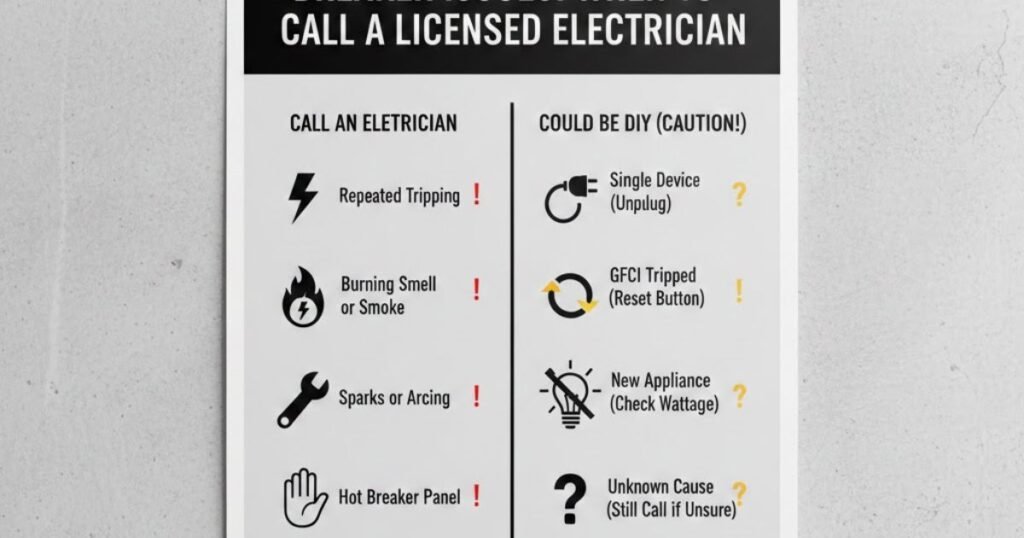
Short rule: Visual checks and documentation are fine for homeowners; anything that requires opening the panel, touching conductors, testing live equipment, or making permanent changes should be done by a licensed electrician.
Homeowner tasks (safe, simple)
- Document symptoms (smell, noise, timing).
- Do non-invasive checks (visual observation from outside the panel, check for scorch marks).
- Reset a tripped breaker only if it’s clearly a simple overloaded device and there are no burning smells, visible damage, or abnormal sounds and follow any breaker label instructions. If in doubt, don’t reset repeatedly.
- Keep an emergency contact for an electrician and know where your service disconnect (main) is located.
Tasks to always leave to licensed professionals
- Replacing breakers, swapping breaker types, or installing new breakers (requires verifying compatibility with the panel bus and UL listing).
- Replacing or upgrading the main service, meter, or service entrance conductors.
- Any work requiring opening the panel, testing live circuits, or handling conductors.
- Diagnosing and fixing arcing, loose lugs, bus damage, or other internal faults.
- Work that requires a permit or a city/county inspection.
Licensed electricians bring required training, tools (meters, insulated tools, PPE), and insurance. They’re also responsible for pulling permits, performing safe isolation procedures, and ensuring the work is code-compliant which protects you and your home.
READ MORE: Commercial Electrical Contractors: Services, Costs & How to Hire
How to Choose & Work With an Electrician
Use this checklist when vetting and working with a pro.
Before hiring
- Verify license and insurance: call your state licensing board or check online.
- Read reviews and ask for local references.
- Ask for a written, itemized estimate (parts, labor, permit fees).
- Confirm who pulls permits and who handles inspections.
- Ask about warranties (typical: 1 year labor, manufacturer part warranties vary).
During the job
- Confirm the electrician will provide a clear scope of work and timeline.
- Ask how they will protect floors and finished spaces during work.
- Request explanation of findings in plain language (what was diagnosed, why it failed, and the recommended solution).
After the job
- Get a final invoice that matches the estimate and permits/inspection paperwork.
- Ask for a simple maintenance recommendation and emergency contact.
- Keep all paperwork for insurance and resale.
Working with a reputable electrician protects your family and ensures the work is documented and code-compliant.
Comparison Table — Homeowner Reset / Quick Fix vs Professional Repair vs Panel Replacement
| Option | Typical cost (US range) | Typical downtime / time on site | Permit required? | Warranty & lifespan | Risk to homeowner | Best for / when to choose |
| Homeowner quick reset / visual check | $0–$50 (no parts) | Minutes to 1 hour | No | N/A | Low if only observing; risk if ignoring signs | Best for first simple checks (no smells, no damage) |
| Licensed electrician — repair (single breaker) | $100–$300 | 1–2 hours on site | Usually no (unless additional work) | 1 year labor typical; breaker lifespan 10–30+ years | Low when done by pro; homeowner risk if attempted DIY | Replace a single faulty breaker or tighten connections. |
| Licensed electrician — full panel replacement / service upgrade | $850–$4,000+ (typical $1,200–$2,900) | Half to full day on site; inspection scheduling may add days | Yes (almost always) | Contractor warranty + manufacturer part warranty; new panel lifespan 25+ years | High if performed DIY; professional work reduces long-term risk | Choose when panel is old, unsafe, underpowered, or has known defective brand. |
| Temporary safety measures (EMERGENCY ACTION) | N/A | Immediate action required | N/A | N/A | High if ignored | In an emergency (smoke, burning smell, active sparking): turn off affected circuits at main and call an electrician/911 as appropriate. |
Typical Warnings, Maintenance & Prevention
Prevention and routine attention significantly reduce the chance of emergency repairs:
- Avoid overloading circuits: Spread heavy loads across multiple circuits; avoid running high-draw appliances on extension cords.
- Use modern protection where required: GFCI in wet areas and AFCI in living spaces protect against shock and fire hazards; installing the correct type of breaker helps meet code and improve safety.
- Keep the panel dry and accessible: Moisture accelerates corrosion; the panel should be reachable for inspection and not blocked.
- Watch for pets or pests: Rodents and insects can damage wiring and create faults.
- Schedule periodic inspections: A licensed electrician can do a safety check every few years, especially in older homes.
- Respond to early signs: Don’t ignore flickering lights, odd smells, or repeated trips early intervention is cheaper and safer.
Avoid “quick” DIY work that involves live parts or internal panel access; these are common causes of accidental shock and improper repairs.
FAQs
Q: Can I replace a breaker myself
A: No. Replacing a breaker requires panel knowledge, matching the breaker to the panel bus, and safe handling of live electrical equipment. Hire a licensed electrician.
Q: How long does a breaker last?
A: Many breakers can last 15–40 years depending on use and environment; frequent tripping, heat, or age can shorten life.
Q: Will my insurance cover panel replacement?
A: Homeowners insurance may cover damage from a covered peril (e.g., lightning). Routine replacement for age or upgrades is usually an owner expense. Check your policy.
Q: Do I always need a permit?
A: Not always for a small repair, but panel replacements, service upgrades, and many electrical changes typically require permits. Ask your electrician.
Conclusion & quick action checklist
Circuit breaker problems range from a single faulty module to signs of a dangerous, aging electrical system. Your role as a homeowner is to recognize warning signs, do safe, non-invasive checks, and hire a licensed electrician for any work involving the panel, wiring, or live conductors. Get written estimates, confirm licensing and insurance, and insist that permits and inspections be handled properly. Prompt attention saves money and reduces fire risk.