Who this helps and what you’ll learn If you own a home or small property with a plate heat exchanger (PHE) for domestic hot water, a small boiler, pool heater, or light commercial system this guide explains the spare parts you’ll actually need, how they fail, what replacement parts cost, and when to DIY versus call a pro. Think of it as a friendly local HVAC technician walking you through plate heat exchanger spare parts, sourcing, pricing, and step-by-step gasket replacement tips.
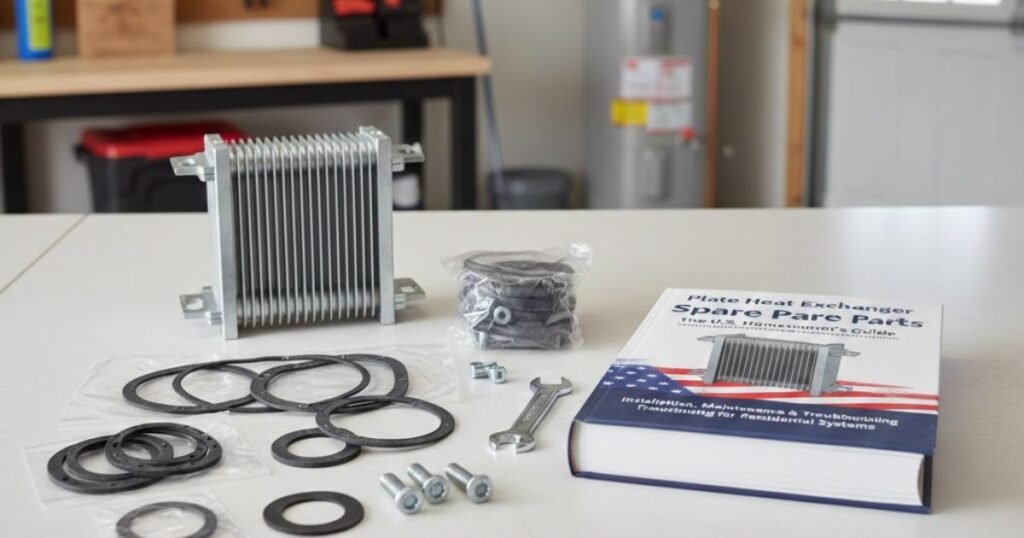
What is a plate heat exchanger and why spare parts matter
A plate heat exchanger (PHE) is a compact device that transfers heat between two fluids using thin corrugated metal plates clamped together in a frame. They’re used in boilers, domestic hot water heaters, hydronic heating, pool heaters, refrigeration, and many small commercial systems because they offer high heat transfer in a small footprint.
Unlike shell-and-tube units, gasketed plate exchangers can be disassembled for cleaning and repairs which makes spare parts (gaskets, plates, tightening bolts, end-plate parts) central to long-term serviceability. When a gasket fails or a plate corrodes, it’s often cheaper and faster to replace a part than to scrap the whole exchanger if the right parts are available and the damage is localized. OEM support, aftermarket availability, and correct parts identification determine whether a repair is realistic.
Parts anatomy (plates, gasket channels, bolts, frame, ports)
- Plates — thin stainless-steel (or other alloy) sheets with corrugated patterns. They create the flow channels and the surface where heat transfers.
- Gaskets — rubber or elastomer seals that press into grooves on the plate edges and direct fluids into alternating plate channels. They’re the most commonly replaced wear part.
- Frame & end plates — the rigid structure that holds the plate pack together; end plates include ports for piping.
- Tightening bolts / tightening set — long threaded rods and nuts that compress the plate pack; they wear or stretch and may need replacement when a unit is serviced.
- Ports, seals & sensors — small components (port sleeves, O-rings, thermowell fittings, temperature sensors) often unique to maker and model.
READ MORE: Heat Exchangers Explained | Types, Uses, Efficiency & Benefits
Common spare parts explained
This section covers the core spare parts you’ll see offered for PHEs, how they fail, and what to expect when replacing them.
1. Gaskets / gasket kits — materials and failure modes
What they do: Gaskets seal the plate edges and force the fluids to follow the correct path. Most gasketed PHE failures trace back to the gasket.
Common materials:
- NBR (Nitrile / Buna-N): Good for hot water and many non-aggressive fluids, economical.
- EPDM: Better for hot water/steam and many hydronic fluids; common for domestic heating systems.
- FKM / Viton: Higher temperature and chemical resistance (oils, glycol mixes) but pricier.
How they fail:
- Hardening and loss of elasticity from heat and time, leading to leaks.
- Chemical attack when exposed to incompatible fluids (e.g., certain oils or aggressive cleaners).
- Physical damage during plate removal or reassembly.
- Improperly seated gaskets after service.
Replacement options: You can buy individual gaskets or full gasket kits (channel gaskets + end-plate gasket). Kits are usually the cost-effective choice when servicing, because any gasket could fail soon after.
Practical tip: Always match the material to your fluid (antifreeze/glycol, potable water, oil). If you’re in doubt, EPDM is a safe default for most hot-water residential systems; FKM for oil/solvent exposure.
2. Individual replacement plates vs plate packs — when plates crack or corrode
When an individual plate needs replacement:
- Visible corrosion pitting or a hairline crack discovered during inspection or dye-penetrant testing.
- Localized damage from freezing or cavitation.
Options:
- Replace a single plate + gasket — common for homeowner or small-facility repairs when the plate pattern is still available and the frame is undamaged. Marketplace listings exist for many OEM plates at prices ranging from low tens to a few hundred dollars depending on size and OEM.
- Replace a plate pack (multiple plates or the whole pack) — chosen when many plates are damaged, when matching plates are discontinued, or for industrial units where plates are custom. This is more expensive and sometimes requires manufacturing MOQ. Expect large units or custom batches to be costly.
3. Frame parts and bolts — when to replace the tightening set
Tightening bolts and supporting frame parts endure high compressive forces. Over time bolts can stretch, threads foul, or corrosion weaken the set. If you’re doing a re-gasketing job and the tightening bolts show rust, seized nuts, or visible deformation, replace the full tightening set it’s cheap insurance and often sold as a kit. OEMs also sell end plate parts and port sleeves for units that see heavy service.
4. Sensors, seals, and end-plate components for domestic units
Smaller domestic units (tankless water-heater heat exchangers, hydronic plate exchangers) often have accessory seals, thermowells, or sensor fittings that are easier and cheaper to source than full plates. When a leak is localized to a port or a sensor mounting, replacing a gasket or O-ring is the lowest-cost fix.
How to identify the right spare part
Getting the right part is 70% of success. Here’s a practical approach.
Plate and gasket part numbers, measurements, and model cross-reference tips
- Locate the model/tag plate — Most OEM plates or frames have a stamped model code and serial number on the frame or on the corner plate. Write these down exactly.
- Plate codes and plate pattern numbers — Plates often have manufacturer-printed codes or edge markings that identify the pressing pattern and part number. These are what OEMs and aftermarket suppliers cross-reference.
- Measure key dimensions — plate height, width, bolt hole spacing, gasket groove shape, and plate thickness. Photos help a lot.
- Manufacturer cross-reference — many OEMs (Alfa Laval, SWEP, Tranter, GEA, APV/Sondex) publish spare-part catalogs or accept direct inquiries to match part numbers; aftermarket suppliers will also cross-reference if you provide measurements and images.
READ MORE: Heat Pump Installation Cost in 2026 (Real Prices, Examples & Savings)
Real price expectations
Below are recent listing snapshots and typical price ranges a U.S. buyer is likely to see. These are examples pulled from current marketplace and OEM listings always verify model numbers and shipping before purchase. (See notes at the end for sources.)
- Small OEM replacement plate + gasket on marketplace: ~US $60 (example listing). This is typical for smaller domestic plates or surplus parts listed on marketplaces.
- Larger industrial plate + gasket listing (marketplace example): US $269.99 for a Tranter plate + gasket listing we found. That’s an example for larger industrial plates.
- Retail/commodity gasket unit pricing: commonly ranges $4–$100 depending on OEM, material, and size. Bulk factory prices (MOQ) can be lower, but retail single-piece pricing for OEM gaskets often sits in the tens to low hundreds.
- Full replacement plate packs or custom plates: can run into the thousands of dollars, particularly for industrial units that require custom stamping, specialty alloys, or minimum order quantities. Custom manufacturing or discontinued-model restorations drive cost higher.
- Tightening bolt sets and small hardware kits: modest often $50–$300 depending on size and material (stainless sets cost more).
- Professional service/labor for re-gasketing: for a small domestic exchanger, expect $200–$800 for service call + labor and parts from a qualified HVAC/plumbing tech; for larger commercial units, labor and teardown/pressure testing can be significantly more. (Labor estimates vary by region and job complexity.)
Important buyer note: these price examples are snapshots of public listings and should be re-checked at time of purchase. Shipping, urgent service fees, and OEM factory lead times can change the final delivered cost.
5-brand comparison table
Notes: Table entries are summarized from OEM product pages and marketplace listings; “Varies check OEM” indicates the public price was not uniformly listed or depends on model. See sources in the notes section.
| Brand | Typical spare parts | Typical price range (USD) | Best for | Warranty & support notes | USA availability |
| Alfa Laval | Gasket kits, plates, tightening sets | Gasket kits/parts often $4–$300 depending on model; full plate units vary. (OEM site lists spare catalogs; retail prices vary). | Wide industrial & domestic range; strong OEM support | OEM warranty; international dealer network and authorized service partners | Readily available via dealers & distributors in USA. |
| SWEP | Brazed plates (brazed units have different spare patterns) | Small units sold at retail under ~$500 for small exchangers; spare-part handling varies — brazed plate parts less interchangeable. | Compact brazed units for HVAC and refrigeration | Good OEM support but brazed design limits some spare-part swaps | Good USA coverage through distributors; brazed units often replaced rather than re-gasketed. |
| Tranter | Plates & gaskets, plate packs | Example plate+gasket listing ~$269.99 (marketplace). Pricing varies by model. | Industrial heavy-duty exchangers used in process and HVAC | Longstanding OEM; parts availability varies by model and regional inventory | Aftermarket OEM parts and distributors; marketplace listings available. |
| APV / Sondex (SPX) | Plates & gasket kits | Small plate listings seen ~$60; gasket prices vary. (Examples from marketplace/catalog snapshots). | Food, dairy, light industrial applications | OEM support via specialist suppliers | Available via specialty suppliers & marketplaces; check certified dealers for warranty parts. |
| GEA | Plates, gaskets, semi-welded cassettes | Commodity gaskets seen in $6–$100 range depending on model and MOQ; full sets vary. | Process, dairy, HVAC, larger industrial | Strong OEM engineering & service network | Available through authorized distributors and aftermarket suppliers in USA. |
| Aftermarket / OEM-compatible suppliers | Plates, gaskets, seals | Commodity gaskets $4–$100; custom plates higher (varies). | Cost-sensitive replacements and discontinued models | Warranty varies by supplier—verify before purchase | Widely available online & via U.S. distributors; caution on fit and authenticity. |
READ MORE: 3-Ton Heat Pump: Cost, Sizing & Best Models
Step-by-step: Replacing gaskets (DIY for homeowners)
Safety first: If your exchanger handles steam, high-pressure hot water, or hazardous chemicals, stop and call a licensed pro. This DIY walkthrough targets low-pressure domestic and light commercial units where fluids are non-hazardous.
Tools & supplies you’ll need
- Replacement gasket kit matched to model (channel gaskets + end gasket).
- Tightening bolt set (optional but recommended if current bolts show corrosion).
- Torque wrench sized to the unit’s bolt specs.
- Mallet (rubber), gasket puller, plastic scraper (no metal edges that can nick a gasket seat), clean rags, isopropyl alcohol or PHE-safe cleaning agents, nitrile gloves.
- Knife or gasket remover (for old adhesive) and dye-penetrant kit if you plan plate inspection.
Safety checklist
- Isolate and drain the exchanger completely. Lock out and tag out any valves; ensure no residual pressure or hot water remains.
- Ensure the fluids are safe to handle (not corrosive or toxic). If uncertain, call a pro.
- Wear gloves and eye protection.
- Work on a level surface with room to lay plates flat.
Step-by-step
- Photograph the unit: Take photos of the assembled unit from several angles, plus close-ups of gasket shapes and the plate tag. These help reassembly and parts ordering.
- Loosen bolts evenly: Loosen the tightening bolts a little at a time in a cross pattern to avoid skewing the frame. Remove nuts and push plates out carefully.
- Remove plates: Slide plates out one by one. Lay them on a clean, flat surface in order (use a numbered towel or board plate order matters).
- Inspect plates: Look for erosion, pitting, or hairline cracks. If a plate is damaged, note its stamped code and photograph it. If multiple plates are compromised, consider replacement of plate packs or professional evaluation.
- Remove old gaskets: Carefully peel old gaskets off. Use plastic scrapers or solvent recommended by OEM to clean gasket grooves; avoid metal tools that gouge the groove.
- Clean plates: Remove deposits with an appropriate cleaning method (chemical descaling or mechanical cleaning following OEM guidance). Avoid abrasive tactics that damage corrugation.
- Fit new gaskets: Dry-fit gaskets to confirm shape and location. Apply any OEM-specified adhesive sparingly (many gaskets are fitted dry). Ensure correct gasket orientation (many have flow indicators).
- Reassemble plates: Stack in the original order. Replace the tightening bolts and nuts if bolts are corroded, replace the set. Tighten incrementally in a cross pattern to the OEM torque spec. Never overtighten.
- Pressure-test: After reassembly, perform a low-pressure test, then bring to operating pressure while checking for leaks. Re-torque after the first hot-cold cycle if OEM recommends it.
When NOT to DIY
- Units with steam or high-pressure service.
- Any exchanger with toxic or caustic fluids (industrial solvents, process chemicals).
- If you find many corroded or pitted plates — this suggests systemic failure and professional evaluation is safer.
- If you don’t have the correct replacement gaskets or torque specs.
Time & cost expectation for DIY re-gasketing (typical domestic unit)
- Parts: gasket kit $50–$300 depending on model and material.
- Tools: if you already own basic tools, no major purchases. Renting a torque wrench or buying new tightening bolts could add $50–$150.
- Time: 2–6 hours for an experienced DIYer; longer if cleaning is extensive.
READ MORE: Baseboard Heater: The U.S. Homeowner’s Complete Guide
When to repair vs replace the whole exchanger — pros & cons
Making the right choice depends on the age of the unit, availability of parts, severity of damage, and long-term reliability requirements.
Repair (re-gasketing / plate replacement)
Pros
- Lower cost for localized failures.
- Faster turnaround if parts are in stock.
- Keeps original unit footprint and piping.
Cons
- May be a temporary fix if other plates are near end-of-life.
- Older units may have obsolete parts or non-standard patterns.
- Labor-intensive for large units.
Good for: Recent units with a few failing gaskets or a single damaged plate; homeowners and small facilities.
Full replacement (new plate pack or new exchanger)
Pros
- New unit with factory warranty, modern materials, and potentially better efficiency.
- Eliminates unknown future failures from old plates.
Cons - Higher upfront cost; full replacement can be thousands for industrial units.
- May require piping changes and space planning.
Good for: Units with widespread plate corrosion, discontinued models with no parts, brazed units where plates can’t be re-gasketed, or when long-term reliability outweighs repair cost.
Rule-of-thumb cost thresholds
- If the repair+labor approaches 50–60% of a new small replacement unit’s cost, replacement is worth considering especially for older units. For industrial units, compare quoted plate-pack rebuild vs new unit quotes from OEM or authorized distributor.
Where to buy spare parts in the USA
Authorized OEM dealers
best for guaranteed-fit parts and warranty compliance. OEM websites and official distributors (Alfa Laval, SWEP, Tranter, GEA, APV/SPX) list spare parts or authorized dealers.
Specialty aftermarket suppliers
many U.S. companies sell OEM-quality compatible parts at lower cost. Good for discontinued models or urgent needs. Verify return policy and warranty.
Marketplaces & surplus sellers
eBay and industrial equipment marketplaces can be great for one-off plates and surplus gasket kits; watch for correct part numbers. Example marketplace listings show individual plates/gaskets from $19–$270 depending on size and model.
Tips to spot counterfeit or wrong parts
- Ask for part number confirmation and photos from the seller.
- Compare gasket groove shape and bolt spacing using your photos.
- Beware extremely low prices that look “too good” — low-cost gaskets from unknown factories may lack material certifications.
- Prefer suppliers with returns and cross-reference support.
Maintenance tips to extend part life
- Seasonal inspection: Check for seepage around gaskets and corrosion on bolts twice a year.
- Monitor pressure & temperature swings: Repeated extreme cycles accelerate gasket aging.
- Flush periodically (if the system allows): Remove scale and deposits; contaminated fluid shortens plate/gasket life.
- Use compatible fluids: Avoid contaminating potable water systems with aggressive additives. Choose gasket elastomer for the fluid in your system.
- Follow torque specs: Over-tightening shortens gasket life; under-tightening causes leaks. Keep a torque log when you perform service.
Conclusion: quick checklist and next steps
- Photograph your unit and record model/serial numbers.
- Identify whether the fault is gasket, plate, or frame related.
- Get multiple quotes (OEM & aftermarket) before buying parts.
- For small domestic exchangers, gasket kits and a tightening set often solve 80% of problems.
- If you find multiple damaged plates or heavy corrosion, budget for a plate-pack rebuild or a full replacement.
- When in doubt with steam, toxic fluids, or large industrial systems call a licensed service provider.
5 FAQs
Q1: What are common plate heat exchanger spare parts I should keep on hand?
A1: For homeowners and small facilities, keep a gasket kit (matching material), a spare end-plate gasket, and a tightening bolt set. If your unit uses sensors or thermowells, have their O-rings and seals on hand too.
Q2: How much does a plate heat exchanger gasket kit cost?
A2: Retail gasket kits typically range from about $20 to $300 depending on OEM, gasket material, and size. Custom or specialty elastomers cost more. Always confirm model numbers before purchase.
Q3: Can I replace a plate myself?
A3: Yes — for low-pressure domestic units and if the plate is easily accessible. You’ll need to drain the system, photograph and mark plate order, remove and inspect plates, and reassemble with proper torque. Call a pro for steam, hazardous fluids, or if structural/frame damage exists.
Q4: How long do plate gaskets last?
A4: Gasket life varies with temperature, fluid chemistry, and duty cycle. Under normal domestic hot-water service, expect several years; in harsher environments or with incompatible fluids, life can fall to months. Regular inspection is the best mitigation.
Q5: Where do I find Alfa Laval, SWEP, or Tranter spare parts in the USA?
A5: OEMs maintain dealer networks and official spare-part catalogs (Alfa Laval, SWEP, Tranter, GEA, APV/Sondex). Authorized distributors, aftermarket specialists, and industrial marketplaces also stock parts always confirm part numbers and warranty when buying.
Sources (examples used to compile price and brand info)
- Alfa Laval spare parts and gasket catalog pages (OEM spare-part info and stock notes).
- SWEP product pages and distributor listings (brazed plate unit notes brazed units have different spare-part patterns).
- Tranter marketplace listing: example plate + gasket listing US $269.99 (e.g., Tranter GXD-026 listing on public marketplace).
- Example small gasket/plate listings and price snapshots (e.g., Alfa Laval gasket listing on marketplace ~US $60; various single-plate listings on eBay & Alibaba showing $19–$100 ranges).
- GEA/aftermarket gasket examples and factory pricing snapshots showing a broad $4–$100 per-unit range depending on MOQ and model.