Getting hot water fast at a single sink is solved neatly with an under-sink (point-of-use) heater. This guide cuts through specs, real prices, and pro advice so you can pick the best under-sink hot water heater for your kitchen, bathroom, or office and avoid costly installation surprises. Lets deep dive into “Best Under Sink Hot Water Heater 2026 — Mini-Tank & Tankless Buyer’s Guide & Prices”
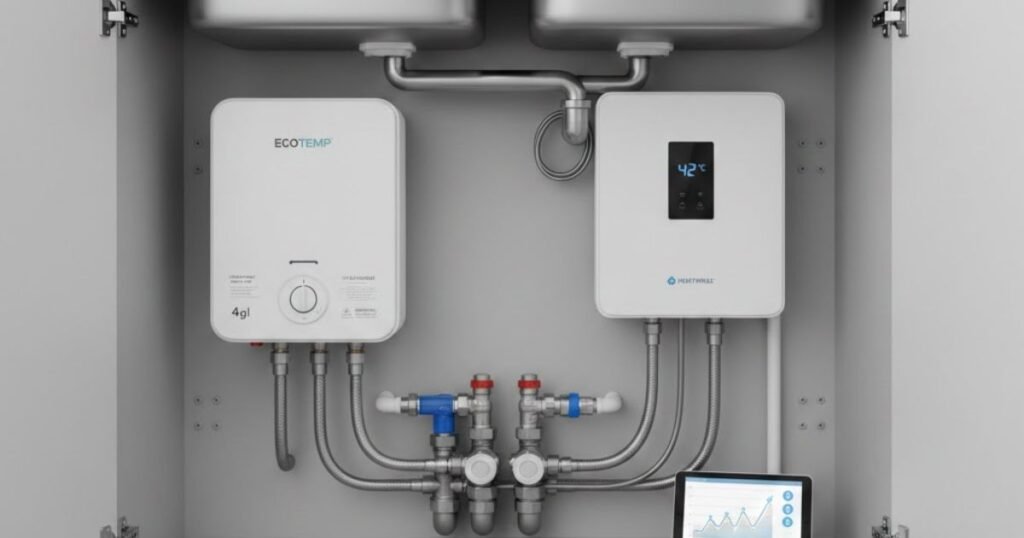
How under-sink heaters work — (mini-tank vs tankless)
Under-sink heaters serve one purpose: deliver hot water to a single fixture quickly without running long lengths of pipe from a central water heater. There are two common types:
Mini-tank (point-of-use) heaters
Small insulated tanks (typically 1–4 gallons) that store preheated water ready to deliver instantly. They plug into a standard 120V outlet or hard-wire, heat with a single element, and are easy to install under cabinets. Mini-tanks are best if you want simple, steady hot water at low flow for sinks and small lavatories.
Point-of-use electric tankless (mini tankless) heaters
Compact units that heat water on demand as it flows through a heating element. They often require 240V and higher amperage. Tankless units can deliver continuous hot water but their flow rate (GPM) depends on inlet temperature and electrical capacity. Tankless works well where you need a steady stream (small showers, busy kitchens) but requires proper electrical service and sometimes multiple parallel units for higher flows.
Short version: mini-tanks = tiny stored supply, simple install; tankless = on-demand, higher electrical need, continuous flow if sized correctly.
Check this Under Sink GE Hot Water Heater (Only 7 Left)-

- COMPACT DESIGN – Ideal in limited spaces like kitchens, bathrooms, laundry rooms, barns, cabins, RVs, garages, sheds, pe…
- EASY INSTALLATION – Installs in minutes with existing plumbing. Uses standard 1/2-in NPT water connections for simple wa…
- HOT WATER BOOSTER – Works as a standalone unit, or inline with another water heater to boost long pipe runs or washing m…
READ MORE: Hot Water Cylinder Temp: Ideal Settings, Safety & Energy Savings
Who should buy an under-sink heater
- Apartment renters who want instant hot water at a kitchen or bathroom sink without replacing the building’s main heater.
- Homeowners with long waits for hot water at distant sinks a point-of-use heater gives near-instant hot water.
- Home offices, garages, or tiny kitchens where a full water heater isn’t practical.
- Busy kitchens where multiple short hot water uses occur (dish rinsing, hand washing) choose a higher-GPM tankless or a larger mini-tank.
- Bar sinks and prep areas — a small mini-tank under the counter is often the cheapest, simplest fix.
How to choose: 7-point buying checklist
- Capacity / Flow (GPM & gallons) — For mini-tanks check gallons (2.5–4 gal common). For tankless check GPM at your local inlet temp. Example: ECO 11 claims ~1.3–3.1 GPM depending on inlet temperature.
- Electrical requirements — Mini-tanks often run on 120V / 12–15A (plug in). Tankless point-of-use models usually need 240V and 20–50+ A circuits. Verify your panel and breaker space.
- Footprint & clearance — Measure under your sink. Some mini-tanks are low-boy style and sit on the cabinet floor; others are wall-mountable.
- Recovery / heat-up time — Mini-tanks have a recovery time as they reheat the stored water; tankless is instant but limited by flow.
- Warranty & parts — Look for multi-year tank warranties (6 years is common for mini-tanks) and accessible replacement parts.
- Installation complexity — Do you have a free 120V outlet? Do you have space for a 240V run? Will you hard-wire? If you’re unsure, budget for a licensed electrician/plumber.
- Local code & permits — Confirm whether your municipality requires a permit for a new electrical circuit or for plumbing modifications.
READ MORE: Gas Water Heater Replacement Cost (2026) — What Homeowners Pay & Why
In-depth reviews of Under Sink Water Heaters
Below I review each model with short summaries, pros & cons, who it’s best for, and the real price and retailer I checked on Feb, 2026.
1. Bosch — Tronic (Tronic 4000 series) — Mini-tank
Bosch’s Tronic mini-tanks (the ES/Tronic 3000 line) are compact, reliable point-of-use heaters with a 6-year limited tank warranty. The 2.5–2.7 gal models are aimed squarely at under-sink installs and plug into a standard 120V outlet.
Pros
- Compact footprint; fits under most cabinets.
- 6-year tank warranty.
- Simple 120V install — often plug-and-play.
Cons
- Small capacity limits consecutive uses (e.g., handwashing + sink rinse in quick succession).
- Recovery time required between draws.
Quick install tips: Leave 1–2 inches clearance for plumbing fittings; install on a stable shelf or floor. If you need to hard-wire, hire an electrician.
Best for: Small kitchen or bar sink where occasional hot water is needed quickly. Check Product only 1 Left-

- 3.5 KW TANKLESS WATER HEATER: Designed specifically for point of use applications to provide an endless supply of instan…
- COMPACT AND LIGHTWEIGHT: Effortlessly fits under sinks
- GREAT FOR LOW-FLOW FAUCETS: With as low as a 0.55 GPM activation flow rate, it’s perfect for commercial low-flow faucets…
2. Stiebel Eltron — SHC 2.5 — Mini-tank
Stiebel Eltron’s SHC 2.5 is a European-designed mini-tank known for a clean profile and reliable build.
Pros
- Low profile and good insulation; attractive for visible installs.
- Made by a respected German manufacturer.
- 6-year tank warranty.
Cons
Slightly lower wattage (1300W) means slower recovery than higher-watt mini-tanks.
Quick install tips: This model often includes a wall-mount option measure and pre-mark before drilling to avoid corrosion-causing mistakes
Best for: Bathroom sink or powder room where style + efficiency matter. Check This Product-

- The SHC 4, 4 gallon mini tank 120V (volt) electric water heater frees up precious space while providing plenty of hot wa…
3. Rheem — Performance 2.5 gal mini-tank
Rheem’s Performance mini-tank is a budget-minded solution with 6-year limited warranty and a conventional 120V plug design. Home Depot price listing showed $212.99 on Feb 9, 2026.
Pros
- Affordable and widely available.
- Easy to swap for older mini-tanks (same footprint/pipe connections typically).
Cons - Basic feature set — not the quietest or fastest recovery.
Quick install tips: Use dielectric unions on copper piping if mixing metals; keep the unit accessible for occasional flushing
Best for: Homeowners wanting a straightforward replacement or low-cost point-of-use heater. Check this Product-

- Endless On-Demand Hot Water – Consistent hot water when you need it that never runs out
- Continuously monitored water temperature and controlled flow rates ensure efficiency and consistent performance within 1…
- Save Space – Rheem Professional POU T tankless electric water heaters are 90% smaller than traditional tank heaters, gre…
4. EcoSmart — ECO 11 — Electric tankless (point-of-use)
The ECO 11 is a compact electric tankless rated around 11–13 kW and claims roughly 1.3–3.1 GPM depending on inlet temperature. It’s a popular point-of-use tankless choice; pricing tracked in major listings was around $206.76 on Feb 9, 2026.
Pros
- Continuous hot water (no tank recovery).
- Small footprint; mounts on the wall.
Cons
- Needs 240V and a substantial breaker/amperage; may require electrical upgrade.
- Flow rate varies with inlet water temperature in cold climates you’ll get lower GPM.
Quick install tips: Confirm the required breaker and conductor size for the specific ECO-11 variant. If your panel lacks capacity, adding a dedicated 240V circuit can cost several hundred dollars.
Best for: Small bathroom sink or kitchen sink where continuous flow is useful and you have 240V capacity. Check this Product-

- Endless On-Demand Hot Water; Consistent hot water when you need it that never runs out; Continuously monitored water tem…
- Save Space; EcoSmart tankless electric water heaters are 90% smaller than traditional tank heaters; may be installed on …
- Save Energy; EcoSmart tankless electric water heaters are 99% thermal energy efficient; Only heats water when called unl…
5. A. O. Smith — EPU-2.5 (ProLine) — Mini-tank
A.O. Smith’s ProLine EPU-2.5 is a durable, pro-grade mini-tank with industry-standard specs and a 6-year limited warranty; prices vary strongly by distributor and reseller (listings ranged widely as of Feb 9, 2026). Check with local plumbing supply for best pricing; examples showed both modest retail and higher wholesale/reseller prices.
Pros
- Built for longevity and pro installations.
- Widely supported parts and service network.
Cons
- Seller variation means price shopping is important.
Best for: Contractors and homeowners who want a rugged, serviceable mini-tank.
Quick install tips: If buying through a wholesaler, confirm return policy and warranty registration steps.

- Compact and Versatile Design: The Ariston Mini-Tank Electric Water Heater is ideal for supplying heated water to single …
- Powerful Heating Solution: Equipped with a titanium glass-lined tank for durability and optimal heat retention, this wat…
- Versatile Installation Options: This product bundle can be installed as a stand-alone unit or as a booster to an existin…
READ MORE: Titan Water Heater Review 2026 | Efficiency, Cost, Pros & Real User Experience
Under Sink Water Heater Comparison table
Here’s a side-by-side look at five top models I’ve vetted for performance, value, and reliability. I pulled specs from manufacturer sites and review roundups like those from Consumer Reports and plumbing forums. Prices are current as of Feb, 2026, checked across Home Depot, Lowe’s, Amazon, and direct sellers.
| Brand / Model (example) | Type | Capacity / Flow | Power (V / Amps) | Warranty | Price (retailer, Feb, 2026) | Best for |
| Bosch — Tronic (Tronic 4000 series) | Mini-tank | ~2.5–2.7 gal | 120V / ~12–15A | 6-year tank | See Price | Small kitchen or bar sink |
| Stiebel Eltron — SHC 2.5 | Mini-tank | 2.5 gal | 120V / 1300W | 6-year | See Price | Sleek bathroom sink solution |
| Rheem — Performance 2.5 gal mini-tank | Mini-tank | 2.5 gal | 120V / 1440W | 6-year | See Price | Budget-friendly, easy replace |
| EcoSmart — ECO 11 (ECO-11) | Electric tankless (point-of-use) | ~1.3–3.1 GPM (depends) | 240V / 11–13 kW (model variants) | Limited | See Price | Small bathroom or single sink with continuous flow |
| A. O. Smith — EPU-2.5 (ProLine) | Mini-tank | 2.5 gal | 120V / 1440W | 6-year | Varies by seller — typical listing as of Feb 9, 2026 (~$249–$598 depending on supplier). | Durable pro-grade compact model |
(Notes: model names and sizing may vary slightly between retailers; always confirm the exact model number before ordering.)
Check this Under Sink Beast Hot Water Heater (Only 3Left)-
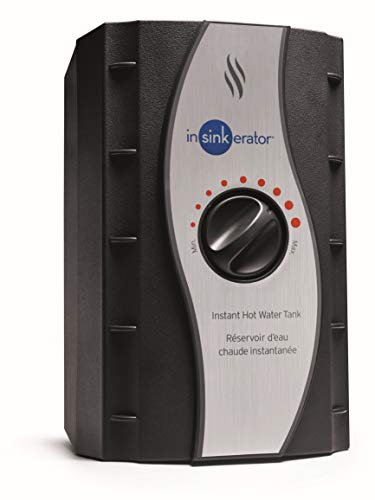
- INSINKERATOR INSTANT HOT WATER TANK: 10.875-inch by 6.125-inch, 2/3-gallon tank (HWT-00) with easily adjustable tank wat…
- DURABLE DESIGN: Stainless steel tank with 750-W heating element and adjustable temperature with a simple turn of the kno…
- DIY INSTALL: Easy install with standard under-sink outlet for tank’s power cord plus tool-free tank connections; dry sta…
Installation & wiring: what to expect (do’s/don’ts)
Do
- Turn off power and water before you start.
- Measure twice cabinet width, depth, and door swing.
- Use flexible connectors to simplify alignment.
- Add a drip pan if the unit will sit on the cabinet floor under sensitive items.
Don’t
- Don’t attempt to install a 240V tankless without verifying panel capacity and breaker space.
- Don’t mount a mini-tank directly on the cabinet floor without a pan if the cabinet stores absorbent items.
- Don’t use Teflon tape on John Guest or push-fit connections that are not intended for tape follow fitting instructions.
When to call a pro
- You need a new 240V circuit or panel work.
- Local code requires a licensed installer for water heaters or for electrical modifications.
- You’re uncomfortable cutting copper or soldering; a plumber will do this safely.
Sample cost ranges (approximate, U.S., 2026 prices)
- Mini-tank unit purchase: $150–$300 (depending on brand).
- Basic DIY install (if permitted): $0–$150 (connectors, brackets, pan).
- Plumber install: $150–$400 (labor varies by region, adds fittings).
- Electrician (240V run): $300–$900 (depends on distance to panel, permits, panel capacity).
- Total pro install (unit + plumber + electrician + permit): $600–$1,600 for a 240V tankless; $450–$900 for a 120V mini-tank when a simple plug and minimal plumbing work are needed.
(These are approximate ranges; get local quotes. Expect electrician costs to dominate when a new circuit is needed.)
Sizing examples (flow rate examples for common fixtures)
- Bathroom sink / lavatory: 0.5–1.0 GPM typical (mini-tank 2.5 gal is usually fine).
- Kitchen sink with sprayer: 1.0–2.0 GPM; a mini-tank may work for short bursts, but a tankless sized for ≥2 GPM is more comfortable.
- Small shower (low flow): 1.5–2.0 GPM many single ECO-11 style units will struggle in cold inlet temps; tankless needs higher kW or parallel units.
- Example: If your inlet water is 50°F and you want 105°F output, you need a temperature rise of 55°F. A 13 kW electric tankless might deliver ~1.5–2.0 GPM in that case check manufacturer charts.
Tip: Use GPM calculators on retailer/manufacturer pages, but cross-check with local inlet temperatures (colder inlet temps reduce GPM).
READ MORE: Noritz Tankless Water Heater Buying Guide
Maintenance & troubleshooting
Routine
- Flush mini-tanks annually to remove sediment (helpful in hard-water areas).
- Check pressure relief valve (if present) and valve seats.
- Inspect electrical cord and plug for damage (mini-tanks).
- For tankless, descale or follow manufacturer descaling schedule if you have hard water.
Troubleshooting
- No hot water: confirm power at outlet or breaker, check reset button on unit, check thermostat setting.
- Too-hot or too-cold: adjust thermostat; for tankless, confirm inlet temp and flow rate match capacity.
- Leaking: tighten fittings or call plumber if tank seam is leaking (tank failures require replacement).
Final verdict
- Best overall (balance of price, size, ease): Bosch Tronic / ES 2.5 — compact, reliable, and widely available at a reasonable price.
- Best budget mini-tank: Stiebel Eltron SHC 2.5 — often the lowest price for a trusted brand and good insulation.
- Best for continuous use / small continuous flow: EcoSmart ECO 11 (tankless) — choose this if you have 240V and want on-demand flow; confirm GPM vs inlet temp.
- Best for contractors / durability: A.O. Smith EPU-2.5 — pro-grade design and parts availability, but shop multiple sellers for best price.
5 FAQs
What is the best under-sink water heater for a kitchen sink?
For most kitchens, a 2.5–4 gallon mini-tank (Bosch, Rheem, A.O. Smith) gives fast, steady hot water for handwashing and light rinsing. If you use a sprayer or want continuous flow, a correctly sized 240V point-of-use tankless is better.
How much does it cost to install an under-sink water heater?
Unit cost is typically $150–$300 for mini-tanks, and $200–$400 for small tankless units. Installation ranges widely: DIY plumbing may be minor, but adding a 240V circuit costs $300–$900 or more. Total pro installation can be $450–$1,600 depending on electrical work and local labor.
Are under-sink water heaters safe to install under a sink?
Yes, when installed correctly. Use a drip pan, ensure proper ventilation, and follow electrical codes. Mini-tanks that plug into 120V are the simplest; tankless units need proper breakers and wiring. If in doubt, hire licensed pros to avoid fire or water damage risks.
How long does a 2.5 gal mini-tank last?
With normal use and regular maintenance (flushing in hard-water areas), a mini-tank can last 6–12 years. Warranty periods are commonly around 6 years for the tank, which is a good indicator of expected lifespan. Replace sooner if you experience frequent leaks or performance drops.
Can a tankless under-sink heater run a dishwasher or shower?
Most point-of-use tankless units (ECO-11 style) are sized for a single sink or small lavatory, not dishwashers or showers in cold climates. Showers need higher GPM and higher kW. If you want to run a dishwasher or shower, size up to a whole-house or higher-kW tankless unit, or consider multiple point-of-use units.
Author bio
Sam Rigil — Licensed Plumber & HVAC Technician (10+ years)
Sam writes homeowner guides and trains apprentices for a regional plumbing contractor. He installs residential water heaters, runs electrical circuits for tankless systems, and evaluates point-of-use solutions for kitchen and bath remodels. Sam tests products in the field and advises homeowners on safe, code-compliant installs.
Sources & methodology note (prices checked Feb, 2026)
Prices and technical specs in this article were verified on Feb 9, 2026 by checking major retailer pages and manufacturer listings: Home Depot product pages for Bosch Tronic and Stiebel Eltron, Rheem product listings, EcoSmart product listings on major retailers, and A.O. Smith distributor listings. Representative pages used for price/spec checks include the Bosch and Stiebel Home Depot listings, Rheem Home Depot page, EcoSmart Amazon listing, and A.O. Smith distributor pages. (Retailer pages used for price checks are the same pages cited next to model prices earlier in the article.)


Pingback: Power Vent Water Heater | How It Works, Cost, Pros & Cons - Plumbing Guider