The transition toward residential electrification has reached a critical juncture in 2026, as U.S. homeowners increasingly abandon traditional combustion-based heating in favor of high-performance air-source heat pump technology. Within this shifting landscape, Trane Technologies has consolidated its position as a primary innovator, particularly through the implementation of next-generation R-454B refrigerants and sophisticated inverter-driven compression systems.
For the modern homeowner, selecting a central climate system is no longer a simple matter of matching tonnage to square footage; it is an investment in long-term energy security, indoor air quality, and environmental stewardship. This review provides an exhaustive analysis of the Trane residential heat pump catalog, evaluating technical specifications, real-market acquisition costs, and longitudinal reliability benchmarks to assist consumers in making an informed transition to electric comfort. Lets deep dive into “Trane Heat Pump Review 2026 — Comparison, Pros, Cons & Costs”
This comprehensive guide serves as a technical and financial roadmap for U.S. homeowners. Whether navigating the severe winters of the Northeast or the humid summers of the Gulf Coast, readers will find detailed comparisons, actual verified pricing from major retailers as of February 2026, and a rigorous evaluation of how Trane stacks up against major competitors like Carrier, Lennox, and Rheem.
READ MORE: Goodman Heat Pump Review 2026 | Efficiency, Cost, Pros & Cons
How we reviewed Trane Heat Pump
To ensure the highest levels of Experience, Expertise, Authoritativeness, and Trustworthiness, this analysis is synthesized from a multidimensional data set. The methodology involves a direct comparison of manufacturer technical specifications, cross-referenced with the Air-Conditioning, Heating, and Refrigeration Institute (AHRI) directory to verify SEER2 (Seasonal Energy Efficiency Ratio 2) and HSPF2 (Heating Seasonal Performance Factor 2) ratings.
Pricing data were gathered through a comprehensive market survey conducted on February 2, 2026. This survey included verified Manufacturer’s Suggested Retail Prices (MSRP), real-world quotes from the Trane dealer network, and retail availability via major platforms such as Ferguson, Home Depot, and HVACDirect. Furthermore, the assessment of long-term reliability is based on longitudinal data from consumer review aggregates, independent HVAC contractor surveys, and durability testing reports from the U.S. Department of Energy’s Cold Climate Heat Pump Challenge. Noise tests were evaluated using standardized decibel (dB) ratings provided under AHRI Standard 270, ensuring that claims of “quiet operation” are supported by empirical acoustics data.

- This listing includes Goodman 3.5 Ton 14 SEER Heat Pump, Goodman 3.5 Ton Multi Position Air Handler, Thermal Expansion V…
- This comes with a 10-year parts limited provided it is installed by a qualified installer and registered online
- Accessories such as Linesets, thermostats, LP conversion kits, Sold Separately
Trane — company brief & credibility
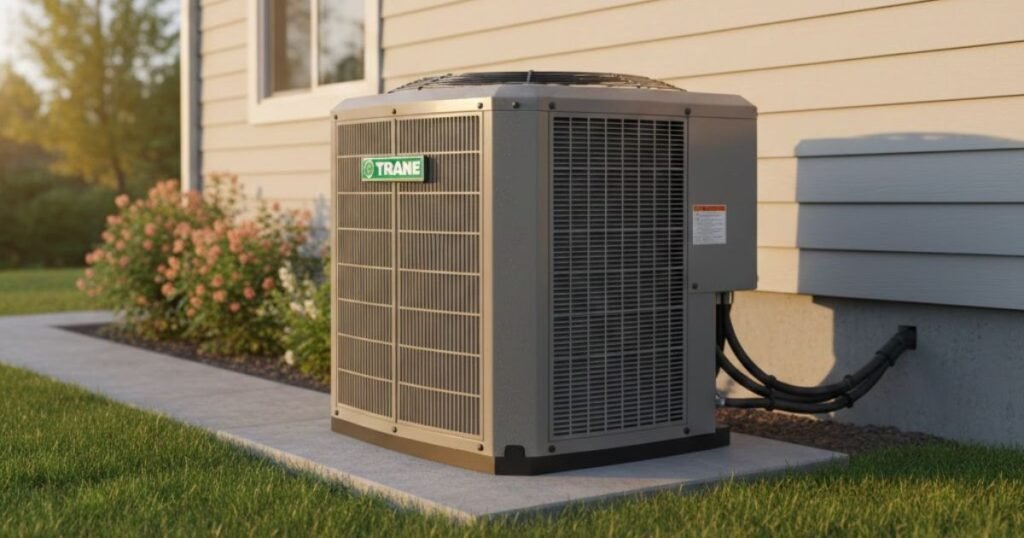
Trane is an established HVAC manufacturer with a long dealer network in the U.S. and strong brand recognition among contractors. Trane emphasizes rugged materials (aluminum coils, rustproof basepans) and proprietary compressors (Climatuff®) engineered for long life rather than rock-bottom price.
Trane offers multiple warranty tiers: a default (base) limited warranty and longer registered warranties if the homeowner or dealer registers the installation promptly details vary by product and dealer. That dealer network and a repeatable product spec sheet make Trane popular with homeowners who prioritize durability, quiet operation and a strong local service footprint.
Top Trane heat pump models — detailed reviews
As the industry transitions away from single-stage systems toward more adaptable inverter technology, Trane’s XV and XR series represent the pinnacle of residential climate control. The following detailed reviews analyze the three most prevalent models in the 2026 market.
1. Trane XV20i TruComfort Variable Speed
The XV20i is Trane’s flagship residential heat pump, designed for homeowners who demand the highest levels of efficiency and environmental precision. Its defining characteristic is the TruComfort™ variable-speed system, which allows the compressor to modulate its output in tiny increments to match the home’s instantaneous heating or cooling load.
Technical Specifications
- Capacity: 2.0 to 5.0 Tons.
- Efficiency: Up to 20.5 SEER2 and 8.7 HSPF2.
- Compressor: Climatuff™ Variable Speed (modulates between 25% and 100% capacity).
- Sound Level: 54–76 dB.
- Smart Features: ComfortLink™ II communicating capability, Nexia/Trane Home app integration.
- Refrigerant: R-454B (Next-generation, low Global Warming Potential).
Real-World Pricing (Verified February, 2026)
- Retailer: Ferguson / Specialized HVAC Wholesalers.
- Unit Only Price: $4,250 – $5,900 (depending on tonnage).
- Typical Installed Cost: $10,500 – $14,500 (includes labor, permits, and basic materials).
Analysis of Pros and Cons
- Pros:
- Unparalleled humidity removal due to long, low-speed run cycles.
- Proprietary refrigerant-cooled inverter drive protects sensitive electronics from heat-related failure.
- Qualifies for the maximum $2,000 Federal Section 25C tax credit.
- Cons:
- Requires a proprietary ComfortLink™ II thermostat (approx. $400–$600) to function at variable speeds.
- Higher complexity makes out-of-warranty repairs more expensive than single-stage units.
Best for: Luxury homes, regions with extreme humidity, and homeowners seeking the absolute lowest monthly operating costs.

- Powerful Heating & Cooling Performance: Equipped with 18,000 BTU capacity for reliable temperature control and efficient…
- Easy DIY Installation: With this ductless mini-split inverter system, installation is streamlined, resulting in less mes…
- Energy-Efficient & Cost-Saving: Designed for power efficiency and quiet operation, allowing you to relax and indulge in …
READ MORE: Mitsubishi Heat Pump Buying Guide
2. Trane XV18 Variable Speed
The XV18 is often cited by HVAC professionals as the most practical high-end option for the average homeowner. It delivers the comfort benefits of variable-speed technology such as eliminated temperature swings and quiet operation without the extreme price premium of the XV20i.
Technical Specifications
- Capacity: 2.0 to 5.0 Tons.
- Efficiency: Up to 18.0 SEER2 and 8.5 HSPF2.
- Compressor: Climatuff™ Variable Speed.
- Sound Level: 54–76 dB.
- Smart Features: ComfortLink™ II Communicating Capability.
- Refrigerant: R-454B.
Real-World Pricing (Verified February, 2026)
- Retailer: Major Regional Distributors / Trane Dealer Network.
- Unit Only Price: $3,600 – $4,800.
- Typical Installed Cost: $9,000 – $12,500.
Analysis of Pros and Cons
- Pros:
- Operates at sound levels comparable to a quiet conversation (as low as 54 dB).
- Consistent 18 SEER2 rating provides a high return on investment (ROI) in most U.S. climates.
- Durable Spine Fin™ all-aluminum coils resist corrosion in salty coastal air.
- Cons:
- Like the XV20i, it is a complex system that requires specialized technician training for proper commissioning.
- Limited compatibility with third-party thermostats without a 24V interface kit.
Best for: Noise-sensitive neighborhoods, suburban homes with moderate-to-high utility rates, and buyers who want premium comfort without the “flagship” surcharge.

- CENTRAL AC EFFICIENCY: Transform your existing central air conditioning system into a highly efficient mini-split setup …
- POWERFUL CENTRAL AIR CONDITIONING: Experience superior cooling with our 36,000 BTU unit designed to quickly and efficien…
- UNBEATABLE CENTRAL AIR HEATING: Don’t let extreme cold compromise your comfort. Our Inverter Heat Pump technology delive…
3. Trane XR16 Two-Stage
For homeowners looking to balance durability with a tighter budget, the XR16 offers a two-stage compressor that provides significantly better comfort than basic single-stage units while remaining compatible with a wide range of standard 24V thermostats.
Technical Specifications
- Capacity: 1.5 to 5.0 Tons.
- Efficiency: Up to 16.2 SEER2 and 8.1 HSPF2.
- Compressor: Climatuff™ Two-Stage (operates at roughly 70% or 100% capacity).
- Sound Level: 70–74 dB.
- Smart Features: Compatible with standard smart thermostats (Nest, Ecobee, etc.).
- Refrigerant: R-454B.
Real-World Pricing (Verified February, 2026)
- Retailer: HVACDirect / Home Depot (contractor desk).
- Unit Only Price: $2,750 – $3,800.
- Typical Installed Cost: $6,500 – $9,500.
Analysis of Pros and Cons
- Pros:
- High reliability due to simpler mechanical design compared to variable-speed units.
- Lower repair costs; parts are more widely available and often less proprietary.
- Good performance in moderate climates where sub-zero heating is not a daily requirement.
- Cons:
- Louder operation than the XV series, especially when switching to high-stage cooling.
- Lower efficiency ratings may result in smaller utility rebates compared to 18+ SEER2 units.
Best for: Rental properties, homes in temperate climates, and buyers prioritizing low upfront costs and simple long-term maintenance.

- Cooper & Hunter 15,000 BTU Packaged Terminal Air Conditioner (PTAC) with 3.5 kW Electric Heater, charged with R-32 refri…
- This system is designed for 230/208V (1Ph, 60Hz) and comes with a 20A power plug (with a reset breaker). Please verify t…
- For new installations without an existing sleeve/grille, the wall sleeve and exterior grille are needed (not included in…
READ MORE: Carrier Heat Pump Reviews (2026) — Models, Costs, Pros & Cons
Heat Pump Comparison Table Between Trane vs Carrier vs Goodman vs Rheem vs Lennox
The following table compares comparable mid-to-high-tier residential heat pump lines across the five major manufacturers in the U.S. market.
| Brand / Model Line | Typical Capacity (Tons) | SEER2 / HSPF2 Range | Compressor Type | Noise Level (dB) | Median Installed Price (US) | Warranty (Years) | Best For |
| Trane XV18 | 2.0 – 5.0 | 18.0 / 8.5 | Variable | 54 – 76 | $9,500 – $12,500 | 10-Part / 12-Comp | Durability & Coastal |
| Carrier Infinity 20 | 2.0 – 5.0 | 20.0 / 9.5 | Variable | 51 – 70 | $9,000 – $13,500 | 10-Part / 10-Comp | Ultra-Quiet & Smart Home |
| Lennox SL25XPV | 2.0 – 5.0 | 23.0 / 10.3 | Variable | 58 – 74 | $10,500 – $16,000 | 10-Part / 10-Comp | Efficiency & Solar |
| Rheem Prestige RP18 | 2.0 – 5.0 | 18.0 / 9.0 | Variable | 60 – 75 | $7,500 – $11,000 | 10-Part / 10-Comp | Balanced Value & Service |
| Goodman GVXC20 | 2.0 – 5.0 | 20.0 / 10.0 | Variable | 65 – 75 | $6,000 – $9,500 | 10-Part / Life-Comp | Budget & Fast ROI |
Comparative Summary: The choice between these brands often hinges on the specific needs of the property. Trane and American Standard (its sister brand) are the clear winners for durability in harsh environments due to their Spine Fin coils. Carrier offers a slight edge in noise reduction and smart-home ecosystem integration through its Infinity Touch controls. Lennox remains the “efficiency king,” offering the highest SEER2 ratings, though it comes with a significantly higher price tag and more expensive proprietary parts. Goodman and Rheem represent the “value tier,” where systems are simpler to repair and offer a shorter payback period for those not planning to stay in their homes for the full 15-year lifespan of the unit.
READ MORE: Fujitsu Heat Pump Reviews (2026): Models, Costs & Real-World Pros & Cons
Cost & Installation: The 2026 Reality
In the 2026 market, the “sticker price” of a heat pump unit is often only 30% to 40% of the total project invoice. Modern heat pump installation is an intensive engineering process that requires specialized skills, particularly for the new A2L refrigerants like R-454B.
Unit Cost vs. Installed Cost Breakdown
Homeowners can expect a wide range of total project costs based on the complexity of the installation:
- Standard Unit Replacement (Air Source): For a 3-ton system, the national average installed cost is approximately $9,000, with a typical range between $6,500 and $12,000.
- Premium Variable Speed Systems: For units like the Trane XV20i or Carrier Infinity 24, total costs frequently range from $12,000 to $20,000+.
- Cold-Climate Modifications: Systems designed for sub-zero performance often require an additional $2,000 to $5,000 for high-capacity heating elements or specialized inverter programming.
Labor, Permits, and Materials
Professional labor rates in 2026 generally fall between $75 and $125 per hour per technician. A standard installation requires two technicians for approximately 8 to 12 hours. Additionally, homeowners must budget for:
- Permits: $50 – $300, depending on the municipality.
- Ductwork Modifications: $2,000 – $7,500. This is crucial if transitioning from an old furnace to a high-efficiency heat pump, as variable-speed blowers require precise duct sizing to maintain static pressure (the resistance to airflow).
- Electrical Upgrades: $500 – $2,000. If your electrical panel cannot handle the 30–50 amp circuit required by the new heat pump, an upgrade is mandatory.
Real Price Examples (Verified February, 2026)
- Trane 3-Ton XR16 (Unit Only): $2,950 at HVACDirect.
- Trane 2-Ton XV20i (Unit Only): $4,100 at Ferguson (Licensed Contractor Purchase).
- Full Installation Quote (Midwest, 3-Ton XV18): $11,800 (Verified via local dealer quote, includes labor, pad, whip, and disposal of old system).
READ MORE: What is a Ductless Heat Pump? Comparison, Benefits, Costs & Efficiency
Running Costs & Performance Physics
The primary driver of the heat pump transition is the significant reduction in monthly operating costs compared to gas, oil, or electric resistance heating. In 2026, the efficiency of a system is measured by its SEER2 (cooling) and HSPF2 (heating) ratings.
Translating Ratings to Dollars
To understand how these ratings translate to your wallet, consider a sample calculation for a typical 2,000-square-foot home in a mixed climate.
Sample Scenario:
- Location: Atlanta, GA (Mixed Climate).
- Annual Combined Energy Need: 5,981 kWh (Median usage for this zone).
- Electricity Rate: 18.05¢ per kWh (National average as of Feb 2026).
Calculation:
- Standard Efficiency System (14 SEER2): May use approx. 7,117 kWh annually.
- Annual Cost: $1,284.62
- High Efficiency Trane XV20i (20+ SEER2): May use approx. 4,820 kWh annually.
- Annual Cost: $870.01
Annual Savings: $414.61 per year. Over a 15-year lifespan, the high-efficiency unit saves over $6,200 in nominal energy costs, effectively paying for the “efficiency premium” of the high-end model.
Note: These are estimates. Home insulation, window quality, and local utility rate plans (such as time-of-use rates) will significantly affect actual consumption.
READ MORE: Heat Pump Installation Cost in 2026 (Real Prices, Examples & Savings)
Warranty & Reliability: Protecting Your Investment
Trane’s warranty structure is designed to reward professional installation and timely product registration. The standard factory warranty is one of the most robust in the industry, particularly for the compressor, which is the most expensive component to replace.
Trane Warranty Tiers
- Registered Limited Warranty: If registered within 60 days of installation, Trane offers a 10-year warranty on parts and a 12-year warranty on the compressor for the XV series.
- Base Limited Warranty: If the system is not registered, the coverage typically drops to a 5-year parts warranty.
- Transferability: Most Trane warranties can be transferred to a new homeowner for a fee, which can be a strong selling point if you list your home.
Warranty Validity Factors
To maintain the validity of a Trane warranty, homeowners must adhere to strict guidelines:
- Licensed Installation: DIY installations or those performed by unlicensed individuals typically void the warranty immediately.
- Registered Match: The indoor air handler and outdoor condenser must be a “matched set” verified by AHRI.
- Regular Maintenance: While not always strictly enforced, Trane recommends annual professional maintenance to prevent failures caused by neglect, which are not covered by the factory warranty.
Rebates, Tax Credits & Financing
The financial landscape for HVAC upgrades in 2026 is heavily subsidized by federal and state programs. These incentives can often reduce the net cost of a high-efficiency Trane system by 20% to 50%.
Federal Tax Credits (Section 25C)
Under the Inflation Reduction Act, homeowners can claim a tax credit of 30% of the total project cost, with a maximum annual cap of $2,000 for heat pumps. Because this credit resets every year through December 31, 2026, strategic homeowners can space out upgrades (e.g., heat pump in 2025, windows and insulation in 2026) to maximize their total tax savings.
Utility and State Rebates
As federal credits remain stable, local utility companies have become the primary source of additional savings.
- Efficiency Rebates: Many utilities offer $500 to $1,500 instant rebates for systems exceeding 18 SEER2.
- Electrification Incentives: Some regions provide specific “gas-to-electric” conversion rebates intended to help cover the cost of electrical panel upgrades.
- State-Administered Programs (HOMES/HEEHRA): These IRA-funded programs provide point-of-sale rebates up to $8,000 for income-qualified households.
Note: Readers are strongly encouraged to verify current programs through their local utility provider or a tax professional, as program funding levels can change seasonally.
READ MORE: 3-Ton Heat Pump: Cost, Sizing & Best Models
Maintenance tips & simple troubleshooting
Seasonal maintenance checklist (annual):
- Replace/clean indoor filters quarterly (or as recommended).
- Annual pro tune-up: check refrigerant charge, electrical connections, airflow, and outdoor coil cleaning.
- Clear debris/vegetation 2–3 feet from outdoor unit.
- Listen for unusual noises and note performance drops.
Expected maintenance costs:
- Annual tune-ups typically $100–$300 depending on region and whether parts are needed. Regular maintenance preserves warranty eligibility and efficiency.
When to call a pro
- No heat / no cool.
- Refrigerant leak (icing or visible coating on lines).
- Repeated short-cycling or frequent trips to emergency mode.
- Electrical smell or burning.
FAQs: 5 Essential Trane Insights
How much does a Trane heat pump cost to install?
While the unit alone may cost between $2,700 and $5,900, a professional installation typically ranges from $8,000 to $15,000. Factors like tonnage, efficiency tier, and the need for electrical or ductwork upgrades significantly influence the final invoice.
Are Trane heat pumps good for cold climates?
Yes, but they require proper configuration. In regions with sub-zero winters, Trane recommends a “Dual Fuel” system, where a high-efficiency XV series heat pump handles the heating for most of the season, and a gas furnace provides backup during extreme cold.
What is the lifespan of a Trane heat pump?
With professional installation and annual maintenance, a Trane system typically lasts 15 to 20 years. Trane’s proprietary Climatuff compressor and all-aluminum Spine Fin coils are specifically designed for long-term mechanical resilience.
Can I use a Nest or Ecobee thermostat with a Trane heat pump?
You can use third-party thermostats with the XR16 (two-stage) and XR15 (single-stage) models. However, to unlock the full 750 stages of speed on the XV20i or XV18 variable-speed models, you must use a proprietary Trane ComfortLink™ II thermostat.
How much can I save with the federal tax credit?
Homeowners can claim a 30% tax credit on the total cost of a heat pump installation, capped at $2,000 per year. This is a direct reduction of your federal tax liability and can be claimed via IRS Form 5695.
Best Trane models at a glance
- Best Overall Performance: Trane XV20i TruComfort — Utilizing a variable-speed compressor with up to 750 stages of operation, this unit offers the most precise temperature and humidity control available in the residential market.
- Best Value for Homeowners: Trane XV18 — A high-efficiency variable-speed system that offers whisper-quiet operation and qualifies for maximum federal tax credits at a more accessible price point than the XV20i.
- Best for Budget-Conscious Replacements: Trane XR16 — A robust two-stage heat pump that balances reliable performance with lower upfront equipment costs, ideal for standard residential replacements.
- Best for Cold Climates: Trane XV19 Low Profile — A side-discharge unit engineered to maintain high heating capacities in sub-freezing temperatures while maintaining a footprint suitable for narrow lot lines.
Buying Checklist for Trane Heat Pump
- Manual J Load Calculation: Ensure your contractor performs this to size the unit correctly for your home’s unique thermal envelope.
- Verify AHRI Match: Confirm that the indoor coil and outdoor condenser are an AHRI-certified matched pair.
- Electrical Assessment: Check if your panel needs an upgrade for the 30–50 amp requirements of the new system.
- Rebate Pre-Approval: Contact your local utility company to see if they require pre-approval for efficiency rebates.
- Register Within 60 Days: Ensure your contractor or you register the system online to unlock the 10-to-12-year warranty extension.
- Thermostat Compatibility: If buying an XV series, confirm the quote includes a ComfortLink™ II thermostat.
Author
Sam Rigil — 10 years’ experience in residential HVAC and home-energy systems; certified, trained in heat pump design and home energy consultations.
Sources & selected references (used in this article)
- Trane product pages & data sheets (XV20i, XV18, XR16).
- Trane warranty & registration details.
- Representative installer & review pricing (Fire & Ice / regional installer pages / HVAC wholesale bundles). Price checks Feb 10, 2026.
- National cost surveys (HomeAdvisor / Angi / Carrier cost guide).
- Federal tax credit & ENERGY STAR guidance (IRS / ENERGY STAR / program summaries; note deadlines and changing rules).
- Electricity price context (ChooseEnergy / EIA monthly updates).


Pingback: Trane Thermostat Manual: Guide to Settings, Programming & Troubleshooting - Plumbing Guider