In an era where traditional four-year college degrees are becoming increasingly expensive, many people are looking for a smarter way to build a stable, high-paying career. If you enjoy working with your hands, solving puzzles, and helping people stay comfortable in their own homes, searching for an HVAC apprenticeship near me might be the best first step you ever take.
The HVAC (Heating, Ventilation, and Air Conditioning) industry is the backbone of modern comfort. Whether it is a sweltering summer day or a freezing winter night, people rely on skilled technicians to keep their systems running. This constant demand creates a unique opportunity for beginners to enter a field with incredible job security.
But how do you get started? You don’t just wake up one day as a master technician. You start as an apprentice. This guide will walk you through everything you need to know about starting an HVAC apprenticeship program, from finding local opportunities to understanding what the daily grind really looks like.
READ MORE: Weil‑McLain Boiler Reviews (2026) — Models, Costs, Pros & Cons
What Is an HVAC Apprenticeship?
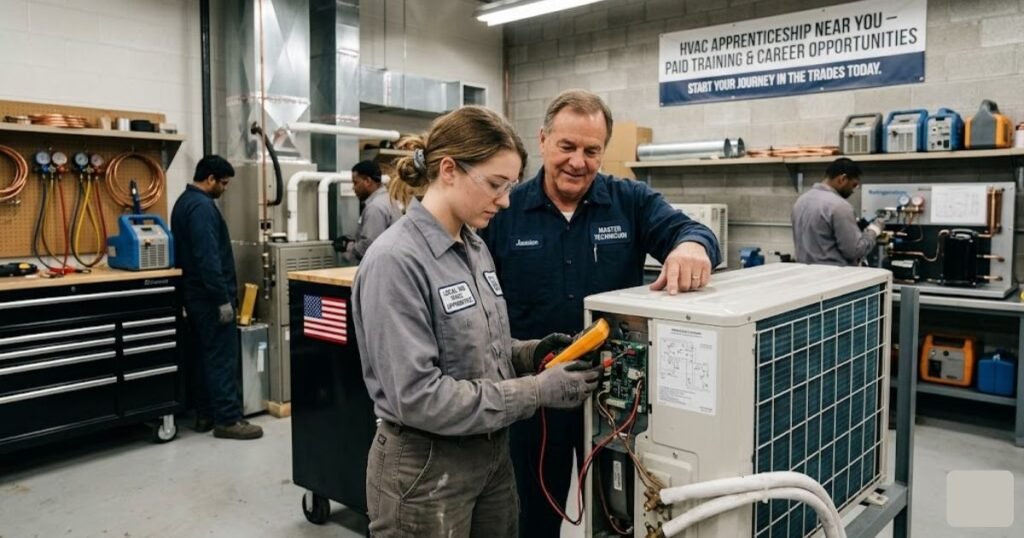
At its core, an HVAC apprenticeship is a “earn while you learn” training model. It is a formal arrangement where a beginner (the apprentice) works under the direct supervision of a licensed, experienced professional (the journeyman or master technician).
Unlike a standard classroom environment where you might only read about blueprints and electrical circuits, an apprenticeship puts you in the field. You aren’t just a student; you are an employee.
The Three Pillars of an Apprenticeship:
- On-the-Job Training (OJT): You spend the majority of your time at actual job sites residential homes, commercial buildings, or construction zones learning how to install, repair, and maintain units.
- Classroom Instruction: Most reputable programs require a certain number of hours in a classroom or lab setting. Here, you learn the theory behind thermodynamics, electricity, and local building codes.
- Paid Work Experience: Perhaps the biggest draw is that you are paid for every hour you work. As your skills grow, your paycheck typically grows along with them.
Why Choose an HVAC Apprenticeship?
If you are weighing your career options, the benefits of a local HVAC apprenticeship are hard to ignore. It is one of the few career paths that allows you to bypass the “experience needed” trap that plagues many other industries.
1. Earn While You Learn
Most career paths require you to pay thousands of dollars in tuition before you ever earn a dime. In an HVAC apprenticeship, you are a paid member of a team from day one. While your starting wage might be lower than a veteran’s, you are essentially getting a free education while receiving a paycheck.
2. Avoid Massive Student Debt
The average college graduate leaves school with tens of thousands of dollars in loans. HVAC apprentices often finish their training with zero debt. In fact, many unions and private companies cover the cost of your technical schooling as part of your employment agreement.
3. Practical, High-Demand Skills
HVAC isn’t a “luxury” service; it’s a necessity. As long as people live in houses and work in offices, they will need climate control. This means your skills will always be in demand, regardless of how the economy is performing.
4. Rapid Career Growth
Once you complete your apprenticeship and earn your license, the door swings wide open. You can specialize in commercial refrigeration, become a lead installer, or eventually start your own business. The ceiling in this industry is as high as you want to build it.
READ MORE: Best AC Technician Near Me | Licensed & Insured
How to Find HVAC Apprenticeship Programs Near You
When you type “HVAC apprenticeship near me” into a search engine, you might be overwhelmed by the results. The key is knowing where to look for quality programs that actually lead to licensure.
1. Check with Local Unions
The United Association (UA) of Journeymen and Apprentices of the Plumbing and Pipefitting Industry is a major player in HVAC training. Union apprenticeships are highly structured, offer excellent benefits, and are recognized nationwide. Search for your local UA union hall to see when they are accepting applications.
2. Contact Local HVAC Contractors
Many private companies run their own “in-house” apprenticeship programs. Small-to-medium-sized local businesses are often looking for hard-working “helpers” who they can train from the ground up. Don’t be afraid to call local companies and ask if they are hiring apprentices or helpers.
3. Visit Trade Schools and Community Colleges
Even if you want an apprenticeship, your local community college is a great resource. They often have partnerships with local businesses. They can help place you in a paid HVAC apprenticeship while you attend their night classes.
4. Use Local Workforce Centers
Your state’s Department of Labor or local workforce development office often keeps a registry of “Registered Apprenticeships.” These are programs that meet specific state and federal standards for quality and safety.
5. Online Search Tips
To get the best results for a local HVAC apprenticeship, try these specific search terms:
- “HVAC apprentice jobs [Your City, State]”
- “HVAC training near me”
- “Entry-level HVAC helper [Your County]”
- “Registered HVAC apprenticeship programs in [Your State]”
READ MORE: Emergency HVAC Service Near Me | Local HVAC Repair & Installation Services
HVAC Apprenticeship Requirements
Before you start applying, you need to make sure you meet the basic criteria. While every program is slightly different, most share a common set of requirements.
- Age: You generally must be at least 18 years old.
- Education: A high school diploma or GED is almost always required. If you are still in high school, focusing on shop classes, math, and physics can give you a head start.
- Driver’s License: This is non-negotiable for most employers. You will likely need a clean driving record, as you may eventually be responsible for driving a company service van.
- Physical Stamina: You will be lifting heavy equipment, climbing ladders, crawling into tight attic spaces, and working in extreme temperatures.
- Basic Skills: You don’t need to be a math genius, but you should have a solid grasp of basic algebra and the ability to read and follow technical manuals.
What Do HVAC Apprentices Actually Learn?
An HVAC system is a complex marriage of mechanical parts, electrical circuits, and chemical reactions. Your HVAC career training will cover a wide range of disciplines to ensure you can handle any situation.
Technical Skills
- Heating Systems: Learning how gas furnaces, boilers, and heat pumps function.
- Cooling Systems: Understanding the refrigeration cycle, compressors, and condensers.
- Electrical Basics: Wiring thermostats, testing circuits with multimeters, and understanding voltage and amperage.
- Refrigerant Handling: You will learn how to safely recover and charge refrigerants. This usually includes preparing for the EPA 608 Certification, which is required by law for anyone handling refrigerants.
- Piping and Braze: Mastering how to cut, bend, and join copper tubing using torches.
Soft Skills
- Customer Service: You are often entering people’s homes during stressful situations (like when their AC dies in 100-degree weather). Learning how to communicate professionally is vital.
- Documentation: Keeping accurate logs of work performed and parts used.
- Safety Practices: This is the most important part. You’ll learn about “Lockout/Tagout” procedures, ladder safety, and how to handle pressurized gases.
READ MORE: Carrier Heat Pump Reviews (2026) — Models, Costs, Pros & Cons
How Long Does an HVAC Apprenticeship Take?
The journey from a “green” beginner to a skilled technician isn’t overnight. On average, a comprehensive HVAC apprenticeship program takes between 3 to 5 years to complete.
The length depends on a few factors:
- State Requirements: Different states have different laws regarding how many “on-the-job” hours are required before you can sit for a journeyman’s exam (often around 6,000 to 8,000 hours).
- Program Structure: Union programs are usually a fixed five-year path. Private company programs might move faster depending on how quickly you master the skills.
- Your Dedication: If you work full-time and take extra classes, you may be able to fast-track certain certifications.
While five years might sound like a long time, remember that you are getting paid for the entire duration. By the time you finish, you are a seasoned pro with years of experience.
Do HVAC Apprentices Get Paid?
Yes! One of the best things about searching for an HVAC apprenticeship near me is that these are paid positions.
Typically, an apprentice starts at about 40% to 50% of what a fully qualified journeyman makes. However, most programs have a “wage progression” scale. For example, every 1,000 hours of work or every successfully completed semester of school might trigger a scheduled pay raise.
By the time you reach your third or fourth year, you could be making a very comfortable living all before you’ve even officially “graduated” to technician status.
READ MORE: Heat Pump vs AC: Which Is Better for U.S. Homeowners?
HVAC Apprentice vs. HVAC Technician: What’s the Difference?
It’s easy to get these terms confused, but there is a clear distinction in the industry.
| Feature | HVAC Apprentice | HVAC Technician |
| Experience Level | Beginner/Entry-level | Experienced/Licensed |
| Supervision | Works under a journeyman | Often works independently |
| Responsibility | Assists with installs and basic repairs | Diagnoses complex issues and signs off on work |
| Licensure | Working toward a license | Holds state/local licenses (and EPA 608) |
| Pay | Entry-level to mid-range | High-range with performance bonuses |
Think of the apprentice as the “co-pilot” who is learning the controls, while the technician is the “captain” responsible for the entire flight.
Tips for Choosing the Right Apprenticeship
Not all apprenticeships are created equal. When you find a local HVAC apprenticeship opportunity, ask these questions to ensure it’s the right fit for your future:
- Is the program accredited? Check if the training is recognized by the state licensing board.
- What is the pay structure? Ask for a written schedule of how and when your raises will occur.
- Does the company provide tools? Some companies provide a basic tool kit or a “tool allowance,” while others expect you to buy your own from day one.
- Will they help with certifications? A good program should actively prepare you for the EPA 608 exam and other NATE (North American Technician Excellence) certifications.
- What is the “culture” like? You’ll be spending 40+ hours a week with these people. Look for a company that prioritizes safety and mentorship over just “getting the job done fast.”
READ MORE: Is a Heat Pump Worth It in Summer? A Simple Homeowner’s Guide
Career Opportunities After Your Apprenticeship
Completing your training is just the beginning. The HVAC world is massive, and you can take your career in many different directions:
- Residential Service Technician: Working directly with homeowners to fix and maintain their systems.
- Commercial HVAC Specialist: Working on massive chillers and boilers for hospitals, skyscrapers, and data centers.
- HVAC Installer: Focusing on the construction side putting in brand-new systems in new homes or buildings.
- Sales and Estimating: Using your technical knowledge to help customers choose the right systems for their needs.
- Business Owner: Many of the most successful HVAC companies were started by people who began as apprentices. Once you have the license and the experience, you can be your own boss.
Common Mistakes to Avoid
Starting a new career is exciting, but don’t let that excitement lead to poor decisions. Avoid these common pitfalls:
- Chasing the Highest Starting Pay Only: A company might offer $2 more per hour but have zero actual training or mentorship. Focus on the long-term education, not just the starting wage.
- Ignoring Safety Rules: In HVAC, shortcuts can be deadly. Always wear your PPE (Personal Protective Equipment) and never touch a circuit you haven’t tested yourself.
- Skipping the Classroom: It’s tempting to think you only need the hands-on part. But without the theory, you’ll never be able to troubleshoot the really difficult problems that earn the big bucks.
- Not Researching Local Licensing: Every state has different rules. Make sure the hours you are working actually count toward the license you want.
Conclusion
If you’ve been searching for an HVAC apprenticeship near me, you are already on the path to a rewarding and resilient career. This isn’t just a “job”—it’s a trade that allows you to build a life of independence and financial stability.
While the training requires hard work, long hours, and a willingness to get your hands dirty, the payoff is immense. You get to solve problems, help your community, and join a brotherhood of skilled professionals who keep the world running comfortably.
Take the first step today. Reach out to local contractors, visit a union hall, or look into your local community college. The future of the HVAC industry is waiting for its next generation of experts and that could be you.
Frequently Asked Questions (FAQ)
How do I find an HVAC apprenticeship near me?
The best way to find a local apprenticeship is to search for “Registered Apprenticeship Programs” through your state’s Department of Labor website. Additionally, you can contact local HVAC unions (like the UA) or call reputable HVAC contractors in your city to ask about entry-level “helper” or apprentice positions.
Do HVAC apprentices get paid while training?
Yes, absolutely. One of the defining features of an apprenticeship is that it is a paid position. You will receive an hourly wage for your work in the field, and many programs also offer scheduled raises as you hit specific training milestones.
How long does it take to become an HVAC technician?
It generally takes between 3 to 5 years of apprenticeship training to become a fully qualified HVAC technician. This timeline ensures you have the thousands of hours of hands-on experience required by most states to sit for a licensing exam.
What qualifications do I need for an HVAC apprenticeship?
Most programs require you to be 18 years old, have a high school diploma or GED, and possess a valid driver’s license. You should also be physically fit enough to handle tools, climb ladders, and work in various weather conditions.
Is HVAC a good career for beginners?
HVAC is an excellent career for beginners because it offers a clear, structured path from “zero experience” to “expert.” Because the demand for climate control is constant, it provides a level of job security that many other modern careers simply cannot match.