If you’ve gotten quotes for a new heat pump lately, you already know the sticker shock. Premium systems can run well into five figures installed, and the Carrier Infinity line sits near the top of that price ladder. So before you sign anything, it’s worth asking the obvious question: is a Carrier Infinity heat pump actually worth the extra money, or are you just paying for a badge?
I’ve spent 11 years around HVAC installs, and I’ll walk you through what the Infinity line actually delivers the good, the disappointing, and the stuff most sales brochures gloss over. This guide is for homeowners comparing Carrier Infinity heat pump reviews against real installed pricing, current SEER2/HSPF2 numbers, and competing brands like Trane, Lennox, Bosch, and Mitsubishi, so you can make a decision you won’t regret in year three. Lets deep dive into “Carrier Infinity Heat Pump Reviews: Is It Worth the Cost?”
Key Takeaways
- Carrier Infinity heat pumps top out around 20–23 SEER2 and 9.5–10.5 HSPF2, depending on the model, with outdoor sound as low as 51–54 dB.
- Installed pricing typically runs $13,000–$21,500 for a full system replacement, varying by tonnage, ductwork condition, and region.
- Carrier’s standard warranty is 10-year parts (or 5-year parts + 3-year labor), but only if you register within 90 days.
- The federal 25C tax credit that used to knock up to $2,000 off a qualifying heat pump expired for equipment installed after December 31, 2025. Budget around state and utility rebates instead.
- Homeowner reviews are polarized: people who get a properly sized, well-commissioned system rave about the comfort and quiet; people who get a rushed install report expensive, hard-to-diagnose failures.
READ MORE: Carrier Heat Pump Reviews — Models, Costs, Pros & Cons

What Is the Carrier Infinity Heat Pump?
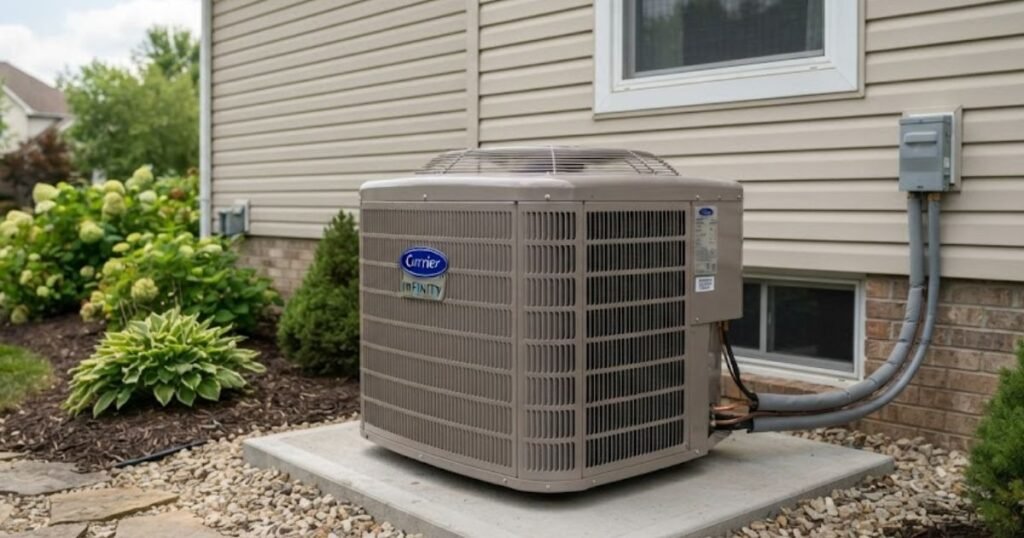
The Infinity series is Carrier’s flagship residential lineup, sitting above the Performance and Comfort tiers. Every current Infinity heat pump uses a variable-speed compressor paired with Greenspeed Intelligence, Carrier’s software that continuously adjusts output anywhere from roughly 20-30% up to 100% capacity instead of just switching on and off like a basic system.
That matters for two reasons. First, running longer at lower speeds pulls more moisture out of the air, so humidity control is noticeably better than a single-stage unit. Second, it’s simply quieter, since the compressor isn’t slamming from off to full blast every cycle.
Here’s what typically comes with an Infinity system:
- Variable-speed compressor that fine-tunes output to match the home’s actual load
- Infinity System Control thermostat for zoning, scheduling, and diagnostics
- Wi-Fi connectivity with remote monitoring and over-the-air updates
- Cold-climate heating down to roughly -13°F on standard models (colder on the dedicated cold-climate unit)
- Compatible indoor air handlers and coils engineered specifically for communicating operation
Carrier positions Infinity as the line for buyers who plan to stay in their home long-term and want the quietest, most precise comfort the company sells not the cheapest way to heat and cool a house.
Carrier Infinity Models Compared
Carrier offers three primary models within its premier lineup, each tailored to different climate demands and efficiency targets. Under current SEER2 and HSPF2 testing protocols, these models have been thoroughly updated to reflect accurate real-world operational efficiencies.
| Specification/Feature | Carrier Infinity 20 (27VNA0) | Carrier Infinity 23 (27VNA3) | Carrier Infinity 24 (25VNA4) |
| Cooling Efficiency | Up to 20 SEER2 / 11.5 EER2 | Up to 23 SEER2 / 13.5 EER2 | Up to 22 SEER2 / 14 EER2 |
| Heating Efficiency | Up to 9.5 HSPF2 | Up to 10.5 HSPF2 | Up to 10.5 HSPF2 |
| Compressor Type | Variable-Speed | Variable-Speed | Variable-Speed |
| Capacity Modulation Range | 30% – 100% | 30% – 100% | 25% – 100% |
| Lowest Sound Rating | 54 dBA | 53 dBA | 51 dBA |
| ENERGY STAR® Certified | Yes | Yes | Yes |
| Refrigerant Type | Puron Advance™ (R-454B) | Puron Advance™ (R-454B) | Puron Advance™ (R-454B) |
| Cold Climate Heating | Good | Excellent (Down to -13°F) | Excellent (Down to -15°F) |
| Thermostat Compatibility | Infinity System Control | Infinity System Control | Infinity System Control |
| Best For | Moderate northern & southern states | Regions with high utility rates | Severe cold or extreme humidity |
| Est. Installed Cost Range | $11,500 – $15,500 | $13,500 – $17,500 | $14,500 – $19,500 |
Note on Efficiency Ratings: The Carrier Infinity 24 review profile highlights its broader modulation capability (down to 25%), which can sometimes yield superior real-world energy profiles over the Carrier Infinity 23 review model depending on your local ductwork configuration and home structural design.
READ MORE: Goodman Heat Pump Review | Efficiency, Cost, Pros & Cons

Carrier Infinity Heat Pump Key Features Explained
- Greenspeed Intelligence is the core technology that separates Infinity from Carrier’s cheaper tiers. It reads outdoor and indoor conditions and adjusts compressor speed in small increments rather than big jumps, which keeps indoor temperatures within a tighter band.
- Ideal Humidity System technology lets the system run longer at low speed specifically to wring moisture out of the air Carrier claims up to 400% more moisture removal than a standard single-stage system in the right conditions. If you live somewhere humid, this is one of the more noticeable real-world upgrades.
- Silencer System II combines a compressor sound blanket, a redesigned fan blade, and a vibration-dampening base to keep outdoor noise down. This is the reason Infinity systems consistently post the lowest decibel ratings in Carrier’s lineup.
- Smart diagnostics and over-the-air updates mean your dealer can often see fault codes remotely before you even notice a problem, and Carrier can push performance updates without a truck roll.
- Dual-fuel compatibility lets the heat pump pair with a gas furnace for backup heat in extreme cold, which is common in colder states where a heat pump alone would need expensive electric resistance backup on the coldest days.
Carrier Infinity Heat Pump Performance Review
In day-to-day use, the variable-speed compressor is what most homeowners notice first. Instead of a blast of cold or hot air followed by silence, the system runs in the background at low speed most of the time, holding the house within about a degree of the setpoint.
- Cooling performance: Strong, especially paired with a matched variable-speed air handler; humidity stays noticeably lower than with a single-stage AC.
- Heating performance: Solid down to around -13°F on standard models; below that, expect the system to lean on auxiliary heat or a paired furnace.
- Defrost performance: Carrier’s advanced defrost cycles are generally efficient, though a handful of owners report defrost-related error codes on poorly commissioned units.
- Everyday usability: The Infinity System Control app and thermostat get generally good marks, though a few reviewers mention a learning curve and occasional Wi-Fi drops.

Carrier Infinity Heat Pump Energy Efficiency
SEER2 and HSPF2 are the two numbers that matter most. SEER2 measures cooling efficiency; HSPF2 measures heating efficiency. Higher is better on both. For reference, the current federal minimum is 14.3 SEER2 and 7.5 HSPF2 — an Infinity 23, at up to 23 SEER2 and 10.5 HSPF2, is running well above that floor.
There’s also COP (Coefficient of Performance), which tells you how much heat energy the system produces per unit of electricity it consumes. A heat pump with a COP of 2.5 at a given outdoor temperature is putting out 250% more heat energy than the electricity it uses — which is the whole appeal of a heat pump over resistance heat or, in many regions, over a gas furnace on a cost-per-BTU basis.
Realistic example: A homeowner replacing a 15-year-old single-stage heat pump with an Infinity 23 in a moderate climate might see cooling-season electricity use for that equipment drop by roughly 20-30%, plus a meaningful drop in winter electric heating cost if replacing electric resistance backup. Exact savings depend heavily on your old system’s condition, local electricity rates, and how well the new system is sized.
Tax Credit Update: The federal Section 25C Energy Efficient Home Improvement Credit, which previously covered 30% of a qualifying heat pump’s cost up to $2,000, expired for equipment installed after December 31, 2025, under the One Big Beautiful Bill Act. If you’re installing in 2026, don’t build that credit into your budget — instead, ask your installer about state energy office programs, utility rebates, and the federally funded HEAR (Home Electrification and Appliance Rebates) program, which is still rolling out state by state for income-qualifying households.
READ MORE: Lennox Heat Pump Review: Prices, Pros, Cons & Comparison
Carrier Infinity Heat Pump Noise Level Review
This is genuinely one of Infinity’s strongest selling points. Outdoor sound ratings run as low as 51 dB on the Infinity 24 and 53-54 dB on the 20 and 23 comparable to steady rainfall or a quiet conversation, and noticeably quieter than older single-stage heat pumps, which can run 65-72 dB under full load.
Several homeowners specifically mention not being able to tell the unit is running unless they look at the fan. That’s the Silencer System II components the compressor sound blanket and vibration-isolating base doing their job. If noise near bedroom windows or a small side-yard is a priority, Infinity is a legitimate reason to pay the premium over Carrier’s Performance tier.
Carrier Infinity Heat Pump Smart Features
You cannot operate an Infinity heat pump with a generic smart thermostat or a third-party retail control option without stripping away the system’s core capabilities. To unlock its variable-speed modulation and advanced comfort routines, the system must be paired with the proprietary Carrier Infinity thermostat (the Infinity System Control).
Advanced Control Capabilities
- Intuitive Zoning: The controller can manage up to eight independent residential zones, monitoring distinct duct dampers to direct heating or cooling exactly where it is needed.
- Occupancy & Weather Adaptation: The thermostat tracks local outdoor weather patterns and monitors indoor humidity trends to adjust its internal staging cycles before outdoor temperature spikes hit your home.
- Real-Time Energy Tracking: Homeowners can view intuitive, clean visual charts detailing exactly how many kilowatt-hours of electricity the HVAC system consumed over the past day, week, month, or year.
- Advanced Remote Diagnostics: If the system detects an internal operating anomaly, it displays a clear fault code on screen and can automatically email an alert directly to your designated dealer, allowing for faster, more accurate service calls.
Carrier Infinity Heat Pump Installation
This is where a lot of Infinity satisfaction or dissatisfaction actually gets decided, and it has less to do with the equipment than with the installer.
- Load calculations matter. A proper Manual J calculation determines the right tonnage. Oversized systems short-cycle and struggle with humidity; undersized systems run constantly and can’t keep up on extreme days.
- Ductwork compatibility is the single most common issue installers report. If your existing ducts weren’t sized for a variable-speed system’s airflow, you may need modifications.
- Communicating controls take real setup time. Infinity’s variable-speed, communicating technology needs correct wiring and commissioning static pressure checks, refrigerant charge verification, and thermostat programming to perform as advertised.
- Typical installation timeline for a straightforward replacement is one to two days; jobs requiring ductwork changes or electrical panel upgrades can take longer.
Homeowner Tip: Ask your installer directly whether they’ve completed factory training on Infinity’s communicating systems. Several of the worst homeowner experiences with Infinity heat pumps trace back to installers who treated it like a standard single-stage swap instead of a fully commissioned, communicating system.
READ MORE: Ultra Quietest Heat Pump for Your Home: Review, Comparison & Cost
Carrier Infinity Heat Pump Cost
Installed pricing depends heavily on tonnage, your region’s labor rates, existing ductwork condition, and which model you choose. Based on current 2026 installer quotes and pricing guides:
| Cost Factor | Typical Range (Installed) |
| Infinity 20, 2-3 ton | $13,000 – $17,500 |
| Infinity 23, 3-4 ton | $15,500 – $19,500 |
| Infinity 24, 3-5 ton | $16,000 – $21,500 |
| Equipment only (no install) | $6,000 – $10,000 |
| New construction install | Generally lower than replacement, no demo/disposal cost |
| Common accessories (air purifier, zoning, surge protection) | $500 – $3,000 add-on |
Factors that push price up include larger tonnage, ductwork modifications, electrical panel upgrades for the new equipment, and higher local labor costs in tight-supply markets. Off-season scheduling (spring or fall) and getting multiple quotes are the two most reliable ways to bring the number down.
Carrier Infinity Heat Pump Warranty
Carrier’s Infinity heat pumps carry the Consumer Choice Warranty, and the terms genuinely change based on whether you register on time:
- 10-year parts limited warranty (compressor and covered functional parts), if you register within 90 days of installation or automatically in jurisdictions like California and Quebec where registration can’t be required.
- Alternative option: 5-year parts + 3-year labor, available only if your installing dealer participates in the Consumer Choice program. You choose one option or the other at registration; you can’t have both.
- If you don’t register within 90 days, coverage drops to a 5-year parts-only warranty a significant downgrade.
- 10-year unit replacement warranty is available on eligible equipment with timely registration, covering compressor failures specifically.
- Labor coverage beyond the manufacturer’s terms is up to your installing dealer ask specifically what labor warranty they’re including, since Carrier’s factory warranty on labor is limited even under Consumer Choice.
Don’t Skip This: Registration is genuinely the single most consequential paperwork step in this whole process. Missing the 90-day window can cut your parts coverage in half. Confirm with your installer, in writing, that they’ll register the equipment don’t assume it happens automatically.
READ MORE: Best Swimming Pool Heat Pump: Review, Comparison, and Buying Tips
Carrier Infinity Heat Pump Maintenance
A properly maintained Infinity system should comfortably reach 15-20 years of service. Here’s a seasonal checklist:
- Monthly: Check and replace air filters (variable-speed systems are sensitive to airflow restriction).
- Spring: Clean the outdoor coil, clear debris from around the unit, confirm proper drainage.
- Fall: Have a technician check refrigerant charge, inspect electrical connections, and verify defrost cycle operation.
- Annually: Schedule a professional tune-up — this is often a warranty condition, not just a suggestion.
- Ongoing: Keep the Infinity System Control’s software updated (usually automatic via Wi-Fi) and keep at least 2 feet of clearance around the outdoor unit.
Carrier Infinity Heat Pump Real Homeowner Reviews
Pulling from recent verified reviews and installer feedback, a consistent pattern shows up: satisfaction correlates strongly with installation quality, more than with the equipment itself.
Common positives:
- Noticeably quieter than the system it replaced
- Steady, even temperatures without the swings of older single-stage systems
- Strong humidity control, especially in muggy climates
- Lower summer and winter utility bills compared to older equipment
Common complaints:
- Higher upfront cost than Performance or Comfort tier systems
- A real learning curve with the Infinity System Control thermostat
- When installation is rushed or under-commissioned, owners report recurring error codes, icing issues, or components (like blower motors or control boards) failing well before the warranty-implied lifespan
- A vocal minority describe difficult, drawn-out warranty claims when major electronic components fail out of pocket
The takeaway: this is not “set it and forget it forever” equipment. It rewards a well-trained installer and prompt registration, and it can frustrate owners who got a rushed install from a lower-tier dealer.
Carrier Infinity Heat Pump Pros and Cons
Pros
- Among the quietest heat pumps on the market (51-54 dB outdoor)
- Excellent humidity control from extended low-speed run times
- Strong SEER2/HSPF2 ratings, especially on the Infinity 23 and 24
- Robust smart thermostat and remote diagnostics
- Wide dealer network for service across the U.S.
Cons
- Premium pricing often 20-50% more than Carrier’s Performance tier for comparable tonnage
- Warranty coverage drops significantly if you miss the 90-day registration window
- Some proprietary electronic components (like variable-speed control boards) are expensive to replace out of warranty
- Performance is highly installer-dependent; a poor install can undercut the equipment’s real capability
READ MORE: Trane Heat Pump Review — Comparison, Pros, Cons & Costs
Carrier Infinity vs Competitors
| Brand & Model | SEER2 | HSPF2 | Noise | Compressor Warranty | Best Climate |
| Carrier Infinity 23 | Up to 23 | Up to 10.5 | 53 dB | 10-yr parts (registered) | Cold, humid |
| Trane XV20i | Up to ~20.5 | Up to 8.7 | Low-60s dB range | 12-yr compressor | Extreme heat/cold durability |
| Lennox SL25XPV | Up to 23-24 | Up to 10.3 | ~58 dB | 10-yr parts | High-efficiency priority |
| Bosch IDS Ultra | Up to 19 | Up to 10 | Mid-range | 10-yr parts | Extreme cold (-13°F+ start temp) |
| Mitsubishi Hyper-Heat (H2i) | Up to 19-20 | Up to 12.5 | 51 dB outdoor | 12-yr compressor | Coldest climates, ductless flexibility |
Carrier Infinity Heat Pump Buying Tips
- Get at least three quotes from Carrier Factory Authorized Dealers pricing varies significantly by region and installer.
- Confirm your installer does a real Manual J load calculation — don’t accept “rule of thumb” sizing based on your old unit’s tonnage.
- Ask about registration — confirm in writing that the dealer will register your equipment within 90 days.
- Check current state and utility rebates — with the federal 25C credit gone, local incentives are now the main lever for lowering your net cost.
- Ask about financing terms — many dealers offer 0% promotional financing windows; compare the total cost against paying cash.
- Request the specific model’s AHRI-matched rating, not just the “up to” number on the brochure actual efficiency depends on your matched indoor coil/air handler.
While Buying Carrier Infinity Heat Pump Common Mistakes to Avoid
- Skipping the load calculation and letting the installer size the unit based on the old system alone.
- Missing the 90-day warranty registration window — this alone can cut your parts coverage from 10 years to 5.
- Assuming any HVAC installer can properly commission a communicating system — ask specifically about Infinity/variable-speed training.
- Comparing only the “up to” SEER2 numbers across brands without checking your specific matched system’s AHRI-certified rating.
- Forgetting to budget for accessories like a whole-home surge protector, which several long-term owners recommend given the cost of Infinity’s electronic components.
Final Rating
| Category | Score (out of 10) |
| Comfort | 9.0 |
| Efficiency | 8.5 |
| Noise | 9.5 |
| Reliability | 7.5 |
| Value | 7.0 |
| Overall Score | 8.3 / 10 |
Final Verdict
The Carrier Infinity heat pump line earns its premium reputation in the areas that matter most day-to-day: it’s quiet, it holds a steady temperature, and it handles humidity better than most systems on the market. The efficiency numbers are competitive with anything from Trane or Lennox, and the smart control platform is genuinely useful once you’re past the learning curve.
Where it gets shakier is reliability and value not because the equipment is poorly engineered, but because its sophistication raises the stakes on installation quality and warranty registration. A well-commissioned Infinity system from an experienced dealer tends to run for 15-20 years with minimal drama. A rushed install from an inexperienced contractor is where most of the negative reviews come from.
Frequently Asked Questions
Is the Carrier Infinity heat pump worth the money?
If you plan to stay in the home for 10+ years and live somewhere with real heating or cooling demand, the comfort and efficiency gains generally justify the extra cost. If you’re moving soon or on a tight budget, a mid-tier system may make more financial sense.
How long does a Carrier Infinity heat pump last?
With proper installation, correct sizing, and annual maintenance, most Infinity systems last 15-20 years.
What is the difference between Carrier Infinity 20, 23, and 24?
The main differences are efficiency ceiling and noise level. The Infinity 20 tops out around 20 SEER2/9.5 HSPF2, the Infinity 23 reaches up to 23 SEER2/10.5 HSPF2, and the Infinity 24 reaches up to 22 SEER2/10.5 HSPF2 with the quietest rated operation, as low as 51 dB.
How much does a Carrier Infinity heat pump cost installed?
Expect roughly $13,000 to $21,500 for a full installed system in 2026, depending on tonnage, model, ductwork condition, and regional labor rates.
Is Carrier Infinity better than Trane or Lennox?
It depends on what you’re optimizing for. Carrier’s Infinity 23/24 generally posts higher SEER2 and HSPF2 numbers than Trane’s XV20i, while Lennox’s SL25XPV is Carrier’s closest rival on raw efficiency and sometimes edges it out.
This guide reflects Carrier’s published specifications, warranty terms, and market pricing as of mid-2026. Always confirm current model availability, AHRI-matched ratings, warranty terms, and local rebates with a Carrier Factory Authorized Dealer before making a final decision.