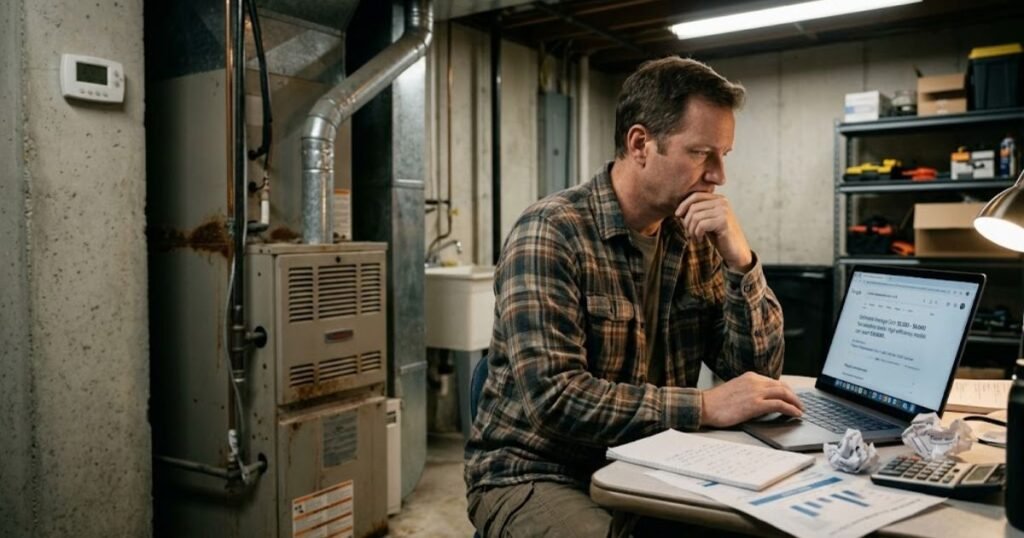
I’ve spent more than 15 years climbing into attics, crawlspaces, and basements across the country replacing furnaces that were wheezing their last winter. If there’s one thing I’ve learned, it’s that almost nobody pays the “sticker price” they expected.
They either overpay because they didn’t understand what they were buying, or they get a lowball quote that turns into a change order once the crew shows up. This guide is meant to fix that. No sales pitch, no fluff, just what things actually cost and why. Lets deep dive into “Furnace Replacement Cost in USA (2026)”
Key Takeaways
- National average installed cost: ~$4,800, with most homeowners paying $2,800–$7,500+
- Gas furnaces remain the most popular and cost-effective option in most of the country
- Higher AFUE ratings cost more upfront but pay you back through lower utility bills
- Home size and BTU load not brand name is the single biggest driver of base cost
- Labor typically makes up 30–50% of the total project cost
- Getting 3 written estimates is still the most reliable way to avoid overpaying
READ MORE: Heat Pump vs. Furnace vs. Boiler: Cost & Efficiency Comparison
Average Furnace Replacement Cost in USA
| Tier | Installed Cost Range | What You Get |
| Budget replacement | $2,800 – $3,800 | Standard-efficiency (80% AFUE) gas or electric furnace, basic labor, no ductwork changes |
| Mid-range | $3,800 – $5,800 | 90–95% AFUE furnace, better warranty, some ductwork or venting adjustments |
| Premium/high-efficiency | $5,800 – $7,500+ | 96–98% AFUE variable-speed furnace, smart thermostat, premium labor and warranty |
| National average | ~$4,800 | Mid-tier gas furnace, standard installation, single-family home |
Equipment alone typically runs $1,500–$4,000, while labor, permits, and miscellaneous materials add another $1,300–$3,500 on top. That split is worth remembering — a suspiciously cheap “installed” quote is often missing something on the labor or materials side, which tends to show up later as a change order.

Furnace Replacement Cost by Fuel Type
1. Gas Furnace
Average installed cost: $3,800 – $7,500
Gas furnaces are the workhorse of American heating. They heat fast, run efficiently, and fuel costs are generally lower than electricity in most regions.
- Pros: Fast, powerful heat; lower operating costs in most markets; wide range of efficiency options
- Cons: Requires gas line and venting; combustion byproducts require CO safety monitoring
- Best for: Homes already on natural gas, cold climates, larger homes
- Maintenance: $100–$200/year for a tune-up
- Expected lifespan: 15–20 years
2. Electric Furnace
Average installed cost: $2,000 – $5,500
Electric furnaces have simpler mechanics — no combustion, no venting — which keeps installation costs down.
- Pros: Lower upfront cost, no gas line needed, quieter, longer lifespan
- Cons: Higher monthly operating cost, especially in cold climates
- Best for: Mild climates, homes without gas access, secondary/backup heating
- Maintenance: $75–$150/year
- Expected lifespan: 20–30 years
3. Oil Furnace
Average installed cost: $6,000 – $9,500
Oil furnaces are common in older homes across the Northeast, where natural gas lines aren’t always available.
- Pros: Strong heat output, works well in extreme cold
- Cons: Highest equipment cost, requires oil tank maintenance, fuel price volatility
- Best for: Rural/older Northeast homes already set up for oil delivery
- Maintenance: $150–$300/year, plus periodic tank service
- Expected lifespan: 15–25 years
4. Propane Furnace
Average installed cost: $3,500 – $7,000
Propane furnaces work similarly to gas furnaces but are common where natural gas lines don’t reach.
- Pros: Efficient combustion heat, good option off the gas grid
- Cons: Requires a propane tank and delivery contract; fuel cost fluctuates
- Best for: Rural homes without natural gas access
- Maintenance: $100–$200/year
- Expected lifespan: 15–20 years
| Fuel Type | Installed Cost | Operating Cost | Lifespan |
| Gas | $3,800 – $7,500 | Low–Moderate | 15–20 yrs |
| Electric | $2,000 – $5,500 | Moderate–High | 20–30 yrs |
| Oil | $6,000 – $9,500 | High | 15–25 yrs |
| Propane | $3,500 – $7,000 | Moderate–High | 15–20 yrs |
READ MORE: Gas Water Heater Replacement Cost (2026) — What Homeowners Pay & Why

Furnace Cost by Efficiency (AFUE)
AFUE (Annual Fuel Utilization Efficiency) tells you what percentage of fuel actually becomes heat in your home versus what’s lost up the flue. A 96% AFUE furnace turns 96 cents of every fuel dollar into heat; the rest escapes as exhaust.
| AFUE Rating | Typical Cost Range | Best Climate | Rough Payback Period |
| 80% | $2,800 – $4,500 | Mild climates, low use | N/A (baseline) |
| 90% | $3,800 – $5,500 | Moderate climates | 5–8 years |
| 92% | $4,200 – $6,000 | Moderate–cold climates | 5–7 years |
| 95% | $4,800 – $6,800 | Cold climates | 4–7 years |
| 96% | $5,200 – $7,200 | Cold climates, heavy use | 4–6 years |
| 98% | $5,800 – $7,800+ | Very cold, high-use climates | 5–8 years |
Expert tip: In warmer southern states, chasing a 98% AFUE furnace rarely pays off your furnace just doesn’t run enough hours per year to recoup the extra cost. That money is often better spent on a variable-speed blower or better duct sealing.
READ MORE: Best ecobee Smart Thermostat Review: Essential vs Enhanced vs Premium

Furnace Replacement Cost by Home Size
Furnace sizing is based on heating load (measured in BTUs), not just square footage but square footage gives a useful starting estimate before a proper load calculation.
| Home Size | Typical BTU Output | Estimated Installed Cost |
| 800 sq ft | ~40,000 BTU | $2,800 – $4,200 |
| 1,000 sq ft | ~45,000 BTU | $3,000 – $4,500 |
| 1,200 sq ft | ~50,000 BTU | $3,200 – $4,800 |
| 1,500 sq ft | ~60,000 BTU | $3,600 – $5,200 |
| 2,000 sq ft | ~80,000 BTU | $4,200 – $6,000 |
| 2,500 sq ft | ~90,000 BTU | $4,800 – $6,800 |
| 3,000 sq ft | ~100,000 BTU | $5,200 – $7,200 |
| 4,000 sq ft | ~120,000 BTU | $6,000 – $8,500 |
💡 Money-Saving Tips: Never let a contractor size your furnace off square footage alone. Insist on a Manual J load calculation. Oversized furnaces short-cycle, wear out faster, and leave rooms unevenly heated; undersized ones run constantly and still can’t keep up on the coldest days.
Furnace Replacement Cost by U.S. Region
| Region | Typical Installed Cost | Key Cost Drivers |
| Northeast | $4,500 – $8,000 | Higher labor rates, more oil furnaces, older homes/ductwork |
| Midwest | $3,800 – $6,800 | High cold-weather demand, moderate labor costs |
| South | $3,200 – $6,000 | Lower labor costs, smaller units, less extreme cold |
| Southwest | $2,800 – $5,500 | Lower heating demand overall, smaller equipment |
| West Coast | $4,200 – $7,500 | Higher labor and permit costs, stricter efficiency codes |
Local demand matters too contractors in areas with a short, brutal winter often book solid in October and November, and emergency mid-winter replacements almost always cost more than a planned summer or fall install.
READ MORE: Best Tankless Water Heater— Top Picks, Costs & Buyer’s Guide

Factors That Affect Furnace Replacement Cost
- Furnace size (BTU output): Bigger homes need bigger, pricier units
- Brand: Premium brands cost more but often carry better warranties
- Labor: Typically 30–50% of total project cost
- Ductwork: Repairs or modifications can add $500–$3,000+
- Venting: Switching vent types (e.g., high-efficiency furnaces need PVC venting) adds cost
- Gas line work: New or relocated gas lines run $200–$1,000+
- Electrical upgrades: New circuits or panel work can add $300–$1,500
- Permits: Usually $50–$300 depending on municipality
- Thermostat upgrades: $150–$500 installed
- Smart thermostats: $200–$600 installed
- Air filtration add-ons: $300–$1,200
- Humidifiers: $400–$1,000 installed
- Accessibility: Attic or crawlspace installs cost more in labor
- Emergency replacement: Expect a 10–30% premium for same-day/urgent service
- Old furnace removal & disposal: Usually $100–$300, sometimes bundled into the quote
Furnace Installation Labor Cost
Average labor cost: $1,200 – $3,000, depending on complexity
A standard furnace swap (same fuel type, same location, no ductwork changes) typically takes a two-person crew 4–8 hours. Jobs involving fuel-type conversion, ductwork rework, or difficult attic access can stretch to 1–2 full days.
What’s usually included in labor pricing:
- Removal and disposal of the old unit
- Installation and connection of the new furnace
- Venting and electrical hookup
- System startup, calibration, and safety testing
Permit fees: $50–$300 | Inspection costs: Often included in permit fee, or $75–$150 separately.
READ MORE: 8 Best DREO Smart Tower Fans: Review & Comparison

Furnace Brands and Pricing
| Brand | Price Range | Warranty | Reliability | Best For |
| Carrier | $4,500 – $8,500 | 10 yr parts (registered) | Very Good | Premium efficiency seekers |
| Trane | $4,800 – $9,000 | 10 yr parts | Excellent | Long-term reliability |
| Lennox | $4,600 – $8,800 | 10–20 yr parts | Very Good | High-efficiency homes |
| Goodman | $2,800 – $5,500 | 10 yr parts | Good | Budget-conscious buyers |
| Rheem | $3,200 – $6,500 | 10 yr parts | Good | Balanced value |
| American Standard | $4,500 – $8,500 | 10 yr parts | Excellent | Reliability-focused buyers |
| Bryant | $3,800 – $7,200 | 10 yr parts | Very Good | Mid-to-upper budgets |
| York | $3,200 – $6,200 | 10 yr parts | Good | Value-focused installs |
| Amana | $3,400 – $6,800 | Up to lifetime unit replacement* | Very Good | Long-term homeowners |
| Heil | $2,900 – $5,800 | 10 yr parts | Good | Budget replacements |
*Amana’s extended warranty tiers require professional registration and specific installer certification — confirm terms before assuming coverage.
Expert tip: Brand matters less than installer quality. A mid-tier furnace installed correctly by an experienced tech will consistently outperform a premium furnace installed poorly. Ask any contractor how many units of that specific model they’ve installed.
Repair vs Replace
| Factor | Repair Makes Sense | Replace Makes Sense |
| Furnace age | Under 10 years | Over 15 years |
| Repair cost | Under $500, isolated issue | Over 50% of replacement cost |
| Repair frequency | First issue in years | 2+ repairs in the last year |
| Efficiency | Still 80%+ AFUE | Older low-efficiency unit |
| Safety | No safety concerns | Cracked heat exchanger, CO risk |
A commonly used rule of thumb: if the furnace is over 15 years old and the repair cost exceeds 50% of a new unit, replacement is usually the better long-term financial decision.
READ MORE: Best Small Room 8000 BTU Portable Air Conditioner Units (Comparison & Reviews)
Hidden Costs Homeowners Forget
- Permit fees: $50–$300, often skipped by unlicensed installers (a red flag)
- Thermostat replacement: $150–$500 if your old one is incompatible
- Duct cleaning: $300–$700
- Duct replacement/repair: $500–$3,000+
- Asbestos removal (older homes): $1,500–$3,000+ if old ductwork/insulation contains asbestos
- Vent modifications: $200–$800
- Electrical upgrades: $300–$1,500
- Carbon monoxide detector installation: $50–$150
💡 Money-Saving Callout: Before you sign anything, ask your contractor point-blank: “Is this quote all-inclusive, or could permits, disposal, or ductwork be extra?” Get the answer in writing.
Furnace Replacement vs Heat Pump
| Factor | Gas Furnace | Heat Pump |
| Initial cost | $3,800 – $7,500 | $4,500 – $12,000+ |
| Energy efficiency | High (90–98% AFUE) | Very high in mild climates |
| Heating performance | Strong in extreme cold | Can struggle below ~25°F without backup heat |
| Cold climate suitability | Excellent | Good with cold-climate models, better paired with backup heat |
| Lifespan | 15–20 years | 15 years (also provides cooling) |
| Maintenance | $100–$200/year | $150–$300/year |
| Operating costs | Depends on gas prices | Depends on electricity prices; often lower in mild climates |
Heat pumps have gotten dramatically better in cold weather over the last decade, and many homeowners in moderate climates now install one instead of a furnace, or pair one with a furnace in a “dual-fuel” setup. If you live somewhere with real winters, a straight furnace replacement or a dual-fuel system is usually still the safer bet.
Signs You Need a New Furnace
- Furnace is over 15–20 years old
- Utility bills are climbing without a clear reason
- Uneven heating between rooms or floors
- Banging, screeching, or rattling noises
- Frequent repairs (more than once a year)
- Cracked heat exchanger (a safety issue, not optional)
- Visible rust on the unit or nearby ductwork
- Yellow (instead of blue) burner flame a possible carbon monoxide warning sign
- Poor indoor air quality, excess dust, or humidity issues
If you notice a yellow burner flame, a persistent burning smell, or your carbon monoxide detector goes off, that’s not a “schedule it for next month” situation shut the system down and call a licensed technician immediately.
Ways to Save Money on Furnace Replacement
- Get at least 3 written estimates — pricing for the same job can vary by $1,500 or more between contractors
- Replace during the off-season (late spring/summer) when demand and prices are lower
- Look for rebates — check ENERGY STAR-qualified equipment for rebate eligibility
- Check federal/state incentives — availability and amounts change yearly, so verify current programs before assuming eligibility
- Watch for manufacturer promotions — 0% financing or rebate periods are common in the fall
- Ask about utility rebates — many utility companies offer $50–$500+ for high-efficiency upgrades
- Consider financing — 12–18 month 0% APR plans are common and can beat paying cash if it frees up your emergency fund
- Bundle HVAC replacement — replacing a furnace and AC together often saves on shared labor
- Maintain your existing ductwork — sealing instead of replacing can save thousands if the ducts are structurally sound
Furnace Replacement Process
- Inspection: Technician assesses your current system and home
- Load calculation: Proper BTU sizing using a Manual J calculation
- Choosing equipment: Selecting fuel type, AFUE rating, and brand
- Permits: Contractor pulls required municipal permits
- Removal: Old furnace is disconnected and removed
- Installation: New unit is set, connected to gas/electric, ductwork, and venting
- Testing: Startup, calibration, and safety checks (including CO testing)
- Final inspection: Municipal inspector signs off (where required)
Most standard replacements are completed in a single day; complex jobs involving ductwork or fuel conversion may take longer.
Mistakes Homeowners Make
- Buying oversized equipment “just to be safe” — this actually reduces comfort and lifespan
- Choosing the lowest quote without confirming what’s included
- Ignoring AFUE ratings and only comparing sticker price
- Skipping permits to save money — this can cause problems at resale
- Hiring unlicensed contractors — always verify licensing and insurance
- Not checking warranty registration — many manufacturer warranties require registration within 60–90 days of install, and failing to register can cut your coverage significantly
Frequently Asked Questions
How much does it cost to replace a furnace in the USA?
Most homeowners pay between $2,800 and $7,500 installed, with a national average around $4,800. Final cost depends on fuel type, efficiency rating, home size, and labor complexity.
Is it cheaper to repair or replace a furnace?
Repair is usually cheaper short-term if the furnace is under 10 years old and the fix is under $500. Replacement typically makes more financial sense once the furnace is 15+ years old or repair costs exceed 50% of a new unit’s price.
How long does a new furnace last?
Most furnaces last 15–20 years with regular maintenance. Electric furnaces can last 20–30 years since they have fewer moving combustion parts.
Does homeowners insurance cover furnace replacement?
Typically only if the damage results from a covered peril, like a fire or burst pipe. Standard wear-and-tear failures are not covered — routine maintenance and eventual replacement are the homeowner’s responsibility.
What is the cheapest time of year to replace a furnace?
Late spring through summer, when HVAC companies have lower demand and are more likely to offer discounts or promotions to keep crews busy.
Final Verdict
A furnace replacement is a significant investment most homeowners will land somewhere between $2,800 and $7,500 installed, with $4,800 as a realistic national average to plan around. The best value isn’t always the cheapest or the most expensive unit; it’s the correctly sized, properly installed system that matches your climate and how long you plan to stay in the home.
If you’re on the fence, remember: replacement usually pencils out once your furnace is past 15 years old, breaking down repeatedly, or eating into your utility budget every winter. When you do replace it, get multiple written estimates, confirm what’s actually included, verify your contractor’s license and insurance, and register your warranty the day the job is done. A little diligence upfront is the difference between a furnace that quietly does its job for two decades and one that becomes a recurring headache.
Pingback: Best Whole-House Humidifier for Furnace: Review, Comparison & Installation - Plumbing Guider