The evolution of the residential thermostat from a simple bimetallic strip to a sophisticated, network-integrated environmental controller reflects the broader transformation of the modern American home. Within this landscape, Honeywell Home, now a cornerstone brand of Resideo Technologies following its high-profile spin-off, continues to define the standard for climate control reliability and innovation. For the U.S. homeowner in 2026, the challenge is no longer finding a thermostat that works, but rather selecting a model that aligns with specific HVAC architecture, smart home ecosystem preferences, and energy conservation goals. The current Honeywell lineup is bifurcated into distinct categories: the tried-and-true T-Series, the aesthetic-focused Color series, and the newly emergent X-Series, which introduces Matter certification and integrated security features to the thermostat interface.
Selecting the ideal Honeywell thermostat requires a nuanced understanding of the technical requirements governing modern HVAC systems. As homes become more energy-efficient and air-tight, the role of the thermostat has expanded to include indoor air quality (IAQ) monitoring and complex multi-stage equipment management. This guide provides a comprehensive analysis of the leading Honeywell models available in 2026, offering detailed insights into their performance, compatibility, and long-term value for homeowners seeking to optimize their living environment.
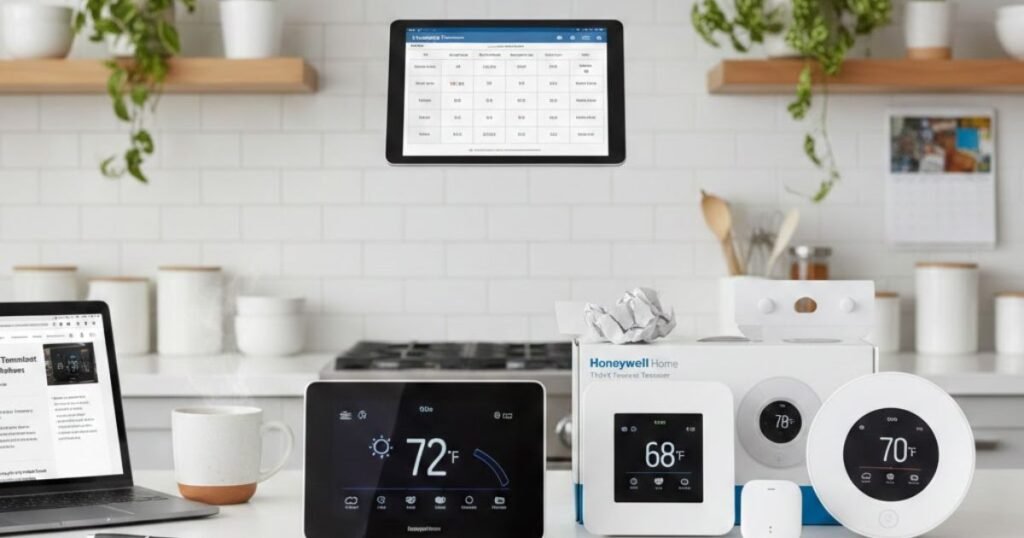
Best Honeywell Thermostat Models Comparison table
The following data represents verified retail information and technical specifications as of February 2026. This comparison highlights the core differences in technology, pricing, and optimal use cases across the flagship Honeywell lineup.
| Model | Type (Smart / Programmable / Matter) | Key feature (one short line) | Price (retailer & retrieval date) | Pros (2) | Cons (2) | Best for |
| Honeywell Home T9 | Smart | Advanced multi-room sensor prioritization | See Price | Accurate room balancing; responsive touchscreen | Requires C-wire; higher cost with extra sensors | Uneven home temperatures |
| Honeywell Home T10 Pro | Smart | RedLINK 3.0 support for long-range sensors | See Price | Professional-grade IAQ control; RedLINK reliability | Trade-focused install; higher MSRP than retail | Complex HVAC & IAQ setups |
| Honeywell Home T5 / T5+ | Smart | 7-day programming with geofencing | See Price | Affordable Wi-Fi control; simple geofencing | Limited sensor support; basic interface | Smaller homes/apartments |
| Honeywell T6 Pro | Smart / Programmable | High compatibility for professional installs | See Price | Supports 3H/2C systems; reliable local control | Less “sleek” design; app can be basic | Multi-stage systems |
| Honeywell Smart Color | Smart | Customizable color touchscreen display | See Price | Aesthetic customization; easy-to-read screen | No remote sensor support; 2.4GHz Wi-Fi only | Visual-focused users |
| Honeywell Home X2S | Matter / Smart | Budget-friendly Matter-certified hub | See Price | Matter interoperability; very affordable | No touchscreen; basic button interface | Matter ecosystem entry |
| Honeywell Home X8S | Matter / Smart | Ring doorbell video streaming on-screen | See Price | 5-inch premium display; IAQ monitoring | High price point; limited to specific doorbells | High-end smart home hubs |
price checked Feb 14, 2026. Data reflects current retail availability and verified manufacturer specifications.
READ MORE: Programmable Thermostat: The Complete 2026 Buyer’s Guide (Costs, Best Models & Installation)
Best Honeywell Thermostat Models deep dives
The current generation of Honeywell thermostats is built upon the foundational T-Series architecture, which standardizes the mounting and wiring interface across various price points. However, the internal logic and sensor compatibility vary significantly between models, necessitating a closer look at each flagship device.
1. Honeywell Home T9 Smart Thermostat — Overview
A mainstream smart thermostat that pairs with wireless room sensors (official Honeywell/Resideo smart room sensors) so you can prioritize rooms rather than the thermostat’s physical location.
Pros
- Room-sensor-based multiroom comfort.
- Geofencing + app schedule for automated away/home behavior.
Cons
- Requires a C-wire or adapter in some installs (Resideo documentation notes C-wire requirements and adapters).
- User interface is functional but not as modern as some rivals.
Who it’s for: Homeowners who want to balance comfort room-to-room without the higher cost of premium competitors.
Wiring & compatibility notes: The T9 requires a 24VAC common supply; Resideo’s T9 technical literature explains wiring needs and that a C-wire adapter is provided in some SKUs. Check your furnace/air handler control board before buying.
Check this & Get Discount here-
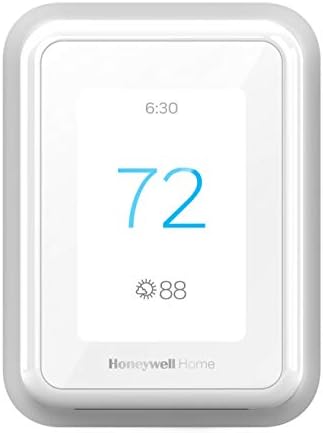
2. Honeywell T10 Pro Smart Thermostat — Overview
A higher-end, professional-focused thermostat that supports RedLINK wireless sensors, more HVAC stages with an optional Equipment Interface Module (EIM), and advanced control geared to technicians.
Pros
- Professional features: RedLINK sensor support and EIM for multi-stage control.
- Suitable for zoned and complex HVAC setups.
Cons
- Pricier than consumer models and often sold through pro channels or resellers.
- More complex install for DIYers.
Who it’s for: Installers and homeowners with zoned systems or multi-stage heat pumps who need professional-level integration.
Check this & Get Discount here-

- Honeywell THX321WFS3001W T10+ Pro Smart W/RedLINK 3.0 Thermostat and Indoor Air Sensor
3. Honeywell Home T5 / T5+ — Overview
A midrange Wi-Fi thermostat with geofencing and flexible programming; often sold at around $99–$109 at major retailers.
Pros
- Strong value for the price and ENERGY STAR certified SKUs are available.
- Simple schedule options and solid app control.
Cons
- No Honeywell room-sensor integration like the T9/T10.
- Design is utilitarian.
Who it’s for: Budget-focused smart upgrades renters and homeowners who want Wi-Fi and geofencing without premium cost.
Check this & Get Discount here-
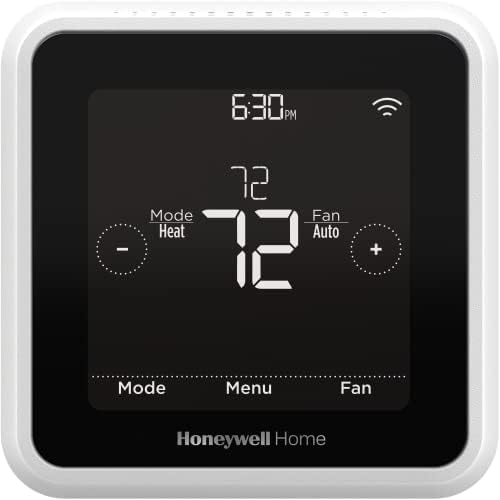
4. Honeywell T6 Pro (TH6220WF2006/U) — Overview
A popular programmable Wi-Fi thermostat that lands between DIY and pro features; commonly stocked by electronics retailers.
Pros
- Reliable for common HVAC systems and straightforward programming.
- Good choice for retrofits and contractor installs.
Cons
- Less advanced smartphone automation than T9/T10.
- Smaller display area.
Who it’s for: Technically confident DIYers and contractors who want stability and familiarity.
Check this & Get Discount here-
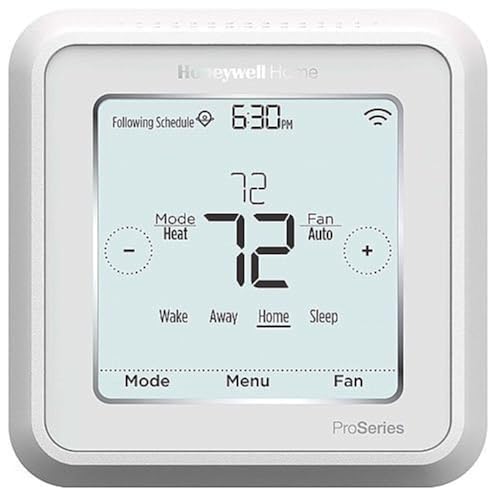
5. Honeywell Smart Color Thermostat (RTH9585WF) — Overview
Honeywell’s color touchscreen thermostat with Wi-Fi features and 7-day programming; trades higher-end sensors for a nicer display.
Pros
- Attractive color UI.
- Good set of Wi-Fi features.
Cons
- Bulkier than flush-mount designs.
- Not the top pick for multiroom sensor setups.
Who it’s for: Users who want a nicer display and the basics of Wi-Fi smart control.
Check this & Get Discount-

6. Honeywell Home X2S — Overview (Matter-capable budget model)
Honeywell’s entry-level Matter-capable thermostat (MSRP reported at $79.99) aimed at broad smart-home compatibility and energy savings. Launched spring 2025; widely covered by tech press.
Pros
- Matter support at a budget price makes it future-proof for multi-ecosystem homes.
- ENERGY STAR focused features and simple scheduling.
Cons
- Does not support Honeywell wireless room sensors (explicit manufacturer limitation).
- Simpler UI and fewer advanced HVAC controls.
Who it’s for: Buyers who want the cheapest path into Matter and a capable smart thermostat without room-sensor features.
Check this & Get Discount here-

READ MORE: How to Test a Water Heater Thermostat
Honeywell Thermostat Installation & wiring
Basic wiring facts (plain language):
- Most modern Honeywell smart thermostats run on 24VAC and commonly require a C-wire (common) to provide continuous power. If you don’t have a C-wire, many Honeywell models offer a C-wire adapter, but the adapter may not support all features or pro-level configurations.
- Single-stage heat/cool: look for labels on your control board such as R, G, Y, W, C. These map to thermostat terminals. Dual-stage or heat-pump systems add extra terminals and may require pro help.
- If your thermostat blanks or reboots on Wi-Fi pairing: check the C-wire first, then confirm wire color-to-terminal matches, and ensure power is off at the breaker during wiring.
Simple diagram language:
- Furnace control board → thermostat wires: R (power/24VAC hot), C (common), G (fan), Y (compressor/cool), W (heat).
- Heat pump installs: look for O/B and follow the thermostat manual for reversing valve wiring.
Common pitfalls
- Swapping wires by color alone (wires get re-used; test terminals).
- Not powering down the system before disconnecting old thermostat.
- Buying a thermostat incompatible with electric baseboard heat (many require line-voltage controls most Honeywell smart models are for low-voltage systems).
If you’re unsure, take a clear photo of your current control board and matching wires a pro or knowledgeable DIY installer can confirm compatibility quickly.
Smart home & integrations
Integration is the cornerstone of the smart home experience. In 2026, Honeywell’s commitment to interoperability has reached a new peak with the adoption of the Matter standard.
The Matter revolution (X-Series)
The Matter protocol allows the Honeywell X2S and X8S to communicate directly with other smart devices locally, rather than relying on the cloud. For the homeowner, this means that if the internet goes down, the thermostat can still participate in local automation, such as a “Goodnight” routine that dims the lights and locks the doors while adjusting the temperature. It also simplifies the setup process, as Matter-certified devices can be added to any compatible platform (Apple, Google, Amazon) using a single QR code.
Alexa, Google, and Apple Home compatibility
For the non-Matter models (the T-Series and Smart Color), integration is handled via cloud-to-cloud connections through the Resideo or Honeywell Home app.
- Amazon Alexa: Users can ask Alexa to change the temperature or check the current status of the thermostat. The X8S even includes a built-in smart speaker for direct interaction.
- Google Assistant: Seamlessly integrates with Google Home hubs, allowing for voice control and inclusion in complex routines.
- Apple Home (HomeKit): Most Wi-Fi-enabled T-Series models are HomeKit compatible, allowing for control via the Apple Home app and Siri. However, the T9’s remote sensors are sometimes limited in how they appear within the Apple ecosystem compared to the native Honeywell app.
READ MORE: 3-Ton Heat Pump: Cost, Sizing & Best Models
Sensors & zoning
Understanding the difference between sensor-based comfort and physical zoning is crucial for homeowners with multi-room temperature issues.
How Honeywell Smart Room Sensors work
The Smart Room Sensors (compatible with T9, T10, and X8S) measure temperature, humidity, and motion. They transmit this data back to the thermostat, which then makes a decision based on the user’s priority settings.
- Occupancy Detection: Sensors can detect when a room is in use and automatically instruct the thermostat to prioritize that room’s comfort.
- Averaging: Users can choose to average the temperature across all sensors to prevent one room from becoming drastically hotter or colder than the rest of the home.
- Scheduling: Priorities can be changed based on the time of day—for example, focusing on the living room during the day and the bedrooms at night.
Sensors vs. physical zoning
It is a common misconception that adding sensors creates a “zoned” home. True zoning requires motorized dampers in the ductwork that can open and close to direct air to specific areas. A thermostat with sensors simply keeps the furnace or AC running until the prioritized area is satisfied. While sensors are a highly effective and affordable way to improve comfort, they may result in “over-conditioning” non-priority rooms in order to satisfy the priority zone.
Energy savings & incentives
A smart thermostat is one of the few home upgrades that can pay for itself through reduced utility bills. Honeywell models are rigorously tested to meet ENERGY STAR specifications for efficiency.
Documented energy savings estimates
According to Resideo’s 2024 analysis of over 6,000 U.S. users, consistent use of scheduling and geofencing features provides measurable energy reductions.
- Heating Savings: Homeowners typically save 22% on heating energy consumption.
- Cooling Savings: Homeowners typically save 17% on cooling energy consumption.
- Annual ROI: These savings equate to an average of $204 in annual household savings. Most homeowners find that the device pays for itself within 12 to 24 months.
Rebates and Utility Rewards
Many U.S. utility providers offer instant rebates for the purchase of an ENERGY STAR-certified thermostat, often ranging from $50 to $100. Furthermore, programs like “Grid Rewards” allow homeowners to earn annual credits by allowing the utility to make minor, temporary temperature adjustments during periods of extreme grid demand.
Troubleshooting & tips
While Honeywell thermostats are known for their longevity, occasional issues can arise, particularly regarding connectivity and power.
Connectivity and pairing issues
The most common complaint involves the thermostat losing its Wi-Fi connection. This is often due to the router being too far from the device or interference from other household electronics.
- Power Cycle: Removing the thermostat from the wall plate for 30 seconds and then snapping it back on is often enough to resolve minor software glitches.
- Factory Reset: If pairing fails repeatedly, a factory reset can be performed through the “Advanced Menu” or “Settings” to clear any corrupted network data.
Blank screen and power issues
A blank screen usually indicates a loss of 24V power.
- Circuit Breakers: Check that the breaker for the furnace or air handler hasn’t tripped.
- Drain Pan Switch: Many HVAC systems have a safety switch in the condensate drain pan. If the pan fills with water due to a clogged drain line, the switch will cut power to the thermostat to prevent the system from continuing to produce condensation.
- Furnace Door: Smart thermostats will go blank if the furnace cabinet door is not securely latched, as most units have a safety interlock switch on the door panel.
Final verdict & buying checklist
The “best” Honeywell thermostat is the one that matches the specific technical needs of the home while providing the features the user will actually use every day.
- Check for a C-wire first: If your home is older and lacks this wire, prioritize the T9 or T5+, which include the necessary adapters.
- Evaluate your home’s layout: If you have cold or hot spots, the T9 or T10 with Smart Room Sensors is the only logical choice.
- Consider your ecosystem: If you are building a Matter-based home, the X2S and X8S are the only forward-compatible options.
- Complexity vs. Simplicity: If you have an advanced system with humidifiers or ventilators, consult a pro and opt for the T10 Pro.
- Visual Appeal: If you want a display that looks like a piece of high-end tech or matches your decor, the Smart Color or X8S are the top contenders.
FAQs
1. Does a Honeywell smart thermostat work without Wi-Fi?
Yes. If the internet goes down, a Honeywell smart thermostat will continue to function as a traditional programmable thermostat based on its stored schedule. However, you will lose the ability to control it via your smartphone or voice assistants until connectivity is restored.
2. Can I install a Honeywell T10 Pro myself?
While possible, the T10 Pro is a trade-grade device with complex setup menus. Honeywell generally recommends professional installation for Pro-series models to ensure that advanced features like staging and IAQ control are configured correctly. Professional installation also typically extends the manufacturer’s warranty from 2 years to 5 years.
3. What is the range of the Smart Room Sensors?
Honeywell Smart Room Sensors have a range of approximately 200 feet. However, thick walls, flooring, and metallic interference can reduce this range. For very large homes or those with significant interference, the T10 Pro’s RedLINK sensors provide a more reliable connection than the T9’s standard wireless sensors.
4. Is the Honeywell T5+ compatible with heat pumps?
Yes, the T5+ is compatible with most standard heat pump systems. However, if your heat pump has multiple stages of backup or auxiliary heat, you should verify compatibility with the specific “stages” supported by the T5 (typically up to 2 heat/1 cool or 2 heat/2 cool depending on the sub-model).
5. How often should I replace the batteries in my Honeywell thermostat?
For models that use batteries (like the non-Wi-Fi T6 Pro), batteries should be replaced once a year. Using high-quality alkaline batteries is recommended to prevent leaking and to ensure the display remains clear. Smart Wi-Fi models are typically hardwired and do not require batteries for their primary operation.