The “infinite hot water” dream is the primary reason most U.S. homeowners ditch their old 50-gallon tanks. But if you’ve ever stood in a lukewarm shower because someone started the dishwasher, you know that “endless” doesn’t always mean “enough.” Choosing the best tankless gas hot water heater isn’t just about picking a brand; it’s about matching a unit’s British Thermal Units (BTUs) and Gallons Per Minute (GPM) to your local climate and household habits.
In this guide, we break down the top models for 2026, explain the “hidden” costs of installation, and provide a practical sizing calculator so you never run out of steam.
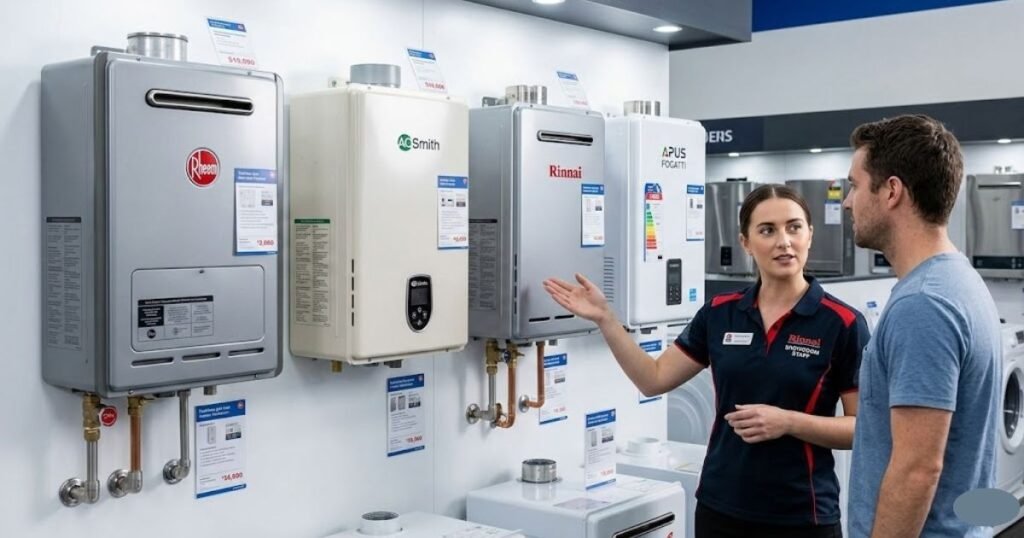
Tankless Water Heater Comparison 2026
| Model | Max GPM | Max BTU | UEF (Efficiency) | Location | Est. Retail Price (March 2026) |
| A. O. Smith ProLine XE (ATI-310CX3) | 8.0 | 190,000 | 0.81 | Indoor | See Price |
| Rheem RTG-70XLN-3 | 7.0 | 160,000 | 0.82 | Outdoor | See Price |
| Rinnai V53DeN | 5.3 | 120,000 | 0.81 | Outdoor | See Price |
| FOGATTI InstaGas Comfort 120S | 5.9 | 120,000 | 0.81 | Indoor/Out | See Price |
| APUS AP-AWH-Q20NG | 6.8 | 140,000 | 0.82 | Indoor | See Price |
READ MORE: Best Tankless Water Heater 2026 — Top Picks, Costs & Buyer’s Guide
Methodology: How We Chose Best Tankless Water Heater
We evaluated these models using a consistent, EEAT-friendly (Experience, Expertise, Authoritativeness, Trustworthiness) process:
- Manufacturer Specifications: We verified maximum GPM, BTU input, and Uniform Energy Factor (UEF) from 2026 official manuals and product listings.
- Real-World Retail Pricing: We sampled major U.S. retailers (Home Depot, Zoro, and specialty plumbing dealers) to report current market prices as of March 2026.
- Installation Practicality: We assessed venting requirements (concentric vs. PVC), gas line needs, and common permit requirements for U.S. jurisdictions.
- Reliability & Service: We prioritized brands with established technician networks and long-term heat exchanger warranties.
- Use Cases: We matched models to household sizes using real-world temperature-rise calculations for both Northern and Southern U.S. climates.
READ MORE: Is a Tankless Water Heater Better?
Best Tankless Gas Water Heater Reviews
1. A. O. Smith — ProLine XE (ATI-310CX3)
The A. O. Smith ProLine XE is a heavy-duty, non-condensing indoor unit designed for homes that demand high performance without the high maintenance of traditional tankless systems. Its standout feature is the X3 Scale Prevention Technology, which is a literal lifesaver for homeowners in regions with hard water (like the Southwest or Florida).
Key Features
- Capacity: Up to 8.0 GPM.
- Input: 190,000 BTU.
- Durability: Commercial-grade copper heat exchanger for faster heat transfer.
- Anti-Scale: X3 technology prevents mineral buildup, extending the unit’s life without requiring a water softener in many cases.
Pros:
- High flow rate handles 3+ showers simultaneously in warm climates.
- X3 technology significantly reduces the need for annual descaling.
- Industry-leading 15-year limited heat exchanger warranty.
Cons:
- Requires specific concentric venting, which can be pricier than PVC.
- Higher upfront unit cost compared to mid-tier brands.
Best for: Large Households and Hard Water Areas
Verdict: The “set it and forget it” choice for big families who want professional-grade durability. See Product Below–

- Enjoy Continuous Flow: This heater allows a flow rate up to 8.0 GPM while X3 Scale Prevention Technology prevents scale …
- Lower Your Energy Cost: Using our high-efficiency tankless water heater with up to .81 Uniform Energy Factor (UEF). Incl…
- Stable Water Temperature: The commercial-grade copper heat exchanger in the AO Smith tankless water heater provides 25x …
2. Rheem — RTG-70XLN-3
Rheem is a household name for a reason: reliability and parts availability. The RTG-70XLN-3 is an outdoor, mid-efficiency model that strikes a perfect balance between price and performance. Because it’s an outdoor unit, it saves interior space and eliminates the need for expensive indoor venting.
Key Features
- Capacity: 7.0 GPM.
- Input: 160,000 BTU.
- Smart Tech: EcoNet enabled for Wi-Fi monitoring (with add-on).
- Emissions: Ultra-Low NOx burner.
Pros:
- Simplified outdoor installation cuts labor costs significantly.
- Very quiet operation compared to older tankless models.
- Excellent parts availability across the U.S.
Cons:
- Outdoor placement is not ideal for extreme Northern climates where sub-zero freezes are common.
- Non-condensing, so it’s slightly less efficient than “Super High Efficiency” models.
Best for: Mid-Sized Homes (2–3 Bathrooms)
Verdict: The best “bang for your buck” for the average American suburban home. See Product Below–
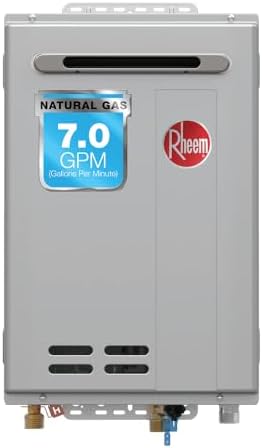
- High-efficiency tankless gas water heater delivers up to 7.0 GPM, perfect for 2–3 bathroom homes with multiple hot water…
- Powered by natural gas with 160,000 BTUs, this durable tankless unit ensures fast, reliable hot water—even during peak h…
- Designed for outdoor installation, this high-efficiency tankless natural gas water heater features a durable metal cabin…
3. Rinnai — V53DeN
Rinnai practically invented the U.S. tankless market, and the V53DeN is their entry-level “Value Series” workhorse. It’s compact—about the size of a medium suitcase—and designed for outdoor mounting.
Key Features
- Capacity: 5.3 GPM.
- Input: 120,000 BTU.
- Footprint: Extremely compact wall-mount design.
Pros:
- Proven reliability from a top-tier brand.
- Low entry price for a high-quality Japanese-engineered unit.
- Simple to service for most local plumbers.
Cons:
- 5.3 GPM will struggle in Northern winters if you try to run two showers at once.
- Fewer “bells and whistles” (no built-in recirculation).
Best for: Small Homes or Guest Houses
Verdict: An unbeatable, budget-friendly pick for condos, small 1–2 bath homes, or vacation cottages. See Product Below-

- Unlimited Hot Water For Your Family: Enjoy endless hot water with our Rinnai tankless hot water heater, providing a flow…
- Energy Efficiency At Its Best: This compact gas tankless water heater conserves energy by heating water only when needed…
- Peace Of Mind With Long-Lasting Performance: The Rinnai tankless hot water heater offers a 10-year warranty on the heat …
4. FOGATTI — InstaGas Comfort 120S Series
Fogatti has made waves in the last few years by offering high-spec units at “big box” prices. The 120S series is aimed squarely at the homeowner who wants the tankless experience without the $2,000 equipment bill.
Key Features
- Capacity: ~5.1–5.9 GPM.
- Input: 120,000 BTU.
- Safety: CSA certified with advanced water servo technology for temperature stability.
Pros:
- One of the most affordable 120k BTU units on the market.
- Includes a wired controller (many brands charge extra for this).
- Lightweight and easy to mount.
Cons:
- Newer brand; long-term service data is less robust than Rheem or Rinnai.
- Customer support is primarily online/phone-based.
Best for: Budget-Conscious Shoppers & DIY Replacements
Verdict: A solid “value” choice that performs surprisingly well, provided you have a local plumber willing to install a non-legacy brand. See Product Below-

- Powerhouse Performance: The FOGATTI tankless water heater takes up a third of the space of traditional tank heaters but …
- Instant Heating: Unlike traditional tank heaters, this tankless water heater gas delivers instant and endless hot water …
- Precision Temperature Control: With advanced water servo technology and temperature sensors, the gas tankless water heat…
5. APUS — AP-AWH-Q20NG
APUS is a newer entrant that focuses on the “wait for hot water” problem. Their Q20NG model often includes built-in booster pumps or “Zero-Cold-Water” recirculation technology, which keeps hot water moving in the pipes so you don’t waste gallons waiting for the shower to get warm.
Key Features
- Capacity: Up to 6.8 GPM.
- Input: 140,000 BTU.
- Tech: Built-in Wi-Fi and smart app controls.
Pros:
- Feature-rich for the price (recirculation tech is usually a $400+ upgrade elsewhere).
- Smart app allows you to set schedules for hot water.
Cons:
- Service network is limited; finding a technician specifically trained on APUS can be a challenge.
- Built-in pumps add another mechanical point of failure over 15 years.
Best for: Tech-Savvy Owners & Faster Hot Water
Verdict: High-tech and high-value for those who want modern features on a mid-range budget. See Product Below-
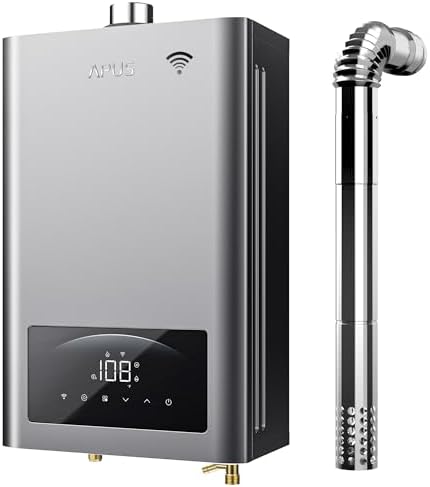
- Instant Hot Water: This upgraded smart natural gas tankless water heater delivers consistent performance with its 140,00…
- Zero Cold Water Tech – Instant Hot Water:Our tankless water heater gas system features APUS exclusive single-circulation…
- Built-in Booster Pump: Increases water flow by up to 130%, delivering a maximum of 6.8 GPM. Gas tankless water heater ea…
READ MORE: What Size Tankless Water Heater Do I Need?
How to Choose Tankless Gas Water Heater
Sizing a tankless heater is different from sizing a tank. You don’t care about “gallons held”; you care about Temperature Rise and Peak Demand.
Step 1: Calculate Your Peak Flow (GPM)
Add up the things you might run at the same time:
- Shower: 2.5 GPM
- Kitchen Faucet: 1.5 GPM
- Dishwasher: 1.5 GPM
- Washing Machine: 2.0 GPM
Example: Two simultaneous showers = 5.0 GPM.
Step 2: Determine Required Temperature Rise
Groundwater isn’t the same temperature everywhere.
- Northern U.S. (e.g., Chicago): Groundwater is ~40°F. To reach 120°F, you need an 80°F rise.
- Southern U.S. (e.g., Miami): Groundwater is ~70°F. To reach 120°F, you only need a 50°F rise.
Pro Tip: A unit rated at 7.0 GPM in Florida might only deliver 3.5 GPM in Maine during the winter because it has to work twice as hard to heat the water. Always check the manufacturer’s “Flow Rate vs. Temperature Rise” chart.
Step 3 — calculate required BTU/hr to supply that flow & ΔT
Formula (engineering):
BTU/hr required = GPM × 8.34 × ΔT × 60
Practical examples (ΔT = desired 120°F − incoming):
- 1–2 people (4 GPM)
- ΔT cold 40°F → 120−40 = 80°F → BTU/hr ≈ 160,128 BTU/hr.
- ΔT moderate 50°F → ≈ 140,112 BTU/hr.
- ΔT warm 70°F → ≈ 100,080 BTU/hr.
- 3–4 people (6 GPM)
- ΔT cold 40°F → ≈ 240,192 BTU/hr.
- ΔT moderate 50°F → ≈ 210,168 BTU/hr.
- ΔT warm 70°F → ≈ 150,120 BTU/hr.
- Large households (8 GPM)
- ΔT cold 40°F → ≈ 320,256 BTU/hr.
- ΔT moderate 50°F → ≈ 280,224 BTU/hr.
(Those numbers come from the standard heat-transfer formula above — treat them as planning-level guidance; consult installer for exact sizing.)
Important practical note: Manufacturer input BTU/hr ratings are the maximum energy the burner can supply. A 190,000 BTU/hr unit cannot reliably supply a 240,000 BTU/hr demand — so if your calculation needs more BTU/hr than the unit input, you will need either a larger single unit, a condensing high-efficiency unit with higher input, or two units in parallel. In cold climates where ΔT is high, many homeowners choose either a higher input unit (≥199k BTU where available) or twin units staged for peak demand. Always confirm the manufacturer’s published flow vs temperature rise curve for the model you pick.
READ MORE: How to Flush a Tankless Water Heater (Step-by-Step Guide)
Tankless Water Heater Installation, Venting, and Code Checklist
Don’t just buy the unit and hope for the best. Gas tankless heaters are sophisticated machines that require specific infrastructure.
- Gas Line Size: Most tankless units require a 3/4-inch gas line to handle the high BTU pull (120k–199k). Many older homes have 1/2-inch lines. Upgrading this can cost $300–$900.
- Venting (Indoor Units): Non-condensing units (like the A.O. Smith ATI-310) require Category III stainless steel or concentric venting. Condensing units can often use cheaper PVC.
- Condensate Handling: High-efficiency units produce acidic water (condensate). You’ll need a drain line or a neutralizer kit.
- Permits: Most U.S. jurisdictions require a plumbing and/or gas permit. Expect to pay $50–$250.
- Electrical: You need a standard 120V outlet nearby to power the unit’s computer and igniter.
Tankless Water Heater Cost
While the unit might cost $1,000, the “all-in” price for a U.S. homeowner usually looks like this:
- Equipment: $600 – $2,000
- Professional Labor: $800 – $1,850
- Materials (Venting/Gas/Valves): $200 – $600
- Total Estimated Install: $1,600 – $4,500
Annual Operating Cost: According to This Old House and Angi data for 2026, natural gas tankless users save roughly $100–$200 per year on energy compared to traditional gas tanks, meaning the unit pays for itself over its 20-year lifespan.
Tankless Water Heater Maintenance & Warranty
To keep your warranty valid, most manufacturers require:
- Annual Descaling: Flushing the unit with food-grade vinegar or a descaling solution to remove calcium. (Cost: $100–$250 if professional; $40 if DIY).
- Inlet Filter Cleaning: Checking the screen for sediment.
- Warranty Check: Most top brands (Rinnai, Rheem, A.O. Smith) offer 12–15 years on the heat exchanger and 5 years on parts. Keep your installation receipt—they won’t honor the warranty without proof of professional install.
READ MORE: Hot Water Runs Out Too Fast — Fixes, Costs & When to Replace
Pros & cons recap (whole-house gas tankless)
Pros
- Lower standby energy losses → lower annual energy use in many households.
- Compact wall space, longer expected life (15–20 years).
- Continuous hot water for long showers and large families (if correctly sized).
Cons
- Higher upfront cost and installation complexity (venting, gas line).
- Performance depends on accurate sizing and water hardness management.
- Some lower-cost brands have less widespread service networks.
Buying & installation checklist
- Confirm peak simultaneous GPM needs.
- Check incoming ground/well water temp (seasonal minimum) for ΔT.
- Review manufacturer flow vs ΔT curve for your chosen model.
- Verify venting type and clearance requirements.
- Get three written installer quotes (include gas-line and venting scopes).
- Confirm permit requirements with your local building department.
- Ask installers about recommended descaling schedule and water-treatment options.
- Verify warranty registration process and local service network.
How much does a tankless gas water heater cost including installation?
In 2026, the average all-in cost for a whole-house gas tankless system is between $2,500 and $4,500. While value-tier units start at $600, the labor for gas line upgrades and specialized venting usually accounts for 50% or more of the total bill.
What size tankless gas heater do I need for a 3–4 person household?
For most U.S. homes, a unit with 6.0 to 8.0 GPM (roughly 160,000–199,000 BTUs) is the sweet spot. This allows for two simultaneous showers without a drop in temperature, even in moderate climates. If you live in a very cold northern state, prioritize the 199,000 BTU models.
Are tankless gas heaters better than electric?
Gas is generally superior for whole-house use. Gas units have much higher flow rates and lower operating costs. Electric models are cheaper to buy and don’t need venting, but they often require massive 200-amp electrical panel upgrades to provide enough hot water for more than one shower at a time.
How long do tankless gas water heaters last?
A well-maintained tankless gas heater can last 18 to 20 years, nearly double the lifespan of a traditional 40-gallon tank. The key is regular descaling (flushing) to prevent the heat exchanger from overheating due to mineral buildup.
Do I need a water softener with a tankless heater?
If your water hardness is above 7–10 grains per gallon (gpg), yes. Hard water will “cook” minerals onto the heat exchanger, reducing efficiency and eventually causing the unit to fail. Models like the A.O. Smith ProLine XE with X3 technology are designed to handle hard water better than most, but a softener is still the best insurance.
Final Verdict
Tankless gas water heaters can be a great long-term upgrade for U.S. homeowners but only if sized and installed correctly. Start by determining your peak GPM and the coldest incoming water temperature, then compare manufacturer flow/ΔT charts. Get three installer quotes (ask each quote to show gas-line and venting scope) and verify labor, permit, and warranty registration steps before purchase.