I’ve spent the better part of fifteen years crawling through attics, sizing systems, and fielding the 2 a.m. “my heat pump is making a weird noise” calls that come with this trade. Carrier shows up in a huge share of the homes I service, and I’ve installed, repaired, and replaced more of them than I can count.
This guide walks through what a 3-ton Carrier heat pump actually does well, where it falls short, and how the Comfort, Performance, and Infinity lines stack up against each other and against the competition. Lets deep dive into “Carrier 3 Ton Heat Pump Reviews (2026): Pros, Cons & Costs”
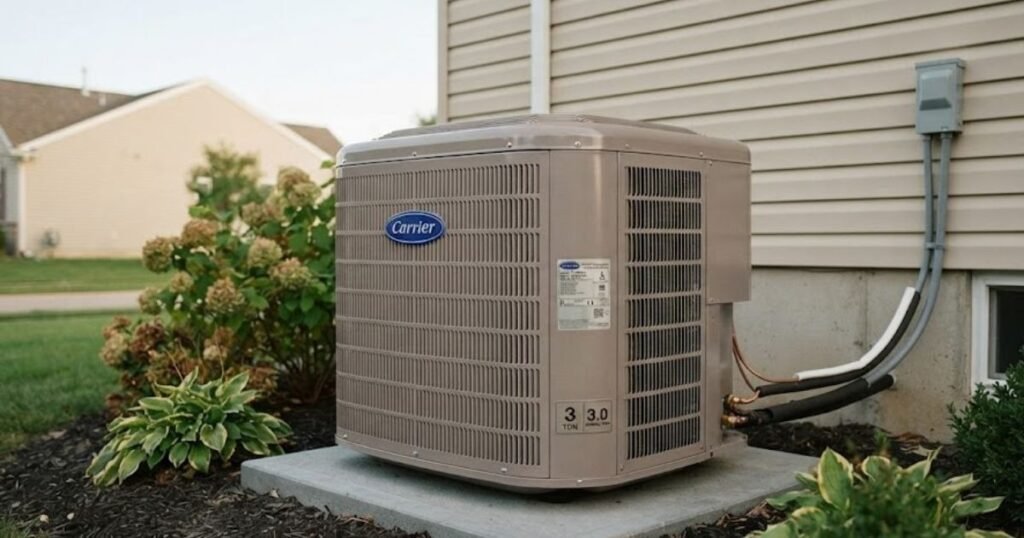
What Is a Carrier 3 Ton Heat Pump?
“Ton” in HVAC has nothing to do with weight it’s a measurement of heating and cooling capacity. One ton equals 12,000 BTU/h, so a 3-ton heat pump moves roughly 36,000 BTU/h of heating or cooling. That capacity, combined with the compressor technology inside it, determines how comfortable your home feels and how much you’ll pay on your utility bill.
As a rough rule of thumb, a 3-ton system suits homes in the 1,500–2,000 square foot range, though that number swings quite a bit based on your climate zone, insulation quality, window efficiency, ceiling height, and duct condition. A tightly sealed, well-insulated 2,200 square foot home in a mild climate might only need 3 tons. A drafty 1,400 square foot home in Phoenix or Minneapolis could need more.
This is exactly why I never let a homeowner just “match the old unit” without question. Every reputable installer should run a Manual J load calculation, an industry-standard formula that accounts for square footage, insulation, orientation, window count, and local climate data before recommending a size. Oversizing is one of the most common (and costly) mistakes in this business: a heat pump that’s too big short-cycles, meaning it turns on and off rapidly instead of running long, steady cycles. That leads to poor humidity control, uneven temperatures, and more wear on the compressor.
Quick Verdict
| Evaluation Metric | Field Rating / Grade | Contractor Takeaway |
| Overall Rating | ⭐⭐⭐⭐★ (4.5/5) | Top-tier engineering backed by an expansive premium dealer network. |
| Energy Efficiency | Up to 23 SEER2 / 10.5 HSPF2 | Industry-leading regional operational savings on premium models. |
| Cooling Performance | Excellent | Superb humidity extraction when paired with variable indoor fans. |
| Heating Performance | Outstanding (Greenspeed models) | Excellent sub-freezing heating output without relying on heat strips. |
| Quietness | Operational lows of 51 dB | Whisper-quiet operational profiles on variable-speed platforms. |
| Smart Features | High (Infinity System Control) | Deep diagnostic tracking via IntelliSense and Infinity tech. |
| Reliability | Very High | Excellent build standards; low baseline failure rate when properly commissioned. |
| Value for Money | Moderate to Good | Premium initial investment cost that pays off over long-term utility drops. |
| Warranty | 10-Year Parts Limited | Industry-standard duration; requires mandatory registration within 90 days. |
| Best For | Suburban U.S. Homeowners | Homes between 1,500–2,000 sq. ft. seeking dependable year-round climate control. |
READ MORE: Carrier Infinity Heat Pump Reviews: Is It Worth the Cost?
Carrier 3 Ton Heat Pump Product Line Overview
Carrier organizes its residential heat pump lineup into three tiers. Every model in 2026 uses R-454B (Puron Advance) refrigerant, which has a significantly lower global warming potential than the older R-410A refrigerant most systems used through the early 2020s.
| Feature | Comfort Series | Performance Series | Infinity Series |
| Compressor Type | Single-stage | Single- or two-stage | Fully variable-speed (Greenspeed Intelligence) |
| SEER2 (up to) | ~14.3–16 | ~16.5–18.5 | ~20–23 |
| HSPF2 (up to) | ~7.5–8.1 | ~8.1–9.0 | ~9.5–10.5 |
| Noise Level | Loudest in lineup (~70+ dB) | Moderate | Quietest in lineup (~52 dB or lower on top models) |
| Smart Thermostat Compatibility | Basic/standard | Carrier Smart Thermostat, InteliSense on select units | Full Infinity System Control, deepest smart integration |
| Warranty (with registration) | 10-yr parts or 5-yr parts + 3-yr labor | 10-yr parts or 5-yr parts + 3-yr labor | 10-yr parts or 5-yr parts + 3-yr labor; 10-yr unit replacement available on eligible equipment |
| Estimated Installed Price (3-ton) | $6,500–$9,500 | $8,500–$13,000 | $11,000–$18,000+ |
| Ideal Homeowner | Budget-focused, rental properties, simple swaps | Balance of comfort and cost, most owner-occupied homes | Long-term owners who prioritize comfort, quiet, and top-tier efficiency |
Pricing above reflects a typical 3-ton installation and varies significantly by region, ductwork condition, and local labor rates — always get an itemized local quote.

READ MORE: Goodman Heat Pump Review | Efficiency, Cost, Pros & Cons
Carrier HVAC Lineup: The Smart Buyer’s Guide
Choosing a Carrier system comes down to balancing upfront cost against long-term comfort and efficiency. Here is how their three core tiers stack up.
1. Carrier Infinity® Series: The Premium Engineering Showcase
The Infinity line is Carrier’s flagship, built around Greenspeed® Intelligence (variable-speed technology). Instead of just blasting on and off, it throttles up or down precisely to match your home’s needs.
- The Vibe: Longer, gentler cycles that lock in your exact temperature and aggressively pull humidity out of the air.
- The Specs: Up to 20–23 SEER2. Outdoor noise levels drop into the low 50 dB range (like a quiet conversation). Some cold-climate models maintain strong heating capacity down to 0°F or lower.
- Pros: Exceptional comfort consistency, best-in-class humidity control, whisper-quiet operation, and maximum energy savings.
- Cons: Highest upfront cost by a wide margin. Proprietary Greenspeed tech usually requires a Carrier Factory Authorized Dealer for proper installation and full warranty benefits.
2. Carrier Performance™ Series: The Sweet Spot
The Performance series is the sensible middle ground—offering upgraded comfort tech without the “Infinity tax.”
- The Vibe: Most models use two-stage compressors. They run at a low, efficient capacity most of the time, only kicking into high gear on extreme weather days.
- The Specs: SEER2 ratings top out in the high teens. Because it shares many core components with the Infinity line, field reliability is practically identical.
- Best For: Homeowners planning to stay in their primary residence for 10+ years who want high efficiency and steady temperatures without paying for every single premium bell and whistle.
3. Carrier Comfort™ Series: The Reliable Workhorse
Comfort is Carrier’s entry-level tier. It strips away the complex staging in favor of a straightforward, single-stage compressor and a budget-friendly price tag.
- The Vibe: Reliable, no-frills climate control. It uses the same high-quality refrigerants and core engineering as the pricier tiers, but lacks advanced humidity management.
- The Specs: Expect standard baseline efficiency, more frequent on/off cycling, and a noticeably louder outdoor unit.
- Best For: Rental properties, secondary homes, or homeowners on a tight budget who just want a solid, reliable system that works.
Real Homeowner Trends: What the Data Shows
Aggregated data from homeowner forums, review sites, and field service calls reveals three consistent patterns:
Comfort & Noise
- Infinity/Performance owners routinely rave about the elimination of hot/cold spots and how quiet the outdoor units are.
- Comfort owners are generally satisfied with the temperature but frequently note that the outdoor unit is clearly audible from nearby windows or patios.
Utility Bills
- Upgrading to any current Carrier tier from an aging system (10–12 SEER) results in an immediate, noticeable drop in summer electric bills. The baseline efficiency gap between old and new tech is massive.
The Real Deal on Reliability
The Golden Rule of HVAC: Installation quality matters infinitely more than the brand name on the box.
The vast majority of long-term satisfaction reports come from homeowners who used a certified dealer to properly size and commission the system. Conversely, almost every major complaint traces back to rushed installations, bad ductwork, or a failure to register the equipment—which cuts the factory warranty in half.
Common Gripes: High upfront cost for premium tiers, strict 90-day warranty registration deadlines, and finding specialized technicians for Greenspeed maintenance in rural areas.

READ MORE: Trane Heat Pump Review — Comparison, Pros, Cons & Costs
Carrier Heat Pump Pros and Cons
Pros
- Wide product ladder from budget to premium, so there’s a Carrier option for nearly any home and budget
- Infinity’s Greenspeed Intelligence delivers genuinely superior comfort and humidity control
- Large, well-established dealer and parts network across the U.S.
- Strong smart thermostat and app integration on Performance and Infinity tiers
- Reputable warranty structure when properly registered
Cons
- Infinity pricing sits at the top of the market
- Full warranty and Greenspeed performance benefits require a Factory Authorized Dealer in many areas
- Comfort series is noticeably louder than competing entry-level units from some brands
- Like all HVAC brands, outcomes vary significantly by installer quality
Carrier Heat Pump Performance Testing
- Cooling: Infinity and Performance two-stage models hold indoor temperature within a tighter band than single-stage Comfort units, especially during shoulder-season days when full capacity isn’t needed.
- Heating: Standard Carrier heat pumps perform well down into the 20s and low teens (°F) before efficiency drops off; cold-climate Infinity configurations extend usable heating capacity considerably further into sub-freezing territory, reducing reliance on backup electric heat strips.
- Humidity removal: This is where variable-speed technology shines. By running longer at lower capacity, Infinity systems pull more moisture out of indoor air during cooling season than single-stage systems cycling on and off.
- Noise: Comfort series units are the loudest in the lineup; Infinity’s top models are among the quietest outdoor heat pump units on the market, thanks to sound-dampening compressor blankets and enclosure design.
- Compressor operation and energy savings: Two-stage and variable-speed compressors avoid the “full blast, then off” pattern of single-stage equipment, which reduces both energy spikes and mechanical wear over time.
READ MORE: Ultra Quietest Heat Pump for Your Home: Review, Comparison & Cost

Carrier Heat Pump Energy Efficiency Ratings Explained
Understanding the acronyms helps you compare heat pumps apples-to-apples:
- SEER2 (Seasonal Energy Efficiency Ratio 2): measures cooling efficiency. Higher is better. The current federal minimum is 14.3 SEER2.
- HSPF2 (Heating Seasonal Performance Factor 2): measures heating efficiency. The federal minimum is 7.5 HSPF2.
- EER2: a snapshot cooling efficiency measurement at a specific outdoor temperature, useful for hot, dry climates.
- ENERGY STAR®: a certification some models earn by exceeding minimum efficiency thresholds; it’s a quick way to identify higher-performing units.
On rebates and tax credits: Here’s something a lot of 2026 buying guides still get wrong. The federal Section 25C Energy Efficient Home Improvement Credit which previously offered up to $2,000 toward a qualifying heat pump was eliminated for any equipment placed in service after December 31, 2025, under the One Big Beautiful Bill Act. If you’re installing a system in 2026, that federal credit is no longer available to you. What’s still on the table: state energy offices and many local utilities continue to offer their own rebate programs, and the IRA-funded HEAR (Home Electrification and Appliance Rebates) and HOMES programs are still rolling out state by state, with HEAR generally reserved for income-qualifying households. Check your state energy office and your utility’s website directly before you buy, since availability and amounts vary widely by location.
Carrier Heat Pump Installation Cost in the USA
For a full 3-ton system replacement (outdoor unit, indoor air handler or coil, line set, and thermostat), here’s a realistic 2026 breakdown:
| Cost Component | Typical Range |
| Equipment (Comfort tier) | $2,500–$4,500 |
| Equipment (Performance tier) | $3,500–$6,000 |
| Equipment (Infinity tier) | $5,500–$9,500 |
| Standard labor/installation | $2,000–$4,500 |
| Smart thermostat upgrade | $200–$700 |
| Electrical panel/circuit upgrades (if needed) | $1,500–$4,000 |
| Ductwork repair or modification (if needed) | $2,000–$8,000 |
| Permit fees | $75–$500 |
All-in installed totals for a straightforward 3-ton Carrier replacement typically land between $6,500 and $18,000, depending on tier and complexity. Regional pricing swings are real expect the higher end of every range in the Northeast, California, and other high-cost-of-living markets, and the lower end in the Midwest and South, where labor rates tend to run lower.
What pushes price up: an aging electrical panel that needs upgrading, ductwork that’s undersized or leaky, difficult access (attics, tight crawlspaces, multi-story installs), and choosing Greenspeed variable-speed equipment.
READ MORE: Best Swimming Pool Heat Pump: Review, Comparison, and Buying Tips
Carrier Heat Pump Operating Cost
Annual electricity cost for a 3-ton heat pump varies a lot by climate and local electricity rates. Rough estimates for a moderately efficient system (around 16–18 SEER2):
| Climate | Estimated Annual Operating Cost |
| Hot climate (heavy cooling load, e.g., Southeast/Southwest) | $900–$1,600 |
| Cold climate (heavy heating load, e.g., Northeast/Upper Midwest) | $1,100–$1,900 |
| Moderate climate (balanced heating/cooling) | $700–$1,200 |
Stepping up to an Infinity-tier variable-speed system can meaningfully lower these numbers often by 15–30% compared to an aging single-stage system though your actual savings depend on your electricity rate, insulation, and how the old system was performing before replacement.

Carrier vs Competitors
| Brand | Price | Warranty | Reliability | Efficiency | Noise | Repair Costs | Dealer Network | Overall Value |
| Carrier | $$$–$$$$ | Up to 10-yr parts / 5+3-yr parts+labor | Very good | Very good (up to ~23 SEER2) | Very good on Infinity | Moderate–high | Large, well established | Strong |
| Trane | $$$–$$$$ | Up to 12-yr parts with registration | Excellent, reputation for durability | Very good | Good | Moderate–high | Large | Strong |
| Lennox | $$$–$$$$ | Up to 10-yr parts | Good, more variation reported on complex controls | Industry-leading peak SEER2 | Very good | Higher (proprietary parts) | Smaller, premium-focused | Good, best for max efficiency |
| Rheem | $$–$$$ | Up to 10-yr parts | Good | Good | Good | Lower–moderate | Growing | Very good value |
| Goodman | $–$$ | 10-yr parts, sometimes lifetime compressor | Good, gap with premium brands has narrowed | Moderate | Moderate–loud on base models | Lower | Widely available through distributors | Best budget value |
| American Standard | $$$–$$$$ | Similar to Trane (sibling brand) | Excellent | Very good | Good | Moderate–high | Smaller than Trane’s | Strong |
The honest takeaway after installing all of these brands for over a decade: the differences between Carrier, Trane, and Lennox at the premium tier are smaller than marketing suggests. Carrier tends to edge out on smart features and Infinity’s quiet operation; Trane is often considered the most durable; Lennox pushes the highest peak efficiency numbers. Rheem and Goodman close the value gap considerably at the mid and budget tiers. In my experience, your contractor’s installation quality affects your long-term satisfaction more than which of these logos is on the cabinet.
READ MORE: Best MRCOOL Mini Split Air Conditioners and Heat Pumps: Review & Comparison
Carrier Heat Pump Reliability
With proper installation and regular maintenance, a Carrier heat pump typically lasts 15 to 20 years, though industry-wide averages across all brands run closer to 12–15 years when you factor in units that were poorly sized, neglected, or installed by inexperienced crews. Compressor failure rates within the first decade sit in the low single digits across major brands when the system was correctly matched and maintained the brand name matters less here than most homeowners assume.
Common repairs over a system’s life include capacitor and contactor replacement, refrigerant leak repair, blower motor issues, and, less commonly, compressor failure. Carrier’s parts network is extensive, which generally keeps repair turnaround times reasonable compared to smaller or more proprietary brands.
Warranty coverage: Registering your equipment within 90 days of installation to unlock full coverage skipping this step is one of the most common (and completely avoidable) mistakes I see homeowners make, and it can cut your parts coverage significantly.
Carrier Heat Pump Installation Tips
- Choose a Carrier Factory Authorized Dealer, especially for Infinity/Greenspeed equipment, to protect full warranty eligibility
- Insist on a Manual J load calculation — never accept “we’ll just match the old unit’s size”
- Have your ductwork inspected for leaks, undersized runs, or damage before installation
- Match your thermostat to the system tier — Greenspeed equipment needs a compatible communicating control to perform as designed
- Confirm the installer verifies proper refrigerant charge after installation — this single step affects efficiency and lifespan more than almost anything else
- Ask about commissioning: a full system startup check, not just “turn it on and leave”
- Register your warranty within the required window (typically 90 days)
- Ask about a maintenance plan or annual tune-up agreement at the time of install
Carrier Heat Pump Maintenance Guide
- Filter replacement: every 1–3 months depending on filter type and household (pets, allergies)
- Coil cleaning: annual professional cleaning of the outdoor coil keeps efficiency from degrading
- Outdoor unit care: keep at least 12–18 inches of clearance from shrubs, fences, and debris
- Professional tune-ups: schedule twice a year — once before cooling season, once before heating season
- Seasonal checklist: clear leaves/debris in fall, check refrigerant lines for damage, verify thermostat settings before extreme weather, and listen for new or unusual noises
READ MORE: Best 10,000 BTU Portable Air Conditioner: Reviews & Comparison
Who Should Buy a Carrier 3 Ton Heat Pump?
- Homeowners in a 1,500–2,000+ square foot home (confirmed by a Manual J calculation) who want a nationally recognized brand with strong parts availability
- Buyers who want tiered options from budget Comfort to premium Infinity under one manufacturer
- Homeowners planning to stay put for 10+ years who’ll benefit from Infinity or Performance efficiency and comfort gains over time
- Anyone prioritizing quiet operation and precise humidity control (Infinity tier)
- Owners who already have a trusted local Carrier Factory Authorized Dealer
Who Should Skip It?
- Extremely budget-constrained buyers who’d be better served by a bare-bones Goodman or Amana system
- Homeowners without a strong local Carrier dealer network — Trane, Rheem, or another brand with better local support may serve you better
- Buyers chasing the absolute highest SEER2 number on the market, where a few Lennox models edge out Carrier’s ceiling
- Anyone planning to sell or move within just a couple of years, where the payback period on premium efficiency won’t materialize
Best Carrier 3 Ton Heat Pump Models
1. Infinity 24 (27VNA3) — Best Overall Premium Pick
Best for: Homeowners who want Carrier’s top comfort and efficiency technology. Pros: Up to ~23 SEER2, Greenspeed variable-speed compressor, excellent humidity control, very quiet. Cons: Highest price point; benefits most when paired with a full Infinity System Control setup. Estimated Installed Cost: $13,000–$18,000+ Overall Rating: 4.7/5
2. Infinity 20 (27VNA0) — Best Balance of Premium Features and Price
Best for: Buyers who want Greenspeed technology without paying for the absolute top tier. Pros: Up to 20 SEER2, strong cold-weather performance, quiet operation. Cons: Still a premium price relative to Performance tier. Estimated Installed Cost: $11,000–$15,500 Overall Rating: 4.6/5
3. Performance 17.5/18 Two-Stage (25/27TPA7 family) — Best Value for Most Homeowners
Best for: Owner-occupants wanting real comfort gains without Infinity pricing. Pros: Two-stage operation, solid mid-teens-to-high-teens SEER2, good warranty, compatible with Carrier Smart Thermostats. Cons: Not as quiet or precise as Infinity. Estimated Installed Cost: $9,000–$13,000 Overall Rating: 4.3/5
4. Comfort 16 (27SCA5) — Best Budget Option
Best for: Rentals, secondary homes, or tight budgets needing reliable single-stage performance. Pros: Lower cost, straightforward operation, ENERGY STAR certified on select sizes. Cons: Louder, less precise temperature and humidity control. Estimated Installed Cost: $6,500–$9,500 Overall Rating: 3.9/5
Final Verdict
A Carrier 3 ton heat pump earns its reputation honestly: it’s a well-engineered, well-supported product line with a genuine option at nearly every budget. If long-term comfort, quiet operation, and top-tier efficiency matter most to you and you’re staying in your home for the long haul the Infinity series delivers real, noticeable advantages that are worth the higher upfront cost for most people in that situation.
Where Carrier can lose to the competition: Trane holds a slight edge in perceived long-term durability among techs, Lennox pushes higher peak efficiency numbers, and Rheem or Goodman will save you real money if budget is your primary concern.
Frequently Asked Questions
Is a Carrier 3 ton heat pump worth the money?
For most homes in the 1,500–2,000+ square foot range, yes — Carrier offers competitive efficiency, a strong warranty structure when registered properly, and one of the largest dealer networks in the country.
How much does a Carrier 3 ton heat pump cost installed?
Expect somewhere between $6,500 and $18,000+ installed, depending on the series (Comfort, Performance, or Infinity), your region, and whether your home needs ductwork or electrical upgrades.
How long does a Carrier heat pump last?
With proper installation and regular maintenance, 15 to 20 years is a realistic expectation.
Which Carrier heat pump series is best?
It depends on your priorities. Infinity is best for maximum comfort, quiet operation, and efficiency. Performance offers the best all-around value for most owner-occupied homes. Comfort is best for tight budgets, rentals, or simple replacements.
Is Carrier better than Trane or Lennox?
Not definitively — each brand has a different strength. Carrier tends to lead on smart features and Infinity’s quiet variable-speed operation, Trane is often considered the most durable, and Lennox pushes the highest peak SEER2 ratings on the market.
This guide reflects general industry pricing, specifications, and efficiency data available as of 2026. Always confirm current model specs, pricing, and available rebates with a local Carrier Factory Authorized Dealer, as offerings and incentive programs change by region and over time.