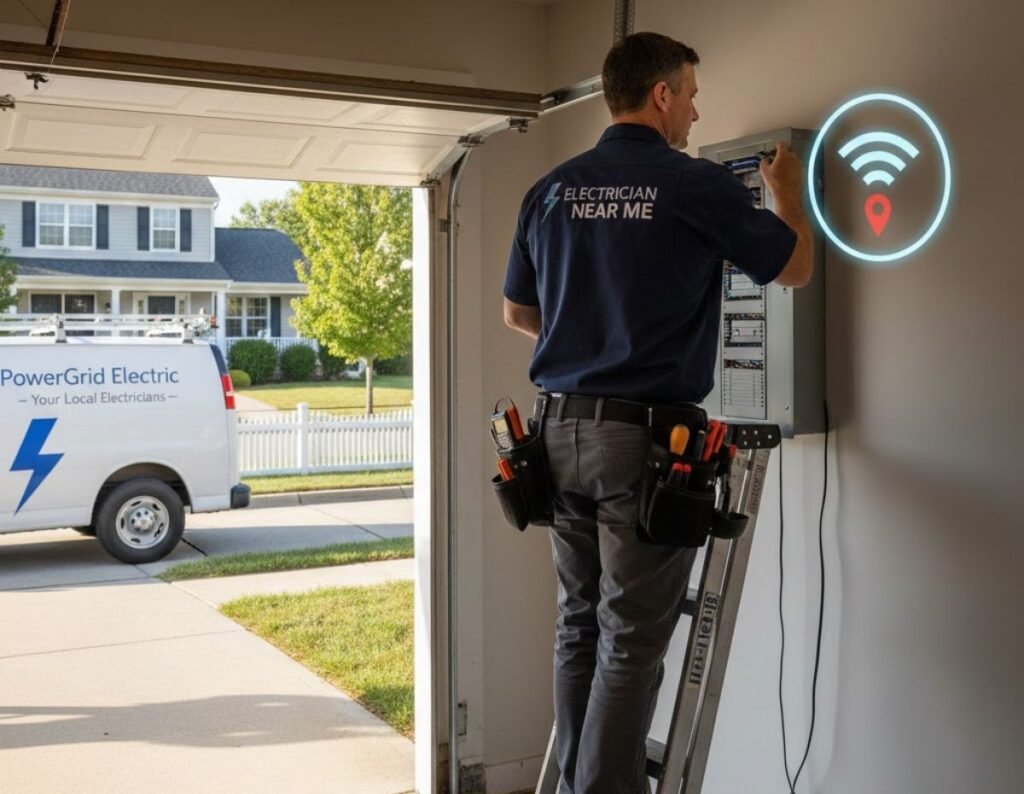
Commercial electrical work is a different animal than residential wiring. Whether you manage an office building, run a retail chain, or own a mixed-use property, the right commercial electrical contractor keeps your lights, power, safety systems and business operations running and helps you stay code-compliant. This guide explains what these contractors do, when to hire them, how much work commonly costs (national ranges, as of January 2026), compliance basics, hiring checklists, sample projects, and a practical comparison table so you can decide which service fits your need.

Commercial Electrical Contractors: Services, Costs & How to Hire
Commercial electrical contractors design, install, maintain, and repair electrical systems for non-residential buildings from tenant fit-outs and LED retrofits to switchgear replacements and emergency power systems. They understand commercial code requirements, coordinate with inspectors and building owners, carry the right insurance and bonds, and deliver documentation that keeps facilities safe and operational. This article helps U.S. property owners and facility managers hire the right firm, estimate costs, and manage compliance.
What a Commercial Electrical Contractor Does
Commercial electrical contractors perform a wide range of services beyond the run-of-the-mill residential tasks. Core responsibilities include:
- Design & planning: Layouts for distribution, lighting, emergency power, fire alarm interfaces, and tenant fit-outs; coordination drawings for coordination with architects, mechanical and structural trades.
- Permitting and inspections: Preparing permit packages, scheduling inspections, and ensuring installations meet the applicable edition of the National Electrical Code (NEC). The NEC (2023 edition) is the reference for installation safety and is widely enforced or adopted by jurisdictions.
- Installation & commissioning: Installing feeders, branch circuits, panels, switchgear, transformers, lighting systems, EV charging infrastructure, data/low-voltage cabling, and commissioning systems for occupancy.
- Upgrades & retrofits: Load studies and panel upgrades, LED lighting retrofits, energy management system installation, and modernization work that typically requires coordination with local utilities for rebates and interconnection.
- Emergency response & repairs: 24/7 troubleshooting for outages, fault diagnosis, and temporary power solutions. Emergency calls often incur premium rates but limit expensive downtime for businesses.
- Maintenance & service contracts: Preventive maintenance (thermal imaging, torque checks, breaker testing) and service level agreements (SLAs) to protect critical loads.
- Safety & training: Creating lockout/tagout procedures, arc-flash studies and PPE programs referenced to NFPA 70E for workplace electrical safety. NFPA 70E complements OSHA’s electrical standards by providing work-practice and PPE guidance.
Typical commercial services:
installations, upgrades (panels/switchgear), emergency repair, preventive maintenance, commissioning, energy upgrades (LED/controls), EV infrastructure, and low-voltage integration (fire alarm, security, data).
How commercial work differs from residential:
commercial jobs require heavier duty equipment (switchgear, transformers), stricter documentation, coordination with building systems (HVAC, fire/life safety), higher voltages and fault currents, bonded/insured crews, and usually municipal permits and inspections. Large projects commonly require coordination with the authority having jurisdiction (AHJ) and strict adherence to the NEC and local amendments.
When You Need a Commercial Electrical Contractor
Hire a commercial electrical contractor when your project involves:
- New construction for retail, office, industrial or mixed-use buildings.
- Tenant fit-outs and remodels that change load or occupancy type.
- Code-required upgrades (e.g., ADA signage power, emergency lighting, surge protection) or when your AHJ requires NEC-level corrections.
- Panel, distribution or switchgear work higher-risk, higher-voltage work needing licensed specialists.
- Installation of backup power systems (generators, ATS), EV charging banks, or solar + storage tie-ins.
- Emergency failures (loss of power, arcing events, burned bus work) these need fast, licensed response and safe isolation.
- Preventive maintenance to protect critical loads (data centers, medical equipment, manufacturing lines).
If your answer to any of the above is “yes,” prioritize certified commercial contractors with experience in the specific system (switchgear, generators, energy management) rather than a general residential electrician.
READ MORE: Electrician Cost Per Hour: How Much Homeowners Pay in the U.S.
Licensing, Codes & Safety (NEC, OSHA, and Local Rules)
Licensing basics:
In the U.S., electrical contracting is licensed at the state or local level. Licensing titles vary LED (Licensed Electrical Contractor), Master Electrician, or Journeyman under a contractor. Contractors must meet experience, exam and insurance requirements set by state licensing boards (for example, California’s CSLB for trade contractors or state electrical boards elsewhere). Always verify the contractor’s license number and standing with the relevant state board.
NEC & local codes:
The National Electrical Code (NEC, NFPA 70) is the primary technical standard for safe electrical installations; the 2023 edition is the most recent widely adopted edition as of this guide. Local jurisdictions adopt the NEC with amendments and at varying adoption schedules, so check the AHJ for the correct code year for your project.
OSHA & workplace safety:
OSHA sets employer obligations for electrical safety under 29 CFR 1910 Subpart S (general industry) and related provisions; these govern safe work practices and employer responsibilities in workplaces. OSHA resources and eTools can help owners and contractors understand which provisions apply to a particular installation.
NFPA 70E (electrical safety in the workplace):
NFPA 70E provides guidance on arc-flash hazard analysis, PPE selection, and safe work practices; many facility operators require contractors to follow NFPA 70E practices when performing energized work. The 2024 edition of NFPA 70E updated procedures for arc-flash mitigation and PPE selection.
Permits & inspections:
Commercial work nearly always requires a permit and progressive inspections (rough-in and final). Contractors typically pull permits or partner with design professionals to provide stampable drawings. Permit fees, inspection cycles, and plan review timelines vary by municipality factor this into schedule and cost.
Insurance & bonding:
Confirm the contractor carries commercial General Liability (CGL) with adequate limits, workers’ compensation, and for large projects performance and payment bonds. Bonding is often required on public or larger private projects and protects owners if a contractor defaults.
Recordkeeping & labeling:
Contractors should deliver as-built drawings, circuit directories, equipment schedules, arc-flash labels (if required), and test reports. These documents are critical for future maintenance and code compliance.
Typical Costs & Pricing Models
Pricing models explained
- Hourly / service rate: Common for troubleshooting and small repairs. Expect a technician’s hourly labor plus a truck/service call fee.
- Project / lump-sum (fixed price): Used for well-scoped installations (tenant fit-outs, panel upgrades). Gives owners price certainty but requires clear scopes and change-order handling.
- Unit pricing: Common for lighting retrofits priced per fixture (labor + parts).
- Maintenance contracts (annual or monthly): Recurring fee covering scheduled inspections and minor repairs, often tiered by SLA response time.
National cost ranges (U.S., as of January 2026)
use these as ballpark guidance; actual quotes vary widely by state, metro area, union vs open shop, materials, and project complexity.
- Hourly / emergency service call: $75–$200 per hour (service call fees $100–$350 typical for first hour). Rates spike for emergency night/weekend calls.
- Commercial wiring / fit-out (per sq. ft.): Rough national ranges $4–$15 per sq. ft., depending on finish level and systems required; small retail fit-outs can start in the low-thousands, while full multi-tenant office fit-outs climb into tens of thousands.
- Panel / switchgear replacement: $3,000–$50,000+ depending on size, number of breakers, utility coordination, and whether a new bus or transformer is required.
- LED lighting retrofit: $50–$500+ per fixture installed depending on fixture type, controls, and rebates; many projects are quoted per-fixture plus disposal and controls integration.
- Emergency generator + automatic transfer switch (ATS): Small standby generator systems $8,000–$30,000; commercial systems for medium/large buildings commonly $50,000–$500,000+ including ATS, permitting and fuel system.
- Arc-flash study: $3,000–$15,000+ depending on plant size and data collection needs.
Factors that drive price:
job size, project complexity, labor classification (master vs journeyman), permitting and plan review costs, materials (copper, conduit, switchgear), access (ceiling/occupied spaces), utility coordination, and required testing/documentation. Overtime, night work, and emergency response increase rates.
How to compare quotes: Ask contractors to break out labor, materials, permit costs, equipment, unit pricing and allowances. A line-itemed scope reduces change-order surprises.
(Accuracy note: these ranges are national ballparks as of January 2026; state and metro rates vary significantly — always get 3 written quotes and verify what’s included.)
READ MORE: Whole House Surge Protector Cost in the USA (2026 Guide)
How to Choose the Right Contractor
Step 1 — Pre-vet candidates
- Verify state license number and classification with the state licensing board. (Ask for the license and then check the board’s online lookup.)
- Confirm insurance: CGL limits (commonly $1M/$2M), workers’ compensation, and bonds if required. Get certificates of insurance.
- Check trade association membership (NECA or local chapters) and training credentials. NECA membership signals industry engagement and access to training programs.
Step 2 — Check experience & references
- Request a portfolio of similar commercial projects. For specialized systems (switchgear, generators, EV chargers), ask for specific project examples.
- Ask for three recent references contact them and ask about schedule adherence, change-order handling, cleanup, and warranty responsiveness.
Step 3 — Get detailed bids
- Request a written estimate with a clear scope: materials, labor, subcontracts, permits, allowances, lead times, site access needs, hoisting, and waste disposal responsibilities.
- Compare bids for completeness, not just price. The lowest bid can hide missed items or low insurance.
Step 4 — Review contracts & warranties
- Use a simple, clear contract with payment milestones tied to deliverables, retainage terms (if any), and a change-order process.
- Confirm warranty terms for labor and materials and emergency response time for warranty calls.
Step 5 — Technical interview questions to ask
(These are useful during the estimate or pre-construction meeting.)
- “Which NEC articles and local amendments apply to this scope?”
- “Will you pull permits and schedule inspections, or do we?”
- “Who is my on-site superintendent and what are their qualifications?”
- “Can you provide arc-flash labels and a single-line as-built?”
- “What is your typical emergency response time and SLA for call-outs?”
- “How do you handle coordination with utilities and other trades?”
Step 6 — Safety & culture
- Review the contractor’s safety program, incident rates, and training records. Confirm if they follow NFPA 70E work practices and use lockout/tagout procedures.
Red flags in proposals: No license number provided, vague or missing scope, uninsurable terms, requests for large upfront payments, refusal to provide references, or no written warranty.
Comparison Table: Common Commercial Electrical Services
National average ranges, U.S., as of January 2026. Local prices vary — get written quotes.
| Service / Task | Typical Project Size | When to Hire | Average Cost Range (US) | Licensing / Permit Required | Best For |
| New commercial wiring / full fit-out | Small retail to multi-tenant office | New build or tenant fit-out | $4,000 – $80,000+ (small retail low end; larger multi-tenant high end) | Yes (permit, inspected) | New builds, tenant improvements |
| Lighting upgrades (LED retrofit) | Small to large | Energy savings, rebate projects | $50 – $500 per fixture or $1,000 – $100,000+ total | Usually yes for larger jobs | Energy efficiency projects |
| Panel / switchgear replacement | Medium to large | Overloaded/aged panels, expansion | $3,000 – $50,000+ | Yes | Older buildings, high-load upgrades |
| Emergency repairs (power loss) | Any | Sudden outage, safety hazard | Emergency rates: $150 – $400+/hr (plus service call fee) | Depends | Outage response |
| Preventive maintenance contract | Recurring | Reduce downtime, extend equipment life | $100 – $5,000+/month or $1,200 – $60,000+/yr (depends on facility) | No (but logged permits for replacement work) | Facilities with critical loads |
(Ranges are ballpark estimates; always get multiple written quotes and verify permit needs with AHJ.)
READ MORE: Rewiring a House: Costs, Process, Permits, and What Homeowners Should Expect
Project Examples & Case Studies
Retail fit-out (small): A 1,500 sq. ft. boutique retail store needed a tenant fit-out new distribution, lighting, and receptacles. Scope included LED accent lighting, three new subpanels, and low-voltage connections. Outcome: completed on a lump-sum contract in 6 weeks; energy-saving LED retrofit cut lighting loads by ~45%, enabling utility rebates.
Office tenant fit-out (multi-tenant): A 15,000 sq. ft. office was reconfigured with higher density workstations and a new server room. Contractor performed a load study, installed a dedicated 200A server feed, upgraded branch circuits, and ran structured cabling. Outcome: minimal downtime, comprehensive as-builts delivered, 1-year maintenance contract included.
Warehouse lighting & controls: An industrial warehouse switched from HID fixtures to LED high-bay with occupancy sensors and daylight harvesting. Outcome: Lighting energy use dropped by ~60%, payback under 3 years after rebates; contractor provided a one-year warranty and performance verification.
Emergency switchgear repair: After a faulted bus caused an outage, a contractor performed emergency isolation, temporary power distribution, replaced damaged bus sections, and coordinated the utility reconnection. Outcome: Two-day emergency mobilization limited business interruption; a follow-up arc-flash study and labeling were delivered.
Maintenance Plans & Long-Term Contracts
Why maintenance matters: Regular electrical maintenance reduces unexpected downtime, extends equipment life, and uncovers hazards (loose lugs, overheated breakers) before they become failures. For facilities with critical loads, a formal maintenance contract and SLA are essential.
What to include in a maintenance plan:
- Scheduled inspections (thermal imaging, torque checks, breaker testing)
- Preventive lamp/fixture replacement schedules and emergency lighting tests
- Battery testing for UPS and emergency lighting systems
- Documentation: inspection reports, action items, and three-year trend logs
- Response time SLAs (e.g., 4-hour, next business day), defined priority levels, and after-hours rates
Typical SLAs & pricing: Response times vary with cost faster response requires higher monthly/annual fees. Small facilities might pay $100–$500/month, while mission-critical sites (data centers, hospitals) pay thousands per month for guaranteed rapid response and dedicated technicians.
Red Flags & When to Walk Away
Walk away or escalate if a contractor:
- Refuses to provide a license number or proof of insurance.
- Asks for large upfront cash payments (reasonable deposits for long-lead items are normal, but not full payment).
- Provides only verbal estimates or vague scopes insist on written contracts.
- Claims they don’t need permits for commercial work. (Permits are commonly required and skipping them risks shut-down and fines.)
- Has consistently poor references or unexplained gaps in portfolio.
- Is evasive about safety practices, arc-flash training, or PPE compliance.
Trustworthy contractors will welcome verification, provide documentation, and supply references without hesitation.
FAQs
Q1: How much do commercial electrical contractors cost per hour?
A1: Nationally, commercial electrician hourly rates for customers typically range $75–$200/hr for skilled commercial work, with service call fees and emergency premiums on top. Rates vary by state, union labor, and job complexity always request a written estimate.
Q2: What’s the difference between a commercial electrician and a residential electrician?
A2: Commercial electricians handle higher voltages, industrial equipment, switchgear, and code requirements for commercial occupancies. They usually carry higher levels of licensing, insurance, and documentation, plus experience coordinating with multiple trades and AHJs.
Q3: Do commercial electrical projects need permits?
A3: Almost always. Commercial projects generally require permits, plan review and inspections under the NEC and local codes. Skipping permits can result in stop-work orders, fines, or insurance denial. Verify permit responsibility with your contractor.
Q4: What should a written electrical estimate include?
A4: A complete estimate lists scope, material and labor line items, permit costs, allowances, exclusions, schedule, payment milestones, warranty terms and change-order procedures. Itemized quotes reduce disputes and hidden costs.
Q5: How quickly can a commercial contractor respond to an emergency?
A5: Response times depend on the contract and location. Emergency call-outs commonly provide 24/7 dispatch; SLAs vary from 1–4 hours for priority outages to next-business-day for lower-priority issues. Expect premium rates for after-hours response.
Final Checklist
Quick action list before hiring:
- Request license number and verify with the state board.
- Ask for COI (certificate of insurance) showing CGL & workers’ comp.
- Get three written, itemized quotes.
- Check three references ask about schedule and warranty responsiveness.
- Confirm permits, inspection responsibilities, and delivery of as-builts.
CTA: Request a written estimate, verify license, check three references — then pick the contractor that balances price, documented safety, and clear communication.