Goodman, now part of Daikin (one of the world’s largest HVAC manufacturers), has built its reputation as the go-to brand for budget-conscious homeowners. From its Texas roots in the 1970s, Goodman offers affordable, no-frills heating and cooling solutions installed in millions of U.S. homes.
Modern Goodmans blend basic reliability with key innovations (e.g. R-32 refrigerant) while keeping costs low. This makes them a popular pick if you need solid performance without premium-brand pricing. In this review, we’ll dive deep into Goodman heat pumps how they work, the latest models (GSZ, GSZC, GSZH, etc.), real efficiency and cost data, homeowner feedback, and how Goodman stacks up against Trane, Carrier, and Lennox.
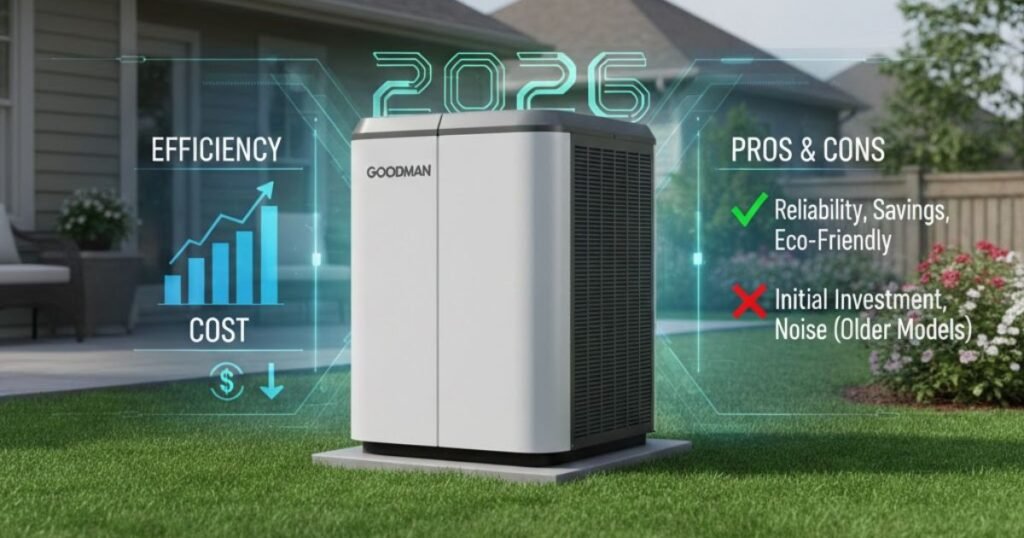
What Is a Goodman Heat Pump?
Goodman (part of Daikin group in recent years) has positioned itself as a value-first major HVAC brand in North America. Historically known for building solid entry- and mid-level packaged systems and split systems, Goodman’s lineup has been modernized with inverter-driven and higher-SEER2 models to compete on efficiency as regulations and consumer expectations shift. Their US presence, dealer network, and aggressive warranty program make them attractive to homeowners who want a dependable system without the top-tier price tag.
Heat pumps move heat rather than generate it. In cooling mode they extract heat from indoors and dump it outside; in heating mode they reverse that flow and pull outdoor heat inside. Modern air-source heat pumps can both cool and heat effectively across most U.S. climates, and inverter-driven variable-speed compressors make them much more efficient and comfortable than older single-stage units.
Suitability by U.S. climate
- Mild/temperate climates (most of the U.S. coastlines, Pacific Northwest, much of the South): Heat pumps are an excellent primary system.
- Colder climates (northern states): Cold-climate heat pumps with enhanced low-ambient performance are required; many of Goodman’s inverter models improve cold-weather output but very cold areas may still rely on backup heat or opt for specialized cold-climate heat pumps.
- Hybrid homes (furnace + heat pump): Multi-fuel setups pair a heat pump for milder months with a furnace for severe cold (common approach).
Heat pumps vs traditional HVAC (furnace + AC)
- Heat pumps replace both a furnace and air conditioner in many homes (one outside unit + indoor coil/air handler).
- They are usually more energy-efficient when outside temperatures are moderate because they move heat rather than generate it.
- Modern high-efficiency heat pumps can beat the lifetime operating cost of many gas furnaces, especially where electricity rates are competitive or if you add solar generation.
Goodman Heat Pump Models & Series
Goodman’s current lineup includes several series of air-source heat pumps. The main lines are often referred to as GSZ (base), GSZC (high-efficiency), and GSZH (mid-range), plus related series like GSZB for inverter-based systems. Each series targets different performance and price levels:
- GSZ Series (Basic Single-Stage) – Entry-level models. Single-stage compressor, fewer bells and whistles. Typical models (e.g. GSZ14/GSZ16) run up to 16 SEER2 and about 9 HSPF2 efficiency. These are the most budget-friendly. They operate at around 72–76 dB and have standard fixed-speed operation. Example: The GSZB4 (14.3 SEER2/8.2 HSPF2) and GSZM4 (14.5 SEER2) fit here.
- GSZB Series (Mid-Tier Two-Stage/Variable) – Mid-range. Includes two-speed and variable-speed inverter models. Offers higher SEER (up to 18 SEER2, 9.5 HSPF2). Compressors can modulate or stage for better comfort than single-stage. Noise is moderate (~70–74 dB) and they often include smart controls. These blend cost and efficiency.
- GSZC Series (High-Efficiency Two-Stage) – Top-of-line Goodman air-source units. Two-stage scroll compressor (ComfortBridge™ compatible) for precise temperature control. Efficiency up to 21.0 SEER2 and 10.0 HSPF2 (some sources list up to 21 SEER and 10 HSPF on the newest GSZC18 model). These are often ENERGY STAR® certified. A GSZC system might incorporate extra insulation or sound blankets for quiet operation (as low as ~70 dB). Example: GSZC18 two-stage heat pump (up to 18.5/10* on older rating, or 21/10 in latest testing).
- GSZH Series – An older/mid-range line (sometimes labeled GSZ 14) that goes up to about 15.2 SEER2 and 7.8 HSPF2. It’s essentially a higher-efficiency step than base GSZ but below GSZC. If you see a model like GSZH14 or GSZH18, it’s the 14.3–15 SEER class (legacy product).
In summary, Goodman heat pump tiers roughly map as:
- GSZ (and similar models) = single-stage, up to ~16 SEER.
- GSZB = inverter/two-stage, up to ~18 SEER.
- GSZC = two-stage high-efficiency, up to ~21 SEER.
Compressors: GSZ = single-stage; GSZC = two-stage; GSZB = multi-stage or variable (inverter). This means a GSZC can run at low power for mild weather then ramp up, boosting comfort and efficiency. All Goodman pumps use scroll compressors (with Copeland bits) and standard refrigerants (R-410A or R-32) compatible with most systems.
SEER2 & HSPF2 Ratings: As of 2025, the DOE updated testing (“SEER2”) so Goodman labels have slight changes from older SEER. But generically: base Goodman pumps start around 14–16 SEER, two-stage mid-range models hit ~18, and premium GSZC units go into the high 18–21 SEER2 range with ~8–10 HSPF2 heating. For example, the GSZC18 is AHRI rated ~19 SEER / 10 HSPF (still excellent performance). These efficiency levels mean Goodman can qualify for ENERGY STAR on the top models.
READ MORE: Geothermal Heat Pump Buying Guide
Performance & Energy Efficiency
Goodman heat pumps perform in line with their ratings. In real-world use, a Goodman running in the high teens (SEER) will save a noticeable amount versus older 13-SEER equipment. For instance, moving from a 13-SEER system to a 16-SEER model can cut cooling energy by roughly 15–20%. That translates to perhaps hundreds of dollars saved per year in moderate climates. (Indeed, one analysis notes a 16 SEER AC uses ~20% less power than a 13 SEER one). So upgrading an aging Goodman 13-SEER to a new GSZC18 (18–21 SEER) should boost efficiency accordingly.
Energy Star & Rebates:
Many high-end Goodman heat pumps (especially GSZC models) exceed ENERGY STAR minimums. ENERGY STAR qualification means local utilities often offer rebates, and federal tax incentives may apply. Under the Inflation Reduction Act, homeowners can claim a 30% tax credit (up to $2,000) on a new high-efficiency heat pump. For example, a $4,000 Goodman with registration and required HSPF2 could net a $1,200 credit (30% × $4,000), significantly cutting net cost. Always check the specific model’s rating; ENERGY STAR requires HSPF≥8.8 (Goodman’s top models surpass this).
Real-World Efficiency:
Actual efficiency depends on climate and installation. In mild heating seasons, a Goodman with HSPF ~9-10 will draw ~1 kW to provide ~3 kW of heat. As outdoor temperature drops below the design balance point (often ~25–30°F), the heat pump’s output falls and auxiliary heat kicks on. A good setup will switch on backup strips only occasionally in Southern or Midwestern US. In very cold regions, homeowners should size a heat pump to the mildest common temp and plan electric or gas backup heat. Modern R-32 Goodman units handle cold better than older R-410A systems one field test showed at 29°F, a new R-32 Goodman still delivered ~20% more heating output than an older R-410A model. That means you get usable heat even on chilly days.
Monthly Cost Examples:
Suppose a 2,000 ft² house in a hot climate swaps a 13-SEER unit for a 17-SEER Goodman. If the old system used ~$200/month to cool in summer, the new system might use around ~$160 (20% savings) under the same conditions. Multiply by 5-6 months of AC season, and you save hundreds. Similarly, an efficient heat pump with HSPF 9 vs an old electric furnace (100% efficient) can slash winter bills in moderate northern states. That said, exact savings vary widely: usage, local rates, thermostat settings, and system condition all matter.
Noise & Comfort:
Goodman designs its outdoor units to be reasonably quiet for their class. Standard models run around 72–76 dB, aided by foam insulation and compressors on rubber mounts. That’s about as loud as a dishwasher or vacuum. The top GSZC units (with more insulation and variable speed) can be a bit quieter, but they aren’t whisper-quiet like ultra-premium brands. (For reference, Carrier’s top variable-speed AC can dip as low as 51 dB at minimum output, far quieter, but those units cost much more.) In practice, we’ve found Goodman heat pumps maintain steady temperatures and humidity (when matched with a good air handler), providing comfortable summer cooling and winter warmth.
Installation Cost & Pricing (USA)
Goodman heat pumps are among the most affordable on the market. Unit cost: The outdoor unit alone typically runs from about $1,400 (small GSZ) up to around $2,800 for a large GSZC18 high-efficiency model. For example, one dealer lists a 2–3 ton GSZC at ~$2,000–$2,800 each, while basic single-stage units (GSZ) come in around $1,400–$2,000. Of course, price varies by tonnage; a 4–5 ton heat pump will be at the higher end of these ranges.
Installation cost:
In the U.S., total installed price (unit + labor) depends on home size and region, but expect roughly $6,000–$12,000 for a typical single-unit Goodman replacement in an average home. Larger homes needing multi-zone or multi-unit setups can exceed this. Nationwide, heat pump installs generally fall between $6,000 and $25,000. The lower end (~$6–8K) covers a straightforward 2.5–3.5 ton replacement in an existing home; upper end covers large or complex installs. For example, Trane’s own pricing guide shows a mid-tier heat pump installed in a 2.5–3 ton range around $8,000–$13,000, whereas a top model can hit $13K–$20K. Goodman will usually be at or below the low end of those ranges given its equipment cost.
Home size factors:
A modest 1,200–1,500 ft² home might need a 2.5 ton pump (25,000 BTU) expect ~$6–7K installed for a Goodman. A 2,000–2,500 ft² home might need 3.5–4 ton (42,000–48,000 BTU) perhaps $8–10K installed. Very large homes with multiple zones could be $12K+. These are ballparks; always get local quotes. Helpful tip: Increasing efficiency (higher SEER) can slightly raise equipment cost, but may reduce labor if it uses the same size.
Incentives:
Remember federal and state programs. As of 2023–2025, the ENERGY Efficient Home Improvement Credit offers a 30% tax credit on heat pump systems (up to $2,000 for heat pumps). For example, a $6,000 installation yields a $1,800 credit. Some utility companies also offer rebates for ENERGY STAR heat pumps (often a few hundred dollars). Local co-ops and municipalities in states pushing electrification sometimes have additional cash rebates. We saw customers often save $500–$1,500 in combined incentives when upgrading to a high-efficiency Goodman. Always check IRS guidelines and local utility resources for the latest deals.
READ MORE: Mitsubishi Heat Pump Buying Guide
Comparison: Goodman vs. Carrier, Trane, Lennox
| Brand | Price Range (Installed) | Peak SEER2 | Warranty (Parts/Compressor/Labor) | Reliability | Best For |
| Goodman | ~$3,000–$10,000* (equipment+install) | Up to ~21 SEER2 (GSZC) | Lifetime compressor, 10y parts/unit (with registration) | Generally reliable if installed properly (low callback rate) | Budget-minded homes; basic heating/cooling needs |
| Trane | ~$3,500–$15,600** | Up to 22 SEER** | 12y comp, 10y parts (standard) | Very high – premium build, 12–15+ year lifespan | Durability and performance in tough climates |
| Carrier | ~$5,000–$12,000† (high-end systems) | Up to 24 SEER** | 10y comp/10y parts, 3y labor** | High – advanced tech, but complex (good dealer network) | Top efficiency and quiet operation (Greenspeed) |
| Lennox | ~$3,100–$10,000* | Up to 28 SEER** | 10y comp/10y parts, 3y labor** | High – premium engineering, quiet operation | Ultra-high efficiency, smart-home features |
Best for: Goodman is best for homeowners on a budget who want a simple, reliable system without fancy extras. Trane suits those who want top-tier durability and can invest more. Carrier is ideal if you want the absolute quietest and most efficient system (with smart controls). Lennox appeals to tech-savvy buyers chasing the highest SEER and smart-home integration.
Pros & Cons of Goodman Heat Pumps
Pros:
- Affordability: Goodman units cost much less than comparable models from Carrier/Trane. The straightforward design cuts costs (Goodman doesn’t pay for big marketing budgets).
- Solid Warranty: With registration, Goodmans carry a 10-year parts and lifetime compressor warranty. This level of coverage (parts and even unit replacement on the compressor in many models) rivals or exceeds most brands. It shows Goodman’s confidence in its product and offers homeowner peace of mind.
- Parts Availability: Since Goodman is so common, replacement parts are easy to find. One owner noted Goodman parts are “almost always available”, unlike some premium brands. Plentiful parts mean simpler (and often cheaper) service.
- Quiet Relatively: Higher-end Goodman models use insulated compressors and run at 72–76 dB, which most people find reasonable. They won’t disturb conversation or TV indoors. (Purely silence-focused buyers may prefer, say, a Carrier Infinity at 50–60 dB, but Goodmans are quiet for their class.)
- Value for Money: Many reviewers and HVAC pros note Goodman units are a “bang for buck” choice. You get dependable heating/cooling with basic smart technology (ComfortBridge thermostat link on higher models) without a huge price tag.
Cons:
- Basic Features: Goodmans typically lack the advanced features of premium brands. For example, they don’t have proprietary variable speed control like Carrier’s Greenspeed or Lennox’s iComfort. There’s no built-in Wi-Fi; advanced diagnostics are simpler. If you want things like built-in humidifiers, modulating air flow or fancy touchscreens, you’ll look elsewhere.
- Noise (Moderate): While not excessively loud, standard Goodman units at 72–76 dB do produce noticeable noise when running at full capacity. That’s louder than top-tier models (some Lennox/Carrier units dip under 55 dB at low speed). In practice, we hear Goodmans run like a strong box fan. Not bothersome in most yards, but not whisper-quiet. (If you need quiet for a bedroom near the unit, you might trade up to a premium model.)
- Installation-Sensitive: Goodman’s simplicity also means installers sometimes skimp. Many HVAC pros note install quality matters most. Because Goodman is easy to buy, it’s often installed by general contractors or inexperienced techs. A poor install can ruin performance and reliability common HVAC advice is “buy quality install, brand is secondary”. So you must choose a reputable contractor for a Goodman.
- Brand Perception: Goodman is often called “builder’s grade” which carries stigma. Some fear it’s cheaply built. In reality, components (compressors, coils) are similar to other brands, but the cabinet and electronics are simpler. The myth that Goodmans “always break” is largely about faulty installs. Just note that if you prefer owning a luxury label, Goodman isn’t that; it’s purely value-driven.
READ MORE: Ductless Heat Pump
Real Homeowner Experiences
To get a real sense of Goodman’s performance, let’s hear what actual users say (from forums, reviews, our own experience):
- Installation & First Impressions: Many homeowners find Goodman installations straightforward. One user who had a 2.5-ton Goodman installed reported: “It seems to work really well. It runs smoothly without vibration.”, noting the compressor was slightly louder than his old unit. This matches what we hear: the unit hums at startup but settles into a steady, smooth run. If properly charged and set up, owners rarely mention malfunction in the first weeks. Most just notice “it cools well and starts up fine.”
- Comfort (Summer/Winter): Owners often report Goodman keeps them comfortable. For example, a Las Vegas resident wrote that their Goodman “runs cool” even after replacing an 18-year-old R-22 unit. People say the system maintains set temperatures reliably. In winter, the aux heat may come on in deep cold, but many southern/midwestern owners say they rarely see backup engage except on very cold mornings (Goodman’s heat strips help out). One homeowner in a northern climate noted it “cranks heat nonstop” in January, but that’s expected behavior for heat pumps in cold weather. Overall, the consensus is the heat pump does both jobs competently, keeping houses warm in winter and cool in summer as promised.
- Noise and Maintenance: Some owners comment on noise. As mentioned, one user said the Goodman compressor was “significantly louder” than his old unit. Another simply said his 12-year-old Goodman (with a Rheem for comparison) was a bit louder but “trouble free.” This suggests noise is not a dealbreaker, just a quirk. In practice, placing the outdoor unit on a rubber pad and a few feet from living areas usually makes the sound unobtrusive.
For maintenance, the message is: schedule annual tune-ups, and you should be fine. People who’ve owned Goodmans for 10+ years often report just periodic filter and coil cleaning. One HVAC worker noted he sees “20 year old Goodman” units still working if installed and maintained properly. This implies that with care (and sticking to that yearly service), a Goodman can last decades. - Long-Term Reliability: Multiple long-time owners vouch for Goodman’s longevity. For instance, one comment said his Goodman has been “trouble free since installed 12 years ago”. Another user chimed in that although Goodman has a “bad name,” correctly installed units last like any other brand. They even saw factory / commercial units running 25 years old without issue. In our own experience and talking to contractors, we hear many Goodman heat pumps reach 15+ years with nothing more than routine parts replacement. So the long-term picture is positive, if your installer does the job right and you keep it serviced.
- Warranty Service: Owners appreciate Goodmans’ warranty. We saw reports that getting a part covered was straightforward with Goodman’s customer service. One reason is Goodman’s parts are plentiful, so repairs are rarely delayed. A few people mentioned receiving replacement parts quickly under warranty, which contrasts with stories about proprietary parts on other brands. This ease adds to overall satisfaction.
In short, homeowner voices say: “Goodman isn’t flashy, but it does the job.” Comfort is on par with other brands, noise is noticeable but acceptable, and reliability hinges mostly on installation and maintenance. The fact that many people happily mention having no issues after a decade speaks well for Goodman’s value proposition.
READ MORE: Air Source Heat Pumps
Warranty, Reliability & Brand Trust
Goodman’s warranty program is a strong selling point. By default, all Goodman heat pumps come with a 5-year limited parts warranty. However, if the homeowner (or installer) registers the product within 60 days, Goodman extends that to 10 years on all parts. Crucially, many Goodman heat pump models also include a lifetime limited warranty on the compressor (again, with timely registration). For example, the GSZC series boasts “10-Year Parts Limited Warranty, Lifetime Compressor Limited Warranty” on select models. This means if the compressor fails under normal use while you still own the home, Goodman will replace it at no charge. (The catch is registration and owning the home; see Goodman’s warranty registration page for details.)
Some higher-end Goodman packages also throw in a 10-year unit replacement warranty on the compressor a feature usually only seen in premium brands. On the other hand, labor (installation) warranties depend on your contractor, and Goodman’s standard policy doesn’t cover labor after a short period. But it does outshine basic “3-year labor” offerings by some competitors.
With these warranties, a new Goodman is a low-risk purchase. It’s a common myth that Goodman has poor reliability; in reality, Goodman stands behind its products aggressively. As one industry article points out, Goodman’s limited warranty (10-year parts, lifetime compressor with reg) is “among the longest in the industry”. This underscores the trust Daikin/Goodman place in their equipment.
Manufacturer Reputation: Goodman is manufactured by Daikin, a global HVAC giant. Since Daikin took over Goodman in 2012, product quality and consistency have improved under the larger company’s standards. Goodman products are built in USA factories (e.g. in Texas and Tennessee) and use many of the same components as Daikin’s higher-end models (e.g. Copeland compressors).
Is a Goodman heat pump worth it? (who should buy, who should look elsewhere)
Best use cases for Goodman
- Budget-conscious homeowners who want a solid heat pump backed by a competitive parts/compressor warranty.
- Landlords replacing units across multiple addresses who need dependable performance at a lower capital cost.
- Homeowners upgrading from very old equipment who will see real energy savings and comfort improvements without premium pricing.
However, there are scenarios where you might look beyond Goodman:
- Extremely Cold Climates: In subzero regions (think interior Alaska or northern Minnesota), a high-end cold-climate heat pump or dual-fuel system may be safer. Goodman’s top HSPF (around 9–10) is good but not the very highest. In these areas, a manufacturer that specifically markets “cold climate” models (e.g. some Mitsubishi, Fujitsu or even Daikin-branded units) might yield better year-round efficiency.
- Ultra-Quiet/Super-Efficient Needs: If you want whisper-quiet operation (below 60 dB) or SEER above 21, look to Carrier Infinity or top Lennox models. They’re pricier but unmatched in those niches.
- Smart-Home Integration: Goodman works with typical thermostats (Wi-Fi ones can be used) but lacks its own smart ecosystem. If you want the latest Wi-Fi features or proprietary home automation integration, brands like Carrier (ComfortLink) or Lennox (iComfort) might interest you.
- Longevity Guarantee: Although Goodman’s lifetime compressor warranty is great, if absolute longest lifespan is your goal, premium brands like Trane (known for 20+ year units) could be justified despite cost. For instance, the Trane XV20i has heavy-duty coils and is built to last through “torture tests”.
READ MORE: Radiant Floor Heating: Types, Costs & My Installation Experience
FAQ
Is a Goodman heat pump reliable for long-term use?
Yes, Goodman heat pumps are generally reliable for long-term use when properly sized and installed. Goodman’s competitive parts and compressor warranties (with registration) add owner protection; however, long-term reliability also depends on installer quality and maintenance..
How long does a Goodman heat pump last?
Typical service life for a well-maintained Goodman heat pump is 15–20 years. Lifetime and longevity depend on usage, maintenance, climate, and installation quality; compressors and coils can last longer when regularly serviced.
Are Goodman heat pumps good for cold climates?
Goodman heat pumps can work well in moderate cold climates. Their high-efficiency models use R-32 refrigerant and provide usable heat even down to ~25–30°F. For example, a test showed a Goodman still delivered significant BTUs at 29°F. In practice, you’ll likely want an auxiliary heat source (electric strips or a furnace) for freezing nights. In temperate zones (the mid-Atlantic, parts of the Midwest/South), Goodman units heat efficiently on their own most of the winter. If you live in an area where winter temperatures often drop below 0°F, consider pairing the Goodman with a backup heat or choosing a cold-climate heat pump system for maximum efficiency in extreme cold.
How much does it cost to install a Goodman heat pump in the USA?
Total cost varies by home and equipment, but expect roughly $6,000–$12,000 for a typical single Goodman heat pump installation in a 1,800–2,500 ft² home. Nationwide averages span $6,000 to $25,000, driven by system size and complexity. For a 3-ton Goodman GSZC heat pump plus new air handler and duct hookup, many homeowners see quotes in the $7K–$10K range. Smaller homes (1,200–1,500 ft²) with a 2–2.5 ton unit might be $6–7K. Large homes or multi-zone installs can exceed $12K. Remember to factor in local rebates and the 30% federal tax credit (up to $2,000), which can lower your net cost.
Is Goodman better than Trane or Carrier?
“Better” depends on what you need. Goodman excels on value – similar core technology at a much lower price. For basic heating/cooling, Goodman often matches the reliability of pricier brands, as long as it’s correctly installed. By contrast, Trane and Carrier are premium. Carrier’s top system (Infinity 24) hits 24 SEER (versus Goodman’s ~21) and is ultra-quiet; Trane units are built to last through tough conditions. But they cost significantly more. In summary, Goodman is a great choice if you want solid performance and are on a budget. If you have a larger budget and want maximum efficiency/durability (and will stay in the home a long time), looking at Carrier or Trane might make sense. Each brand can do the job – Goodman just does it with less flair and price.
Sources: Author is an HVAC specialist and homeowner. Information above is drawn from Goodman’s documentation, manufacturer/industry publications, and homeowner/technician forums. All pricing and specs reflect current (2025/2026) national data and manufacturer ratings.