You wake up on a chilly morning and step into the shower. You expect a steady stream of hot water. Instead, you get a lukewarm drizzle or a strange rumbling sound coming from the basement. These small frustrations often point to a hidden problem in your pipes. Specifically, the hard water impact on water heater lifespan can be much more severe than most homeowners realize.
Hard water affects millions of homes across the United States. It quietly attacks your appliances every time you turn on the tap. If you ignore it, you face higher energy bills and a water heater that dies years before its time. This guide helps you understand how minerals damage your system. You will learn the signs of trouble and the best ways to protect your investment. We will cover maintenance steps, the role of water softeners, and the real-world costs of keeping your home running smoothly. Lets deep dive into “Hard Water Impact on Water Heater Lifespan — Signs, Fixes, and Costs”
What is hard water?
Hard water contains high levels of dissolved minerals. The two most common minerals are calcium and magnesium. Rainwater starts as soft water. It picks up these minerals as it filters through rocks like limestone and chalk before reaching your local well or city supply (USGS, 2024).
Professionals measure water hardness in two ways. They use grains per gallon (gpg) or parts per million (ppm). Most experts consider water “hard” if it contains more than 7 grains per gallon. If your water exceeds 10.5 gpg, it is “very hard” (Water Quality Association, 2024).
Regional notes for U.S. homeowners:
- The Midwest and Southwest often have the hardest water in the country.
- Cities like Indianapolis, Las Vegas, and Phoenix frequently report very high mineral counts.
- Coastal areas in the Northeast and Northwest generally enjoy softer water.
- If you use a private well, your hardness levels can change based on the depth of your well and local geology.
READ MORE: Best Whole House Water Softener System for Home (2026) — Top Picks & Buyer’s Guide
How hard water damages water heaters
Hard water and water heater systems do not get along. The damage starts the moment you heat the water. When water gets hot, the dissolved calcium and magnesium “precipitate.” This means they turn back into solid crystals. These crystals stick to the hottest surfaces they can find.
1. Scale buildup on heating elements and tanks
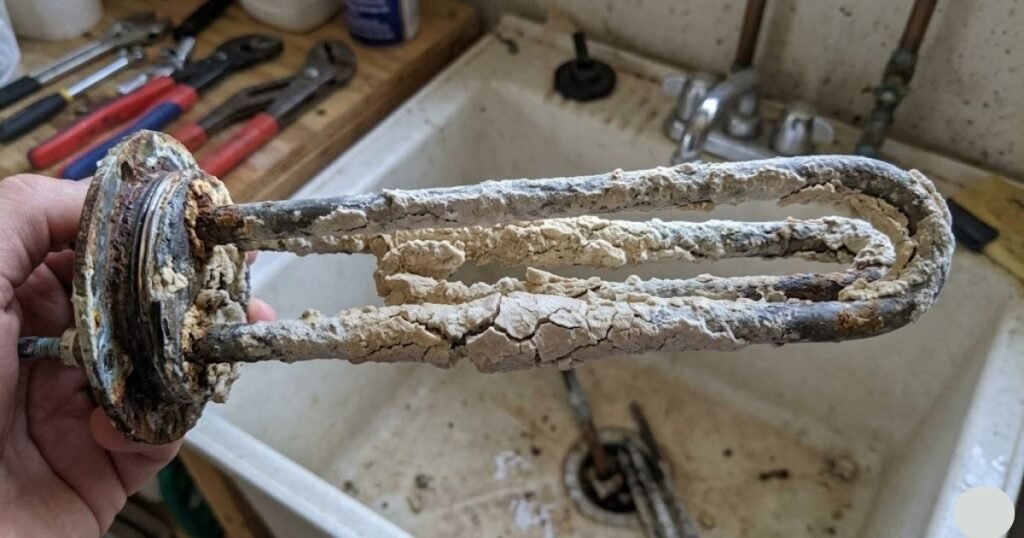
In an electric water heater, the minerals coat the heating elements. In a gas unit, the minerals settle on the bottom of the tank directly above the burner. This coating is called “scale” or “limescale.”
Scale acts like an insulator. It creates a thick barrier between the heat source and the water. The heating element must work much harder to get the water to the right temperature. This extra heat stresses the metal. Eventually, the element burns out or the tank bottom weakens and leaks.
2. Sediment and corrosion
As scale breaks off the walls, it settles at the bottom of the tank as sediment. This sludge reduces the amount of hot water your tank can hold. It also traps pockets of water against the metal floor. These “hot spots” cause the metal to expand and contract unevenly. This movement creates tiny cracks in the glass lining of the tank. Once the lining fails, the steel tank begins to rust (ASPE Plumbing Engineering Design Handbook, 2023).
3. Efficiency and energy costs
Hard water makes your heater incredibly inefficient. You pay for energy that never reaches your water. Research shows that just a quarter-inch of scale can increase your energy costs by 25% or more (Battelle Memorial Institute Study, 2024).
Stepwise mechanics of damage:
- Hard water enters the tank.
- The burner or element heats the water.
- Minerals solidify and attach to surfaces.
- Scale layers grow thicker every month.
- Heat transfer slows down.
- The unit overheats to compensate.
- The tank lining cracks or the element fails.
READ MORE: Why My Tankless Water Heater Shuts Off During Shower — Fixes & Costs
Signs Your Water Heater is Affected by Hard Water
You do not need to be a plumber to spot water heater scale buildup. Your system will give you several warnings. If you notice these signs, take action immediately to avoid a total breakdown.
- Rumbling or popping noises: This “kettling” sound happens when water gets trapped under layers of sediment. The water boils and turns to steam, creating a mini-explosion inside the tank.
- Reduced hot water supply: If your 40-gallon tank only feels like a 20-gallon tank, sediment probably fills the bottom half.
- Higher energy bills: Check your gas or electric bill. If your usage spikes without a clear reason, your heater is likely fighting scale.
- Visible scale on fixtures: Look at your showerhead or kitchen faucet. White, crusty buildup there means the same thing is happening inside your heater.
- Frequent repairs: If you replace elements or thermostats every year, hard water is the culprit.
How to check your system
You can perform two simple checks yourself. First, look at the Temperature and Pressure (T&P) valve. This is the lever on the side or top of the tank. If you see crusty white powder around it, scale is interfering with the safety seal.
Second, inspect the anode rod. This is a long metal rod that hangs inside the tank. Its job is to rust so your tank doesn’t have to. In hard water areas, anode rods vanish quickly. If the rod looks like a thin wire or is completely gone, your tank is currently rusting from the inside out (Manufacturer Maintenance Manuals, 2024).
READ MORE: How to Clean Sediment from a Water Heater
How Much Hard Water Shortens Water Heater Lifespan?
A standard tank-style water heater should last 8 to 12 years. A tankless unit can last up to 20 years. However, hard water changes these numbers drastically.
In homes with very hard water, a tank-style heater might fail in just 4 to 6 years. This represents a 50% reduction in lifespan. Tankless units are even more sensitive. Scale can clog the narrow heat exchanger in a tankless system within 2 or 3 years if you do not treat the water (AHRI Report, 2023).
Manufacturers often include “water quality requirements” in their warranties. If your water is extremely hard and you do not maintain the unit, the manufacturer might deny your warranty claim. They view hard water damage as “neglect” rather than a part failure.
Water Heater Hard Water Prevention & maintenance
You can fight back against hard water damage. Proper water heater maintenance hard water routines can add years to your appliance. Follow this checklist to keep your system healthy.
- Flush the tank annually: Connect a garden hose to the drain valve. Drain the tank completely to wash out sediment. If your water is very hard, do this every six months.
- Replace the anode rod: Check the rod every two years. Replace it if it shows significant wear. A new rod costs about $30 to $50 and can double the life of your tank.
- Install a sediment filter: A pre-filter on your main water line catches large particles before they enter the heater.
- Lower the thermostat: Set your heater to 120°F. Higher temperatures (above 140°F) cause minerals to fall out of the water much faster.
- Schedule a pro inspection: Have a plumber check the heating elements and internal lining every two years.
Whole-house water softener vs. targeted solutions
A water softener is the most effective way to stop scale. These systems use ion exchange to remove calcium and magnesium entirely.
Whole-House Softener (Salt-based)
- Pros: Removes 99% of minerals; protects all appliances and pipes; makes hair and skin softer.
- Cons: Requires monthly salt refills; adds a small amount of sodium to the water; needs a drain line.
Salt-Free Water Conditioners
- Pros: Low maintenance; no salt needed; does not waste water.
- Cons: Does not remove minerals; only prevents them from sticking to surfaces; less effective in extremely hard water.
Electronic Descalers
- Pros: Very cheap; easy to install on the pipe.
- Cons: Mixed results in independent testing; often fails in high-flow situations.
READ MORE: How to Drain a Rheem Water Heater — Step-by-Step Guide
Do water softeners extend water heater life?
The short answer is yes. A water softener water heater lifespan study confirms that softened water maintains 100% of the heater’s efficiency for the life of the unit (WQA/Battelle Study, 2024).
For tankless models, a softener is almost mandatory in hard water areas. Tankless units use very small passages to heat water quickly. Even a tiny amount of scale can cause the unit to overheat and shut down.
However, there is one trade-off. Softened water can be more “aggressive” toward the anode rod. Because the minerals are gone, the water looks for other minerals to grab. It often attacks the anode rod faster. If you install a softener, check your anode rod every year instead of every two years.
Cost considerations: Repair vs. Replace
When damage occurs, you must decide whether to fix the unit or buy a new one. Here are the average costs for U.S. homeowners (Data from 2024-2025 regional plumbing surveys).
| Repair/Service Task | Estimated Cost Range (2025) |
| Professional Tank Flush | $150 – $300 |
| Heating Element Replacement | $200 – $450 |
| Anode Rod Replacement | $150 – $350 |
| New Tank Heater (Installed) | $1,200 – $3,500 |
| New Tankless Heater (Installed) | $2,500 – $5,500 |
If your heater is more than 8 years old and has a major scale problem, replacement is usually the smarter choice. A new, high-efficiency unit will save you enough on energy bills to pay for itself over time.
READ MORE: How to Drain an Electric Water Heater: Step by Step Guide
Comparison Table: Hard Water Effects and Fixes
| Issue | Hard Water Effect | Short-Term Fix | Long-Term Fix |
| Scale on elements | Reduced heat transfer, higher bills | Flush tank; replace element | Install softener; regular descale |
| Sediment in tank | Rumbles, reduced capacity | Flush and vacuum tank | Annual maintenance; replace if corroded |
| Corrosion | Leaks, early failure | Replace anode rod | Hardness control; tank replacement |
Quick action plan for homeowners
If you suspect hard water is hurting your heater, follow these steps right now:
- Check your water hardness: Buy a $10 test kit at a hardware store or check your city’s annual water quality report.
- Listen to your heater: Stand near the unit while it is running. If you hear popping or “rocks” tumbling inside, you have sediment.
- Perform a mini-flush: Drain a few gallons of water into a bucket. If the water looks cloudy or contains white flakes, scale is present.
- Call a pro if: You see any water leaking from the bottom of the tank or if you have no hot water at all.
- Ask your plumber: “Should I install a power-powered anode rod or a water softener for my specific hardness level?”
FAQs
How does hard water affect my water heater?
Hard water causes calcium and magnesium to settle inside your tank. This creates a thick layer of scale on heating elements and the tank floor. This scale forces the heater to work harder, leading to higher energy bills, “kettling” noises, and eventually a cracked or rusted tank.
Can hard water shorten the lifespan of a water heater?
Yes, significantly. While a well-maintained heater lasts about 10 years, hard water can cause failure in 4 to 6 years (AHRI, 2023). Scale causes the metal to overheat and the protective lining to fail, which leads to leaks and total system breakdown much sooner than expected.
What are the signs that hard water is damaging my water heater?
Common signs include rumbling or popping noises during heating, a decrease in the amount of available hot water, and a steady increase in your monthly energy bills. You might also see white, crusty deposits on your faucets or find “sand-like” sediment when you drain the tank.
Will a water softener extend my water heater’s lifespan?
A softener extends the lifespan by removing the minerals that cause scale. It keeps heating elements efficient and prevents sediment buildup. However, softened water can wear out anode rods faster, so you must inspect the rod annually to ensure the tank remains protected from corrosion.
How much does it cost to repair or replace a water heater damaged by hard water?
Minor repairs like replacing an element or flushing the tank cost between $150 and $450. If the tank is leaking, a full replacement usually costs between $1,200 and $3,500 for tank models or up to $5,500 for tankless systems (2025 pricing data).
Conclusion
Hard water is a common reality for many Americans, but it does not have to ruin your home. By understanding the hard water impact on water heater lifespan, you can take control of your maintenance. Regular flushing and anode rod checks are cheap ways to save thousands of dollars in the long run. If your water is “very hard,” a softener is a wise investment that protects your heater, your dishes, and your skin. Take a few minutes this weekend to check your system. A little bit of neighborly advice today can prevent a cold shower tomorrow.

