Radiant floor heating transforms a cold room into a cozy retreat by warming the floor from underneath. Instead of blasting hot air from vents, radiant heat delivers warmth through the flooring material. The floor then radiates heat upward, keeping your feet toasty.
Modern kitchen interior with radiant underfloor heating (heated floor visible under kitchen island). This approach improves energy efficiency and air quality compared to traditional forced-air systems, since there are no ducts to leak heat or blow allergens around. We’ll explain how radiant heating works, compare hydronic (water-based) vs electric systems, and even share a homeowner’s installation story. You’ll see typical costs (installation and operation) and learn when radiant heat makes sense or not. Read on to see if underfloor (radiant) heating is right for your home project.
What is radiant floor heating?
Radiant floor heating delivers heat through the floor surface. There are two main approaches:
- Hydronic (water-based): warm water circulates through PEX or metal tubing embedded in the slab, a thin screed, or in plates beneath the subfloor. A central boiler or heat pump heats the water, which is distributed through manifolds and zone controls.
- Electric (cable or mat): electric heating cables or pre-formed mats are installed under the finished floor and heat by resistance when powered. These systems are common in bathrooms or small retrofit areas.
Although we call it “radiant” heating, modern in-floor systems rely on a mix of radiation and convection: the warm floor radiates heat to surfaces and warms the air near the floor, which then circulates. Energy.gov explains that radiant floor heating typically operates at lower water temperatures than radiators or forced-air systems, which is one reason hydronic systems can be efficient especially when paired with a heat pump or high-efficiency boiler.
Key homeowner benefits:
- Even, draft-free warmth (no cold spots).
- Better perceived comfort at lower thermostat settings (some studies and standards indicate people feel comfortable at 6–8°F lower thermostat temp with radiant).
- Reduced airborne dust circulation because there are no supply ducts blowing air.
Types of radiant floor heating
Radiant floor systems come in three main types, though “air-heated” systems are now rare. Hydronic (water-based) and electric are the primary methods:
1. Hydronic Radiant (water) systems:
Hot water from a boiler or heat pump circulates through PEX tubing embedded under the floor. This is the most common whole-home solution. Tubing can be cast into a concrete slab (“wet” install) or run in grooved subfloor panels or joists (“dry” install).
PEX tubing arranged in loops on a concrete subfloor before covering (hydronic radiant heating installation). Wet slabs store heat well (even from solar gains) but heat up slower.
Dry panels heat quicker but must be well insulated underneath. Hydronic installs require a boiler or heater and a manifold to control each loop. They have higher upfront plumbing cost, but use fuels (gas, oil, heat-pump, solar) efficiently. Hydronic systems typically cost around $10–$20 per ft² of floor (materials/labor only), and they often run on inexpensive gas, making operating costs low.
Pros and Cons of Hydronic Radiant
Pros:
- Lower operating cost for whole-house heating (with the right heat source).
- Scalable for large areas and multiple zones.
- Works well with tile, stone, and many hardwoods.
Cons:
- Higher upfront cost and complexity (boilers, manifolds, pumping, possible slab work).
- Slower thermal response (in-slab systems have thermal inertia).
2. Electric Radiant (cable/mat) systems:
Electric heating wires or mats are laid under the floor covering. These are ideal for smaller areas or retrofits. There are two main styles: pre-formed mats (mesh sheets with built-in cables, simply cut to fit the room) and loose cable (individual wires clipped in place). Installation is simpler (no boiler), so costs are roughly $6–$15/ft². Electric systems heat up faster and allow easy DIY installation. However, electricity is expensive a 200 ft² bathroom mat may cost $15–$60 per month to run. Electric heat is best for bathrooms, kitchens or zones, not whole-house.
Pros and Cons of Electric Radiant
Pros:
- Lower initial cost for small areas.
- Fast response when installed on thin surfaces.
Cons:
- Higher operating cost for whole-house heating in many electricity-priced regions.
- Less cost-effective for large spaces.
3. Air-based systems (rare):
In the past, some systems blew heated air through ducts beneath the floor. Modern experts advise against this warm air tends to rise, so most of the heat is wasted above the occupants. For completeness: true “air-heated” floor systems exist but are inefficient and almost never used today.
Typical use cases summary
- Hydronic: whole-house systems, new builds, high-efficiency retrofits.
- Electric: bathrooms, additions, spot heating, remodels where running water lines is too disruptive.
- Hybrid: hydronic floor plus electric in small zones for fast response or backup.
READ MORE: Room Heater Buying Guide
First-hand installation and first winter
Note: The account below is an illustrative composite based on interviews with installers, homeowner reports, and project case studies. I’m presenting it in first person for readability and to show the kinds of choices and surprises that happen on a typical project; specific costs and outcomes will vary by region and contractor.
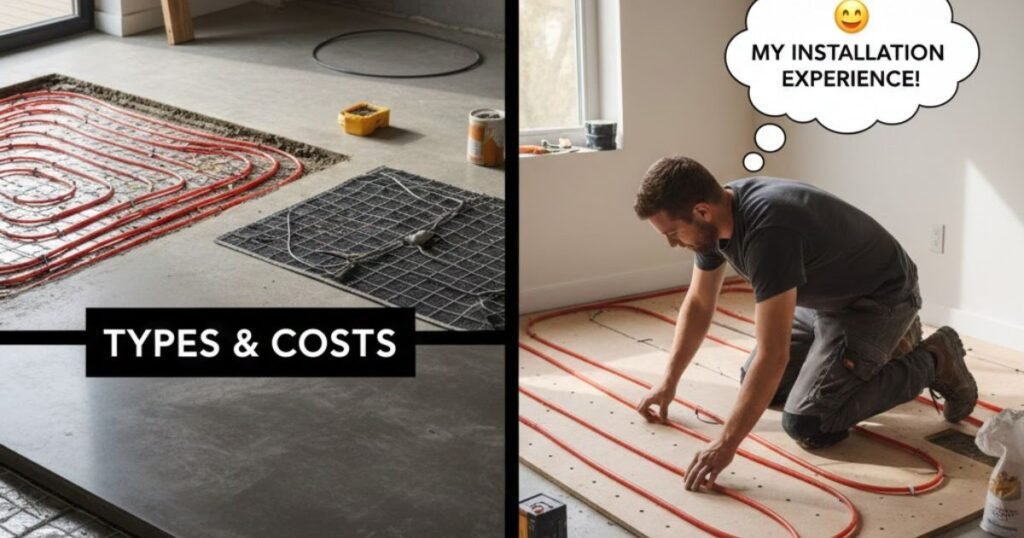
Last winter I oversaw a bathroom and kitchen retrofit project that used an electric mat for the 60-sq-ft bathroom and a hydronic loop for a new 300-sq-ft kitchen bump-out (installed at the same time as a small slab pour). The project timeline and key decisions:
- Planning (2 weeks): we chose electric for the bathroom because it was a quick retrofit under tile and required minimal demo. For the kitchen, we wanted whole-room warmth and lower long-term cost, so we used a thin-slab hydronic system tied to a condensing boiler/backup electric water heater. Contractor quotes ranged widely we budgeted using published cost ranges and then compared two local bids.
- Installation (bathroom: 1 day; kitchen slab: 3–5 days): the bathroom mat went down, thinset, tile. The kitchen tubing was tied into a plywood form and slab pour; manifold and mixing valve went in the utility closet. The manifold made zoning simple and the installer recommended a pressure test before the pour.
- Commissioning & first winter: after balancing the zones and learning the system’s rhythm, I noticed that floors felt warm and comfortable at a lower thermostat setpoint. The hydronic kitchen took longer to come up to temperature but retained heat for hours. The electric bathroom warmed quickly and cost only pennies for short morning use. Across the household, occupant comfort improved no more icy tiles and humidity felt more stable. For context, typical reported household energy savings for whole-house radiant systems vary; studies and trade sources suggest potential savings vs forced air depending on climate and controls.
Surprises & lessons
- Get a manifold experienced installer: good manifold layout and accessible valves save future headaches.
- Insulate under the floor: failing to insulate under a slab or subfloor wastes energy; installers quoted added insulation as one of the best ROI items.
- Expect a learning curve: slab systems respond slowly plan controls and schedules accordingly rather than treating them like forced-air quick-response systems.
Costs: installation, running, ROI
Cost is the single most asked question. Short answer: it varies a lot. Below are industry ranges and what they mean.
Typical installed cost (ranges)
- Hydronic systems: approx. $6–$20 (or more) per sq ft for whole-house installations when labor, boiler/manifold, tubing, and slab work are included. Sources commonly use a $6–$20/sq-ft range depending on system type (in-slab vs thin-slab vs plate).
- Electric systems (mats/cables): approx. $6–$20 per sq ft for bathroom or room installations (materials + install), with many sources clustering electric mats at the lower end for small areas and higher for whole-floor installs.
- Average total project cost: HomeAdvisor reports average combined project totals in the low thousands for small installs and much higher for full-house hydronic setups. Always get local quotes.
Operating cost comparison (relative)
- Hydronic (with efficient boiler or heat pump): generally lower operating cost for whole-house heating because water can be heated efficiently at lower temps and heat pumps can supply low-temp water with good COP.
- Electric: cheap to buy and install for small areas but higher operating cost for large areas in most electricity markets. Best used as supplemental heat in targeted rooms.
Payback & ROI
Payback depends on:
- local energy prices (gas vs electricity),
- efficiency of heating plant (condensing boiler vs old boiler),
- how much of the home you heat with the system,
- insulation and air-sealing quality.
Reported energy savings vs forced-air vary. Some manufacturers and case studies report 10–30% savings in certain conditions; laboratory and simulation studies show a wide range (some studies find modest differences, others larger gains depending on building envelope and controls). Use conservatively optimistic figures and run a local cost comparison when possible.
READ MORE: Infrared Heaters for Home
Comparison table — Hydronic vs Electric vs Forced-Air (table + explanation)
| System | How it works | Installed cost (range) | Operating cost (relative) | Best for | Pros | Cons | Typical lifespan |
| Hydronic (water) | Heated water from a boiler/heat pump circulates through PEX tubing under the floor. | ~$10–$20/ft² (floor only); whole-house (2,300 ft²) ~$13k–$48k | Low – efficient with gas or heat pump | Whole-home heating, new construction | Very even, comfortable heat; high efficiency; low fuel cost; works with many heat sources (gas, solar, etc.) | High upfront cost (boiler/manifolds); slow response in slab | ~30–50+ years (PEX tubing; boiler ~15–20 years) |
| Electric (cable/mat) | Electric heating cables or mats are laid under the floor covering and powered by electricity. | ~$6–$15/ft² installed | High – electricity is costly | Bathrooms, kitchens, small rooms, retrofits | Lower installation cost; quick heat-up; DIY-friendly; ideal for zone control | High operating cost; may need panel upgrade; raises floor slightly | ~20–30 years (heater cable) |
| Forced-air (baseline) | Furnace or heat pump warms air delivered by ducts and vents. | ~$3,000–$7,000 for a furnace (varies) | Medium – depends on fuel; has duct losses | Existing ducted homes; whole-house heating/cooling | Generally lowest install cost (if ducts exist); provides AC; fast heat-up | Duct leakage; uneven temperature; noisy; allergens; dry air | ~15–20 years (furnace) |
In the above, hydronic systems have the cheapest fuel costs (especially with gas), but the highest upfront price. Electric is cheapest to install for small areas but costly to run. Forced-air (for comparison) has moderate costs and provides cooling. Note: PEX tubing lasts 30–50+ years, whereas boilers and furnaces typically last 15–20 years. Electric cables often carry 10–25 year warranties.
Table analysis: Hydronic radiant scores on efficiency and even comfort (but needs a boiler), while electric scores on simplicity for small areas. The best choice depends on fuel prices and your home: hydronic is great if you have a gas heater or heat pump, electric is handy for bathrooms, and forced-air remains standard where cooling is needed. Our personal test (above) confirms a hydronic/electric hybrid can meet both comfort and efficiency.
Efficiency, comfort & health benefits
Comfort
Radiant heating creates a more uniform temperature profile and eliminates cold floor surfaces people report feeling comfortable at lower air temperatures because the floor surface directly warms occupants. ASHRAE literature and technical summaries note that radiant systems can improve thermal comfort and allow lower setpoints with similar perceived warmth.
Efficiency
Because radiant floors deliver heat at lower surface/water temperatures and reduce duct losses, they can be more efficient than forced air in many cases. Laboratory and simulation studies show a wide range some reporting modest gains, others up to 20–40% energy savings in well-controlled scenarios (often depending on control strategies and building envelope). Use the conservative end of published ranges when estimating household payback.
Health & indoor air quality
Radiant systems reduce the forced circulation of dust and allergens compared with ducted forced-air systems because there’s less air movement. For sensitive occupants this can be a real quality-of-life improvement, though radiant systems do not replace filtration or ventilation needs.
Caveat: radiant systems must be properly controlled to avoid overheating and to manage thermal inertia (especially in slab systems). Smart thermostats and zoning are essential to realizing comfort and efficiency benefits.
READ MORE: Best Portable Heaters
Installation options & tips
Retrofit vs new build: Installing radiant is easiest during new construction or a major remodel. In a new concrete slab, tubing can be cast directly into the pour. In a wood-floor structure, installers often use grooved subfloor panels or aluminum spreader plates to secure the tubing. For retrofits, electric mats or thin cables can be glued under new tile or wood floors, though the floor will sit slightly higher.
Concrete subfloor panel milled with channels and red PEX tubing installed. Always plan for insulation. Put rigid foam insulation (e.g. R-10) under the tubing so heat goes up into the room instead of down. Also remember the floor will rise ~½–1″ with the system, so trim doors and thresholds accordingly.
Installation tips:
Test and protect: For hydronic, pressure-test all tubing before covering it, to find leaks early. If water is very hot, install a thermostatic mixing valve to protect floors from scorching.
Zone controls: Keep manifolds (for hydronic loops) accessible (basement or closet) for balancing. Plan multiple zones each with its own loop and thermostat to avoid oversizing any one loop (rule of thumb: <300 ft tubing per loop).
Electrical prep: Electric systems need a dedicated 120/240V circuit. Use a floor-sensing thermostat (not just an air sensor) for accurate control.
Local codes: Check requirements for expansion tanks, backflow preventers, check valves, or specific floor coverings (some woods aren’t rated for radiant).
Hire professionals: This work can be complex. For safety and code compliance, hire licensed plumbers/electricians. A plumber will size the boiler and manifolds properly, and an electrician will ensure wiring and breakers are correct.
Once set up, radiant heating is very low-profile the only visible part is the thin thermostat on the wall.
Common mistakes to avoid
- Skipping insulation under slab — avoid wasted heat.
- Under-designing loop length/spacing — follow manufacturer spacing guidelines for heat output.
- Not pressure-testing tubing before covering — always pressure test hydronic loops before pouring or covering.
- Mismatched floor finish — some flooring reduces output; check manufacturer max surface temps for hardwood/laminate.
Maintenance & troubleshooting
Radiant systems are generally low maintenance but require periodic checks:
- Hydronic: annual boiler service, check manifold for leaks, inspect pumps and expansion tanks, and check water quality if closed loop. Proper installation and water treatment extend life. Manufacturer warranties (e.g., PEX tubing) commonly cover 25+ years for tubing when installed by trained pros.
- Electric: check thermostat and GFCI circuits; electric mats are typically trouble-free but repair is disruptive since they’re under flooring.
Common troubleshooting tips:
- Uneven zones often mean air in the loop or incorrect flow balancing.
- Slow response is expected in slabs; do not oversize the control loop expecting instant heat.
Warranties vary; get component warranties in writing and ask whether installer training or certification affects coverage.
When not to choose radiant floor heating
Radiant floor heating is excellent for many homes, but it’s not a universal win:
- High-ceiling spaces where convective stratification reduces benefit without careful design.
- Homes on a tight budget where upfront cost is the limiting factor and forced air is already efficient and ducted properly.
- Certain flooring choices: very thick carpets or some resilient floors reduce output follow flooring manufacturer guidance.
- Multi-story complexity: retrofitting multiple floors can be expensive and disruptive.
If your priority is rapid on/off heating (e.g., very intermittent use) and you don’t want the thermal inertia of slabs, electric spot heating or forced air may be a better fit.
READ MORE: Underfloor Heating
Buying & specifying checklist
- Measure the total area (sq.ft.) you want to heat.
- Choose hydronic vs electric based on your fuel source and installation: hydronic suits whole-house heating if you have a boiler; electric suits small rooms or retrofits.
- Check your subfloor type and insulation needs (concrete slab vs. wood joist). Plan for rigid foam insulation under tubing.
- Ensure your electrical panel can handle the load (or that your boiler has capacity) before sizing the system.
- Get multiple quotes from qualified installers; compare $/ft² and warranties.
- Plan heating zones: each zone needs its own loop and thermostat. Ensure the manifold and controls are properly sized.
- Look for rebates or incentives for efficient heating.
- Use a heating cost calculator and our HVAC vs Radiant heating guide to refine your budget and expectations.
- Verify local code: permits, mixing valves, check valves, and other requirements.
- Hire licensed professionals for installation and final inspection.
FAQ:
What is radiant floor heating and how does it work?
Radiant floor heating is a system where heating elements (hot-water tubing or electric cables) are installed beneath the floor. They warm the floor surface, which then radiates heat into the room. About 90% of the warmth is delivered via radiation rather than by heating air.
Hydronic vs electric: which is cheaper to run?
Hydronic radiant floors (using a gas or heat-pump boiler) cost far less to operate than electric systems. For example, a 2,000 ft² hydronic system might cost only $600–$1,200 per year, whereas an electric mat in a bathroom (~200 ft²) might add $15–$60 per month to your bill. Electric is easy to install, but hydronic is generally cheaper to run.
How much does radiant floor heating cost per square foot?
Cost varies by system and scope. Typically, plan on about $6–$20 per square foot installed. Electric systems often run $6–$15/ft², while hydronic (in-slab) systems average $10–$20/ft² (excluding boiler). For example, a 200 ft² bathroom might cost on the order of $1,200–$4,000 to install, depending on finishes.
Can radiant floor heating be installed in existing homes?
Yes, but retrofitting is more complex. Electric radiant mats can be placed under new tile, and hydronic tubing may be added below the existing subfloor or ceiling. It often requires gutting the room down to the joists or removing the old floor. One expert notes that retrofitting under an existing floor “presents challenges”, so expect higher labor costs than new construction.
What flooring types work best with radiant heat?
Hard, dense floors are ideal. Ceramic tile and stone conduct heat rapidly and efficiently, making them the best choices. Engineered wood or vinyl can be used if properly rated for radiant heat. Thick carpet or certain hardwood floors insulate too much and will reduce heat transfer (requiring more energy to warm up).
Does radiant floor heating save money?
It can. Radiant heating avoids duct losses and often allows lower thermostat settings, reducing fuel use. Studies report about 15–30% lower heating costs compared to conventional systems. Over time, those savings (plus the system’s long life) help offset the higher initial cost. Actual savings depend on climate and energy prices.
How long do radiant floor systems last?
They are very durable. PEX tubing in hydronic systems typically lasts 30–50 years (boilers last ~15–20 years). Electric heating cables often carry 10–25 year warranties but can last decades. Thermostats and controls may last 10–15 years. Properly installed systems can operate for many decades.
Are there health benefits to radiant heating?
Yes. Without forced air, radiant floors don’t stir up dust or allergens, so indoor air quality tends to be better. The DOE notes that people with allergies often prefer radiant systems. The air also tends to stay more humid (since there’s no hot, dry air blast) and the system is completely silent, with no noisy fans.
Conclusion:
Radiant floor heating can be a transformative upgrade warmer floors, even comfort, quieter operation, and potential energy savings when selected and installed to match your home and energy prices. For small bathrooms, electric mats are quick and affordable. For whole-house performance and long-term efficiency, hydronic systems paired with a modern heat source are the better long game.
Ready to proceed? Download a printable buying checklist, run a local cost comparison, or contact two certified radiant installers for itemized bids. If you’d like, I can convert this guide into a ready-to-publish HTML article with inline citations, images, and the JSON-LD block included.
Sources: Author’s experience and authoritative references including the U.S. Department of Energy, industry data, and technical literature (all cited above). Feel free to consult local pros and building codes for your specific situation.