As a licensed electrician with over 20 years of experience working on homes across the United States, I’ve seen firsthand how electrical systems age. Rewiring a house is one of those projects that many homeowners put off until it’s absolutely necessary. But when it’s time, it’s a big job that touches every room and affects your daily life.
Rewiring a house means replacing the home’s electrical wires and related devices (outlets, switches, fixtures, and sometimes the service panel) with new, up-to-code components. This often involves pulling new cables through walls, floors, and ceilings to meet modern standards. In the U.S., many homes were built decades ago when wiring standards were different. As a result, outdated wiring is common for example, census data shows about 20% of U.S. housing was built before 1980.
Old systems like knob-and-tube or aluminum wiring are still lurking in these homes. These older systems pose safety concerns: they lack ground wires, are prone to deterioration, and can overheat. For homeowners, this raises worries about fire risk and shocks. Insurance companies take notice: many insurers will refuse or charge more if a home has known hazard wiring types (knob-and-tube or aluminum).
What Does Rewiring a House Involve?
Rewiring a home is a major electrical renovation. It typically entails removing old cables and installing new wiring throughout the house. This can mean cutting into walls, floors, and ceilings to run new wires, then patching finishes afterward. The electrician will replace worn wires, update outlets and switches, and often install new circuit breakers. The process is intensive: “Home rewiring is an intensive job that affects more than just wires. When you remove and replace the wires throughout your home, you’ll have to go through every room’s walls, floors, and ceilings”.
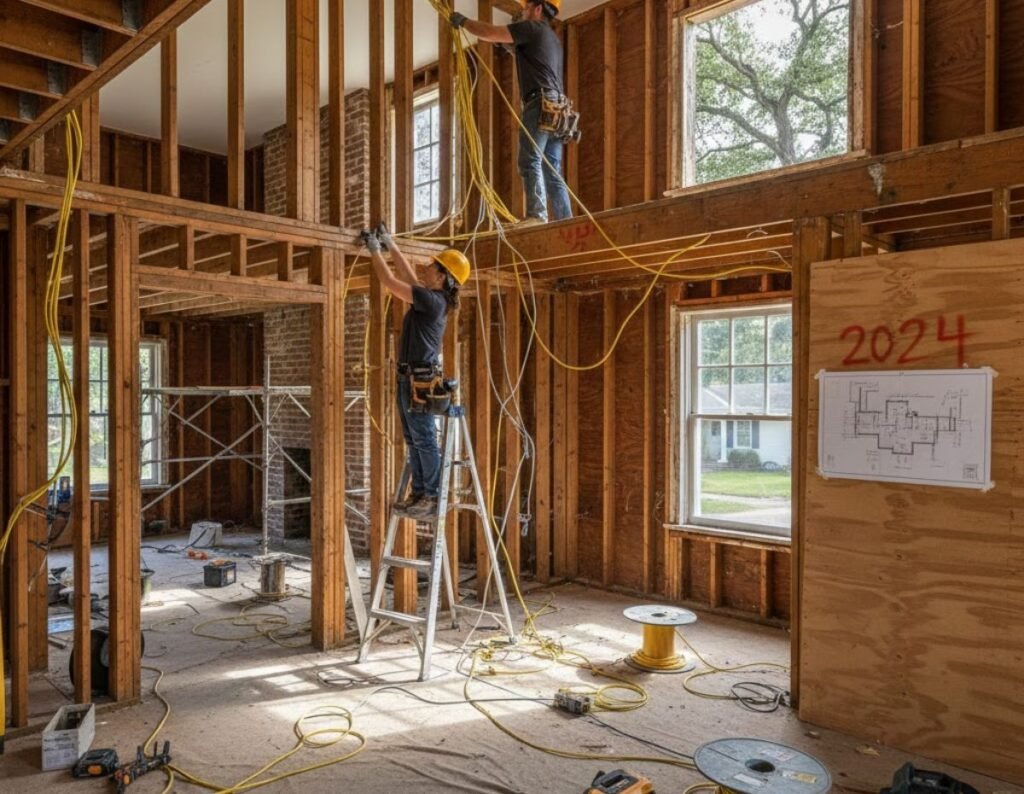
Figure: Electricians run new electrical cables through a wall during a home rewiring project. A full rewiring generally replaces all of the home’s circuits; in other words, most rooms are opened up and completely updated. In contrast, partial rewiring is sometimes sufficient if only specific circuits need upgrading (for example, just the kitchen or an added addition). Partial rewiring may cost only a few thousand dollars (e.g. $2,000–$8,000), whereas a complete house rewire can run much higher.
Modern electrical work uses standardized copper wiring and devices. Historically, American homes used older wiring types:
- Knob-and-tube wiring: Common in homes built before the 1950s. It uses porcelain knobs and tubes to insulate wires. It’s ungrounded and can’t handle modern loads.
- Aluminum wiring: Popular in the 1960s and early 1970s due to copper shortages. It has higher fire risks at connections if not properly installed or retrofitted.
- Modern copper wiring: Today’s standard, usually NM-B (Romex) cable with grounding. It’s safer, more flexible, and meets current codes.
Partial vs. whole-house rewiring: In some cases, a full rewire isn’t needed. For example, you might only rewire a basement workshop or an older segment of the house. Partial rewiring might address specific circuits (like adding dedicated 240V circuits or fixing bad wiring in one wing of the home). Electrical contractors note that partial rewiring can cost in the $2,000–$8,000 range, whereas a whole-house job will scale much higher. However, if multiple circuits are problem-prone or the home is very old, most experts recommend doing the full house at once for consistency and to avoid duplicating disruption.
Signs Your Home Needs Rewiring
Many homeowners don’t realize their wiring is outdated until problems start showing up. Here are some common red flags I’ve encountered on job sites:
- Frequent circuit breaker trips or blown fuses
- Lights that flicker or dim when you turn on appliances
- Outlets that are warm to the touch, discolored, or spark
- A persistent burning smell from outlets or switches
- Buzzing sounds from outlets or the panel
- Reliance on extension cords because there aren’t enough outlets
- Two-prong, ungrounded outlets throughout the house
If your home was built before 1980, it’s worth having an electrician inspect it. I’ve worked on plenty of mid-century homes where the wiring looked fine on the surface but was brittle and unsafe inside the walls.
READ MORE: Cost to Upgrade Electrical Panel to 200 Amps
Rewiring an Old House in the USA
Older American homes present unique challenges during rewiring an old house. Think plaster walls that crumble easily, tight attics, and crawl spaces that are tough to access. In many pre-war homes, knob-and-tube wiring is still active, which isn’t inherently bad if undisturbed but adding new circuits or loads can overload it.
Historic homes add another layer. If your property is in a designated historic district, local preservation rules might limit how you can modify the electrical system. You’ll need to work with electricians experienced in compliant upgrades that maintain the home’s character, like hiding new wiring carefully.
In these cases, the job often takes longer and costs more due to the extra care required for wall repairs and accessibility.
House Rewiring Cost in the USA
Let’s talk numbers—house rewiring cost USA is one of the first questions homeowners ask.
Rewiring a house is an expensive project, and costs vary widely. On average, national data suggests about $2–$4 per square foot for a full rewire. At that rate, a 2,000 ft² home would run roughly $4,000–$8,000 just for the wiring. Industry surveys show typical totals for a mid-size home (about 1500 ft²) range from around $3,500 to $12,000. However, very large or complex projects (old mansions, extensive renovations) can reach up to $30,000 or more.
Here are some ballpark figures by home size (materials + labor, before upgrades):
- 1,000 ft² house: $2,000–$4,000 (roughly $2–$4/sqft)
- 1,500 ft² house: $3,000–$6,000
- 2,000 ft² house: $4,000–$8,000
- 2,500 ft² house: $5,000–$10,000
- 3,000+ ft² house: $6,000–$12,000+
(Note: These ranges are illustrative averages. Your actual quote will depend on many factors.)
Factors affecting price:
- Location and labor rates: Electrician labor costs vary by region, with higher rates in major metro areas and lower rates in rural locations. Since rewiring is labor-intensive, local wages heavily influence total cost.
- Number of circuits and outlets: Adding more outlets, lighting, or dedicated circuits (kitchen, garage, HVAC) increases both material and labor expenses and may require a panel upgrade.
- Electrical panel upgrades: Upgrading from a 60-amp or 100-amp panel to a 200-amp service can add $1,500–$4,500 and is commonly included in full-house rewiring projects.
- Accessibility of wiring: Homes with open basements or exposed framing cost less to rewire, while plaster walls, tight spaces, and finished interiors increase labor and repair costs.
- Panel condition and location: Outdated or unsafe panels (such as Federal Pacific or Zinsco) should be replaced, and relocating or adding subpanels increases labor and permit fees.
- Permits and inspections: Electrical permits are required in most U.S. jurisdictions, with fees typically ranging from $100 to $1,000 depending on the scope of work.
- Materials and upgrades: Copper wire pricing and optional upgrades like smart panels, surge protection, or premium outlets can raise material costs.
- Post-rewiring repairs: Wall and ceiling repairs, drywall, plaster, and painting are often not included in electrician quotes and can significantly add to the final project cost.
In summary, the average whole-house rewiring in the U.S. often falls in the $4,000–$12,000 range, but your quote could be lower or higher. Always get multiple quotes and ensure they include any necessary panel upgrades and permit fees. Because costs vary so much by project, be sure to discuss all these factors with your electrician.
READ MORE: Electrician Near Me
Electrical Panel Upgrades
Most older U.S. homes were built with 60-amp or 100-amp service panels, which served the needs of their time (lighting and simple appliances). Today’s homes demand far more power (central AC, electric ovens, EV chargers, computers, etc.). As a result, panel upgrades are common during rewiring.
A typical panel upgrade in 2025 is from 100 amps to 200 amps. According to electrical contractors, a 100A→200A upgrade costs roughly $1,800–$4,500. (The panel unit and breakers themselves might be $500–$1,000, plus $1,000–$3,000 labor and permitting.) For context, this Massachusetts-based electrician reports average panel upgrade cost ~$3,000 for a 200A service, including permitting. In many parts of the U.S., 200A is now the standard service size for new homes.
Reasons to upgrade the panel include:
- Increased electrical capacity: Modern loads like EV chargers, heat pumps, and large appliances often require 240V circuits at 30–50 amps or more. A 200-amp electrical panel provides the capacity and breaker space that many 100-amp panels lack.
- Improved safety and code compliance: Upgrading allows installation of AFCI and GFCI breakers, meets current NEC requirements, and reduces fire and shock risks associated with outdated panels.
- Higher home value and resale appeal: A 200-amp service upgrade reassures buyers, improves inspection results, and can positively impact appraisal value.
- Permit and inspection requirements: Most U.S. jurisdictions require an electrical permit for panel upgrades to ensure compliance with NEC and local building codes.
Step-by-Step Rewiring Process
A full house rewire is a multi-step project. Below is a typical sequence of steps an electrician will follow:
- Electrical inspection and planning: A licensed electrician inspects existing wiring, the electrical panel, outlets, and code issues, then designs a new circuit layout and load calculation to identify what must be replaced.
- Permits and approvals: Electrical permits are pulled from the local building department before work begins, ensuring compliance with the National Electrical Code (NEC) and local regulations.
- Power shutoff and old wiring removal: After permitting, power is safely disconnected and outdated wiring and electrical boxes are removed, often requiring limited wall access.
- Installing new wiring and devices: New copper wiring, outlets, switches, and circuits are installed. If required, the main panel or subpanels are upgraded to support modern electrical loads.
- Safety testing and protection: All circuits are tested for voltage, grounding, and continuity. GFCI and AFCI protection is verified where required.
- Labeling, cleanup, and repairs: Breakers are clearly labeled, and wall openings are patched (final drywall and painting are typically done separately).
- Final inspection and sign-off: A local electrical inspector verifies code compliance and approves the work, making the rewiring legal, safe, and complete.
Permits, Codes, and Legal Requirements
In the United States, electrical work must comply with the National Electrical Code (NEC), updated every three years. The NEC sets minimum safety standards, covering everything from wire sizing to GFCI outlets in wet areas and AFCI breakers in bedrooms.
However, local authorities having jurisdiction (AHJ) your city or county building department can adopt stricter rules.
Permits are required for whole house rewiring in nearly every U.S. jurisdiction. This ensures the work is inspected and meets code. Skipping permits can void insurance, complicate home sales, and create liability issues.
Your electrician handles the permit process, but expect fees of $200 to $1,000 depending on location.
Skipping the permit or failing inspection has serious consequences. Your insurance company may refuse to cover any damages resulting from unpermitted work. Failing to get a permit can lead to fines, stop-work orders, and even being forced to undo all the work. In summary: always use a licensed, insured electrician who will obtain the proper permits. This ensures the rewiring is legally approved and safe.
READ MORE: HVAC Near Me
How Long Does It Take to Rewire a House?
Timeline varies widely:
- Small home (under 1,500 sq ft): 3 to 7 days
- Average 2,000 sq ft home: 7 to 14 days
- Larger or older homes: 2 to 4 weeks
These are working days for the electrical crew. Add time for inspections and drywall repairs.
Many homeowners choose to stay elsewhere during the project, especially if power is off for extended periods. Electricians can set up temporary power panels for essentials like fridge and lights.
If you’re living in the home, expect daily disruptions power outages in sections, dust, and noise.
DIY vs. Hiring a Licensed Electrician
I can’t stress this enough: Rewiring a house is not a DIY project.
Electrical work requires deep knowledge of codes, safety practices, and techniques. Mistakes can cause fires, shocks, or failed inspections.
In most states, major electrical work must be done by a licensed electrician USA. Homeowners might handle minor tasks like replacing a light fixture, but rewiring requires permits pulled by a licensed pro.
Hiring a licensed and insured electrician protects you legally and financially. Check references, verify licensing through your state board, and confirm insurance.
Insurance, Home Value, and Resale Impact
Insurance eligibility and savings: Many homeowners insurance policies require modern wiring to remain valid. Outdated systems like knob-and-tube or aluminum wiring may lead to denied coverage or higher premiums. Rewiring improves insurability and can reduce insurance costs.
Higher home value and resale appeal: Updated wiring, grounded outlets, and a modern electrical panel increase buyer confidence, improve appraisal value, and reduce price negotiations during home inspections.
Return on investment (ROI): While exact ROI varies, rewiring enhances safety, lowers insurance risk, and helps homes sell faster. Many homeowners recover much of the cost through indirect financial and long-term safety benefits.
Common Mistakes Homeowners Make
Over the years, I’ve seen these pitfalls repeatedly:
- Skipping permits to “save money”—it backfires during sales or claims
- Hiring the lowest bidder without checking credentials
- Underestimating total repair costs
- Not planning for future needs like EV charging or smart home tech
- Delaying the project until a failure forces emergency work (which costs more)
In short, plan thoroughly: hire a good electrician, pull permits, and make sure all upgrades are included in the scope. This avoids surprises and ensures a safe, complete project.
READ MORE: Electric Company Near Me
Frequently Asked Questions
How much does it cost to rewire a house in the USA?
Costs vary widely. On average, expect about $2–$4 per square foot for a full rewire (materials + labor). That means roughly $4,000–$8,000 for a 2,000 ft² home. Typical total ranges (including permits and panel upgrades) are $3,000–$12,000 for a modest home. Very small homes or partial rewires can be as low as $1,500–$2,000 (DIY or very limited work), while large, complex projects can exceed $20,000. Always get multiple quotes.
Is rewiring worth it for resale?
Yes. Updated electrical is a major selling point. Buyers and appraisers note modern panels and wiring positively. A home with knob-and-tube or aluminum wiring, by contrast, will generally lose value in an appraisal or scare off insurers. So while rewiring is costly upfront, it often pays off by enabling a faster sale at a higher price and avoiding buyer demands.
Can I stay in my house during rewiring?
Possibly, but it’s often more comfortable to make alternate plans. Rewiring means periodic power outages, dust, and workers moving through your space. Some electricians can phase the work (one floor at a time) and leave a few circuits live, but even then you may go days without full power. If you choose to stay, prepare (have coolers for fridge, plan for hot showers elsewhere, etc.). Many families stay with relatives or book a hotel for a few nights during the most disruptive phases. Discuss with your electrician: they may arrange temporary feed circuits or generators, but don’t assume you can fully live normally on day one.
Does homeowners insurance cover rewiring?
No, rewiring is not covered by standard homeowners insurance. Insurance covers sudden damage from events like fires or storms, but not routine upgrades. If your wiring fails or an electrical fire starts, insurance will pay only for the damage (and only if you had up-to-code wiring). Insurance will generally not pay to replace old wiring proactively. In fact, insurers expect homeowners to update hazards: policies often exclude losses if it’s found the wiring was grossly outdated or DIY. The key benefit of rewiring is prevention (safer home and insurance compliance), not insurance reimbursement.
How often should a house be rewired in the U.S.?
There is no fixed schedule, but a good rule of thumb is every ~25–40 years. Electrical components age and can degrade. Angi.com advises that “ideally, a house should be rewired every 25 years” to maintain safety and efficiency. If your home was built before 1960 (60+ years ago), plan to update it if you haven’t already. Even newer homes may need a check-up if heavily renovated. Always pay attention to warning signs (see above) rather than only time.
Final Thoughts
Deciding on whole house rewiring is a big step, but it’s often necessary for safety and functionality. If your home shows signs of aging wiring or you’re planning major renovations, start with a professional inspection.
Modern electrical systems provide peace of mind, lower fire risks, and support today’s technology. Work with a reputable licensed electrician USA who explains options clearly.
Your home’s electrical system is its nervous system keep it healthy, and it’ll serve you well for decades.