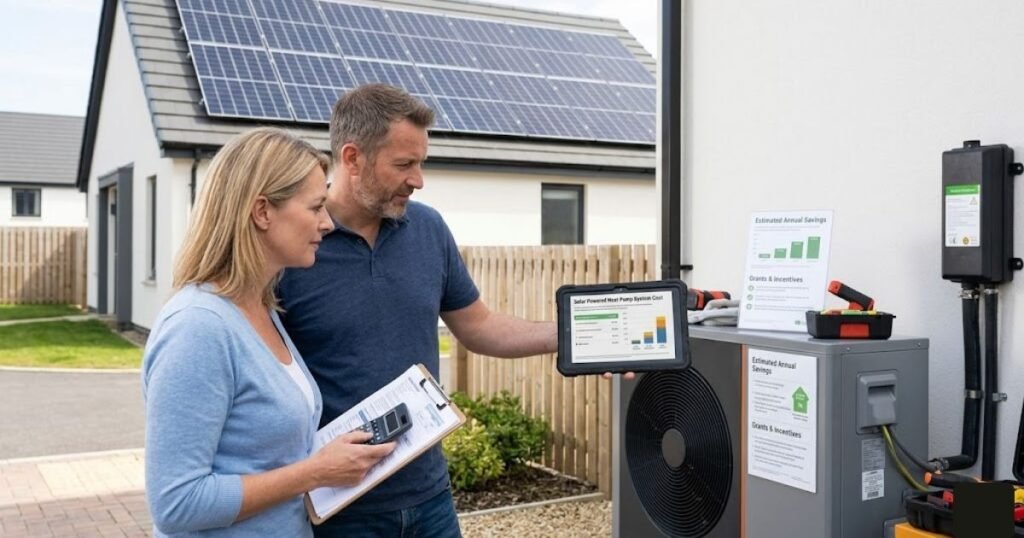
The year 2026 has brought a massive shift in how we think about home comfort. With utility rates climbing steadily over the last few years, the “dynamic duo” of home energy solar panels and heat pumps has moved from a niche luxury to a mainstream necessity for many American families.
But here is the million-dollar question (or, more accurately, the several-thousand-dollar question): What is the actual solar powered heat pump cost?
If you’re tired of opening a $400 electricity bill in the summer or a $600 gas bill in the winter, you’ve likely looked at this combo. It’s the ultimate “energy independence” play: you use the sun to generate power and a high-efficiency heat pump to move that energy into your home’s climate control.
In this guide, we’re going to break down the costs, the savings, and the “gotchas” that every USA homeowner needs to know before signing a contract. Lets deep dive into “Solar Powered Heat Pump Cost: USA Homeowner Guide to Savings”
READ MORE: Carrier Heat Pump Reviews (2026) — Models, Costs, Pros & Cons
What Exactly Is a Solar Powered Heat Pump?
Before we dive into the receipts, let’s clear up a common misconception. A “solar-powered heat pump” isn’t usually a single piece of equipment you buy in one box. Instead, it is a synchronized system consisting of two main parts:
- The Heat Pump: A high-efficiency HVAC system that provides both heating and cooling. Unlike a furnace that creates heat by burning fuel, a heat pump moves heat from one place to another. In the summer, it moves heat out of your house. In the winter, it pulls heat from the outside air (even when it’s cold!) and moves it inside.
- The Solar Photovoltaic (PV) System: A series of panels on your roof that convert sunlight into electricity. This electricity is then used to run the compressor and fans in your heat pump.
When these two work together, you essentially have a “net-zero” heating and cooling system. You aren’t paying a utility company for the fuel to stay warm; you’re harvesting it from the sky.
Why Are Homeowners Rushing to This Now?
In 2026, we are seeing three major trends:
- Volatile Energy Prices: Natural gas and grid electricity prices have become increasingly unpredictable.
- The “Electrification” Movement: Many new building codes and city ordinances are encouraging or requiring homes to move away from fossil fuels.
- Technology Maturity: Modern heat pumps are now “Cold Climate” certified, meaning they work effectively even in the snowy reaches of Michigan or Maine places where they used to struggle.
READ MORE: Best Bosch Heat Pump Air Conditioner: Review, Comparison & Buying Guide
How Much Does a Solar Powered Heat Pump Cost?
Let’s get straight to the point. For a standard 2,000-square-foot home in the USA, the total upfront cost for a solar powered heat pump system in 2026 typically ranges from $25,000 to $55,000 before incentives.
Wait don’t close the tab just yet! That is a big range, and it includes the entire setup (panels + HVAC). Once you factor in federal tax credits and state rebates, that net cost often drops by 30% to 50%.
Average Price Ranges (2026 Estimates)
| Component | Lower-End (Small Home/Basic) | Average (2,000 sq. ft. Home) | High-End (Large/Premium) |
| Heat Pump System | $6,000 | $14,000 | $22,000 |
| Solar Panel System | $12,000 | $28,000 | $40,000 |
| Installation & Labor | $2,500 | $5,000 | $8,000 |
| Total (Pre-Incentive) | $20,500 | $47,000 | $70,000 |
Note: These prices are “all-in” estimates including equipment and professional installation. Your specific zip code and home layout will shift these numbers.
READ MORE: Goodman Heat Pump Review 2026 | Efficiency, Cost, Pros & Cons
Breaking Down the Costs: Where Does the Money Go?
When you receive a quote from a contractor, it can look like a wall of text. Let’s pull it apart so you can see what you’re actually paying for.
The Heat Pump Unit ($5,000 – $18,000)
The cost depends on whether you go with a Ducted or Ductless (Mini-Split) system.
- Ducted: If you already have vents in your house, you’ll likely replace your old AC/furnace with a central heat pump.
- Mini-Splits: These are great for older homes without ductwork. You have “heads” mounted on the walls in different rooms. These can be more expensive if you need 5 or 6 different zones.
The Solar Array ($15,000 – $35,000)
Solar is priced by the “watt.” In 2026, the national average is roughly $2.50 to $3.30 per watt. To power a heat pump, which is a significant energy user, you’ll likely need a system between 7kW and 12kW.
Battery Storage ($9,000 – $16,000)
This is the “optional” but popular add-on. If you want your heat pump to work during a power outage, or if your local utility has “Time-of-Use” rates (where they charge more at night), a battery like the Tesla Powerwall or Enphase IQ is a huge benefit. However, it does add roughly $10k-$15k to the bill.
Electrical Upgrades ($1,500 – $4,000)
Many older American homes have 100-amp electrical panels. A heat pump and solar system often require a 200-amp service upgrade. This is a hidden cost many homeowners forget until the electrician arrives.
Permits and Inspections ($500 – $2,000)
Your local city or county will want their cut. You’ll need permits for both the electrical work and the structural rooftop work.
READ MORE: Best Ductless Mini Split Air Conditioner 2026: Review, Comparison, Cost & Buying Guide
Factors That Affect Your Final Price
No two homes are the same, which is why “ballpark” figures can sometimes be misleading. Here is what will move your specific needle:
1. The “Envelope” of Your Home
If your home has 30-year-old windows and thin insulation in the attic, your heat pump has to work twice as hard. This means you need a bigger heat pump and more solar panels. Improving your insulation first can actually save you $5,000 on the system size!
2. Climate Zone
If you live in Arizona, your solar panels will produce massive amounts of power, but your AC will run 24/7. If you live in Minnesota, your solar production might be lower in the winter, and you’ll need a specialized “cold climate” heat pump that can extract heat at -15°F. These specialized units cost about 20% more than standard ones.
3. Roof Condition and Orientation
Does your roof face South? If so, you’re in luck. If it faces North or is covered in shade trees, you’ll need more panels (and more money) to get the same energy output. Also, if your roof needs replacing in 3 years, do it now. Removing and reinstalling solar panels later costs a fortune.
4. Efficiency Ratings (SEER2 and HSPF2)
Heat pumps are rated by their cooling efficiency (SEER2) and heating efficiency (HSPF2).
- Standard: Lower upfront cost, higher monthly “top-off” from the grid.
- High-Efficiency: Higher upfront cost, but requires fewer solar panels to run.
READ MORE: Air to Water Heat Pump — Complete 2026 Buyer’s Guide (costs, brands, pros & cons)
Solar Powered Heat Pump Is It Worth It? The ROI Calculation
The “sticker shock” is real, but the return on investment (ROI) is where the magic happens. Let’s look at the math.
Assume a homeowner spends $35,000 net (after incentives) for a full system.
Previously, they were paying:
- $200/month for electricity
- $150/month for heating oil or gas
- Total: $350/month ($4,200/year)
With a solar-powered heat pump, that bill could drop to the “grid connection fee,” which is often just $15–$20/month.
$$ \text{Annual Savings} = \$4,200 – \$240 = \$3,960 $$
At this rate, the system pays for itself in roughly 8.8 years. Given that solar panels last 25+ years and heat pumps last 15, you are looking at 15 to 20 years of essentially free energy.
Beyond the Money: Comfort and Value
- Precision Comfort: Modern heat pumps use “Inverter Technology,” meaning they don’t just blast on and off. They sip energy and keep the house at a perfectly steady temperature.
- Home Value: Studies consistently show that homes with solar and high-efficiency HVAC sell faster and for 3-5% more. In a $500,000 home, that’s a $20,000 boost in equity.
READ MORE: Best MRCOOL Mini Split Air Conditioners and Heat Pumps: Review & Comparison
Solar Heat Pump vs. Traditional HVAC
Why not just stick to a regular central AC and a gas furnace?
| Feature | Traditional HVAC | Solar + Heat Pump |
| Upfront Cost | Low ($8k – $12k) | High ($30k – $55k) |
| Monthly Bills | High (Market Dependent) | Near Zero |
| Carbon Footprint | Large (Burning Fuel) | Minimal |
| Maintenance | Annual furnace checks | Simple filter/coil cleans |
| Energy Security | Low (Grid Dependent) | High (Independent) |
The Verdict: If you are moving in two years, get a traditional system. If you plan to stay in your “forever home” for 7+ years, the solar/heat pump combo is the superior financial move.
How to Slash the Cost: 2026 Incentives and Rebates
In 2026, the landscape for incentives is better than ever, but it is also more complex. You have to “stack” your benefits.
The Federal “Clean Energy” Tax Credit (Section 25D)
For the solar portion of your project, you can typically claim a 30% tax credit on your federal returns. If your solar system costs $25,000, that is a $7,500 discount right off the top.
HEEHRA Rebates (The Inflation Reduction Act)
Depending on your household income, you may qualify for “point-of-sale” rebates.
- Low Income: Up to $8,000 off a heat pump.
- Moderate Income: Up to $4,000 off.
- Note: These are state-administered, so check your local state energy office website!
Utility Rebates
Many local power companies (like ConEd, PG&E, or Duke Energy) offer their own rebates ranging from $500 to $2,000 because they want to reduce the strain on the grid.
READ MORE: Best Electric Heat Pump Water Heater: Reviews, Comparison, and Buying Guide
5 Expert Ways to Save Money on Your Installation
If the quotes you’re getting are too high, use these strategies to bring the price down:
- Seal the “Leaks” First: Spend $1,000 on professional air sealing and attic insulation. It might allow you to drop from a 4-ton heat pump to a 3-ton unit, saving you thousands.
- Get 3 Quotes (The “Golden Rule”): Solar and HVAC pricing varies wildly. Never go with the first door-to-knock salesperson. Use a comparison tool to see 3-5 local vetted installers.
- Choose “Standard” Panels: You don’t always need the absolute highest-efficiency “Space-Grade” solar panels. Mid-tier panels often provide 90% of the benefit for 60% of the cost.
- Timing Matters: Fall and Spring are the “shoulder seasons” for HVAC installers. They are often slower and more willing to negotiate on labor costs compared to the dead of summer or winter.
- Check for 0% Financing: Many state programs offer low-interest or 0% loans for energy efficiency. This lets you pay for the system using the money you saved on your utility bill.
Who Should Consider a Solar Powered Heat Pump?
A solar powered heat pump is not the right fit for every home, but it can be an excellent option for certain homeowners.
It may be a strong choice if you:
- Have high energy bills
- Plan to stay in your home for many years
- Want to reduce your home’s carbon emissions
- Live in a sunny state or a region with strong solar incentives
- Want more stable long-term energy costs
- Are already planning to replace your HVAC system
This type of system is often most attractive to homeowners who think beyond the initial installation price and want to focus on lifetime value.
It can also be a smart choice for people who are already considering solar panels and want to make the most of that investment by pairing them with efficient heating and cooling.
READ MORE: Best Swimming Pool Heat Pump 2026: Review, Comparison, and Buying Tips
Common Mistakes Homeowners Make
Avoid these pitfalls to ensure your investment doesn’t turn into a headache:
- Oversizing the Solar System: Don’t build a system for your current energy use if you plan to upgrade your windows and insulation next year. You’ll overpay for panels you don’t need.
- Ignoring the Roof: If your roof is 15 years old, replace it before the solar goes on.
- Forgetting Backup Power: Solar panels, by law, shut off during a blackout unless you have a battery or a specific “islanding” inverter. If you want heat during a blizzard when the power is out, you need a battery.
- The “Cheapest Labor” Trap: Heat pumps are sensitive. If they aren’t charged with refrigerant correctly or the ductwork isn’t balanced, they will be noisy and inefficient. Hire a Diamond-certified or NATE-certified installer.
Frequently Asked Questions (FAQ)
How much does a solar powered heat pump cost for a house?
For an average 2,000 sq. ft. home, the combined cost usually lands between $30,000 and $50,000 before incentives. After tax credits and rebates, many homeowners pay a net price of $18,000 to $28,000.
Are solar powered heat pumps worth it for homeowners?
Yes, especially for those in areas with high electricity rates. With a typical payback period of 7–10 years and a lifespan of 20+ years, the system eventually provides “free” heating and cooling while increasing home resale value.
Can a heat pump run directly on solar panels?
Technically, most systems run through your home’s electrical panel. The solar panels feed the house, and the heat pump draws from that supply. To run it “off-grid” or purely during the night, you will need a solar battery storage system.
What size solar system do I need for a heat pump?
Most heat pumps require an additional 3kW to 5kW of solar capacity beyond your normal home usage. For most homes, this results in a total solar array size of 8kW to 11kW.
Do solar powered heat pumps qualify for tax credits?
Yes! In 2026, the federal Residential Clean Energy Credit offers a 30% credit for the solar portion. While some federal air-source heat pump credits have shifted, many state-level HEEHRA rebates offer up to $8,000 in direct savings.
Final Recommendation: Should You Buy?
The move to a solar-powered heat pump is a marathon, not a sprint. If you are tired of being at the mercy of utility companies and you plan to stay in your home for the next decade, it is one of the smartest financial moves you can make in 2026.
Your Next Step: Reach out to a local energy auditor. Have them look at your insulation and roof first. Once your “envelope” is tight, get three quotes for a bundled solar and heat pump package. Often, “whole-home electrification” contractors can give you a better deal than hiring two separate companies!
Are you ready to stop paying for power and start growing it on your roof?
How much did your last winter heating bill cost you? Let that number be your motivation to start shopping.
Pingback: How Much Does Air Conditioner Capacitor Replacement Cost? - Plumbing Guider