If you want a compact, plug-in electric heater that focuses on moving heat through a room (not just blasting a hotspot), Vornado’s vortex-style heaters are worth a look. They’re best for U.S. homeowners who need supplemental heat for bedrooms, home offices, or small-to-medium living spaces and who value quicker, more even circulation, decent safety features, and simple controls. Vornado offers models from small personal units to whole-room ceramic heaters with auto-climate controls prices commonly run from about $35 for very small models up to $120–$150 for feature-rich units (retail varies by model and retailer).
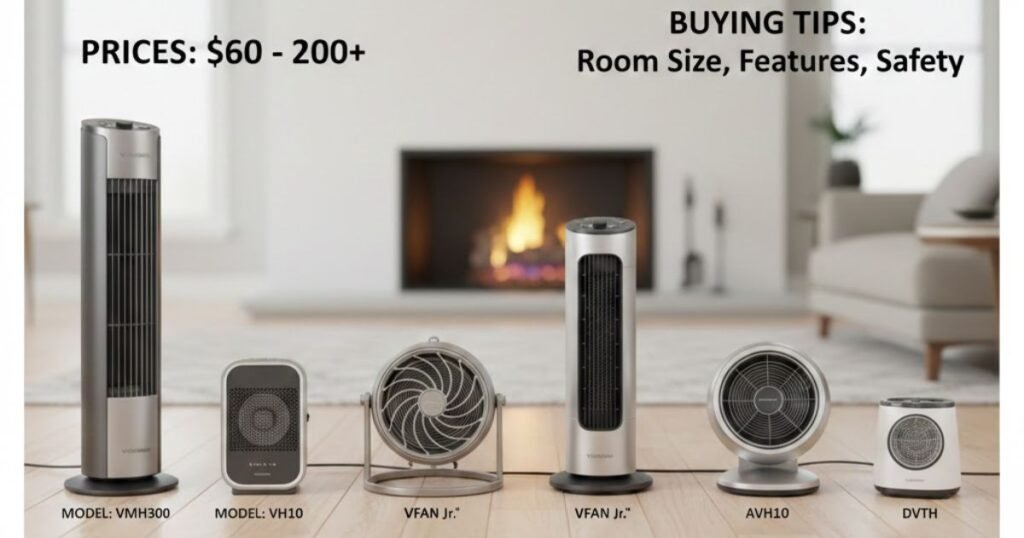
How Vornado vortex heating works
Vornado (the brand) emphasizes “vortex” or “Vortex Whole Room” circulation rather than point-and-bake heat. The idea is simple: instead of relying solely on convection from a hot coil that creates an intense hot spot near the unit, Vornado units combine a heating element with a shaped fan and airflow path tuned to produce a spiraling (vortex) air current. That current pulls room air into the heater, warms it, and pushes it in a focused but circulating stream so warm air spreads across the room and recirculates back toward the heater. The upshot is faster, more even distribution and fewer cold pockets especially helpful in rooms where you want an everywhere-warm feel without oversizing the heater.
What “vortex” circulation means for real rooms
- Fewer hotspots: Instead of feeling roasting near the heater and cold 10 feet away, a Vornado tends to blend heat into the whole room. That’s useful in bedrooms, home offices, and small living rooms.
- Quicker perceived warmth: Moving warm air to where people are sitting often feels faster than waiting for the entire room air temperature to climb.
- Doesn’t replace whole-house heating: Vortex heaters are supplemental they’re great for zoning (heat one room) but aren’t efficient replacements for central heating for whole-house comfort.
- Noise and feel: Because a fan is doing the work, you’ll hear a quiet airflow on many models generally louder than an oil-filled radiator’s whisper but typically quieter than many turbo space-heater fans.
Best Vornado heaters — model summaries
Below are short, practical write-ups for the required models. Specs and prices are taken from manufacturer/retailer listings (shown in the “Real price” lines).
1. Vornado AVH10 — Whole-Room / Auto Climate
Specs: 1,500 W; digital thermostat and display; Auto-Climate mode (automatically adjusts heat/fan); fan-only option; covers manufacturer-claimed ~250–300 sq ft (manufacturer claim varies by listing).
Who it’s for: Homeowners who want a simple, “set it and forget it” whole-room ceramic heater with a digital thermostat and auto control. Good for living rooms and larger bedrooms.
Pros: Auto-climate keeps target temp steady; fan-only setting usable year-round; cool-touch exterior and safety shutoff.
Cons: Fan noise when on high may bother very noise-sensitive sleepers; as a 1,500 W electric heater it still consumes the same max power as similarly rated competitors.
Real price (typical): $99.99 (manufacturer shop / retail listing).
2. Vornado VH200 — Whole-Room Vortex heater
Specs: 1,500 W; mechanical thermostat with 3 heat settings (1500/1125/750 W); cool-touch case; Vortex whole-room circulation.
Who it’s for: Buyers who want a straightforward mechanical heater at a budget price solid option for small living rooms, dens, and bedrooms.
Pros: Simple dial controls (no learning curve); trusted Vornado circulation; usually one of the brand’s more budget-friendly models.
Cons: No digital thermostat means less precise temperature control; fewer features than AVH10.
Real price (typical): About $69.99 (many retailers list it at/near this price).
3. Vornado VH10 — Personal / Compact whole-room heater
Specs: 1,500 W (two heat settings: 750/1500 W); 2 heat settings; cool-touch cabinet and tip-over protection; integrated handle for moving between rooms.
Who it’s for: People who want a compact, attractive heater for bedrooms, home offices, or tight spaces where a low profile matters.
Pros: Small footprint, quiet in lower setting, easy to store; Vornado’s circulation tech in a compact package.
Cons: As a small package you’ll still hit the same 1,500 W limit coverage is realistically for small to medium rooms, not large open living areas.
Real price (typical): $79.99 (manufacturer/retailer listing).
Note: Vornado’s shop also shows other recent releases and slightly different model names (e.g., VMH/Velocity series); if a model year variant exists (2025/2026), the listing usually notes it on the Vornado shop page.
READ MORE: Central Heating: Cost, Types & Buyer’s Guide for U.S. Homeowners
Vornado vs. other brands
Below is a compact comparison of Vornado vs. four mainstream competitors. “Typical price” is drawn from manufacturer or major retailer listings at the time of research prices fluctuate.
| Brand | Representative model | Type | Wattage | Typical U.S. price (typical retailer/manufacturer) | Best for |
| Vornado | AVH10 | Fan-forced whole-room | 1,500 W | $99.99 (Vornado shop / retailers). | Small–medium rooms, value buyers |
| Honeywell | HZ-789 (EnergySmart radiator) | Oil-filled radiator | 1,500 W | $89.95–$99.99 (Honeywell / retail listings). | Quiet, even heat for bedrooms |
| Lasko | 5586 (digital tower ceramic) | Ceramic tower | 1,500 W | $89.99 (manufacturer listing). | Budget tower heater, oscillation |
| De’Longhi | TRD40615 (Dragon 4) | Oil-filled radiator | 1,500 W | Manufacturer listing / typical: $169–$190 (De’Longhi site / retailers). | Premium oil-filled, steady long-lasting heat |
| Dyson | AM09 Hot+Cool | Bladeless fan + heater | Variable (fan-assisted) | Varies widely; often $300–$500 (retailer listings / deals). | Tech-forward, year-round heater + fan |
Short analysis:
- If quiet steady heat in a bedroom is your priority, oil-filled radiators (Honeywell, De’Longhi) tend to be quieter and keep releasing heat after they switch off.
- If fast, whole-room circulation is the priority (feel-warmer-fast), Vornado’s vortex approach is competitive.
- If you want all-season value (heater + high-end fan + app features) and don’t mind the price, Dyson’s Hot+Cool offers extras but at a much higher cost.
Buying & safety checklist
When you shop, keep these checklist items in mind:
Wattage & circuit considerations
Most plug-in portable heaters are 1,500 W (the U.S. standard for high-power domestic space heaters). Make sure the circuit you’ll use can handle it: avoid running other heavy loads (microwave, space heater, hair dryer) on the same 15 A circuit. A 1,500 W heater draws ~12.5 A at 120 V.
Coverage & thermostat
Coverage claims (e.g., “up to 300 sq ft”) are manufacturer estimates. Use them as rough guides and consider room insulation, ceiling height, and how drafty the room is. Digital thermostats with auto modes (e.g., AVH10) keep temp steadier than simple mechanical dials.
Required safety features
- Tip-over protection (mandatory on most modern models).
- Overheat shutoff.
- Cool-touch exterior helps prevent burns on contact.
- Check for CSA/UL listings or similar safety certifications on the product page these indicate the unit was tested for electrical safety.
- No extension cords: most manufacturers advise plugging the heater directly into a wall outlet (extension cords can overheat).
- Keep 3 ft clearance from combustible materials (curtains, bedding, furniture).
- Not typically bathroom-rated: unless explicitly stated, don’t use space heaters in damp bathrooms.
READ MORE: 3-Ton Heat Pump: Cost, Sizing & Best Models
Warranty & returns
Vornado offers multi-year satisfaction/warranty coverage on many whole-room products for example, the AVH10/AVH30 documentation references a five-year satisfaction guarantee against defects for the original owner (confirm model-specific warranty on the product page). Always cite the model’s warranty details in copy.
Running costs — real example with kWh math for a 1,500 W heater
Electric heaters are simple to calculate: watts ÷ 1,000 = kW. Multiply kW × hours used × electricity price (¢/kWh) = cost.
Example scenario: You run a 1,500 W (1.5 kW) Vornado AVH10 at 1.5 kW for 4 hours per day. Assume a typical U.S. residential electricity price of ~17.8¢/kWh (recent national average; varies by state).
- Hourly cost: 1.5 kW × $0.1778/kWh ≈ $0.267 per hour.
- Daily cost (4 hours): $0.267 × 4 ≈ $1.07 per day.
- Monthly (30 days): $1.07 × 30 ≈ $32.10.
- If you run it 8 hours/day, monthly ≈ $64.
What that means: running a 1,500 W heater for long daily stretches adds up. For short sessions (morning/evening), a portable heater is cost-effective for zone heating, but for continuous whole-home heating you’ll likely be better served by a central system or a heat pump. Use timers, thermostats, and lower setpoints to reduce runtime.
Maintenance & troubleshooting (filters? cleaning? storage)
Maintenance
- No filter to replace on most Vornado space heaters (they’re not air purifiers). Check the manual for models with removable air intakes and wipe dust from the grill with a soft brush or vacuum crevice tool occasionally to maintain airflow.
- Storage: store in a dry place. Coil the cord loosely (avoid tight knots).
- Annual check: before winter use, do a visual check for frayed cords or excessive dust buildup.
Troubleshooting
- Heater won’t turn on: check outlet (try another device), check reset on GFCI if connected to a protected outlet, check that tip-over/overheat sensor hasn’t latched (some models need a cool-down).
- Weak airflow: clean intake/exhaust grills; ensure there’s nothing blocking the airflow path.
- Random shutoff: could be overheat protection allow to cool and verify vents are clean and clear.
5 FAQs
Are Vornado heaters safe for bedrooms?
Yes — many Vornado models include tip-over protection, automatic shutoff for overheat, and cool-touch cabinets. Still keep the heater at least 3 feet from bedding and curtains and avoid using extension cords. For kids or pets, choose models with cool-touch surfaces and active tip-over protection.
How much electricity does a Vornado heater use?
A full-power 1,500 W Vornado uses 1.5 kW when on high. Multiply 1.5 kW by hours used and by your local electricity rate (¢/kWh) to get cost. Using a U.S. average of ~17.8¢/kWh, one hour at full power costs about $0.27.
Which Vornado model is best for a bedroom?
For bedrooms many homeowners pick compact, low-noise models with digital thermostats or simple two-speed controls. The VH10 (compact, 2 settings) or AVH10 (if you want digital auto-climate and a fan-only mode) are common picks depending on budget and noise sensitivity.
Do Vornado heaters actually heat a whole room?
They’re designed to circulate warm air around a whole room using vortex airflow. For small to medium rooms (up to the manufacturer’s claimed coverage), yes but performance depends on insulation, ceiling height, and how cold the room is to begin with. Vornado’s claims are a practical baseline, not a guarantee.
What warranty does Vornado offer?
Vornado publishes multi-year satisfaction/warranty terms for specific product lines. Many whole-room heaters carry a multi-year guarantee (some AVH models reference a five-year satisfaction guarantee for original owners). Always verify the specific model’s warranty on the product page or in the product manual.
READ MORE: Lasko Heater Reviews & Buying Guide — Best Models Compared
Pros & cons
General pros of Vornado heaters
- Even circulation using vortex technology — fewer hotspots.
- Compact, often attractive designs across several price tiers.
- Safety features on many models (tip-over, overheat shutoff, cool-touch surfaces).
General cons of Vornado heaters
- Fan-driven units are usually louder than oil-filled radiators at very low settings.
- Running a 1,500 W electric heater all day can be costly; best used for zone heating.
- No integrated air purification or high-end app features (compared to Dyson).
Model-specific bullets
AVH10
- Auto-Climate is convenient for set-and-forget.
- Fan-only mode gives year-round utility.
- $99.99 typical — good mid-tier value.
VH200
- Simple, reliable 3-setting mechanical control.
- Very often priced around $69.99 — strong budget option.
VH10
- Compact footprint and easy to move between rooms.
- Typically listed around $79.99 on manufacturer/retailer pages.
Final verdict & top picks
- Best value: Vornado AVH10 — digital controls, auto-climate, and a typical sub-$100 price make it the best all-rounder for most homeowners.
- Best for a tight budget: Vornado VH200 — mechanical simplicity, reliable Vortex circulation, and a typical price around $69.99.
- Quietest / best for small bedrooms: VH10 — compact profile and two quiet settings make it a good bedroom pick.