In today’s tech-driven world, our homes are packed with sensitive electronics from smart refrigerators and HVAC systems to home theaters and electric vehicle chargers. But what happens when a sudden power surge hits? Whether it’s from a lightning strike, a faulty utility line, or even your own air conditioner kicking on, these voltage spikes can fry your appliances and cost you thousands in repairs. That’s where a whole house surge protector comes in. If you’re in the USA and wondering how to protect your entire home’s electrical system, this comprehensive guide is for you.
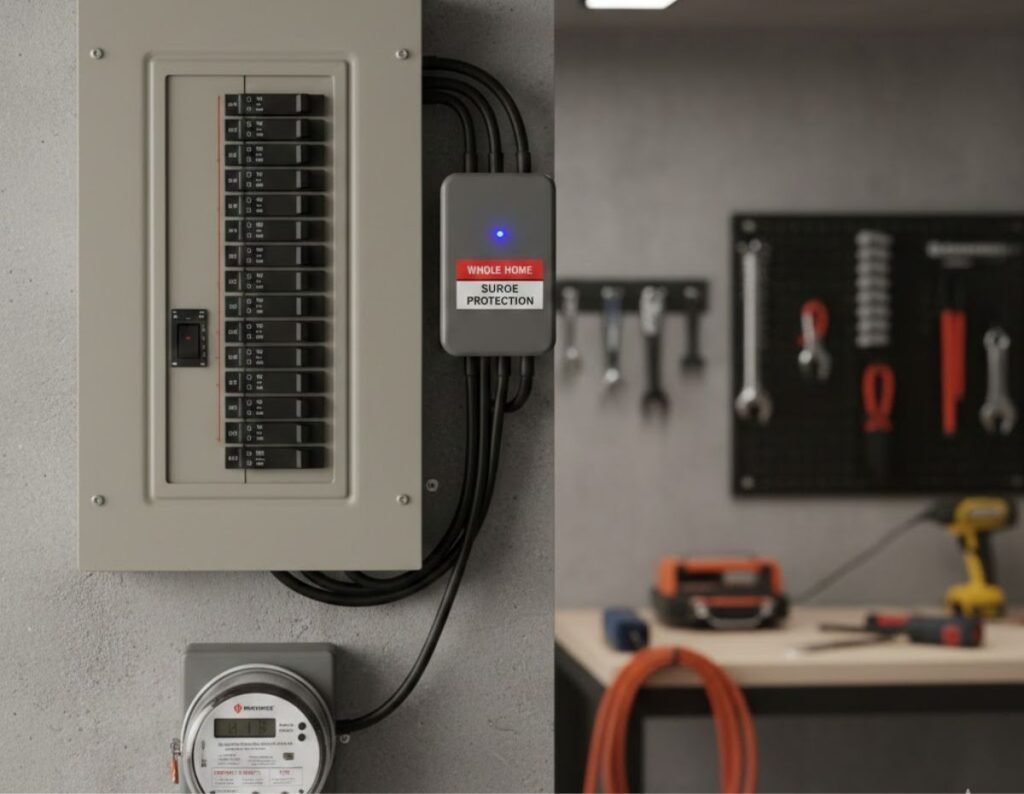
Whole house surge protectors, also known as whole-home surge protective devices (SPDs), are installed at your main electrical panel to shield everything plugged in or hardwired in your house. Unlike those basic power strips you might use for your computer, these heavy-duty guardians handle massive surges that could otherwise travel through your wiring and damage multiple devices at once.
According to the National Fire Protection Association, power surges contribute to thousands of home fires and billions in property damage each year in the USA. With climate change bringing more severe storms and an aging electrical grid, investing in one isn’t just smart it’s essential for peace of mind.
In this article, we’ll break down everything you need to know about whole house surge protectors for USA homes.
What Exactly Is a Whole House Surge Protector?
Imagine your home’s electrical system as a bustling highway. Electricity flows steadily from the utility company through your meter and into your panel, then out to outlets and appliances. But sometimes, traffic gets chaotic a surge is like a massive truck barreling down the road, overwhelming everything in its path. A whole house surge protector acts as a traffic cop, diverting that excess energy safely to the ground before it reaches your stuff.
These devices are typically compact boxes or modules that mount directly onto or near your main breaker panel. They’re designed for residential use in the USA, complying with standards like UL 1449, which ensures they’re tested for safety and performance. Unlike point-of-use surge protectors (those multi-outlet strips), whole house versions protect the entire downstream electrical system, including hardwired items like lights, furnaces, and well pumps.
Power surges aren’t rare events. The Electrical Safety Foundation International estimates that the average American home experiences over 20 surges per day from internal sources alone, like motors in refrigerators or washing machines cycling on. External surges from lightning or grid fluctuations can be far more destructive, spiking voltage from the standard 120/240 volts to thousands in milliseconds. In regions like Florida, Texas, or the Midwest prone to thunderstorms surges are even more common.
Whole house surge protectors come in two main categories: Type 1 and Type 2. Type 1 units install on the line side of your panel (before the main breaker) and are built for the biggest threats, like direct lightning hits. Type 2s go on the load side (after the breaker) and handle everyday surges effectively. Most USA homeowners opt for Type 2 for their balance of protection and ease of installation.
Why you need one (real risks, real savings)
- Protect expensive electronics & appliances: HVAC systems, refrigerators, home theaters, telecom/modem equipment, and newly common smart appliances are vulnerable. A single large surge can cost thousands in replacement/repair. Whole-house SPDs reduce that risk.
- Power grid instability: Switching operations, utility faults, and capacitor bank events can create surges — not just lightning. Whole-house SPDs protect against many of these internal/external events.
- Value vs cost: A whole-house SPD plus a few point-of-use protectors typically costs a few hundred dollars total — far cheaper than replacing high-end gear. Many analysis pieces call it “cheap insurance.”
READ MORE: HVAC Near Me
How Do Whole House Surge Protectors Work?
At their core, whole house surge protectors use metal oxide varistors (MOVs) or similar components to detect and redirect excess voltage. Here’s a simple breakdown:
When normal electricity flows (around 120-240 volts in USA homes), the protector sits idle, like a watchdog. If voltage spikes say, to 500 volts or more the MOVs “clamp” the surge, absorbing the energy and shunting it to your home’s grounding system. This happens in nanoseconds, preventing the spike from spreading.
Key specs to understand:
- Surge Current Rating (kA): Measures how much surge the device can handle in one event. Look for at least 50kA for basic protection, up to 200kA for high-risk areas.
- Joule Rating: Indicates total energy absorption over time. Higher is better—aim for 1,000+ joules.
- Voltage Protection Rating (VPR): The maximum voltage let through after clamping. Lower numbers (e.g., 600V) mean better protection.
These protectors don’t last forever; each surge degrades the MOVs slightly. That’s why many have indicator lights or audible alarms to signal when they need replacement typically every 3-5 years or after a major event.
For optimal defense, experts recommend a “layered” approach: Pair your whole house protector with point-of-use strips for extra-sensitive gear. This combo can block up to 99% of surges, per industry studies. In the USA, where electrical codes (like the NEC) now require surge protection in new builds in some areas, these devices are becoming standard.
The Key Benefits of Installing a Whole House Surge Protector
Investing in a whole house surge protector isn’t just about avoiding disaster it’s about long-term savings and convenience. Here are some eye-catching perks that make them a no-brainer for USA homeowners:
- Comprehensive Protection for Everything: Shields your entire home, from big appliances like ovens and AC units to small gadgets. No more worrying about forgetting to plug something into a strip it’s all covered!
- Cost Savings Over Time: Prevent expensive repairs or replacements. A single surge can damage a $2,000 fridge or $5,000 HVAC system. With average repair costs hitting $500+, the protector pays for itself quickly.
- Fire Prevention Powerhouse: Surges can overheat wiring and spark fires. According to the NFPA, electrical malfunctions cause over 40,000 home fires annually in the USA. A surge protector reduces this risk dramatically.
- Extended Appliance Lifespan: Even minor surges wear down electronics gradually. By filtering them out, your devices last 20-30% longer, per manufacturer estimates.
- Peace of Mind in Stormy Weather: Ideal for surge-prone states like Florida or California. Many models come with warranties covering connected equipment up to $100,000 talk about backup!
- Eco-Friendly Edge: Less electronic waste from fried gadgets means a smaller environmental footprint. Plus, it supports energy-efficient smart homes without fear of glitches.
- Insurance Perks: Some USA insurers offer discounts for homes with surge protection, potentially saving 5-10% on premiums.
Types of Whole House Surge Protectors Available in the USA
Not all surge protectors are created equal. Here’s a quick rundown of the main types you’ll find in USA stores like Home Depot or Lowe’s:
- Panel-Mount Protectors: These snap into your breaker panel like a double-pole breaker. Brands like Siemens and Square D dominate here. They’re discreet, easy for electricians to install, and great for newer panels.
- Meter-Base Protectors: Installed at your utility meter, these handle surges before they enter your home. They’re pricier but offer top-tier protection against external threats.
- Hardwired External Units: Mounted next to the panel, these are versatile for older homes. Eaton and Leviton models often include LED indicators and audible alerts.
- Hybrid Systems: Combine surge protection with other features, like EMI/RFI filtering for cleaner power to audio/video equipment.
When shopping, check for USA-specific certifications like UL 1449 Edition 5 for the latest safety standards. Prices range from $100 for basic models to $500+ for premium ones with extended warranties.
READ MORE: Electrician Near Me
Factors to Consider When Choosing the Best Whole House Surge Protector
Picking the right one can feel overwhelming, but focus on these key elements to match it to your USA home:
- Your Home’s Size and Electrical Load: Larger homes with more circuits need higher kA ratings. If you have a 200-amp panel (common in modern USA houses), go for at least 80kA.
- Location and Surge Risk: In lightning-heavy areas like the Southeast, opt for 100kA+ models. Use tools like NOAA’s lightning map to assess your risk.
- Warranty and Connected Equipment Coverage: Look for 5+ years and $50,000+ in reimbursements. Square D offers up to $100,000.
- Ease of Installation: Breaker-style units are DIY-friendly for pros, but always hire a licensed electrician to comply with USA codes.
- Additional Features: LED status lights, remote monitoring apps, or integration with smart home systems add convenience.
- Budget: Entry-level: $100-200; Mid-range: $200-400; High-end: $400+. Factor in installation ($200-500).
- Compatibility: Ensure it fits your panel brand (e.g., Square D for Homeline panels).
Read reviews on sites like Amazon or Consumer Reports for real USA user experiences. Avoid cheap imports without UL listing they could void your insurance.
Top Whole House Surge Protectors in the USA: Reviews and Comparison
Based on recent 2025 reviews from trusted sources like Wirecutter, CNET, and Bob Vila, here are some standout models for USA homes. We’ve focused on reliability, user feedback, and value.
- Square D HEPD80: A bestseller for its 80kA rating and easy plug-on neutral design. Great for Square D panels, with a 5-year warranty and $100,000 equipment coverage.
- Eaton CHSPT2ULTRA: Tops many lists with a massive 108kA per phase rating. Includes LED indicators and a 10-year warranty—ideal for high-risk areas.
- Siemens FS140: Affordable at around $150, with 140kA protection. Suits Siemens panels perfectly, offering solid basics without frills.
- Leviton 51120-1: Versatile hardwired option with 50kA rating and audible alarm. Good for older homes, backed by a lifetime warranty.
- Intermatic IG1240RC3: Weatherproof for outdoor installs, 120kA rating, and surge counter feature for tracking events.
For a quick side-by-side, check this comparison table:
| Model | Surge Rating (kA) | Joules | Warranty | Price Range (USD) | Best For |
| Square D HEPD80 | 80 | 2,000 | 5 years | $120-180 | Square D panels, value |
| Eaton CHSPT2ULTRA | 108 | 3,000 | 10 years | $200-300 | High-risk areas, durability |
| Siemens FS140 | 140 | 1,500 | 10 years | $140-200 | Siemens panels, budget |
| Leviton 51120-1 | 50 | 1,000 | Lifetime | $100-150 | Older homes, alerts |
| Intermatic IG1240RC3 | 120 | 2,500 | 5 years | $150-250 | Outdoor/meter installs |
These picks are based on factors like surge handling, user ratings (4+ stars on average), and availability at major USA retailers. Always verify compatibility with your panel.
Where to install (service panel vs meter vs subpanel)
- Service entrance (meter or line side): Best protection vs external lightning — often Type 1. May require utility coordination/permission.
- At main breaker / load side of service panel: A common residential approach — Type 2 devices are installed inside or adjacent to the main panel; easier and often chosen by electricians.
- Subpanel protection: Use SPDs on subpanels that feed critical equipment (e.g., workshop, garage, server rack) in addition to main protection.
Pro tip: For maximum protection, combine service-entrance SPD with distribution panel devices and point-of-use protection (the “multi-stage” approach).
READ MORE: Electric Company Near Me
Key specs & terms you should know (and how to use them)
- Clamping (let-through) voltage: The voltage level at which an SPD starts to conduct. Lower is better (it means less voltage reaches your devices).
- Surge current rating (kA): How much surge current the device can divert (often shown as kA per phase or per mode). Larger numbers mean heavier duty.
- Nominal discharge current (In): Standard test value of current an SPD can handle repeatedly.
- Joules rating: Energy absorption rating used for smaller point-of-use protectors; for whole-house SPDs the surge current/kA and UL listing are more important than a single “joules” number.
- Response time: How fast the SPD acts; usually nanoseconds differences here have less practical significance among quality devices.
- MAINTENANCE/End of life indicator: Many SPDs include an LED or mechanical indicator that shows when the SPD has been exhausted and needs replacement. Replace a spent SPD it cannot be “refreshed.”
Step-by-Step Guide to Installing a Whole House Surge Protector
Installation isn’t a weekend DIY for most USA electrical codes require a licensed electrician to avoid risks like shocks or fires. But here’s what the process looks like:
- Assess Your Panel: Turn off power at the main breaker. Check for space (usually needs two slots) and grounding quality.
- Choose the Right Spot: For breaker types, snap into an empty slot. External units mount nearby with wiring through a knockout.
- Wire It Up: Connect hot wires to the protector’s terminals, neutral to the bus bar, and ground to the grounding bar. Torque to specs.
- Test the System: Restore power and check indicator lights. Use a surge tester if available.
- Label and Document: Mark the breaker and note install date for warranty.
Costs? Expect $200-500 for pro installation, plus the device. In states like California or Florida, permits may be needed. If your panel is outdated (e.g., Federal Pacific), upgrade it first for safety.
Pros & Cons — quick summary
Pros
- Broad protection across circuits, including major appliances and whole home wiring.
- Relatively low cost compared to the replacement cost of protected gear.
- Meets NEC trends toward required service protection.
Cons
- Not foolproof against direct lightning.
- Needs periodic replacement after heavy surge activity.
- Installation cost and possible panel upgrades for older homes.
READ MORE: Best Plumbers Near Me | Free Estimate offer
Maintenance and Testing Your Whole House Surge Protector
Once installed, these devices are low-maintenance, but don’t set and forget:
- Visual Checks: Monthly, inspect for lit warning lights or damage.
- Annual Testing: Hire an electrician to simulate surges and verify function.
- Replacement Timeline: Swap every 3-5 years or after big events.
- Grounding Verification: Ensure your home’s ground rods are intact—poor grounding renders protectors useless.
Regular upkeep keeps your USA home protected year-round.
FAQs on Whole House Surge Protectors
- Are whole house surge protectors necessary? Not strictly “necessary” for every home, but highly recommended in the USA where surges are common. If you have valuable electronics or live in storm-prone areas, yes—they’re code-required in new builds in some regions and can prevent costly damage.
- What are the pros and cons of whole house surge protectors? Pros: Protects everything, prevents fires, extends appliance life, and offers warranties. Cons: Upfront cost ($300-800 installed), requires pro setup, and doesn’t cover 100% of surges (pair with strips for best results).
- How effective are whole house surge protectors? Very effective against 80-90% of surges, handling up to thousands of volts. They’re not foolproof against direct lightning but reduce risk significantly when combined with point-of-use protection.
- How much does it cost to install a whole house surge protector? Device: $100-400; Installation: $200-500. Total averages $300-900, varying by location and panel type in the USA.
- Can I install a whole house surge protector myself? Only if you’re experienced—most should hire a licensed electrician to ensure safety and code compliance. DIY risks voiding warranties or causing hazards.
Wrapping It Up:
In a nutshell, yes—if you value your electronics and want to avoid surge-related headaches. With rising energy demands and unpredictable weather, these protectors are a smart, affordable upgrade. Start by assessing your risk, picking a top model like the Eaton CHSPT2ULTRA, and calling a pro for install. Your home (and wallet) will thank you. Stay powered safely!