If you live in a dry, arid area and want low-cost, low-energy cooling for one or a few rooms, a ventless evaporative (“swamp”) cooler can work well. But ventless systems add moisture, are much less effective in humid climates, and are not a substitute for refrigerant-based whole-house AC (mini-split or central). For tight, humid, or smoke-prone locations, choose a vented room AC or ductless mini-split instead. For many U.S. homeowners the choice comes down to climate and how much cooling you need. Lets deep dive into “Best Ventless Air Conditioners 2026: Top Picks, Comparison & Cost”
READ MORE: Carrier Heat Pump Reviews (2026) — Models, Costs, Pros & Cons
What is a “ventless air conditioner”?
“Ventless air conditioner” is a loose, consumer phrase that usually refers to cooling devices that don’t require an exhaust or duct connection to the outdoors. In practice this includes:
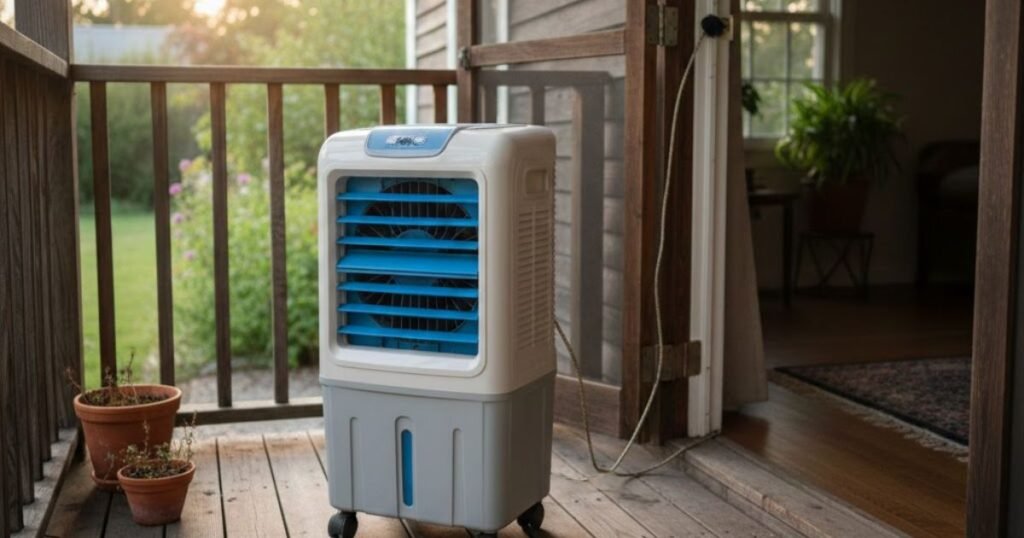
- Portable/plug-and-play evaporative coolers (swamp coolers) — they pull outdoor air across water-soaked pads and put the cooled, moistened air into the room.
- Small thermoelectric (Peltier) chillers and tabletop fans — low-capacity devices that cool a tiny zone without refrigerant but with very limited performance.
- Some so-called “ventless” portable coolers sold online — these are generally evaporative or fan-plus-ice designs, not true refrigeration.
These differ from vented portable ACs (which exhaust hot air through a window hose) and refrigerant systems (window units, portable vented ACs, ductless mini-splits, central AC) that move heat outdoors. The key distinction: ventless devices do not actively dump heat to the outside with a refrigerant loop or dedicated exhaust. That affects both performance and where they work best.
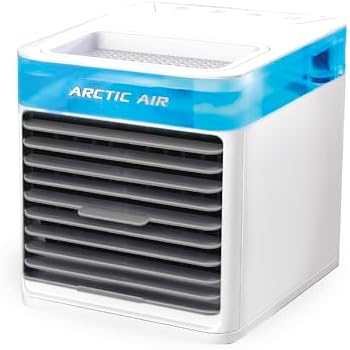
- Personal Air Cooler for Indoor & Outdoor Spaces: Switch to an eco-friendly solution with Ontel Arctic Air Pure Chill 2.0…
- Space-Saving Portable Design: The compact, sleek design allows you to place the box cooler on your office desk, nightsta…
- Energy Efficient Cooling Device: The Arctic Air Pure Chill cooler operates on 8-10 watts of power to minimize energy con…
How ventless units work

Most effective ventless units for homes are evaporative coolers. Their principle is straightforward: warm, dry outdoor air is pulled through moist pads; water evaporates, absorbing heat from the air and lowering its dry-bulb temperature while raising humidity. The cooled air is blown into the house and replaces some indoor air; for the system to work you normally keep at least one window or door slightly open to allow airflow and exhaust. In ideal conditions evaporative cooling can drop air temperature 15–40°F.
Key limits:
- Needs dry air: Evaporative cooling depends on evaporating water into unsaturated air. In humid climates it offers little cooling because the air is already near saturation.
- Adds humidity: That’s useful in deserts but undesirable in already-humid basements or coastal homes (mold risk).
- Not sealed-space cooling: To move heat out you need fresh-air exchange sealed indoor environments make them less effective.
Other ventless technologies (Peltier devices, ice-fan boxes) produce tiny amounts of cooling and are only suitable for very small personal zones or demos.
READ MORE: Weil‑McLain Boiler Reviews (2026) — Models, Costs, Pros & Cons
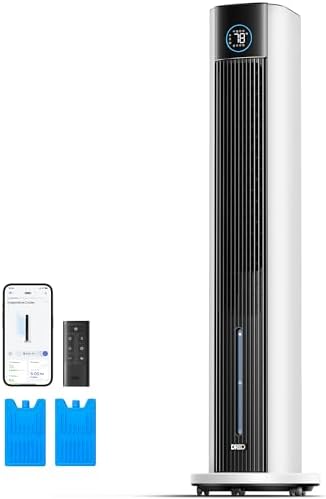
- 𝙐𝙡𝙩𝙞𝙢𝙖𝙩𝙚 𝘾𝙤𝙤𝙡𝙞𝙣𝙜 𝙋𝙚𝙧𝙛𝙤𝙧𝙢𝙖𝙣𝙘𝙚: With wind speeds up to 25 ft/s, a 22% higher evaporation rate, and a 6L water tank, this p…
- 𝙀𝙫𝙖𝙥𝙤𝙧𝙖𝙩𝙞𝙫𝙚 𝘼𝙞𝙧 𝘾𝙤𝙤𝙡𝙚𝙧: Infusing water into the breeze, this cooler evaporates on contact, bringing you a cooling sensat…
- 𝙄𝙘𝙚𝙒𝙞𝙣𝙙 𝘾𝙤𝙤𝙡𝙞𝙣𝙜 𝙎𝙮𝙨𝙩𝙚𝙢: With dynamic air ducts, 35-blade turbine, and optimized cooling pad, this system delivers a powe…
Types of ventless cooling systems
1. Evaporative (swamp) coolers
The dominant “ventless” cooling tech used at scale. Comes as small portable units, larger swamp coolers for single rooms, roof-mounted whole-house units. Works best in arid climates (Southwest, Intermountain West).
2. Thermoelectric (Peltier) coolers
Solid-state devices that move heat with an electrical current. Low power and very limited capacity fine for a tiny desktop cooler, not room conditioning.
3. Absorption and other niche systems
Some industrial or RV systems claim ventless operation via absorption or complex heat-move cycles rarely practical for U.S. homes and often require fuel or complicated plumbing.

- ❄𝙋𝙊𝙒𝙀𝙍𝙁𝙐𝙇 𝘼𝙄𝙍𝙁𝙇𝙊𝙒 & 𝟲𝟬° 𝙊𝙎𝘾𝙄𝙇𝙇𝘼𝙏𝙄𝙊𝙉: Delivers strong, high-velocity airflow with 60° oscillation. Works as a tower fan a…
- ❄ 𝙌𝙐𝙄𝙀𝙏 𝟯𝟲.𝟵𝘿𝘽 & 𝟭-𝟭𝟮𝙃 𝙏𝙄𝙈𝙀𝙍 : Ultra-quiet operation as low as 36.9dB. Ideal for light sleepers, hot sleepers, pet owner…
- ❄ 𝟭.𝟬𝟲𝙂𝘼𝙇 𝙏𝘼𝙉𝙆 & 𝟰 𝙄𝘾𝙀 𝙋𝘼𝘾𝙆𝙎 : Large 1.06-gallon water tank runs up to 10 hours in cooling mode. Includes 4 industrial-g…
Pros & cons ventless cooling
Pros
- Low purchase price compared with mini-splits or central AC (small units $100–$800).
- Low electrical use for evaporative cooling often much less energy than compressor AC in dry climates.
- Portable and simple to set up (plug & place for many models).
- Adds fresh air ventilation when used as intended.
Cons
- Ineffective in humid climates very small temperature drop or none at all.
- Raises indoor humidity can promote mold and condensation if the home is already humid.
- Not suitable for tightly sealed homes without ventilation.
- Some “ventless” marketing claims overpromise; check the cooling method.
- Outdoor pollution, wildfire smoke, or pollen can be drawn inside caution in smoke events.
READ MORE: Dyson Air Conditioner: Is It Worth Buying in 2026?

- ❄️【Powerful & Efficient Cooling Performance】Featuring an upgraded 2026 motor, this swamp cooler delivers a robust 30 ft/…
- ❄️【Smart Control for Personalized Comfort】Choose from 4 distinct modes (Cool/Natural/Normal/Sleep) and 3 adjustable spee…
- ❄️【High-Capacity Design for Extended Operation】Equipped with a unique dual-tank system holding a total of 2.4 gallons, t…
Comparison table: Ventless vs common alternatives
Table: comparison of Ventless Evaporative Cooler, Window AC, Ductless Mini-Split, Portable Vented AC
| Feature / Unit Type | Cooling method | Best for | Cooling power / typical area | Energy use | Installation complexity | Noise | Typical cost range | Pros | Cons |
| Ventless evaporative cooler | Evaporative (water) | Dry climates, single rooms or whole small homes (if designed for whole-house) | Varies by model; portable/single-room ≈ 250–1,000 sq ft equivalent (manufacturer specs vary) | Low–medium (fan + water pump) | Plug & place or rooftop for whole-house | Low–medium | $100–$800 | Low cost, simple install, low energy in dry climates | Not for humid climates; adds moisture; pulls outdoor air (smoke/pollen risk). |
| Window AC | Refrigerant compression | Single room | 5,000–24,000 BTU (≈100–1500 sq ft depending on BTU) | Medium | Moderate (window install) | Medium–high | $150–$900 | Reliable cooling, good capacity for rooms | Requires suitable window; visible; moderate energy use. |
| Ductless mini-split | Refrigerant (heat pump) | Whole room / multiroom | 9,000–36,000 BTU per indoor unit (multi-zone systems expand coverage) | High efficiency (heat pump) | Professional install | Low | $1,500–$5,000+ (single zone) | Efficient, year-round heating & cooling, quiet | Higher upfront cost; pro install needed; exterior condenser required. |
| Portable vented AC | Refrigerant + exhaust hose | Portable single rooms | 8,000–14,000 BTU (typical portable) | Medium–high | Simple (hose to window) | High | $300–$800 | No permanent install, portable | Less efficient than window/mini-split; noisy; hose limits placement. |
Notes on the table: manufacturer sizing and “sq ft equivalent” vary by brand and assumptions (ceiling height, insulation). Use a room-sizing chart or professional load calculation for exact selection.
READ MORE: Portable AC Unit
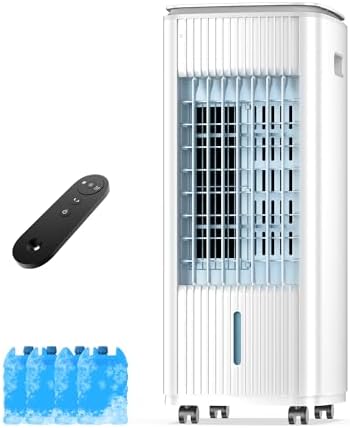
- ❄ 𝟯-𝙞𝙣-𝟭 𝙋𝙤𝙧𝙩𝙖𝙗𝙡𝙚 𝘼𝙞𝙧 𝘾𝙤𝙣𝙙𝙞𝙩𝙞𝙤𝙣𝙚𝙧: No window, no hose, no installation. Add ice packs for powerful evaporative cooling i…
- ❄ 𝟯 𝙎𝙥𝙚𝙚𝙙𝙨 + 𝟳𝟬° 𝙊𝙨𝙘𝙞𝙡𝙡𝙖𝙩𝙞𝙤𝙣 & 𝟲𝟬° 𝙏𝙞𝙡𝙩: Powered by a 65W high-efficiency motor (low energy consumption) and high-densit…
- ❄ 𝟬.𝟴𝙂𝙖𝙡 𝙏𝙖𝙣𝙠 + 𝟰 𝙄𝙘𝙚 𝙋𝙖𝙘𝙠𝙨 – 𝟴 𝙃𝙤𝙪𝙧𝙨 𝙤𝙛 𝘾𝙤𝙤𝙡𝙞𝙣𝙜: Fill the detachable tank for up to 8 hours of run time in cooling mode…
Buying guide — what to look for
If you’re shopping for a ventless evaporative cooler or a small ventless option, focus on these features:
1. Climate suitability
Only consider evaporative/ventless cooling if your average summer humidity is low (arid to semi-arid). In humid coastal or Southeast climates, the indoor humidity increase will reduce comfort and can cause moisture problems. Energy.gov and DOE guidance note evaporative cooling is ideal in low-humidity areas.
2. Capacity & room size (BTU / CFM)
Evaporative coolers are often sold by airflow (CFM) or model coverage. For refrigerant systems, use the ENERGY STAR room AC square-foot chart (or the 20 BTU/sq ft rule of thumb) to match capacity to room size. If you’re unsure, target a bit more capacity rather than less undersized units struggle and waste energy.
3. Water use & reservoir size
Evaporative units need water (some direct side fill, some gravity feed). Expect water usage to vary widely whole-house units use the most. Check manufacturer specs; some units use a few gallons per hour. If you have water limitations, factor that in.
4. Energy efficiency
For refrigerant products look at EER/CEER ratings (ENERGY STAR). For evaporative coolers, compare fan wattage and pump power; a well-designed evap cooler can use 1/4 the energy of central AC in dry climates.
5. Filtration & outdoor air quality
Evaporative coolers bring outdoor air inside. If you live where pollen, dust, or wildfire smoke is a concern, choose a model with a good intake filter (and plan to stop use during smoke events). The EPA recommends caution with evap coolers during poor outdoor air quality.
6. Noise, warranty, and serviceability
Look for washable pads, easy access to pumps and fans, and a reasonable warranty. Noise matters compare dB ratings where provided. Ask about replacement pads and parts availability.

- Copper Motor for powerful cooling: This swamp cooler with an advanced copper motor drives 1800 CFM of airflow at 34 ft/s…
- 3-in-1 Versatile Climate Control: More than just a fan, this room cooler combines a powerful room air conditioner, a ref…
- Continuous Cooling for All-Day Chill: Stay cool longer with the large 5.3-gallon water tank, designed for uninterrupted …
READ MORE: Wall-Mount Air Conditioners (2026): The Smart Guide for U.S. Homeowners
Installation, placement & maintenance
Placement & ventilation
Evaporative coolers need airflow: either open windows/doors or a designed intake/exhaust path (whole-house rooftop models use controlled intake). Position portable units near a window or an exterior wall if possible so they can bring fresh air in and create cross-ventilation.
Setup tips
- Fill to manufacturer-recommended water level. Use clean water to minimize mineral buildup.
- Use a drip pan or secure the unit so it won’t tip when filled.
- If you have hard water, consider water treatment or regular pad cleaning to reduce mineral scaling.
Routine cleaning
- Replace or clean pads at start and end of season.
- Flush the water reservoir to prevent algae and mineral buildup.
- Inspect the pump and fan for debris. Manufacturer maintenance intervals vary follow the manual.
Winter storage
Drain the water, clean pads, and store in a dry place. For rooftop whole-house units, follow winterizing instructions to avoid freeze damage.
When to call a pro
If you’re switching from a sealed refrigerant system to an evaporative whole-house solution (roof install), or if you suspect moisture penetration, call a licensed HVAC contractor. Improper installation can create humidity and mold problems in your home.
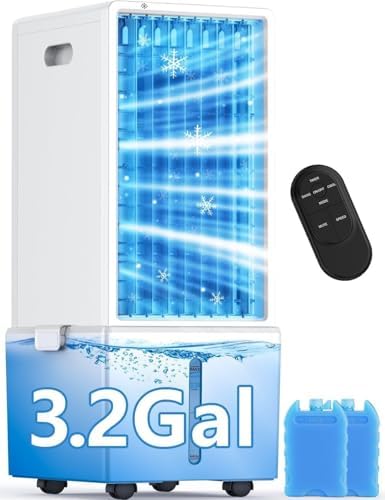
- ❄️【𝟒-𝐈𝐍-𝟏 𝐄𝐯𝐚𝐩𝐨𝐫𝐚𝐭𝐢𝐯𝐞 𝐀𝐢𝐫 𝐂𝐨𝐨𝐥𝐞𝐫 𝐟𝐨𝐫 𝐃𝐫𝐲 𝐑𝐞𝐠𝐢𝐨𝐧𝐬】Functioning as a fan, humidifier, and air cooler all in one, our portab…
- ❄️【𝐒𝐦𝐚𝐫𝐭 𝐖𝐚𝐭𝐞𝐫 𝐀𝐥𝐞𝐫𝐭𝐬, 𝐄𝐧𝐬𝐮𝐫𝐢𝐧𝐠 𝐒𝐞𝐜𝐮𝐫𝐞 𝐂𝐨𝐨𝐥𝐢𝐧】Smart low water alert, cooling never stops! Thanks to its intelligent No W…
- ❄️【𝟒 𝐌𝐨𝐝𝐞𝐬 & 𝟒 𝐒𝐩𝐞𝐞𝐝𝐬, 𝐀𝐝𝐣𝐮𝐬𝐭𝐚𝐛𝐥𝐞 𝐂𝐨𝐦𝐟𝐨𝐫𝐭】Stay cool and comfortable like never before! With 4 modes (Normal/Natural/Slee…
Costs & running-cost example
Purchase price ranges
- Small portable evaporative cooler: $100–$300.
- Larger portable / whole-house evaporative models: $300–$1,500 (roof/installed wholesale units more).
- Typical window AC: $150–$900.
- Portable vented AC: $300–$800.
- Single-zone ductless mini-split (installed): commonly $1,500–$5,000+ depending on brand & install complexity.
READ MORE: Fujitsu Heat Pump Reviews (2026): Models, Costs & Real-World Pros & Cons
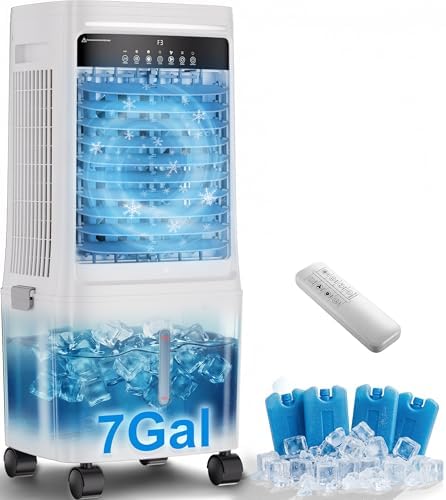
- 【❄️3-in-1: Swamp Cooler, Fan & Humidifier】 Why buy three machines when one does it all? This indoor swamp cooler air con…
- 【❄️7-Gallon Tank for All-Day Cooling – Ice on Top & Bottom for Double Chill】Tired of constant refills? This air cooler h…
- 【❄️120° Sweep, 360° Wheels & Built‑In Night Light】 No dead zones. This oscillating evaporative air cooler swings 120° si…
Running-cost example — simple calculation
Assume a portable evaporative cooler uses ~200 watts on average (fan + pump) and runs 8 hours/day. Electricity at $0.18/kWh:
- Daily energy = 0.2 kW × 8 hr = 1.6 kWh → daily cost = 1.6 × $0.18 = $0.29.
- Monthly (30 days) = $0.29 × 30 = $8.70.
Compare a 10,000 BTU portable refrigerant AC (~1,200–1,400 W running; assume 1.3 kW):
- Daily energy = 1.3 kW × 8 hr = 10.4 kWh → daily cost = 10.4 × $0.18 = $1.87.
- Monthly (30 days) = $56.10.
These are rough examples actual power draw depends on model efficiency, fan speeds, and duty cycle. In dry climates evaporative coolers frequently have much lower electricity costs than compressor AC.
READ MORE: Mini Split Air Conditioners
Safety, building codes & humidity concerns
- Condensation & mold: Ventless evaporative coolers increase indoor relative humidity. In spaces that are already humid, moisture buildup can lead to condensation on windows, peeling paint, mold, and structural issues. Monitor indoor RH (ideally keep below ~50–60%).
- Wildfire smoke & outdoor pollution: Evaporative systems draw outdoor air and can bring smoke/pollutants inside. During poor air quality or wildfire events, avoid using evaporative coolers or add high-efficiency intake filtration per EPA guidance.
- Codes & permits: Small portable units usually need no permit. Rooftop whole-house evaporative installations or permanent HVAC changes may require permits and inspections depending on local code check with your local building department.
- Electrical safety: Make sure circuits aren’t overloaded; portable units with high current draw should be on their own dedicated circuit if recommended by the manufacturer.
Alternatives & when NOT to use ventless
Don’t choose a ventless evaporative cooler if:
- You live in a humid climate (Southeast U.S., Gulf Coast).
- Your home is tightly sealed and poorly ventilated (risk of humidity problems).
- Outdoor air quality is frequently poor (wildfire smoke, heavy dust, industrial pollution).
In those cases, consider ductless mini-splits (efficient, year-round) or window/portable vented ACs (sealed refrigeration, no added humidity). For whole-house comfort, central AC or multi-zone mini-split systems are the right choice.

- ❄【Upgraded Motor Delivers 1S Chill】 Unlock 1-second rapid chill and 70% boosted cooling efficiency in this windowless ai…
- ❄【3 Speeds & 4 Modes Meet Every Need】Customize your environment with this versatile swamp cooler — a powerful room coole…
- ❄【360° Auto-Rotation Covers Max 600 SQ.FT】 This portable swamp cooler features 360° auto-rotation and 1700 CFM, covering…
FAQs
Are ventless ACs safe to use in a home?
Ventless evaporative coolers are safe when used as intended in dry climates but they add humidity and pull outdoor air, which can be a problem if outdoor air quality is poor or your home is already humid. Follow EPA guidance about not using evap coolers during smoke events and keep up with maintenance to avoid biological growth.
Do ventless air conditioners cool as well as window or mini-split AC?
Not usually. In dry climates, evaporative coolers can be very effective and energy-efficient. In humid climates or for sealed indoor spaces, refrigerant systems (window AC, portable vented AC, ductless mini-splits) offer stronger, consistent cooling without increasing indoor humidity.
How much does a ventless evaporative cooler cost to run?
Small units often draw a few hundred watts; a properly sized evaporative cooler running 8 hours/day may cost around $5–$15 per month in electricity depending on your rates. This is generally much lower than compressor AC in dry climates. (Sample calculation in the Costs section.)
Can I use an evaporative cooler in an apartment or rental?
Portable evaporative coolers are simple to install and can be used in many rentals, but remember they need ventilation (a slightly open window or door) and will increase indoor humidity check your lease rules and consider the building’s overall humidity and ventilation.
What maintenance does a ventless evaporative cooler need?
Seasonal maintenance: clean/replace pads, flush the water reservoir, inspect the pump and fan, and winterize/drain for storage. Proper maintenance keeps efficiency up and prevents odors and biological growth.
How to pick — quick decision checklist
- If you live in the arid West and want low-cost, eco-friendly cooling for a room or small home → consider evaporative (ventless) cooler.
- If you need reliable room cooling, don’t want added humidity, or have poor outdoor air quality → window AC or ductless mini-split.
- If you want whole-house, year-round comfort and efficiency → ductless mini-split or central AC (pro install).
Conclusion
Ventless (evaporative) cooling can be an excellent, energy-saving choice in the right climate but it’s not a universal replacement for refrigerant-based AC. If you’re unsure whether your home and local climate are a fit, call a licensed HVAC tech for an on-site assessment.