If you’re swapping out an old heater, finishing an addition, or deciding whether to keep electric baseboards or move to a hydronic (hot-water) system, this guide is for you. I’ll walk you through how baseboard heating works, the main types you’ll find on store shelves and in HVAC catalogs, simple sizing rules you can use to estimate heat needs, the real-world operating cost math, installation and permit basics for U.S. homeowners, and a practical troubleshooting & maintenance checklist. Think of this as advice from a knowledgeable neighbor plus the kind of technical detail a trusted electrician would point out.
Throughout the guide I’ll use plain language and short definitions for jargon (BTU = British Thermal Unit, a way to measure heating power; kW = kilowatt, electrical power). I’ll also include a visible comparison table so you can compare the major types at a glance, and a step-by-step operating cost example you can adapt for your local electricity rate. Where appropriate I’ll flag code and manufacturer guidance you should check before installing anything. (For instance, the National Electrical Code has specific rules for fixed electric space-heating equipment.) The technical sections were reviewed by a licensed electrician to keep the instructions accurate and code-aware.
By the end you’ll be able to: identify which baseboard type fits a room, estimate rough fuel and installation costs, know when a permit or pro is required, and follow a clear troubleshooting & safety checklist if a unit isn’t working the way it should.
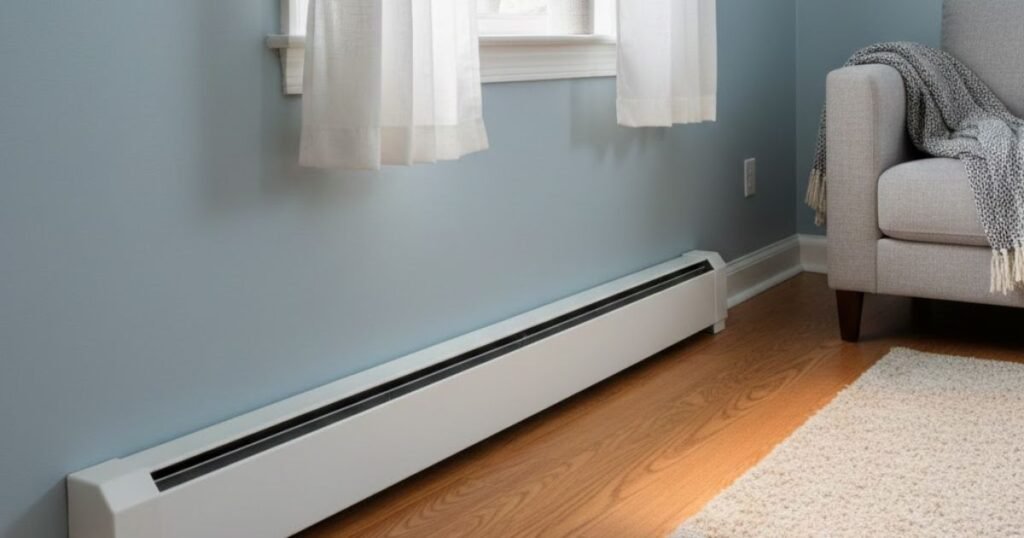
How baseboard heating works
Baseboard heating delivers heat from low, wall-mounted units along the base of a room. There are two dominant heat-transfer styles in baseboard systems:
Convection (typical electric baseboards)
Electric resistive elements inside the unit heat the air directly. Warm air rises from the heater, cools as it moves across the room, then returns to the heater at floor level creating gentle circulation (convection). Convection heaters are great for quick localized warmth and are easy to zone (room-by-room control).
Hydronic (hot-water) / Radiant feel
Hydronic baseboards use hot water (or oil in some sealed units) circulated from a boiler through finned tubes inside the baseboard. The warm pipes heat the nearby air by convection, but hydronic systems also deliver a more even, “radiant-like” warmth because the heated surface keeps a steady temperature. Hydronic systems often hold heat longer after the boiler cycles off.
Two additional technical notes:
- Electric resistive vs. hydronic (hot-water): electric baseboards convert electrical energy to heat at the point of use (100% conversion efficiency at the unit), but electricity is often the most expensive fuel per useful heat delivered. Hydronic systems use a boiler (natural gas, propane, oil, or electric), which can be far less expensive per delivered BTU, depending on local fuel prices and boiler efficiency. According to the U.S. Department of Energy, hydronic (liquid-based) systems use little electricity and can be efficient when paired with an efficient boiler.
- Why placement matters: baseboards work best at floor level along exterior walls under windows because they intercept cold downdrafts and promote even circulation.
Types of baseboard heaters
Here are the common varieties you’ll run into:
1. Electric baseboard (resistive)
- Electric heating element + metal fins inside a low horizontal cabinet.
- Pros: cheap to buy, simple to install (if wiring present), easy to zone with per-room thermostats.
- Cons: can be expensive to run where electricity rates are high.
2. Hydronic (hot-water) baseboard
- Finned tubes warmed by hot water from a central boiler. Circulation can be boiler pump-driven.
- Pros: steady, comfortable heat; lower operating cost if paired with an efficient boiler and inexpensive fuel.
- Cons: higher upfront complexity and cost if you don’t already have a boiler.
3. Oil-filled convector (sealed electric)
- Electric element heats oil sealed in the unit; oil stores heat to release after power down.
- Pros: quiet and steady heat; good for retrofit where silent heat is desired.
- Cons: heavier, slower to respond.
4. Hydronic convectors (sealed or low-water-volume sealed systems)
- Similar to hydronic baseboards but can be part of sealed circuits or use electric boilers (electric hydronic elements). Good where gentle, long-lasting heat is wanted and an existing hydronic plant is present.
READ MORE: Wall Heaters: The Homeowner’s Complete Guide to Buying, Installing & Troubleshooting
Comparison table (near the “Types…” section)
| Type | Heat source | Typical upfront cost (approx., US) | Operating cost (relative) | Best for | Pros | Cons | Typical lifespan |
| Electric Baseboard | Electric resistance | Low–Medium (approx.) | Medium–High | Bedrooms, additions, retrofits without hydronic system | Low install complexity; zonable by room | Higher energy cost in many U.S. regions; visible units | 15–25 years |
| Hydronic (hot-water) Baseboard | Hot water from boiler | Medium–High (if boiler exists: medium; boiler install = high) | Low–Medium | Whole-house heating with boiler, older homes, efficient systems | Comfortable steady heat; lower operating cost with efficient boiler | Higher upfront install; needs boiler & piping | 20–40+ years |
| Oil-filled convector | Electric (oil reservoir) | Medium (approx.) | Medium | Small rooms, retrofits where silent heat preferred | Quiet, retains heat after power off | Slower to heat; heavier | 10–20 years |
| Hydronic convector (sealed) | Hot water sealed system | Medium–High | Low–Medium | Similar to hydronic baseboard—efficient zones | Efficient; quieter | Requires hydronic system | 20–40+ years |
.
Buying guide: sizing, BTU rules-of-thumb, choosing the right type for each room
1. Simple BTU sizing method (quick rule-of-thumb)
A commonly used starting point: assume 25–35 BTU per square foot for a typical moderately insulated U.S. room in a cold climate; use the lower end (25) for well-insulated spaces or milder climates, and the higher end (35) for poorly insulated rooms or very cold regions.
Example quick method:
- Measure room square footage: length × width = area (ft²).
- Multiply area × chosen BTU/ft² (25–35). Result = required BTU.
- Convert BTU to kW if using electric heaters: 1 kW ≈ 3412 BTU. So kW = BTU ÷ 3412.
Quick sample: 12′ × 14′ bedroom = 168 ft².
- Using 30 BTU/ft² → 168 × 30 = 5,040 BTU.
- Convert to kW: 5,040 ÷ 3,412 ≈ 1.48 kW → roughly a 1.5 kW electric baseboard (1500 W) or equivalent hydronic length.
2. Sizing pitfalls to avoid
- Don’t size only by floor area; factor ceiling height (rooms >8 ft need more), lots of windows or a cold exterior wall increases load, and poor insulation or many external doors raises the requirement.
- Matching unit length to heat loss: electric baseboard manufacturers list BTU output by length pick the model length(s) that together equal or slightly exceed your calculated BTU.
- Avoid under-sizing for bathrooms (comfort demands and ventilation heat loss), and consider higher sizing for south-facing glass or sun exposure patterns.
3. Choosing heater type by room
- Bedrooms: electric baseboard or oil-filled convectors work well for zoning and quiet overnight heat.
- Living rooms / larger open areas: hydronic baseboards offer steadier, more comfortable heat if a boiler exists.
- Additions / retrofits without ductwork: electric baseboards are quick and low-disruption.
- Basements / garages: hydronic convectors if you want long-lasting heat and already have hydronic infrastructure.
4. Thermostat & zoning notes
- For electric baseboards use thermostats rated for resistive loads and specifically for baseboard heating (line-voltage thermostats or properly wired low-voltage control with appropriate relays). If you plan multiple zones, use a properly sized control panel or separate breakers and thermostats for safety and better efficiency.
READ MORE: Heat Exchangers Explained | Types, Uses, Efficiency & Benefits
Installation, permits & code basics
Permits & when they’re typically required
Many U.S. jurisdictions require a permit for installing fixed electric heating equipment, installing or modifying hydronic piping connected to a boiler, or carrying out significant electrical work (new circuits, new breaker panels, changes to service). Always check with your local authority having jurisdiction (AHJ) before starting. For example, wiring changes that add new circuits to supply baseboards usually need an electrical permit and inspection.
NEC and disconnecting means
Electric fixed space-heating equipment is covered in the National Electrical Code under Article 424 — Fixed Electric Space-Heating Equipment. The NEC includes requirements for circuit sizing, disconnects, and other safety details; for example, a means to disconnect ungrounded conductors is required so the heater can be safely isolated for servicing. Make sure your electrician follows Article 424 for wiring, overcurrent protection, and disconnecting provisions.
What to expect from an electrician or plumber
- Electric baseboard: electrician will size the circuit (Amps = Watts ÷ Voltage), run dedicated cable(s) to each heater or to a grouped circuit depending on loads, install appropriate breakers, and fit the thermostat wiring. They’ll also ensure disconnect and panel labeling.
- Hydronic baseboard: plumber/HVAC tech will route supply and return piping, connect to the boiler or zone manifold, and set up zone valves or pumps. Expect coordination between plumber and electrician (pump power, controls, and any electrical boiler).
Manufacturer instructions are not optional
Follow the heater manufacturer’s installation manual for clearances, mounting height, and wiring diagrams. Manufacturer manuals also list required clearances from combustibles (for instance, many electric baseboard instructions warn to keep furniture and curtains a safe distance away). These guidelines are binding in permitting and inspections.
Operating costs & energy efficiency
Operating cost depends heavily on local fuel price, equipment efficiency, and usage pattern. Below are two typical cost comparisons and a worked example for an electric baseboard so you can plug in your local rate.
What the numbers mean
- Electric baseboards convert electricity to heat at essentially 100% at the unit, but retail electricity prices vary widely by state and can be the largest factor in operating cost. U.S. annual residential average electricity prices have varied year to year; as a recent reference point, national average residential prices were around 16.48¢/kWh in 2024 per the U.S. Energy Information Administration (EIA). Use your latest utility bill or state averages to get the exact cents/kWh for your area.
- Hydronic systems’ operating cost depends on boiler fuel (natural gas, propane, oil, or electric) and boiler efficiency. If you already have an efficient gas boiler, hydronic baseboards will typically be cheaper to run than electric in most parts of the U.S.
Example: step-by-step operating cost for a 1,500 W electric baseboard
Use a simple scenario: a 1,500 W (1.5 kW) baseboard runs 8 hours per day, electricity price = $0.1648 per kWh (16.48¢/kWh).
- Convert watts to kilowatts:
1,500 W ÷ 1,000 = 1.5 kW. - Daily energy use:
1.5 kW × 8 hours/day = 12.0 kWh/day. - Cost per day:
12.0 kWh/day × $0.1648/kWh = $1.9776/day. (Show digits: 12.0 × 0.1648 = 1.9776) - Monthly cost (30-day month):
12.0 kWh/day × 30 days = 360 kWh/month.
360 kWh × $0.1648/kWh = $59.328 → $59.33/month. (360 × 0.1648 = 59.328) - Annual cost (365 days):
$1.9776/day × 365 = $722.624 → $722.62/year.
Interpretation: one 1,500 W baseboard used 8 hours/day at the national average 16.48¢/kWh costs roughly $59/month, or ~$723/year. Multiply by the number of units or adjust hours and local rate for your situation.
Using the calculation
- If your local residential rate is lower (say 12¢/kWh), the annual cost falls accordingly. If it’s higher (e.g., Hawaii or parts of California >30¢/kWh), electric baseboards become much more expensive to operate.
- For hydronic systems, compare delivered BTUs per dollar using local gas/propane rates and boiler efficiency. Consult the Department of Energy and your utility for fuel price and efficiency guidance.
READ MORE: Ductless Heat Pump
Safety, maintenance & troubleshooting checklist
Daily / seasonal checks
- Keep the front grill and fins clear of dust and obstructions; vacuum with a brush attachment.
- Maintain recommended clearance from furniture, drapes, and bedding (many manufacturers recommend at least 12–36 inches from the front of the heater to combustibles; check your manual).
Routine maintenance (annually or as directed)
- Inspect and clean heaters at the start of heating season. For hydronic units, check for leaks and bleeding air from the system if you see cold spots.
- Electric units: check thermostats and wiring for loose connections (only a licensed electrician should open the heater for wiring checks).
- Hydronic: have the boiler serviced annually by a licensed tech.
Common failure modes & quick troubleshooting
- No heat from electric baseboard: check breaker, thermostat setpoint, and wiring. If breaker trips repeatedly, don’t reset repeatedly—call an electrician.
- Uneven heating on hydronic baseboard: might indicate trapped air or partially closed zone valve; bleeding the zone or checking the pump/valve helps.
- Cold spots along a hydronic baseboard: may indicate sludge or air in the loop requires hydronic service.
- Unit cycles excessively: oversizing thermostats or poor thermostat placement (e.g., next to drafty windows) can cause short cycling.
Safety red flags — call a pro
- Burning smell that persists after initial startup (shorts or burning dust aside), smoke, visible arcing, repeated breaker trips, hot faceplate temperatures above manufacturer limits, or any signs of water leak near electrical connections stop use and call a licensed electrician or HVAC technician.
Pros, cons & best-use cases
Electric baseboard — pros
- Low initial cost, fast installation, easy zoning, no ductwork needed. Great for rooms where you want per-room control.
Electric baseboard — cons
- Higher operating costs in regions with expensive electricity; visible units can be bulky and affect interior layout.
Hydronic baseboard — pros
- Even, steady heat; lower operating costs if paired with an efficient boiler and inexpensive fuel; longer heat retention.
Hydronic baseboard — cons
- Higher upfront cost if no boiler exists; plumbing and boiler maintenance required.
Best-use cases
- Electric baseboard: small additions, bedrooms, retrofits without a boiler, or in regions with cheap electricity.
- Hydronic baseboard: whole-house heating where a boiler already exists or when long-term fuel savings are a priority.
When to replace vs. repair
Repair vs. replace guidelines
- Replace if unit is near end of life (electric baseboards ~15–25 years, hydronic baseboards often outlast boilers but piping and fins can last 20–40+ years), exhibits corrosion, or if operating cost is a concern and you have a cheaper fuel option (e.g., gas boiler).
- Repair when failure is limited (thermostat, wiring, element) and the unit otherwise functions efficiently.
Upgrade options
- Better thermostats: replace old mechanical line-voltage thermostats with modern digital line-voltage thermostats that reduce overshoot.
- Zoning: add multiple thermostats or zone controls to focus heating only where needed. For hydronic systems, install zone valves and separate thermostats for each zone.
- Smart controls: smart line-voltage thermostats are available for electric baseboards; ensure compatibility with your load and meet code. When using low-voltage thermostats with high-current baseboards, use appropriately sized relays/contactors.
Hiring checklist & estimate questions to ask a contractor
When you call an electrician/HVAC contractor, ask:
- Do you have a license in my state? Can you provide license number and proof of insurance?
- Will you pull the necessary permits and arrange inspections?
- Can you provide a written estimate that breaks out equipment cost, labor, permits, and any required upgrades (panel, breakers, piping)?
- For hydronic work: what boiler efficiency (AFUE) do you recommend and why? For electric: will you need to upgrade panel capacity?
- How do you protect existing finishes during work and clean up afterward?
- Ask for references from recent similar jobs and for an estimated timeline.
A good contractor will give a clear, written price, explain code or permit needs, and be willing to show proof of license and insurance before starting.
5 FAQs
1. Are baseboard heaters expensive to run?
Electric baseboard heaters can be costly where electricity is expensive; use your local cents/kWh to calculate running cost. Example math was shown above; hydronic systems are often cheaper to operate if you have an efficient boiler.
2. What’s the difference between electric and hydronic baseboard?
Electric uses resistive elements; hydronic circulates hot water from a boiler. Hydronic usually offers steadier heat and lower fuel cost with the right boiler.
3. Do I need a permit to install baseboard heaters?
Most jurisdictions require permits for fixed electric heating installations or new circuits and for hydronic boiler/piping work check with your local AHJ. NEC Article 424 covers fixed electric space-heating requirements.
4. How far should furniture be from a baseboard heater?
Follow the manufacturer’s manual; many recommend keeping furniture and curtains at least 12 inches (and sometimes up to 36 inches for combustibles) from the heater face.
5. How long do baseboard heaters last?
Electric baseboards typically last 15–25 years; hydronic systems frequently last 20–40+ years depending on boiler and maintenance.
Conclusion
Baseboard heating is a simple, reliable choice for many U.S. homeowners especially when you match the right type to the room, do simple BTU sizing, and compare operating cost using your local energy prices. If you’re leaning toward electric baseboards for a remodel, do the wiring math and budget for potential panel upgrades. If you already have a boiler, hydronic baseboards are often the more comfortable, economical long-term choice. Want help applying the sample calculation to your house or checking how many BTUs your rooms need? Tell me your room sizes, ceiling height, and state (for local electricity price) and I’ll run the numbers for you.