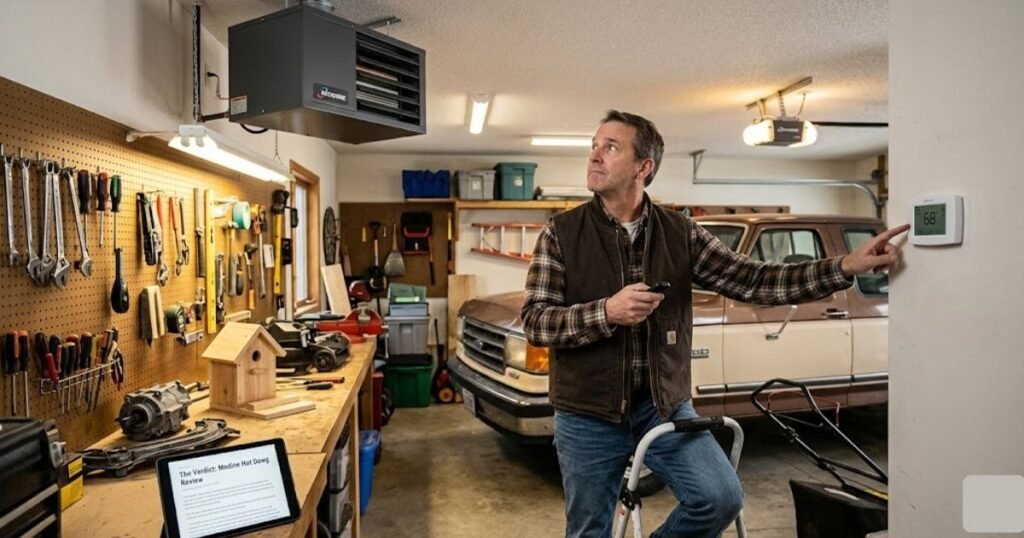
Modine heaters, specifically the Hot Dawg series, have become the gold standard for heating residential garages, workshops, and even small commercial spaces. They are famous for being compact, powerful, and remarkably quiet. But they aren’t the cheapest option on the shelf.
In this Best Modine heater review, we are going to look past the marketing. We will break down which models actually work for your space, how much they really cost in 2026, and whether you should pull the trigger on a Modine or look at a competitor like Mr. Heater or Reznor. Lets deep dive into “Best Modine Heater Review: Is the Modine Hot Dawg Worth It?”
READ MORE: EdenPURE Heaters Review 2026 — Prices & Comparison
What Is a Modine Heater?
At its core, a Modine heater is a gas-fired unit heater designed to be mounted to the ceiling. Unlike a central furnace that uses a complex web of ducts to move air throughout a house, a Modine unit sits in the corner of your shop and blows hot air directly into the room.
Modine Manufacturing Company has been around for over 100 years. While they make massive industrial systems, their “Hot Dawg” line was built specifically for the “little guy”—the homeowner with a two-car garage or the small business owner with a light-duty warehouse.
The Two Ways They Breathe
When you start shopping for a Modine, you will see two main terms: Power-Vented and Separated Combustion. This is the most important choice you will make.
- Power-Vented (HD Models): These heaters pull the air they need for burning (combustion air) directly from the room they are sitting in. They then vent the exhaust gases outside through a pipe. These are great for standard, clean garages.
- Separated Combustion (HDS Models): These units are a bit more sophisticated. They pull fresh air from outside through one pipe, burn the gas, and vent the exhaust out another pipe. The combustion process is completely sealed off from the room.
Why does this matter? If you are a woodworker, your shop is full of sawdust. If you are a mechanic, you might have paint fumes or gasoline vapors in the air. A power-vented heater would suck that dust and those fumes into the burner, which can cause clogs or even safety hazards. For dusty or “fume-heavy” shops, you want a separated combustion model every time.

- Manufactures heating and cooling equipment for industrial and commercial settings
Quick Verdict: Is a Modine Hot Dawg worth it?
Yes. For most homeowners, it is the best balance of longevity, noise level, and ease of installation. It is a “buy once, cry once” kind of tool.
- Who should buy it? Homeowners who plan on staying in their house for a long time, serious hobbyists who need a quiet environment, and anyone who wants a heater that is easy to find parts for.
- Who should skip it? If you only need to heat your garage twice a year to change your oil, a Modine is overkill. In that case, a cheaper portable propane heater or a budget-tier unit might be better.
READ MORE: DeLonghi Heater Reviews (2026) — Models, Prices & Buyer’s Guide
Modine Heater Lineup Explained
Modine doesn’t just make one heater. They have a few different “families” under the Hot Dawg name. Choosing the right “letter” (HD vs. HDS) is just as important as choosing the right size.
Modine Heater Comparison Table
| Model | Venting Type | Fan Type | Best Use | Size Range (BTU) | Key Strength | Possible Drawback |
| HD | Power Vented | Propeller | Standard Garages | 30k – 125k | Simple, reliable | Pulls air from room |
| HDB | Power Vented | Blower | High Ceilings/Ducts | 60k – 125k | High air “throw” | Louder, more expensive |
| HDS | Separated Combustion | Propeller | Dusty Shops/Greenhouses | 30k – 125k | Cleaner operation | Requires two vent pipes |
| HDC | Separated Combustion | Blower | Industrial Shops | 60k – 125k | Most robust combo | Largest and heaviest |
Understanding the Differences
The HD is the classic. If you have a normal two-car garage where you park your cars and maybe do some light tinkering, the HD is your best friend. It is the easiest to install because it only needs one vent pipe going through the wall or roof.
The HDS is for the person who actually works in their space. If you are sanding cabinets or spraying finishes, the HDS is a must. Because it doesn’t “breathe” the shop air, the internal components stay clean, and you don’t have to worry about sawdust clogging the burner.
The HDB and HDC models use a centrifugal blower instead of a standard fan. Think of a standard fan as a desk fan—it moves air, but it doesn’t have a lot of “push.” A blower is more like your home’s furnace fan. It can push air through ductwork or from a very high ceiling down to the floor. Most homeowners don’t need these unless they have 15-foot ceilings or want to heat two separate rooms with one unit.
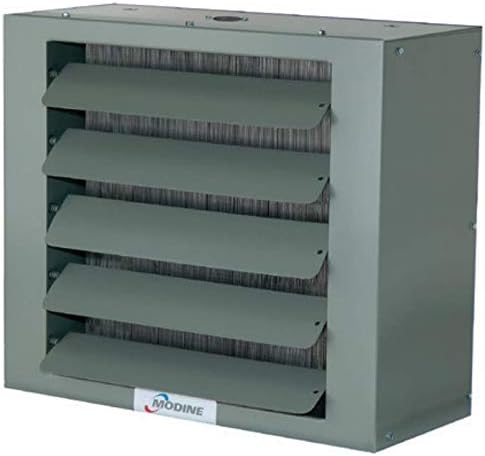
- Manufactures heating and cooling equipment for industrial and commercial settings
READ MORE: Best Tankless (Non-condensing) Gas Water Heater Reviews & Comparison — 2026 buying guide
Best Modine Heater Review: Model-by-Model Breakdown
Now, let’s look at the specific units. Modine sizes their heaters by “MBH,” which is just another way of saying thousands of BTUs per hour. For example, an HD30 is 30,000 BTUs.
1. Modine HD30 (The Garage King)
This is the entry-level model. It is designed for a typical two-car garage (roughly 500 to 700 square feet) in a moderate climate.
- Who it is for: The average suburban homeowner.
- Strengths: Very compact. It only weighs about 60 pounds, making it easy for two people to hang.
- Weak points: If you live in a place like North Dakota or Alaska, 30,000 BTUs might struggle to keep a drafty garage warm.
- Smart Value Buy? Absolutely. It is the most popular model for a reason.

- Standard power exhaust allows for sidewall or roof venting
- Permanently lubricated motor for trouble-free dependability
- 1 inch clearance to combustibles
2. Modine HD45 (The Sweet Spot)
The HD45 is essentially the HD30’s bigger brother. It uses the same cabinet size but puts out 50% more heat.
- Who it is for: People with two-car garages who live in “deep freeze” states.
- Strengths: Fits in the same small space as the HD30 but recovers heat much faster after you open the garage door.
- Weak points: Slightly higher fuel consumption.
- Smart Value Buy? Yes. For an extra $50 to $100 over the HD30, the extra power is usually worth it.

- Quiet operation
- Certified for residential, commercial and industrial use
- Low profile design and neutral color
3. Modine HD60
We are moving into “three-car garage” or “small shop” territory here. The HD60 is significantly more powerful and moves more air.
- Who it is for: Oversized garages or small detached workshops.
- Strengths: Great air “throw.” It can push warm air across a 30-foot room easily.
- Weak points: The cabinet is larger than the 30/45 models, so it takes up more ceiling real estate.
- Smart Value Buy? Yes, if your space is over 800 square feet.

- Hush-Puppy Quiet Operation
- Low Profile Design
- Aluminized Steel Heat Exchanger
4. Modine HD75
The HD75 is the bridge between residential and light commercial. It is a beast of a heater.
- Who it is for: Massive detached garages, pole barns, or small retail storefronts.
- Strengths: Will heat up a cold space incredibly fast.
- Weak points: Can feel like a “blast furnace” if your space is too small. It might cycle on and off too frequently.
- Smart Value Buy? Only if you have the square footage to justify it.
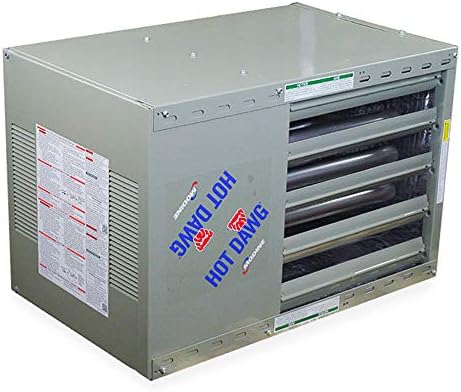
- 75,000 BTU/hr. input
- Standard power exhaust simplifies side-wall or roof venting with small-diameter vent pipe
- Lightweight, easily installs 1″ from ceiling with only two angle brackets (included on sizes 30-75, accessory for 100, 1…
5. Modine HD100 & HD125
These are the heavy hitters. You rarely see these in a standard home garage.
- Who it is for: Large commercial shops, small warehouses, or 4+ car garages with high ceilings.
- Strengths: Industrial-grade heating capacity.
- Weak points: Loudest of the propeller fan models. High gas usage.
- Smart Value Buy? For commercial users, yes. For most homeowners, it’s overkill.
- HD100AS0121 – 100,000 BTU – hot dawg had gas fired unit heater
- Single-stage liquid propane burner – 80% AFUE
- Power vented – aluminized steel heat exchanger – propeller driven – 115V/60Hz/1 phase
6. Modine HDS30 (The Woodworker’s Choice)
This is the separated combustion version of the entry-level model.
- Who it is for: One or two-car garages used as woodshops or for car painting.
- Strengths: Safety. It keeps the fire away from the dust.
- Weak points: More expensive than the HD30. More complex to vent (requires two pipes).
- Smart Value Buy? If you have a hobby that creates dust, this is the only smart buy.
7. Modine HDS45
Like the HD45, this is the high-performance version of the small cabinet.
- Who it is for: Serious woodworkers in cold climates.
- Strengths: All the safety of the HDS30 with the power to handle a cold snap.
- Weak points: Higher upfront cost.
- Smart Value Buy? Highly recommended for Northern workshop owners.

8. Modine HDS60 & HDS75
These are for large hobby shops. If you have a 1,200-square-foot shop where you do a lot of dirty work, these are the gold standard.
- Who it is for: Cabinet shops, auto body repair, and large greenhouses.
- Strengths: Incredibly durable. The separated combustion means the internal heat exchanger is protected from corrosive chemicals or humidity.
- Weak points: Pricing starts to get steep once you add the venting kits.
- Smart Value Buy? Yes, for professionals or serious collectors.
READ MORE: Best 80-Gallon Electric Water Heaters of 2026 | Reviews & Deals
What Modine Heaters Cost Right Now
Let’s talk money. You won’t find a set price for these heaters across the board because every retailer is a little different. Also, prices change depending on whether you want a natural gas model or a liquid propane (LP) model.
Here is a look at current retail price ranges you will find online in 2026:
- Modine HD30: $979 – $1,157
- Modine HD45: $1,025 – $1,200
- Modine HD75: $1,153 – $1,408
- Modine HDS30: $1,199 – $1,277
- Modine HDS60: $1,375 – $1,796
Why is there a price range?
You might see an HD30 for $980 on one site and $1,100 on another. Usually, the cheaper price doesn’t include the vent kit or a thermostat.
What drives the price up?
- Stainless Steel Heat Exchanger: Standard Modines use aluminized steel. If you are heating a greenhouse or a place with high humidity, you should upgrade to stainless steel. It adds about $300 to $500 to the price, but it won’t rust out.
- Propane vs. Natural Gas: Most units ship as Natural Gas. If you need Propane, you might have to buy a “conversion kit” (about $80 – $120) unless the retailer sells a pre-converted model.
- Venting Kits: These are not just “PVC pipe.” They are specialized stainless steel or double-walled pipes. Expect to spend $200 to $400 on a proper vent kit.
- Thermostats and Brackets: A basic thermostat is cheap ($30), but a mounting bracket to hang the heater safely is another $100 to $180.
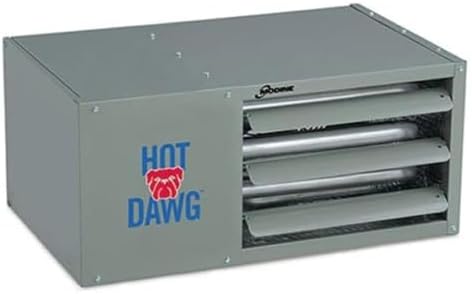
Comparison Table: Modine vs Mr. Heater vs Reznor vs Sterling
Modine isn’t the only player in the game. You will likely see names like Mr. Heater and Reznor while you shop. Here is how they stack up.
| Brand | Popular Model | Heat Type | Best For | Price Range | Main Advantage | Main Drawback |
| Modine | Hot Dawg HD45 | Forced Air | Garages/Shops | $1,000 – $1,200 | Very quiet; low profile | Higher price tag |
| Mr. Heater | Big Maxx (80k) | Forced Air | Budget Garages | $550 – $680 | Lowest price; DIY friendly | Louder; shorter lifespan |
| Reznor | UDX-150 | Forced Air | Commercial | $1,700 – $1,950 | Bulletproof build | Industrial look; expensive |
| Sterling | GG045 (Guardian) | Forced Air | General Shop | $900 – $1,100 | Reliable; classic design | Harder to find retail |
The Fair Shake
Mr. Heater Big Maxx is the king of the budget world. You can find them at big-box hardware stores. They work well, but they are noticeably louder than a Modine. If you just want “heat for cheap,” Mr. Heater wins. But if you want a heater that won’t drown out your radio or conversation, Modine is the better choice.
Reznor is the “old guard.” They make incredible heaters that last forever, but their UDX line is often more expensive and looks a bit more “industrial.” Modine’s low-profile design (only 12 inches tall for the small models) fits better in residential garages with 8-foot ceilings.
Sterling is a great middle-ground. They are very similar to Modine in quality. However, Modine has much better “name brand” support. If you need a replacement part in ten years, you are more likely to find a Modine part at a local HVAC supply shop.
READ MORE: AO Smith vs. Rheem Water Heaters: 2026 Comparison & Expert Reviews
Pros and Cons of Modine Heaters
To keep this “Best Modine heater review” honest, we have to look at the bad with the good.
Pros
- Low-Profile Design: Most models are only 12 to 18 inches tall. This is huge for garages where you need every inch of clearance for your truck or a car lift.
- Quiet Operation: Modine uses high-quality fans and vibration-dampening mounts. You can actually have a phone call while the heater is running.
- USA-Assembled: For many buyers, knowing the unit is assembled in the USA is a major plus for quality control.
- Versatile Mounting: You can hang them from the ceiling or a wall. You can even flip the unit over (on certain sizes) to change which side the gas and electric hookups are on.
- Fuel Flexibility: Easy to switch between Natural Gas and Propane with the right kit.
Cons
- Upfront Cost: It is rarely the cheapest heater in the search results.
- Professional Install Recommended: While a very handy DIYer can do it, you are dealing with gas lines, high-voltage electricity, and fire. Most people will need to pay an HVAC pro $500 to $1,000 for installation.
- Accessory Costs: The “base price” is a bit deceptive. By the time you buy the vent kit, gas line, and thermostat, you’ve spent another $500.
- Venting Requirements: You can’t just stick the vent out a window. It has to be done to code, which can be tricky in certain garage layouts.
Who Should Buy a Modine Heater?
Let’s break it down by the type of person you are.
The Suburban Homeowner (Attached Garage)
If your garage is attached to your house, you probably use it for more than just cars. Maybe it’s a gym or a laundry area. You want an HD30 or HD45. It’s quiet enough that it won’t vibrate the walls of the house, and it’s small enough to stay out of the way.
The Detached Garage Owner
If you have a separate building that isn’t insulated well, you need more “oomph.” Go for the HD60 or HD75. Since it’s detached, you might be using Propane tanks. Modine handles LP very well.
The Hobby Woodworker or Car Guy
If you generate dust or fumes, do not buy a power-vented heater. Buy the HDS30 or HDS45. The separated combustion is a safety feature you shouldn’t skip. It also prevents your heater from getting “clogged” with fine sawdust, which can be a nightmare to clean.
The Greenhouse Owner
High humidity is the enemy of metal. If you are heating a greenhouse, get a Modine with a stainless steel heat exchanger. A standard heater will rust out in two or three seasons. A stainless one will last a decade.
READ MORE: Best Greenhouse Heater Buying Guide: Best Winter Options for U.S. Gardeners
Modine Heater Installation and Buying Tips
Buying the heater is only half the battle. Here is some practical advice to make sure you don’t regret your purchase.
- Check Your Ceiling Height: Modine heaters have a “clearance to combustibles” requirement. Usually, you need at least 1 inch of space between the top of the heater and the ceiling. However, you also need to make sure the bottom of the heater isn’t so low that you hit your head.
- The “One-Size Up” Rule: If your garage is right on the edge (say, 700 square feet), don’t get the HD30. Get the HD45. It won’t work significantly harder, but it will heat the room much faster. A heater that runs for 10 minutes is better than one that runs for 40 minutes straight.
- Choose the Right Gas Type: Check your utility bill. If you have a gas pipe coming into your house, you want Natural Gas (NG). If you have a big white tank in the backyard, you want Liquid Propane (LP). Make sure you order the right version.
- Don’t Skimp on the Vent: Cheap venting can leak Carbon Monoxide into your garage. Buy the official Modine-approved Category III vent kits. They are made of special stainless steel that resists the acidic condensation produced by gas heaters.
- Think About the Thermostat: Do you want a “smart” thermostat? You can hook a Nest or Ecobee to a Modine, but you usually need a “C-wire” adapter or a transformer. If you just want it to stay at 50 degrees so your pipes don’t freeze, a simple $25 honeywell dial works best.
- Stainless Steel? Only buy it if you have high humidity (greenhouse) or live right on the ocean where salt air is an issue. For a standard dry garage, the standard aluminized steel is plenty.
Frequently Asked Questions
Is a Modine heater good for a garage?
Yes, they are arguably the best garage heaters on the market. They are designed specifically for the “low profile” needs of a residential garage and are much quieter than industrial unit heaters.
How big of a Modine heater do I need?
As a general rule of thumb:
30,000 BTU: 1 to 2-car garage (~500 sq. ft.)
45,000 BTU: Large 2-car or small 3-car garage (~750 sq. ft.)
60,000 BTU: Large 3-car garage or small shop (~1,000 sq. ft.)
75,000+ BTU: Large detached shops and pole barns.
What is the difference between HD and HDS Modine heaters?
The HD is power-vented, meaning it takes air from the room to burn the gas. The HDS is separated combustion, meaning it takes fresh air from outside. Use an HDS if your shop is dusty or has chemical fumes.
How much does a Modine Hot Dawg cost?
The unit itself usually costs between $950 and $1,500 depending on the size. However, after you add the venting kit, gas lines, and installation labor, most homeowners should budget between $2,000 and $3,500 total.
Is Modine better than Mr. Heater or Reznor?
“Better” depends on your budget. Modine is higher quality and quieter than Mr. Heater. Reznor is equal in quality to Modine but usually more expensive and geared toward industrial users. Modine is the best “all-around” choice for a homeowner.
Final Verdict
If you are looking for the best Modine heater review, here is the bottom line: You are paying a premium for peace and quiet and a slim design.
For the average homeowner with a two-car garage who just wants to keep the cars warm and do a little work on the weekends, the Modine HD45 is the perfect choice. It has enough power to overcome a cold snap but doesn’t take up much space.
If you are a woodworker or a “gearhead” who spends hours in the shop surrounded by sawdust or exhaust, don’t even look at the HD models. Go straight for the Modine HDS45. The safety of separated combustion is worth every penny of the extra $200.
Modine heaters aren’t the cheapest, but they are a solid investment. They increase your property value, make your winters bearable, and generally last 15 to 20 years with basic maintenance. If you want a “set it and forget it” solution for your cold garage, the Hot Dawg is absolutely worth it.