Few things are as frustrating as stepping into the shower, turning the handle, and waiting for warm water that never comes. If you have a Rheem tankless water heater, you might walk over to the unit and see a two-digit number blinking on the display. This is an error code. It can feel a bit intimidating, but don’t panic. These codes are actually helpful tools. Think of them as the “check engine light” for your home’s hot water.
In many cases, these errors happen because of a temporary glitch or a simple maintenance issue you can handle yourself. In this guide, we are going to walk through how to reset your Rheem tankless water heater, what those common codes actually mean, and how to tell if you should fix it yourself or call in a professional. Lets deep dive into “How to Reset Rheem Tankless Water Heater Error Codes”
READ MORE: How to Increase Heat Setting on Tankless Rheem Water Heater
Dealing with recurring error codes or hard water lockouts on your Rheem unit? Clear mineral scale fast and restore peak performance with the Chromex Tankless Water Heater Flush Kit, featuring an NSF-certified descaling solution and a heavy-duty 1/6HP pump:

What Rheem Tankless Water Heater Error Codes Mean
When your Rheem unit displays an error code, it isn’t just trying to be difficult. It is reacting to a specific set of data from its internal sensors. These sensors monitor everything from water flow and gas pressure to the temperature of the air leaving the exhaust. If something isn’t right, the system shuts down to protect itself and your home.
Here are the most common areas where these codes point:
- Gas Supply Problems: The unit isn’t getting enough fuel to create a flame.
- Ignition Failure: The gas is there, but the spark isn’t lighting it.
- Overheating: The water or the internal components are getting too hot for safety.
- Blocked Venting: The exhaust air can’t get out, or fresh air can’t get in.
- Water Flow Issues: There isn’t enough water moving through the pipes to trigger the burners.
- Mineral Buildup: Calcium and lime from hard water are “clogging” the system’s ability to heat efficiently.
- Sensor or Electrical Problems: A wire might be loose, or a sensor might be dirty.
Understanding that the code is a “symptom” rather than the “disease” is the first step. Sometimes, clearing the symptom (the code) is enough to get things moving again. Other times, the code will come right back because the underlying problem is still there.
Protect your home and water heater setup from hidden leaks before they cause major damage. The Frizzlife LP365 Smart Water Monitor and Automatic Shutoff Valve features ultra-precise micro-leak detection, real-time Wi-Fi alerts, and automatic shutoff capabilities right from your smartphone:

Before You Reset Anything: Safety First
Before we get into the “how-to” part, we need to talk about safety. You are dealing with a machine that uses electricity, water, and gas (or high-voltage electricity for electric models).
Check the Manual
If you have your Rheem manual tucked away in a drawer, grab it. Every model is slightly different. While this guide covers the most common Rheem tankless units used in U.S. homes, your specific model might have a unique button layout.
Turn Off the Power
If you decide to open the front cover of the unit to look at the wiring or filters, turn off the power first. You can do this at the circuit breaker or by unplugging the unit if it’s a gas model with a standard wall plug.
The “Smell Test”
This is the most important rule: If you smell gas (like rotten eggs), do not try to reset the unit. Do not turn any lights on or off. Leave your house immediately and call the gas company or the fire department from outside. A reset involves a spark, and a spark in a room full of gas is a recipe for disaster.
Don’t Force It
If you try to reset the unit and the code comes back three or four times in a row, stop. Repeatedly resetting a unit that has a genuine mechanical failure can cause further damage to the expensive internal heat exchanger.
READ MORE: How to Drain a Rheem Water Heater — Step-by-Step Guide
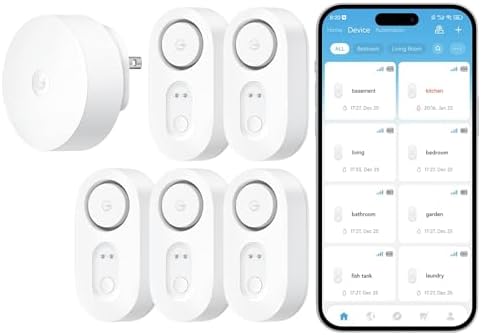
GoveeLife Upgraded Smart Water Leak Detector 1s with High Alarm, 5 Pack:
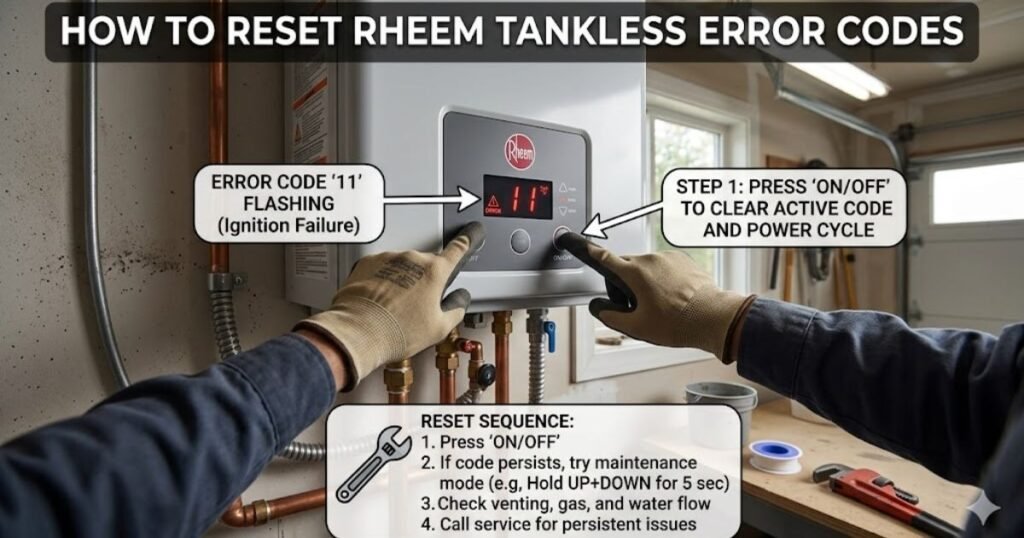
How to Reset Rheem Tankless Water Heater Error Codes
If you’ve checked for gas smells and everything seems normal, you can try a reset. Most Rheem tankless water heaters can be reset using one of the three methods below.
Method 1: The Remote Controller Reset
Most modern Rheem units have a small digital controller located either on the unit itself or inside your home (like in a laundry room or kitchen).
- Turn off all hot water faucets. Make sure no one is trying to run a bath or do dishes.
- Press the “On/Off” button on the remote controller.
- Wait about 30 seconds. This gives the computer inside the unit a chance to “power down.”
- Press the “On/Off” button again to turn the unit back on.
- Open a hot water faucet to see if the error code has cleared and the water gets hot.
Method 2: The Power Cycle
If the remote controller doesn’t seem to clear the code, or if you don’t have a remote, you can do a “hard reset” by cutting the power.
- Locate the power cord for the water heater.
- Unplug the unit from the electrical outlet.
- Wait for 60 seconds. This allows the capacitors on the control board to fully discharge.
- Plug the unit back in. You should hear the unit beep or see the display light up.
- Test the water. If the code stays off, you are likely in the clear.
Method 3: The Internal Reset Button
On some older or specific outdoor models, there may be a physical reset button located inside the front panel.
- Turn off the power to the unit.
- Remove the front cover by unscrewing the four screws on the corners.
- Look for a small button on the main circuit board (usually labeled “Reset”).
- Press and hold the button for a few seconds.
- Replace the cover and turn the power back on.
Note: If you aren’t comfortable opening the unit, stick to Method 1 or 2.
READ MORE: Best Whole House Water Softener System for Home (2026) — Top Picks & Buyer’s Guide
Water Heater Cleaning Tool for Sediment Removal:

Common Rheem Error Codes and What to Check
Not all error codes are created equal. Some are just a “heads up,” while others are a total shutdown. Here is a breakdown of the most common codes homeowners see.
Code 11: Ignition Failure
This is the most common code. It means the unit tried to light the burner but failed.
- Check the gas: Is your gas valve turned on? Did you run out of propane?
- Check the igniter: Sometimes the sparker gets dirty or wet.
Code 12: Flame Failure
The unit lit the fire, but then it went out unexpectedly.
- Check gas pressure: If your gas pressure is too low, the flame won’t stay lit.
- Check the flame rod: This is a small sensor that “sees” the fire. If it’s covered in soot, it can’t see the flame and tells the unit to shut down.
Code 13: Flame Rod Issues
This is similar to Code 12 but usually points to a problem with the sensor itself or the combustion air.
- Check the vents: If the unit isn’t getting enough oxygen, the fire won’t burn right.
Code 29: Low Heat Exchanger Temperature
This often relates to the “condensate” (the water that forms when gas burns).
- Check the drain line: If the little plastic tube coming out of the bottom of the unit is clogged, the water backs up and triggers this code.
- Check the neutralizer: If you have a condensate neutralizer, it might be full.
Code 05: Service Warning
This isn’t necessarily a “breakdown” code. It’s usually a reminder that it is time for maintenance.
- Check your schedule: When was the last time you flushed the unit with vinegar?
Code P1: Low Water Flow
The unit doesn’t think there is enough water moving through it to safely turn on the burners.
- Check the inlet filter: There is a small screen where the cold water enters the unit. If it’s full of sand or debris, you’ll get this code.
READ MORE: How to Clean Sediment from a Water Heater
When a Rheem Reset Works and When It Does Not
It is important to understand the “Why” behind the reset.
A reset works when:
- There was a temporary power surge.
- A strong gust of wind blew down the exhaust pipe and flickered the flame.
- The unit had a minor “brain fart” after a power outage.
A reset DOES NOT work when:
- A part is actually broken.
- The heat exchanger is packed with calcium scale.
- A sensor has failed completely.
If you reset the unit and it works for a week, you’re fine. If you have to reset it every single morning before you shower, stop resetting it. You are masking a problem that could eventually lead to a very expensive repair.
The Original Sediment Gone® Water Heater Flush Kit & Sediment Removal Tool:

Easy Homeowner Fixes to Try First
Before you call a plumber and pay a $150 service fee, check these five things. Most of these take less than ten minutes and require no special tools.
1. The Gas Valve
It sounds silly, but check that the gas valve is fully open. Sometimes they get bumped, or if you had work done on another gas appliance (like a stove), the technician might have turned off the main valve. The handle should be parallel to the pipe.
2. The Water Inlet Filter
This is a huge one. On the bottom of your Rheem unit, where the cold water pipe goes in, there is usually a small plastic “plug” or “cap” that you can unscrew by hand (after turning off the water!). Inside is a mesh screen. If you have “hard water” or well water, this screen gets clogged with pebbles and gunk. Clean it with a toothbrush and put it back.
3. Obstructions in the Vent
Go outside and find where your water heater vents to the exterior. Is there a bird’s nest in there? Is there a wasp nest? Did a bush grow over the opening? Tankless heaters need to breathe. If the air is blocked, the unit will throw an error code every time.
4. The “Chirp” of the Battery
If your unit is connected to a leak sensor or a battery backup, check those. Sometimes a low battery in a peripheral device can cause the main unit to act up.
5. Check Your Faucets
If you only get the error code when you turn on one specific faucet (like the kitchen sink), the problem isn’t the water heater—it’s the faucet. The aerator (the screen at the tip of the faucet) might be so clogged that the water heater doesn’t “feel” the flow.
READ MORE: How to Flush a Tankless Water Heater (Step-by-Step Guide)
When to Call a Professional
We all love a good DIY project, but some things are best left to the pros. Call a licensed plumber or an authorized Rheem technician if you encounter any of the following:
- You smell gas: (As mentioned before, this is an emergency).
- Water is leaking from the unit: Tankless heaters are full of complex copper piping. A leak usually means a seal has failed or the heat exchanger has cracked.
- The unit makes a “boiling” or “knocking” sound: This usually means there is massive scale buildup inside the heat exchanger that a simple flush can’t fix.
- You see scorched metal or burnt wires: If any part of the unit looks “toasted,” do not turn it back on.
- The code returns immediately after a reset: This indicates a hard failure of a component like the blower motor or the computer board.
How to Prevent Future Error Codes
The best way to handle error codes is to make sure they never happen in the first place. Rheem tankless water heaters are incredibly reliable, but they aren’t “set it and forget it” appliances.
Schedule an Annual Flush
This is the single most important thing you can do. Over time, calcium in your water settles inside the heater. This “scale” acts like insulation, making the unit work harder to heat the water. Eventually, the unit overheats and throws a code. Flushing the unit with food-grade white vinegar for an hour once a year will keep it running like new.
Clean the Air Filter
Some Rheem models have an internal air filter that keeps dust out of the combustion chamber. Check this every few months and wipe it off.
Monitor Your Water Quality
If you live in an area with very hard water, consider installing a water softener or a “scale inhibitor” pre-filter. This will protect your water heater (and your dishwasher and laundry machine) from mineral damage.
Keep the Area Clear
If your water heater is in a closet or a garage, don’t stack boxes around it. It needs air circulation to stay cool and function safely.
READ MORE: How to Test a Water Heater Element: Easy DIY Multimeter Guide
Final Takeaway
Seeing an error code on your Rheem tankless water heater can be a headache, but it’s usually just the unit asking for a little attention. Start with a simple reset. If that doesn’t work, check your filters and your vents.
Most of the time, these machines are just looking for a clean supply of water, gas, and air. Keep those three things flowing, and you’ll have hot showers for years to come. If the problem persists, don’t be a hero call a professional to ensure your home stays safe and your warranty remains valid.
Frequently Asked Questions
How do I reset my Rheem tankless water heater?
The easiest way is to use the “On/Off” button on your remote controller. Turn it off, wait 30 seconds, and turn it back on. If that doesn’t work, unplug the unit from the wall for one minute and plug it back in. This “power cycle” clears most minor software glitches.
Why does my Rheem tankless water heater keep showing an error code?
If a code keeps coming back after a reset, it means the sensor is still detecting a problem. Common reasons include a clogged water inlet filter, a bird’s nest in the exhaust vent, or heavy mineral buildup inside the unit that requires a vinegar flush.
What does the error code on my Rheem tankless water heater mean?
Each code corresponds to a specific issue. For example, Code 11 means the gas didn’t ignite, and Code P1 means there isn’t enough water flow. You can find a list of these codes in your owner’s manual or on the back of the front cover of the unit.
Can I reset a Rheem tankless water heater myself?
Yes! Resetting the unit via the remote or the power cord is perfectly safe for homeowners. However, if you need to open the unit and touch the wiring or gas components, it is often better to call a professional if you aren’t comfortable with DIY repairs.
When should I call a plumber for a Rheem tankless water heater error?
You should call a plumber if you smell gas, see water leaking from the bottom of the unit, hear loud banging noises, or if the error code keeps returning after you have cleaned the filters and checked the vents.