Replacing a water heater is one of those home expenses most people do not think about until the old system stops working. But for many U.S. homeowners, upgrading to a heat pump water heater can lower energy use and reduce monthly utility bills over time.
The biggest challenge is often the upfront cost. That is where the heat pump water heater federal tax credit became important for many homeowners.
Under the IRS Energy Efficient Home Improvement Credit rules, qualifying homeowners could claim a federal tax credit equal to 30% of eligible project costs, up to $2,000 per year, for qualifying heat pump water heaters placed in service on or before December 31, 2025. The credit is claimed using IRS Form 5695, and the IRS also noted manufacturer and identification requirements for qualifying equipment in 2025. Lets deep dive into “Heat Pump Water Heater Federal Tax Credit”
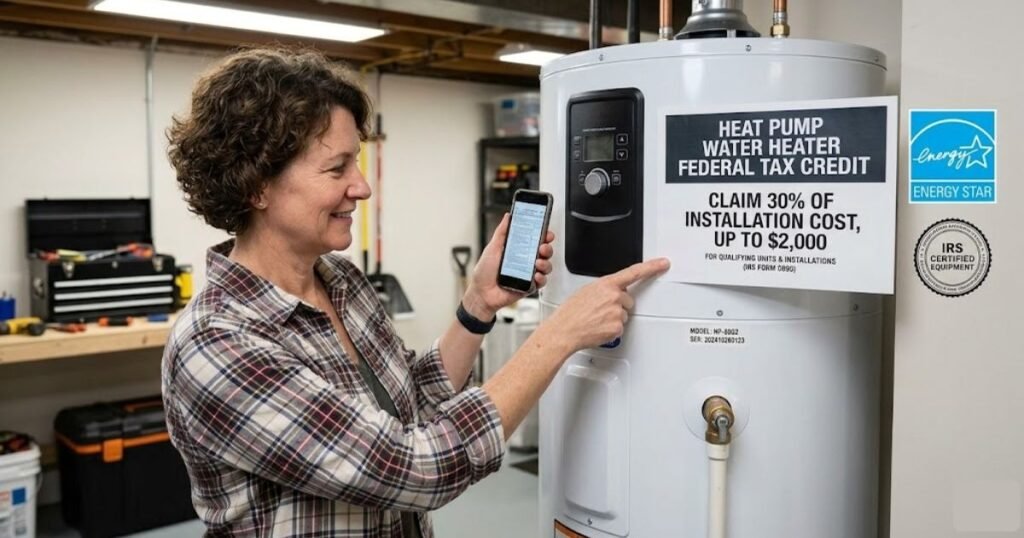
What Is a Heat Pump Water Heater Federal Tax Credit?
The heat pump water heater federal tax credit was a federal energy-efficiency incentive designed to encourage homeowners to install more efficient home equipment.
In simple terms, it was a tax benefit that could lower the amount of federal income tax a homeowner owed.
It is important to understand that a tax credit is not the same as an instant discount at the store.
Here is the difference:
- A discount lowers the purchase price immediately
- A rebate usually sends money back after purchase
- A tax credit reduces taxes owed when filing a federal tax return
For eligible heat pump water heaters, the IRS stated that qualifying property placed in service on or before December 31, 2025 could qualify for the Energy Efficient Home Improvement Credit.
READ MORE: Best High Efficiency Heat Pump Systems: Top Picks, Review & Comparison
How Much Can Homeowners Save?
Now let’s talk numbers. Exactly how much cash are we talking about?
According to both the IRS and official ENERGY STAR heat pump water heater credit guidelines, qualifying homeowners could claim 30% of the total eligible project costs, capped at a maximum of $2,000 per year specifically for heat pump water heaters.
What counts as “eligible project costs”? This is great news for budget-conscious families: the 30% calculation applies not just to the physical price tag of the heat pump water heater itself, but also to the labor costs for professional installation. This includes electrical prep work, plumbing adjustments, permit fees directly tied to the install, and the removal of your old, inefficient tank.
Let’s look at a practical, real-world example to see how this math plays out:
- The Scenario: You hire a licensed plumber to replace your old electric water heater with a top-tier, energy-efficient hybrid model.
- The Equipment Cost: The brand-new heat pump water heater costs $1,800.
- The Labor & Materials Cost: The contractor charges $1,200 for professional installation, minor pipe modifications, and running a dedicated electrical line to the closet.
- Total Project Cost: $1,800 + $1,200 = $3,000.
- The 30% Calculation: 30% of $3,000 is $900.
- Your Final Tax Credit: Since $900 is well below the annual federal cap of $2,000, you are entitled to claim the full $900 on your federal tax return.
What if your project is more complex? Suppose you live in an older home that requires significant structural or electrical panel upgrades to handle the new unit, bringing your total bill to $7,000.
- The 30% Calculation: 30% of $7,000 is $2,100.
- Your Final Tax Credit: Because the federal government caps the annual heat pump water heater tax credit at $2,000, your total credit for this specific upgrade would be capped at exactly $2,000.
It is also important to note that this $2,000 annual limit is a dedicated cap for heat pumps (both water heaters and space heating/cooling systems). It is structurally separate from the lower $1,200 annual limits imposed on other home efficiency upgrades like windows, doors, or standard insulation. This means you can maximize your water heater savings without completely wiping out your ability to claim smaller credits for other basic weatherization projects done in the same tax year, provided you follow the precise IRS rules and filing requirements.
Who May Qualify for Heat Pump Water Heater Federal Tax Credit?
While the federal government wants as many people as possible to adopt this high-efficiency technology, there are specific eligibility guardrails you must stay within to successfully claim the heat pump water heater tax credit. The rules are written in plain language, but missing a single detail can result in the IRS rejecting your claim.
Here is a breakdown of who may qualify and the core conditions required:
- Primary or Qualifying Home Use: To claim this residential energy credit, the unit must be installed in a home located in the United States that you own and use as a residence. This includes your primary home or a secondary home that you personally use (like a vacation cabin). However, landlords who buy these units for rental properties they do not live in cannot claim this specific residential credit, as it is strictly intended for property owners occupying the residence.
- Efficiency Requirements: You cannot just buy the cheapest model off the shelf and expect a tax break. The physical product must meet strict efficiency benchmarks. For water heaters, this typically means the equipment must align with current highest-tier efficiency standards, which are heavily tied to ENERGY STAR criteria.
- The Service Timeline: As noted by the IRS, the equipment must have been actively placed in service within the legal, eligible window—specifically on or before December 31, 2025, for that particular tax cycle.
- Tax Liability Requirements: Because this is a non-refundable tax credit, the filer must have sufficient tax liability to benefit from it. In simple terms, a non-refundable credit can reduce the taxes you owe down to zero, but it will not send you a check for the “leftover” balance if the credit amount exceeds your entire tax bill for the year. If you are a senior on a fixed, non-taxable retirement income or a student with zero tax liability, you may not be able to utilize the credit directly.
- Manufacturer & ID Tracking: For units placed in service during the 2025 calendar year, the IRS implemented stricter compliance rules. Homeowners are required to provide qualified manufacturer details and distinct equipment identification parameters on their tax documents to prove the model is fully certified and compliant.
READ MORE: Best Heat Pump Brands Comparison, Reviews, and Buying Guide
What Counts as a Qualified Heat Pump Water Heater?
With hundreds of water heater models available on the market, how can a homeowner be 100% sure that the unit they are buying qualifies for the ENERGY STAR heat pump water heater credit?
The short answer is to look for the logo. The federal guidelines directly tie the tax benefit to qualifying, highly efficient equipment, and ENERGY STAR-certified heat pump water heaters are the gold standard for this incentive. To earn the ENERGY STAR label, a hybrid water heater must undergo rigorous independent testing to prove it delivers exceptional energy savings compared to standard models.
When shopping online or visiting a local plumbing showroom, do not guess. Follow these steps to confirm product eligibility:
- Check the Manufacturer’s Tax Certification Statement: Every major water heater manufacturer (such as Rheem, A.O. Smith, Bradford White, or EcoSmart) publishes a formal document on their website called a “Federal Tax Credit Manufacturer Certification Statement.” This is a simple, one-page PDF where the manufacturer explicitly certifies under penalty of perjury that specific model numbers meet the IRS requirements for the home energy tax credit. Print this out and save it with your records.
- Verify the Uniform Energy Factor (UEF): The UEF is the modern metric used to measure a water heater’s overall energy efficiency. To qualify for the federal tax credit, heat pump water heaters generally must meet or exceed a high UEF threshold established by the Department of Energy and the IRS.
- Locate the Product Identification Details: As part of the updated compliance rules, ensure your purchase receipt or the product box clearly displays the manufacturer name, brand, model number, and unique serial number. You will need these specific details when cross-referencing your tax documents.
How to Claim the Heat Pump Tax Credit: A Step-by-Step Guide
Filing for a tax credit can feel intimidating, but the process for claiming your Form 5695 water heater credit is remarkably straightforward if you keep clean records from day one. You do not need an advanced accounting degree to get your money back; you just need a methodical approach.
Here is exactly how to do it step by step:
Step 1: Buy and Install a Qualifying Unit
Work with an informed contractor or retailer to select an eligible hybrid water heater. Have it professionally installed, and ensure the system is completely up and running before your target tax filing deadline.
Step 2: Secure Detailed Receipts and Invoices
When the installation is complete, ask your contractor for an itemized invoice. The invoice should explicitly separate the cost of the water heater from the cost of labor, materials, and disposal fees. Keep this along with your retail store receipts.
Step 3: Gather Manufacturer Records
Download the manufacturer’s formal tax certification statement for your specific model number. Note down the exact brand name, model number, and serial number of the unit. The IRS relies on these qualified manufacturer details to prevent fraudulent claims.
Step 4: Complete IRS Form 5695
When tax season arrives, you (or your CPA/tax software) will need to fill out IRS Form 5695, titled Residential Energy Credits.
- Locate Part II of Form 5695, which covers the Energy Efficient Home Improvement Credit.
- Find the specific line designated for qualified heat pump water heaters.
- Input 30% of your total eligible installation and equipment costs, making sure not to exceed the $2,000 cap for that section.
- Follow the form’s instructions to carry that final credit amount over to your main Form 1040 to directly reduce your overall tax bill.
Step 5: Save All Records in an Efficiency File
You do not actually mail your receipts or the manufacturer certification sheet to the IRS with your tax return. Instead, you keep them in your personal home records. Store them safely in a dedicated folder for at least three to seven years, just in case the IRS ever requests verification of your home energy upgrades.
READ MORE: Best Electric Heat Pump Water Heater: Reviews, Comparison, and Buying Guide
Heat Pump Water Heater Tax Credit vs Rebate
When researching ways to save money on a new appliance, you will constantly run across two terms: “tax credits” and “rebates.” Many homeowners use these words interchangeably, but they are completely different financial mechanisms. Understanding the difference between a heat pump water heater rebate vs tax credit is vital for maximizing your savings and budget planning.
Let’s break them down side by side:
| Feature | Federal Tax Credit | Rebate (State, Utility, or Local) |
| How It’s Delivered | Reduced federal income tax liability or a larger tax refund check. | Direct cash back via check, mail-in prepaid card, or instant point-of-sale discount. |
| When You Receive It | Months later, after filing your annual federal tax return (usually the following spring). | Instantly at checkout, or within a few weeks to months after submitting an online claim form. |
| Who Funds It | The United States Federal Government (Internal Revenue Service). | Local electric utilities, state energy offices, or appliance manufacturers. |
| Income Limits | Generally open to all households with sufficient federal tax liability. | Often features income-qualified tiers, particularly for state programs funded by federal grants. |
While this article is completely focused on the federal tax credit, you should know that the Department of Energy (DOE) pages point out that localized rebate programs frequently exist. Depending on where you live, your local electric utility company might offer an additional $500 to $1,000 cash-back rebate for switching from an old electric tank to a high-efficiency hybrid system.
The best part? In many cases, you are legally allowed to combine (“stack”) a local utility rebate with the federal tax credit. This double-dip strategy can instantly vaporize a massive portion of the upfront cost of the upgrade, turning a premium appliance installation into an incredibly affordable project for budget-conscious families.
READ MORE: Best Swimming Pool Heat Pump 2026: Review, Comparison, and Buying Tips
Benefits Beyond the Tax Credit
While saving up to $2,000 on your tax bill is a massive win, the financial benefits of a hybrid system do not stop when tax season ends. In fact, the long-term utility savings are often the most compelling reason for seniors, budget-conscious families, and first-time buyers to make the switch.
Here are the practical, real-world advantages of upgrading to a qualified heat pump water heater:
- Drastically Lower Utility Bills: Traditional electric water heaters work by heating water through pure electrical resistance—a process that devours massive amounts of kilowatt-hours. Because a hybrid system uses a heat pump to harvest warmth from ambient air, it operates with stunning efficiency. The average family can easily save $300 to $600 every single year on electricity costs. Over the 10- to 15-year lifespan of the unit, that adds up to thousands of dollars in pure savings.
- Dehumidification Bonuses: Because heat pumps pull air into the system to extract heat, they naturally exhaust cooler, drier air. If your water heater is installed in a damp basement, a humid garage, or an unconditioned utility room, the unit acts as a built-in, free dehumidifier. This helps prevent mold growth, protects your home’s structural integrity, and makes your basement feel much more comfortable.
- Long-Term Home Value and Reliability: Modern buyers are actively looking for homes with lower operating costs. Installing an advanced, ENERGY STAR-certified hybrid system signals to future buyers that your home is modern, well-maintained, and cheap to run. Furthermore, these units come equipped with advanced diagnostic displays, smart scheduling apps, and leak-detection sensors that can alert your smartphone if a pipe ever starts to drip, preventing catastrophic water damage.
Common Mistakes to Avoid
When it comes to dealing with the IRS, a tiny oversight can lead to a rejected claim, delayed refunds, or unnecessary frustration. To keep your filing stress-free, make sure you don’t fall into these common pitfalls made by other homeowners:
- Forgetting to Save Complete Installation Records: The IRS requires proof of when the unit was bought and installed. If you lose your itemized invoice or your plumber gives you a vague receipt that just says “Plumbing Work,” you might struggle to justify your 30% calculation under audit.
- Assuming Every Single Water Heater Qualifies: Standard, traditional gas or electric tank water heaters do not qualify for the high-tier $2,000 federal credit. Tankless gas water heaters may qualify for a smaller, completely separate credit category ($600 cap), but the maximum $2,000 credit is reserved strictly for electric hybrid heat pump models.
- Mixing Up Rebates and Tax Credits: Do not expect your installer to deduct the federal tax credit from your installation bill. You must actively claim it on your tax return using the appropriate federal tax form.
- Missing the Critical Filing Deadline: Your tax credit must be claimed on the tax return for the specific calendar year the unit was officially placed in service. If your system was installed in 2025, you must file for the credit on your 2025 tax return. You cannot choose to delay it to a future year when you think you might owe more taxes.
- Ignoring Compliance and Manufacturer IDs: For installations on or after 2025, skipping the qualified manufacturer identification step on your tax forms can cause your automated tax return processing to flag or stall.
- Assuming the Credit Applies Automatically: The IRS won’t guess that you bought a new appliance. If you do not explicitly attach Form 5695 to your standard Form 1040, you will completely miss out on the financial benefit.
READ MORE: Solar Powered Heat Pump Cost: USA Homeowner Guide to Savings
Step-by-Step Homeowner Checklist
Ready to upgrade your home’s water heating system and lock in your federal savings? Use this straightforward, printable checklist to ensure you do everything right from start to finish:
- [ ] Confirm Product Qualification: Verify that your chosen heat pump water heater is ENERGY STAR-certified and boasts a qualifying Uniform Energy Factor (UEF).
- [ ] Download Manufacturer Certification: Print out and save the formal “Federal Tax Credit Manufacturer Certification Statement” directly from the brand’s website.
- [ ] Get an Itemized Contractor Invoice: Double-check that your plumber’s invoice clearly lists the hardware cost, labor costs, installation date, and equipment serial numbers.
- [ ] Note the Official Installation Date: Write down the exact date the unit became operational. This marks the official “placed in service” date for tax reporting purposes.
- [ ] Gather Equipment Identification Numbers: Make a clear note of the manufacturer name, model number, and unique serial number located on the side of the tank.
- [ ] File IRS Form 5695: Complete and attach Form 5695 to your federal income tax return, transferring the final calculated credit amount directly to your Form 1040.
FAQ Section
How much is the heat pump water heater federal tax credit?
The federal tax credit allows qualifying homeowners to claim up to 30% of the total cost to purchase and professionally install an eligible heat pump water heater. The total credit amount for this specific category is capped at a maximum of $2,000 per year.
Do all heat pump water heaters qualify for the tax credit?
No, not all models qualify. To be eligible for the federal tax credit, the unit must meet strict efficiency guidelines, which are typically satisfied by models that carry an ENERGY STAR certification. Always check the manufacturer’s official tax certification statement for your specific model number before purchasing.
How do I claim the heat pump water heater tax credit on my taxes?
You claim the credit by filling out IRS Form 5695 (Residential Energy Credits) and attaching it directly to your federal income tax return (Form 1040). You will input your total eligible project expenses, calculate the 30% credit up to the $2,000 limit, and use it to reduce your overall tax liability.
Is the heat pump water heater credit still available in 2026?
The core IRS provisions under the Energy Efficient Home Improvement Credit for qualifying property specified that the standard credit rules applied to equipment placed in service on or before December 31, 2025.
What documents do I need to claim the water heater tax credit?
You need an itemized purchase receipt, a detailed installation invoice showing labor costs, the manufacturer’s signed federal tax certification statement, and the exact model and serial numbers for the equipment. You do not mail these to the IRS, but you must keep them safe in your personal files.
Does the credit reduce my refund or my tax bill?
The tax credit directly reduces your total federal tax liability (your tax bill) for the year. If reducing your tax bill results in your total annual withholdings exceeding what you owe, your federal refund check will increase by that exact amount.
Can renters claim this specific tax credit?
Generally, no. The residential energy efficient home improvement credits are targeted at the individuals who own and reside in the qualifying property where the systems are installed.
Is ENERGY STAR required for the credit?
Many qualifying heat pump water heaters are ENERGY STAR-certified. Homeowners should verify current IRS and manufacturer requirements before purchasing.
Final Thoughts
A qualifying heat pump water heater federal tax credit helped many U.S. homeowners reduce the cost of upgrading to a more energy-efficient water heating system.
For eligible installations placed in service during the approved period, homeowners could potentially claim 30% of eligible project costs, up to $2,000, using Form 5695.
Before claiming the credit, homeowners should:
- Confirm product eligibility
- Verify ENERGY STAR or IRS requirements
- Save all receipts and installation paperwork
- Keep manufacturer identification details
- Review current IRS filing rules carefully
A little preparation can make tax season smoother and help homeowners maximize potential savings from an energy-efficient upgrade.

