Replacing your home’s heating and cooling system is one of the most significant investments you will make as a property owner. When your old unit breaks down during a sweltering July heatwave or a freezing January blizzard, your immediate instinct is likely to pull out your phone and search for affordable HVAC installation near me USA.
Every homeowner wants to keep comfortable without breaking the bank. However, searching for a budget-friendly option can be overwhelming. The internet is filled with wild price variations, aggressive sales pitches, and confusing technical terms.
This comprehensive guide is designed to cut through the noise. We will provide transparent, real-world cost data, detail what a professional installation should include, highlight hidden savings through tax credits and rebates, and give you the exact tools you need to hire a reputable, licensed HVAC contractor in your local area. Lets deep dive into “Affordable HVAC Installation Near Me USA”
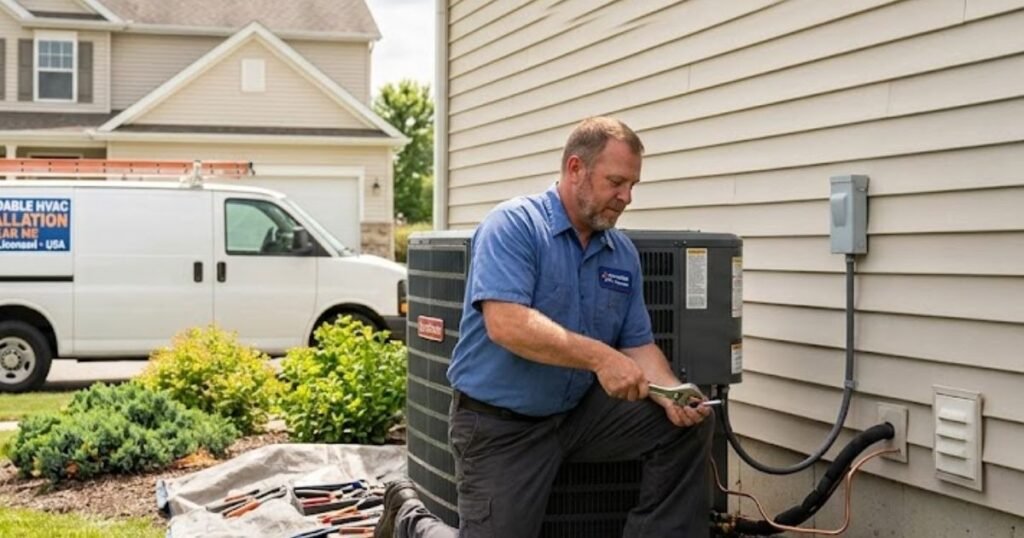
READ MORE: Cheap Air Conditioner Installation Guide for U.S. Homeowners
What Does HVAC Installation Include?
“HVAC installation” sounds simple, but a full, professional job involves several connected components. Skipping any one of them is often how homeowners end up with a system that’s technically “installed” but never performs the way it should.
A complete residential HVAC installation typically includes:
- Air conditioner – the outdoor condenser unit and indoor coil that remove heat and humidity from your home.
- Furnace – the heating unit, usually gas or electric, paired with your AC system.
- Heat pump – an all-in-one heating and cooling option, increasingly popular in mixed climates.
- Ductwork – the network of supply and return air channels that move conditioned air through your house.
- Thermostat – the control interface, which may be a basic model or a smart, Wi-Fi-connected unit.
- Electrical work – new wiring, breakers, or disconnects sized correctly for the new equipment.
- Refrigerant lines – copper lines connecting indoor and outdoor units, which must be properly sized and sealed.
- Testing and balancing – checking airflow, refrigerant charge, static pressure, and temperature split to confirm the system runs as designed.
Pro Tip: Ask any contractor for a written scope of work that lists every item above. If refrigerant line replacement or duct testing isn’t mentioned, ask why it could mean they’re planning to reuse old components that don’t match your new system.
Average HVAC Installation Cost in the USA
Pricing varies by region, home size, and system type, but here’s a realistic national snapshot.
| System Type | Typical Installed Cost |
| Basic HVAC system (builder-grade) | $4,500 – $7,500 |
| Mid-range HVAC system | $7,500 – $11,000 |
| Premium/high-efficiency HVAC system | $11,000 – $16,000+ |
| Heat pump installation | $5,500 – $13,000 |
| Ductless mini-split (single zone) | $3,000 – $6,000 |
| Ductless mini-split (multi-zone) | $8,000 – $16,000 |
| Furnace replacement only | $3,000 – $7,500 |
| AC replacement only | $4,000 – $8,500 |
| New or replacement ductwork | $1,500 – $6,000+ |
These are national averages, not quotes. Local labor rates, permit fees, and home layout can push prices above or below these ranges. Homes in areas with a high cost of living, complex attic or crawlspace access, or older ductwork tend to land at the higher end.
Factors that influence your total price include system tonnage, brand, ductwork condition, electrical upgrades, and how many contractors are competing for your business in your area. That’s exactly why comparing multiple local quotes matters so much it’s the fastest way to understand a fair price for your specific home.
READ MORE: Central Heat Pump Installation Cost: Homeowner Price Guide
What Affects HVAC Installation Cost?
Several variables combine to determine your final HVAC installation estimate:
- Home size – larger square footage requires higher-capacity equipment and more ductwork.
- System capacity (tonnage) – oversized or undersized units both cause problems and cost differently.
- SEER2 rating – higher-efficiency cooling equipment costs more upfront but saves on utility bills.
- AFUE rating – higher annual fuel utilization efficiency in furnaces means better fuel savings but a higher purchase price.
- Brand – premium brands often carry stronger warranties and higher price tags.
- Labor – complexity, home access, and local labor rates all factor in.
- Permits – required in most municipalities and often bundled into your estimate.
- Existing ductwork – repairing, sealing, or replacing old ducts adds cost but improves performance.
- Smart thermostat upgrades – a small added cost that can improve efficiency and comfort.
- Electrical upgrades – older homes may need panel or wiring updates to support new equipment.
- Geographic location – climate zone, local code requirements, and regional labor costs all shift pricing.
How to Find Affordable HVAC Installation Near You
“Affordable” doesn’t mean “cheapest bid.” It means getting a properly sized, correctly installed system at a fair, competitive price. Here’s how to get there:
- Compare at least three quotes. This is the single most effective way to spot both overpriced and suspiciously underpriced estimates.
- Read Google reviews carefully. Look for patterns in comments about punctuality, cleanup, and follow-through not just star ratings.
- Verify licenses. Every state requires HVAC contractors to be licensed; check your state’s licensing board website.
- Check insurance. Ask for proof of liability insurance and workers’ compensation coverage.
- Ask about warranties. Confirm both the manufacturer’s equipment warranty and the contractor’s labor warranty in writing.
- Request a Manual J load calculation. This is the industry-standard method for correctly sizing your system — not a guess based on square footage alone.
- Compare financing options. Some contractors offer 0% promotional financing; others partner with third-party lenders.
- Ask about rebates. Utility and manufacturer rebates can meaningfully lower your net cost.
- Avoid unusually cheap estimates. A bid far below all others is a red flag, not a bargain.
Did You Know? Installation quality can affect a system’s real-world efficiency by 20% or more. Two identical units one installed correctly and one installed poorly can perform very differently on your utility bill.
The lowest price isn’t always the best value. Corners cut during installation, like skipping duct sealing or using the wrong refrigerant charge, often show up later as high energy bills, uneven comfort, or early equipment failure.
READ MORE: Mini Split Air Conditioner Installation: Costs, DIY, & Expert Tips
Signs It’s Time to Replace Your HVAC System
- Your system is over 15 years old
- You’re calling for repairs more than once a year
- Utility bills keep climbing without a clear reason
- Some rooms are too hot or too cold no matter the thermostat setting
- The unit makes new grinding, banging, or squealing noises
- You notice refrigerant leaks or low cooling performance
- Airflow feels weak from the vents
- Your home feels humid even with the AC running
Best HVAC Systems for American Homes
Central Air – The most common cooling setup in the U.S. Works well paired with a furnace in ducted homes. Pro: familiar, widely serviced. Con: requires existing or new ductwork.
Heat Pumps – Provide both heating and cooling from one system. Pro: energy efficient in moderate climates. Con: efficiency can drop in extreme cold without backup heat.
Dual Fuel Systems – Pair a heat pump with a gas furnace for backup heat. Pro: efficient and reliable in variable climates. Con: higher upfront equipment cost.
Ductless Mini-Splits – Individual units for specific rooms or zones. Pro: no ductwork needed, great for additions. Con: higher cost per zone for whole-home coverage.
Gas Furnaces – Traditional, powerful heating for cold climates. Pro: fast, strong heat output. Con: requires gas line access and venting.
Electric Furnaces – Simpler installation, no combustion. Pro: lower upfront cost in some cases. Con: higher operating cost in cold climates.
Best HVAC Brands
| Brand | Reliability | Warranty | Efficiency | Value | Typical Price Range |
| Carrier | High | Strong | High | Mid-High | $$$$ |
| Trane | High | Strong | High | Mid-High | $$$$ |
| Lennox | High | Strong | Very High | Mid | $$$$$ |
| Rheem | Good | Solid | Good | Strong | $$$ |
| Goodman | Good | Solid | Good | Strong | $$ |
| York | Good | Solid | Good | Mid | $$$ |
| American Standard | High | Strong | High | Mid-High | $$$$ |
| Bryant | Good | Solid | Good | Strong | $$$ |
No single brand is objectively “best” for every home. A licensed HVAC contractor near you can recommend the brand that matches your climate, budget, and efficiency goals.
READ MORE: Heat Pump Installation Cost (Real Prices, Examples & Savings)
HVAC Financing Options
Paying for a full HVAC replacement upfront isn’t realistic for every household, and several legitimate financing paths exist:
- Monthly financing plans offered directly through the installing contractor
- Home improvement loans through banks or credit unions
- Manufacturer financing programs tied to specific equipment brands
- Credit cards, especially those with promotional 0% APR periods
- Utility company financing, sometimes bundled with efficiency rebates
- FHA Title I loans, which can cover home improvements including HVAC systems in qualifying cases
Always read the fine print on deferred-interest promotions if the balance isn’t paid off by the end of the promo period, interest can be charged retroactively.
Energy Rebates and Tax Credits
You can dramatically lower the net cost of your installation by taking advantage of federal, state, and utility incentives. The landscape features several excellent savings opportunities:
Federal Tax Credits (Section 25C)
Under the current Energy Efficient Home Improvement Credit framework, homeowners can claim non-refundable tax credits directly on their federal tax returns for qualifying equipment installed in their primary residence:
- Air-Source Heat Pumps: 30% of total installed project cost, capped at a maximum of $2,000 per year.
- Central Air Conditioners & Gas Furnaces: 30% of installed cost, capped at $600 per year per unit type.
Local Utility Rebates
Electric and gas companies offer direct cash-back incentives for reducing demand on the power grid. Installing an eligible high-efficiency system can trigger instant or mail-in rebates ranging from $300 to $1,500 directly from your local energy provider. Ask your installer to provide the specific AHRI (Air-Conditioning, Heating, and Refrigeration Institute) certificate number required to claim these funds.
Questions to Ask Before Hiring an HVAC Installer
- Are you licensed in this state?
- Are you insured, and can you provide proof?
- What warranty is included on parts and labor?
- Do you perform a Manual J load calculation?
- Is ductwork inspection or replacement included in this estimate?
- What brands do you install, and why do you recommend this one?
- Are permits included in the price?
- How long has your company been in business locally?
- Will the same crew handle removal and installation?
- What’s your estimated installation timeline?
- Do you offer financing, and what are the terms?
- Are there any rebates I qualify for through you?
- What happens if you find electrical issues mid-installation?
- Do you offer a post-installation walkthrough?
- What’s your process if something goes wrong after installation?
READ MORE: Emergency HVAC Service Near Me | Local HVAC Repair & Installation Services
HVAC Installation Process
- Home inspection – the contractor evaluates your current system, ductwork, and electrical setup.
- Load calculation – a Manual J calculation determines the correct system size.
- Equipment selection – you choose a system based on budget, efficiency, and home needs.
- Written estimate – a detailed quote outlining equipment, labor, and warranty.
- Permit – the contractor pulls required local permits.
- Old system removal – safe disconnection and removal of the existing equipment.
- New installation – equipment, refrigerant lines, and electrical connections are installed.
- Duct inspection – ducts are checked, sealed, or repaired as needed.
- Testing – airflow, refrigerant charge, and system performance are verified.
- Final walkthrough – the installer reviews the new system and thermostat with you.
Common HVAC Installation Mistakes to Avoid
- Buying an oversized system, which causes short-cycling and humidity problems
- Choosing a contractor based on price alone
- Ignoring the condition of existing ductwork
- Hiring an unlicensed or uninsured installer
- Skipping ongoing maintenance plans after installation
- Not comparing warranty terms between quotes
HVAC Maintenance Tips After Installation
- Replace air filters every 1–3 months
- Schedule annual professional tune-ups
- Keep the outdoor unit clear of debris and vegetation
- Check your thermostat settings seasonally
- Keep vents open and unblocked throughout the home
- Have ductwork inspected periodically for leaks
- Monitor utility bills for unexpected spikes
How to Choose the Best Local HVAC Contractor
- Google reviews – look for consistent, detailed feedback
- BBB ratings – check for complaint history and resolution
- Experience – ask how long they’ve served your specific area
- Certifications – NATE certification is a strong positive signal
- Emergency service – availability matters during extreme weather
- Financing – transparent terms with no hidden fees
- Transparent estimates – itemized, written, and easy to understand
- Warranty – clear parts and labor coverage
- Local reputation – established local companies have more accountability
Final Thoughts
Finding affordable HVAC installation near you comes down to one core idea: focus on value, not just the lowest number on a page. Compare multiple written estimates, verify that each contractor is licensed and insured, and prioritize a proper Manual J load calculation over guesswork. Energy-efficient systems cost more upfront but often pay for themselves through lower utility bills and fewer repairs.
Take your time, ask the questions outlined above, and don’t be afraid to walk away from a bid that feels rushed or unusually low. A well-installed system, from a reputable local contractor, is one of the best investments you can make in your home’s comfort and value.
Seasonal Buying Advice
Timing your HVAC installation can affect both price and availability:
- Spring and fall are typically the best times to schedule installation. Demand is lower, and contractors often have more flexible scheduling and pricing.
- Summer and winter are peak season for AC and furnace failures, which means higher demand, longer wait times, and sometimes rushed installations.
- End-of-year and holiday promotions from manufacturers can offer rebates or financing incentives, especially on higher-efficiency models.
- If your system is aging but still functional, planning a replacement before it fails completely gives you time to compare quotes properly instead of making a rushed emergency decision.
Frequently Asked Questions
How much does affordable HVAC installation cost in the USA?
Most homeowners pay between $4,500 and $16,000 for a full HVAC installation, depending on system type, home size, and efficiency level. Ductless mini-splits and furnace-only or AC-only replacements can cost less.
How do I find affordable HVAC installation near me?
Start by requesting written quotes from at least three licensed, insured local contractors. Compare not just the total price, but what’s included warranty terms, ductwork inspection, and load calculations. Read recent Google and BBB reviews, and ask each contractor the same set of questions so you can compare apples to apples rather than judging on price alone.
What is included in HVAC installation?
A complete installation typically includes the indoor and outdoor equipment (AC, furnace, or heat pump), ductwork inspection or replacement, a thermostat, refrigerant line installation, any necessary electrical work, and final testing and balancing.
How long does HVAC installation take?
Most single-system residential installations take one to three days, depending on complexity. Simple replacements with existing, compatible ductwork can sometimes be completed in a single day. Jobs that involve new ductwork, electrical upgrades, or multi-zone ductless systems typically take longer.
Is financing available for new HVAC installation?
Yes. Many HVAC contractors offer in-house financing plans, and manufacturer financing, utility company programs, home improvement loans, and credit cards are also common options.
Pingback: Cost to Install HVAC Ductwork: 2026 Guide - Plumbing Guider