If your combi boiler is on its last legs, you’re probably wondering one thing: combi boiler replacement cost ? It’s a fair question, and an important one, since a new boiler is one of the bigger home investments you’ll make.
Homeowners usually replace a combi boiler for one of a few reasons. The old unit needs constant repairs. Energy bills keep climbing. The boiler is simply old and worn out. Whatever the reason, the good news is that a new combi boiler can pay you back in comfort and lower energy bills for 15 years or more.
In this guide, you’ll learn exactly what goes into that price tag, how costs break down by home size, boiler brand, and BTU output, what hidden costs to watch for, and how to save real money without cutting corners. Let’s deep dive into “Combi Boiler Replacement Cost 2026: Full USA Pricing Guide”
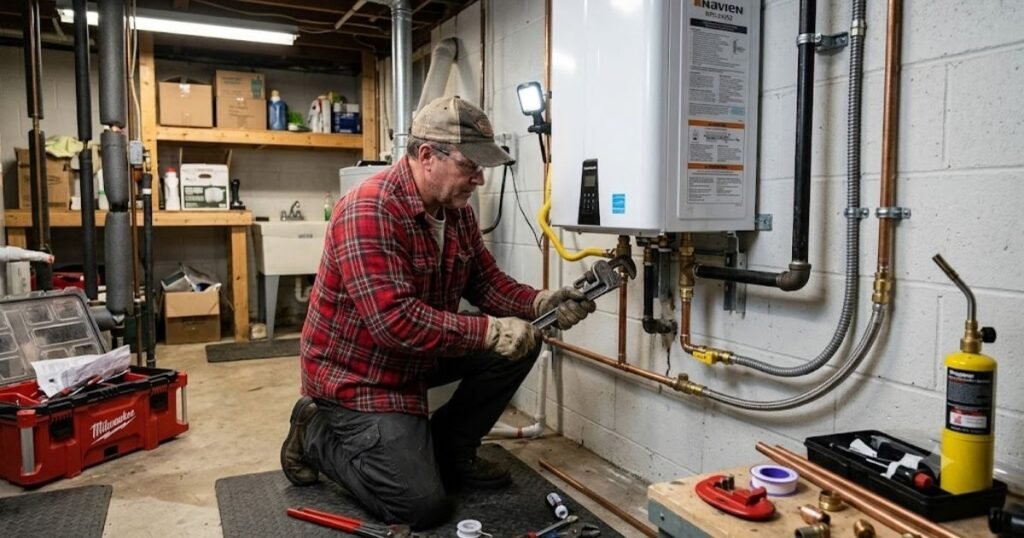
What Is a Combi Boiler?
A combi (combination) boiler is a single unit that provides both home heating and hot water on demand, without needing a separate storage tank. Cold water enters the unit, gets heated instantly, and flows straight to your tap or radiator.
- How it works: When you turn on a hot water tap or the thermostat calls for heat, the boiler fires up a heat exchanger that warms the water immediately.
- Combi vs. conventional boilers: A conventional (or “system”) boiler pairs with a separate hot water storage tank, while a combi boiler skips the tank entirely.
- Advantages: Combi boilers save space, deliver hot water instantly, and tend to be more energy efficient since there’s no standing tank losing heat.
- Disadvantages: They can struggle to supply multiple hot water outlets at once, and if the unit fails, you lose both heat and hot water at the same time.
READ MORE: Weil‑McLain Boiler Reviews — Models, Costs, Pros & Cons
Average Combi Boiler Replacement Cost in 2026
| Tier | Price Range | What’s Included |
| Low-End Replacement | $3,500 – $5,000 | Basic combi-to-combi swap, standard efficiency, minimal modifications |
| Average Replacement | $5,000 – $8,000 | Mid-range brand, standard labor, minor pipe or venting adjustments |
| Premium Replacement | $8,000 – $10,500 | High-efficiency condensing boiler, upgraded controls, better warranty |
| Luxury Installation | $10,500 – $15,000+ | Top-tier brand, full system overhaul, relocation, or complex venting/gas work |
Most homeowners fall into the “average” tier, especially for a straightforward combi-to-combi swap in an accessible location.
Combi Boiler Replacement Cost Breakdown:
| Cost Category | Typical Range |
| Boiler Unit | $1,500 – $5,000 |
| Installation Labor | $500 – $2,500 |
| Removal of Old Boiler | $150 – $500 |
| Disposal Fees | $50 – $200 |
| Pipe Modifications | $200 – $1,000 |
| Venting Upgrades | $300 – $1,500 |
| Gas Line Changes | $250 – $1,200 |
| Electrical Work | $150 – $600 |
| Thermostat Upgrade | $100 – $500 |
| Condensate Drain | $100 – $400 |
| Expansion Tank | $150 – $350 |
| Water Treatment/Filtration | $100 – $400 |
| Permit Costs | $50 – $300 |
| Inspection Fees | $75 – $200 |
A simple like-for-like swap keeps you near the low end. Anything that touches your gas line, venting, or electrical panel pushes the total higher.
READ MORE: Best 5 Navien Combi Boiler: Review, Comparison & Cost
Combi Boiler Replacement Cost by Home Size
| Home Classification | Square Footage | Hot Water Demand | Average Installed Cost |
| Apartment / Condo | Under 1,000 sq ft | 1 Shower | $3,500 – $5,500 |
| Small Home | 1,000 – 1,500 sq ft | 1–1.5 Showers | $5,000 – $7,500 |
| Medium Home | 1,500 – 2,500 sq ft | 2 Showers | $6,000 – $10,000 |
| Large Home | 2,500 – 3,500 sq ft | 2.5–3 Showers | $9,500 – $13,500 |
| Luxury Estate | 3,500+ sq ft | 3+ Showers / Radiant | $14,000 – $19,000+ |
Larger homes need bigger boilers with higher BTU output and stronger hot water demand, which raises both unit and labor costs.
Combi Boiler Replacement Cost by Boiler Size (BTU Output)
| BTU Rating | Estimated Installed Cost | Best For |
| 80,000 BTU | $3,000 – $5,500 | Apartments, small 1–2 bath homes |
| 100,000 BTU | $4,000 – $6,500 | Small to medium homes, 2–3 baths |
| 120,000 BTU | $5,500 – $8,500 | Medium homes, 3 bathrooms |
| 150,000 BTU | $7,000 – $10,500 | Larger homes, multiple bathrooms |
| 199,000 BTU | $9,000 – $14,000 | Large or luxury homes, high hot water demand |
An oversized boiler wastes energy and money, while an undersized one can’t keep up. A licensed contractor should calculate your home’s exact heat load before recommending a size.
READ MORE: Best Natural Gas Boilers for Home Heating: Review & Comparison
Combi Boiler Replacement Cost by Boiler Brand
| Brand | Estimated Installed Range | Known For |
| Navien | $5,000 – $9,000 | High efficiency, strong warranties, popular for tankless-style combi units |
| Lochinvar | $5,500 – $9,500 | Durable commercial-grade construction, good for larger homes |
| Weil-McLain | $4,500 – $8,000 | Long-standing reputation, widely serviced by U.S. contractors |
| Bosch | $4,800 – $8,500 | Compact design, solid mid-range efficiency |
| Rinnai | $5,000 – $9,000 | Reliable performance, strong hot water output |
| Noritz | $4,800 – $8,800 | Good efficiency ratings, competitive pricing |
| Viessmann | $6,000 – $10,500 | Premium European engineering, excellent efficiency |
| Triangle Tube | $6,500 – $11,000 | High-end reliability, favored by professional installers |
Reliability, warranty length, and efficiency (AFUE rating) all vary by brand. A contractor familiar with a specific brand can also mean faster service and easier parts access down the road.
Combi Boiler Replacement Cost by Installation Type
| Installation Type | Added Cost vs. Standard Swap |
| Combi-to-Combi Replacement | Baseline (no added cost) |
| Conventional-to-Combi Conversion | +$1,500 – $3,500 |
| Oil-to-Gas Conversion | +$2,500 – $5,000 |
| Electric-to-Gas Conversion | +$3,000 – $6,000 |
| Relocating the Boiler | +$1,000 – $3,000 |
| Basement Installation | +$300 – $800 |
| Utility Room Installation | Minimal added cost |
A straight combi-to-combi swap in the same location is almost always the cheapest option, since existing gas, water, and venting lines can usually be reused.
READ MORE: Viessmann Boiler Review | Efficiency, Models, Pros & Cons
What Affects Combi Boiler Replacement Cost?
Several factors combine to determine your final price:
- Efficiency and AFUE rating – Higher-efficiency units cost more upfront but save on monthly bills
- Brand – Premium brands carry premium price tags
- Labor rates – Vary significantly by state and metro area
- Climate – Colder regions often need larger, more robust systems
- Accessibility – Tight crawl spaces or attics increase labor time
- Existing plumbing and venting – Older homes may need upgrades to meet current code
- Gas line condition – May need resizing for a more powerful unit
- Electrical requirements – Some units need a dedicated circuit
- Home size and water demand – Bigger homes need bigger boilers
- Permit requirements – Vary by city and county
Labor Costs Explained
HVAC technicians typically charge $75–$150 per hour, while plumbers run $70–$130 per hour and electricians $65–$120 per hour for any required rewiring. Most straightforward combi boiler replacements take one full day to complete. Jobs involving venting changes, gas line upgrades, or relocation can stretch into a two- to three-day project, which adds to your total labor bill.
Hidden Costs Homeowners Often Miss
Beyond the sticker price of the unit itself, budget for these easy-to-forget extras:
- Permit and inspection fees
- Old unit removal and disposal
- Water quality testing or treatment systems
- Condensate pump (needed in some basement installs)
- Smart thermostat or control upgrades
- Pipe insulation for energy efficiency
- Freeze protection in unheated spaces
- A full system flush before the new unit goes in
- New expansion tank
- Smart home integration or Wi-Fi controls
Asking your contractor for a detailed, itemized quote upfront helps you avoid surprise charges later.
READ MORE: Electric Boiler Cost— Real Prices, Installation & Buying Guide
Combi Boiler Repair vs. Replacement
| Factor | Repair | Replace |
| Boiler age | Under 10 years | Over 12–15 years |
| Repair cost | Under 30% of replacement cost | Repeated repairs exceed 30–50% of new unit cost |
| Efficiency | Still performs well | Rising energy bills, poor performance |
| Frequency of breakdowns | Rare | Frequent, recurring issues |
| Warranty status | Still covered | Warranty expired |
Repair makes sense when the boiler is relatively young, the fix is affordable, and breakdowns are rare. Replacement is smarter once repair costs start piling up, the unit is well past 12–15 years old, or your energy bills keep rising despite regular maintenance. In most cases, if a single repair costs more than 30–50% of a new boiler, replacement is the better long-term investment.
How to Save Money on Boiler Replacement
- Get at least three written quotes before deciding
- Schedule replacement in the off-season (spring or fall) when contractors are less busy
- Ask about manufacturer rebates and promotions
- Choose a boiler sized correctly for your home, not oversized
- Bundle a smart thermostat upgrade into the same job
- Keep up with annual servicing to extend the new unit’s life
- Ask contractors about financing or payment plans
- Compare local utility company rebate programs
- Check if your state offers energy-efficiency incentives
- Avoid emergency same-day replacement pricing when possible
- Ask if reusing existing venting or gas lines is an option
- Request an itemized quote to spot unnecessary add-ons
- Consider a slightly lower-tier efficiency model if budget is tight
- Ask about extended warranty bundles at install time
- Verify licensing to avoid costly rework from unqualified labor
READ MORE: Carrier Heat Pump Reviews — Models, Costs, Pros & Cons
Combi Boiler Federal, State & Utility Rebates
Here’s an important update for 2026: the federal Energy Efficient Home Improvement Credit (Section 25C), which previously offered a 30% tax credit (up to $2,000) for qualifying high-efficiency boilers, <cite index=”9-1″>expired after December 31, 2025 under the One Big Beautiful Bill Act</cite>. That means homeowners installing a new boiler in 2026 generally can’t claim this federal credit.
That doesn’t mean all savings are gone, though. <cite index=”10-1″>Some states, local governments, and utility companies still offer their own rebates, grants, or incentives for energy-efficient home improvements, though these vary widely by location</cite>. It’s worth checking with your utility provider and state energy office before you buy. Many manufacturers also run their own seasonal promotions or instant rebates on qualifying high-efficiency units, and some HVAC contractors offer 0% or low-interest financing plans to help spread out the cost.
Step-by-Step Boiler Replacement Process
- Inspection – A technician evaluates your current system and home’s heating needs
- Quote – You receive a detailed, itemized estimate
- Selecting equipment – Choose the right brand, size, and efficiency rating
- Permits – Contractor pulls required local permits
- Removing the old boiler – Old unit is disconnected and hauled away
- Installing the new unit – New boiler is mounted and connected
- Connecting utilities – Gas, water, electrical, and venting are hooked up
- Testing – System is run through a full test cycle
- Final inspection – Local inspector signs off on the installation
- Homeowner walkthrough – Contractor explains controls, maintenance, and warranty
Common Mistakes to Avoid
- Hiring the cheapest bidder without checking licensing or reviews
- Skipping the permit process
- Choosing an oversized or undersized unit
- Ignoring venting or gas line compatibility
- Forgetting to ask about warranty terms
- Not getting a written, itemized quote
- Overlooking energy efficiency ratings
- Delaying replacement until a full breakdown happens in winter
- Not asking about financing options upfront
- Failing to schedule annual maintenance after install
- Choosing a unit based on price alone, ignoring long-term efficiency
- Not verifying insurance and liability coverage of the contractor
Maintenance Tips After Combi Boiler Replacement
- Schedule annual professional servicing
- Check the pressure gauge monthly
- Bleed radiators if you notice cold spots
- Keep the area around the boiler clear
- Test the pressure relief valve yearly
- Monitor for unusual noises early
- Replace filters as recommended
- Insulate exposed pipes
- Check for leaks regularly
- Keep the condensate drain clear
- Don’t skip manufacturer-recommended flushes
- Register your warranty right after install
- Set your thermostat efficiently, not excessively high
- Watch your water pressure after cold snaps
- Address small issues immediately before they grow
Signs It’s Time to Replace Your Combi Boiler
- Frequent, costly repairs
- Visible water leaks around the unit
- Steadily rising energy bills
- Strange banging, whistling, or gurgling noises
- Inconsistent or uneven heating
- Low water pressure that won’t hold
- Boiler is over 12–15 years old
- Visible rust or corrosion on the unit or pipes
Frequently Asked Questions
How much does a combi boiler replacement cost?
Most homeowners pay between $3,500 and $10,000 for a full combi boiler replacement, with the average project landing around $6,000 to $8,000. Your exact cost depends on the boiler brand, size, your home’s existing plumbing and venting setup, and local labor rates.
Is it cheaper to repair or replace a combi boiler?
It depends on the boiler’s age and the size of the repair bill. If your unit is under 10 years old and the repair costs less than 30% of a full replacement, repairing usually makes more financial sense. However, if your boiler is over 12–15 years old, breaks down frequently, or a single repair would cost more than a third to half of a new unit’s price, replacement typically saves money.
How long does a combi boiler replacement take?
A standard combi-to-combi swap usually takes about one full day when the installation is straightforward and no major plumbing, venting, or electrical changes are needed.
Does homeowners insurance cover boiler replacement?
Generally, homeowners insurance covers boiler damage caused by a sudden, unexpected event, such as a burst pipe or fire, but it typically does not cover replacement due to normal wear, age, or lack of maintenance.
What is the average lifespan of a combi boiler?
Most combi boilers last between 12 and 15 years with regular professional maintenance, though some well-maintained units can run efficiently for up to 20 years.
Final Thoughts
A combi boiler replacement is a meaningful investment, typically landing somewhere between $3,500 and $10,000 or more depending on your home, your chosen brand, and the complexity of the job. The price tag depends on real factors: boiler size, efficiency rating, labor costs in your area, and how much your existing plumbing, venting, or electrical setup needs to change.
The smartest move is to get multiple written estimates, verify that any contractor you hire is properly licensed and insured, and choose a correctly sized, high-efficiency unit rather than the cheapest option on the table. Do that, and you’ll set yourself up for years of reliable heat, steady hot water, and lower monthly energy bills.


Pingback: Why Boiler Pressure Drops: Causes & Fixes - Plumbing Guider