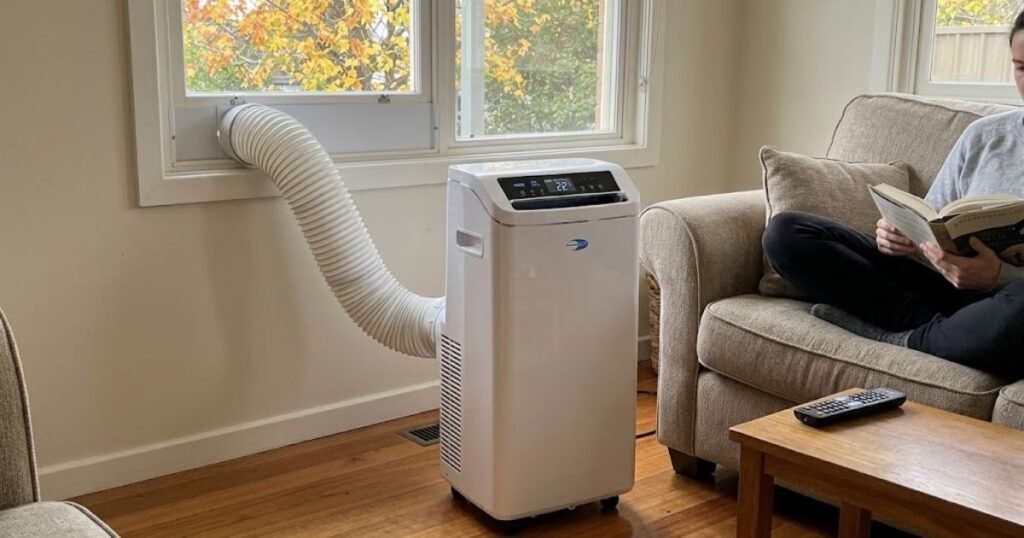
If you’ve ever tried to make one room comfortable year-round without touching your home’s central HVAC system, you know the problem well. A finished basement never quite matches the thermostat setting for the rest of the house. Renters often can’t install a mini-split or a window unit, and some buildings don’t allow permanent alterations at all. This is exactly the gap a portable heat pump with AC is built to fill a single, wheeled unit that cools in summer and adds heat in winter, all without any construction.
Here’s the catch: not every “portable AC with heat” on the market is actually a heat pump. Some units genuinely reverse their refrigeration cycle to move heat indoors, which is what a true heat pump does. Others simply bolt on an electric resistance heating element, which works, but heats very differently and usually less efficiently.
This guide explains the difference in plain language, walks through five popular portable AC and heater combos, and helps you figure out which type of unit and which capacity actually fits your room. Lets deep dive into “Portable Heat Pump With AC: Best Portable AC and Heating”
READ MORE: Best Portable Solar Power Generators Kit: Review, Comparison & Buying Guide
What Is a Portable Heat Pump With AC?
A portable heat pump air conditioner is a freestanding unit that cools your room in summer and can also warm it in winter, typically by running its own refrigeration cycle in reverse. In plain terms: instead of just moving heat out of your room (like a standard AC), a true heat pump can also pull heat from the outside air and move it inside. That’s fundamentally different from a space heater, which creates heat directly from electricity.
Many “portable AC with heat” products on store shelves, though, don’t reverse the refrigeration cycle at all. Instead, they add a simple electric resistance heating coil next to the regular air-conditioning components. It still produces warm air, but the underlying technology — and the efficiency — is different from a heat pump.
| Type | Cooling | Heating | Energy Efficiency | Best For |
| Portable AC only | Yes | No | — | Summer cooling |
| Portable AC + electric heat | Yes | Yes | Moderate | Occasional winter heating |
| Portable heat pump AC | Yes | Yes | Generally better heating efficiency | Year-round room comfort |
How Does a Portable Heat Pump Air Conditioner Work?
Every portable AC relies on the same basic refrigeration loop: a compressor pressurizes refrigerant, which then passes through a condenser (releasing heat), an expansion device (dropping pressure and temperature), and an evaporator (absorbing heat from room air). A single or dual exhaust hose vents the collected heat outside through a window kit. True heat pump models add a reversing valve, which lets the same loop run backward on demand.
Cooling Mode
In cooling mode, the evaporator coil absorbs heat and moisture from indoor air, the compressor moves that heat through the refrigerant, and the condenser rejects it outside through the exhaust hose. The air blown back into your room is cooler and drier than when it went in.
Heating Mode
In a true heat pump, the reversing valve flips the roles of the coils. The outdoor-facing coil now absorbs whatever ambient heat is available outside, and the indoor coil releases that heat into your room. This is why heat pump efficiency tends to drop as outdoor temperatures fall; there’s simply less ambient heat to extract from cold outside air.
READ MORE: Carrier Heat Pump Reviews — Models, Costs, Pros & Cons
Best Portable AC With Heat: 5 Models to Consider
Manufacturer specifications for budget and mid-tier portable AC brands change often, and the same model number can show slightly different numbers across retailers. The figures below reflect the most consistent, currently available manufacturer and retailer documentation at the time of writing. Always double-check the listing for the exact SKU before you buy.
1. SereneLife 14,000 BTU Portable Air Conditioner with Dehumidifier, Heat & Fan
Quick Verdict: A budget-friendly 4-in-1 unit that adds a heat mode to SereneLife’s familiar cooling/dehumidifier/fan lineup. It’s an easy, low-cost way to get some winter heat from the same unit you already use for summer cooling, but SereneLife’s own documentation is inconsistent about exactly how the heat mode works.
Key Specifications:
- Cooling capacity: 14,000 BTU (ASHRAE); comparable cooling-only SereneLife SKUs list roughly 10,000 BTU DOE/SACC, though SereneLife does not consistently publish a DOE/SACC figure for the heat-equipped version
- Coverage: roughly 400–500 sq. ft., depending on the specific SKU
- Modes: Cool, Heat, Dehumidify, Fan, with auto-swing
- Refrigerant: R32 (on comparable cooling-only models)
- Power: 115V, roughly 1,220–1,490W depending on SKU
- Controls: LED/touch panel plus remote; some WiFi-enabled versions available
- Construction: ABS or high-impact polystyrene housing, caster wheels
- Warranty: SereneLife generally offers a limited warranty on its portable AC line (check current listing for exact term)
What We Like:
- Genuinely affordable compared to most heat-equipped portable ACs in this BTU class
- Included window kit and casters make setup and moving between rooms simple
- Auto-swing and multi-speed fan help distribute air more evenly than basic single-vent units
What Could Be Better:
- No consistently published DOE/SACC rating for the heat-equipped 14,000 BTU version makes it harder to compare real-world cooling power to other units
Who It’s Best For: Renters and apartment dwellers who want inexpensive supplemental heat and cooling for a single room and aren’t chasing maximum efficiency.
Who Should Skip It: Buyers who want documented heat-pump performance or a guaranteed DOE/SACC cooling number should look elsewhere or get written confirmation from SereneLife first.
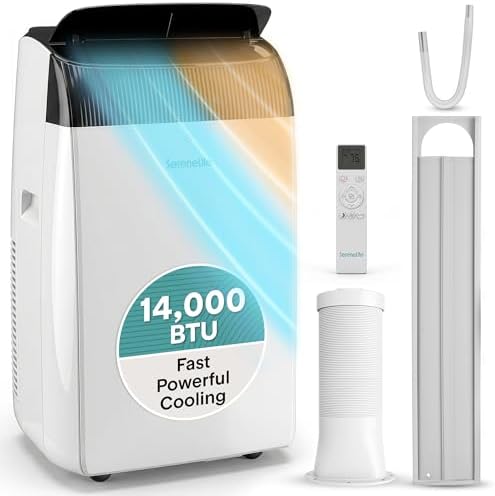
2. Line Blaster 12,000 BTU Portable Air Conditioner With Heat
Quick Verdict: Line Blaster’s mainstream 12,000 BTU portable AC, as documented in its official user manual and retail listings, is a 3-in-1 cooling, dehumidifying, and fan unit; it does not include a heating mode. Some newer WiFi-enabled Line Blaster listings mention an “optional heat pump feature,” but that appears to be a different configuration, and detailed heating specifications for it aren’t consistently published.
Key Specifications (12,000 BTU cooling-only model):
- Cooling capacity: 12,000 BTU (ASHRAE) / 7,100 BTU (SACC)
- Coverage: up to 550 sq. ft.
- Modes: Cool, Dehumidify, Fan (no heat mode confirmed in the standard manual)
- CEER: 6.6
- Refrigerant: R32
- Noise: approximately 52 dB
- Controls: LED panel and remote, 24-hour timer, sleep mode, auto-restart after power loss
- Mobility: 360° swivel casters and handles
What We Like:
- Solid, well-documented SACC rating makes real-world cooling performance easy to judge
- Reasonably quiet at roughly 52 dB for this capacity class
- Automatic restart and sleep mode are convenient day-to-day features
What Could Be Better:
- Limited coverage area; struggles in open-concept floor plans.
- Basic aesthetic design with minimalist display readouts.
- Fan noise is noticeable on maximum high settings.
Who It’s Best For: Shoppers who primarily want reliable summer cooling and dehumidification and are open to a separate heater or a different product if winter heat matters.
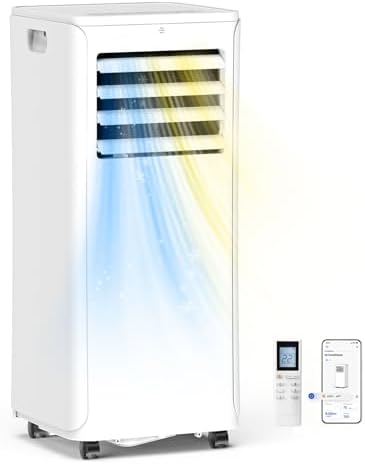
3. EUHOMY 14,000 BTU Portable Air Conditioner, 5-in-1 Smart AC Unit With Heat
Quick Verdict: One of the more fully documented heat-equipped portable ACs in this roundup. EUHOMY publishes both ASHRAE and SACC cooling figures, and the company’s manual for its heat-equipped models describes the heat mode as functioning via heat-pump technology rather than a simple resistance element.
Key Specifications:
- Cooling capacity: 14,000 BTU (ASHRAE) / 10,000 BTU (SACC)
- Coverage: up to 650 sq. ft. (some retailer listings show up to 750 sq. ft. for closely related SKUs — confirm your exact model)
- Modes: Cool, Heat, Dry, Fan, Sleep (5-in-1)
- Heat mode: EUHOMY’s documentation for its heat-equipped portable ACs describes the heat function as operating on a heat-pump basis; the exact ASHRAE heating BTU figure specific to this 14,000 BTU model isn’t separately published in the sources we reviewed, though a related 12,000 BTU EUHOMY model is documented at roughly 10,500 BTU heating
- Dehumidification: up to 140 pints/day
- CEER: 7.9
- Temperature range: 60–86°F
- Noise: approximately 52 dB
- Controls: App, voice assistant, remote, and top control panel
- Window kit: 20–50 in. adjustable
- Fan speeds: 3
What We Like:
- Clear ASHRAE/SACC split (14,000/10,000) makes it easier to compare against other units honestly
- 5-in-1 mode list plus app and voice control cover most household use cases
- High published dehumidification capacity is genuinely useful in humid climates
What Could Be Better:
- Initial Wi-Fi setup can require patience on dual-band 2.4/5GHz home networks.
- Cabinet is slightly bulkier than entry-level 10,000 BTU units.
Who It’s Best For: Buyers who want a heat-equipped unit with a clearly published DOE/SACC cooling number and heat-pump-style operation, plus smart-home controls.
Who Should Skip It: Anyone in a very cold climate who needs guaranteed, high-output heating performance in freezing temperatures heat pump output naturally declines as outdoor temperatures drop, regardless of brand.

4. BLACK+DECKER Smart Portable Air Conditioner With Heat, 14,000 BTU (BPACT14HWT)
Quick Verdict: A well-known brand with an official spec sheet that clearly separates ASHRAE and DOE ratings but that same official page shows meaningfully different numbers than several retailer listings, which is a good reminder to always check the manufacturer’s own page before buying.
Key Specifications (per BLACK+DECKER’s own product page):
- Cooling capacity: 14,000 BTU (ASHRAE 128) / 7,700 BTU (DOE test standard)
- Heating capacity: 11,000 BTU (ASHRAE 128) — note that several third-party retail listings for the same model number instead show 12,000 BTU heating and 10,200 BTU SACC cooling, so specifications should be confirmed against the exact listing you’re buying from
- Coverage: up to 700 sq. ft.
- Modes: Cool, Heat, Dehumidify, Fan (4-in-1)
- Controls: Wi-Fi, smartphone app, Amazon Alexa/Google Assistant compatible, “Follow Me” remote that acts as a remote thermostat
- Mobility: casters and side carrying handles
- Warranty: 1 year labor, 1 year parts, 5 years on the compressor specifically
What We Like:
- The manufacturer’s own site is unusually transparent about the ASHRAE-vs-DOE distinction, which is exactly the kind of labeling this whole category needs more of
- Wi-Fi, app, and voice-assistant support are genuinely useful for a room you don’t want to walk over to every time you adjust the temperature
- A 5-year compressor warranty is longer than many competitors offer
What Could Be Better:
- ASHRAE vs. SACC capacity rating differences require careful sizing reading before purchase.
- Window kit slider may require trimming for non-standard or small window frames.
Who It’s Best For: Buyers who value a recognizable brand name, a longer compressor warranty, and strong smart-home integration, and who are comfortable relying on the DOE/SACC number rather than the larger ASHRAE figure when judging cooling power.
Who Should Skip It: Anyone who wants documented heat-pump technology specifically, since that detail isn’t confirmed here.

5. Westinghouse 14,000 BTU Air Conditioner With Heat Mode (WPac14000h)
Quick Verdict: Westinghouse’s own product page and several major retailers consistently list this unit as 14,000 BTU ASHRAE with an 8,000–8,150 BTU DOE rating (the two figures appear across different retailer pages, likely reflecting minor testing or rounding differences), making it one of the better-documented units in this comparison. Amazon’s own listing for this model additionally describes it as a “Room Air Conditioner with Heat Pump.”
Key Specifications:
- Cooling capacity: 14,000 BTU (ASHRAE) / roughly 8,000–8,150 BTU (DOE)
- Heating capacity: approximately 10,500 BTU, per current manufacturer-referenced listings — confirm this figure at the time of purchase, since Westinghouse’s own product description does not spell out the heating BTU number as clearly as the cooling number
- Coverage: up to 700 sq. ft.
- Modes: Cool, Fan, Dehumidify, Heat (4-in-1)
- Refrigerant: R32
- Noise: approximately 52 dB(A)
- Controls: Wi-Fi app, remote (up to 20 ft. range), top-panel touch controls
- Typical price: around $479 at major home-improvement retailers, though prices fluctuate by season and retailer
What We Like:
- One of the more consistent ASHRAE/DOE disclosures among the five units reviewed here
- Genuinely quiet published noise rating for this capacity class
- Wi-Fi app, remote, and panel controls give three ways to manage the unit
What Could Be Better:
- The exact heating BTU output isn’t as clearly spelled out on Westinghouse’s own site as the cooling figures are
- 700 sq. ft. coverage claims, like most in this category, assume good insulation and shouldn’t be taken as a guarantee in an older or poorly sealed home
Who It’s Best For: Buyers who want a nationally available brand with relatively transparent ASHRAE/DOE labeling and decent smart-home features for a mid-range price.
Who Should Skip It: Anyone who needs a manufacturer-confirmed heating BTU figure in writing before buying should contact Westinghouse directly, since that number isn’t as prominently published as the cooling rating.

READ MORE: Best Portable AC Unit Review: Comparison, Top Picks & Buying Guide
Comparison Table: 5 Portable AC With Heat Models
| Product | Cooling BTU (ASHRAE) | DOE/SACC BTU | Heating | Room Size | Dehumidifier | Smart Features | Noise | Refrigerant | Best For |
| SereneLife 14,000 BTU | 14,000 | Not consistently published for heat SKU | Heat mode present; mechanism not confirmed | ~400–500 sq ft | Yes | Some WiFi versions | ~57 dB (comparable model) | R32 (comparable model) | Budget buyers |
| Line Blaster 12,000 BTU | 12,000 | 7,100 | Not included on standard model | 550 sq ft | Yes | LED panel + remote | ~52 dB | R32 | Cooling-focused shoppers |
| EUHOMY 14,000 BTU 5-in-1 | 14,000 | 10,000 | Heat-pump-based per manual; exact BTU for this SKU unconfirmed | 650–750 sq ft | Yes, up to 140 pt/day | App, voice, remote | ~52 dB | Not separately confirmed | Smart-home users wanting heat pump operation |
| BLACK+DECKER BPACT14HWT | 14,000 | 7,700 (official) | 11,000 BTU (official); mechanism unconfirmed | 700 sq ft | Yes | WiFi, app, Alexa/Google | Not published | Not published | Brand-name reliability, warranty |
| Westinghouse WPac14000h | 14,000 | ~8,000–8,150 | ~10,500 BTU (verify at purchase) | 700 sq ft | Yes | WiFi app, remote | ~52 dB(A) | R32 | Transparent ASHRAE/DOE labeling |
The biggest thing this table should tell you is that the 14,000 BTU ASHRAE number is nearly identical across four of the five products — but their DOE/SACC numbers, when published, range from roughly 7,700 to 10,000 BTU. That’s a meaningful real-world performance gap hiding behind an identical headline number. Don’t pick a winner based on the ASHRAE figure alone.
Which Portable AC With Heat Is Best for You?
Best for Small Bedrooms
A smaller-capacity unit with a documented DOE/SACC rating in the 7,000–8,000 BTU range, like the BLACK+DECKER or Westinghouse models, is plenty for a typical bedroom and avoids oversizing.
Best for Apartments
The SereneLife is worth a look for its lower price point and compact footprint, provided you confirm the heating specifics with SereneLife before you count on it for winter.
Best for Larger Rooms
The EUHOMY and Westinghouse units, both rated up to 700 sq. ft. or more, are better matched to open-concept living rooms or larger basements.
Best for Smart-Home Users
BLACK+DECKER’s Alexa and Google Assistant compatibility, plus the EUHOMY and Westinghouse app controls, all suit households that already lean on voice control.
Best for Year-Round Use
EUHOMY’s manual is the most explicit of the five about heat-pump operation, which makes it a reasonable pick if year-round heat-pump-style heating matters most to you while remembering heat pump output still tapers off in very cold weather.
Best for Budget-Conscious Buyers
The SereneLife typically carries the lowest price point of the group, though that savings comes with less specification transparency.
Best if You Need Strong Dehumidification
EUHOMY’s published 140-pint-per-day dehumidification figure is the highest of the group reviewed here.
READ MORE: Best Portable Propane Hot Water Heater: Reviews, Cost & Comparison
Portable Heat Pump vs Portable AC With Electric Heat
| Feature | True Portable Heat Pump | Portable AC With Electric Heat |
| Cooling | Yes | Yes |
| Heating | Heat transfer via reversed refrigeration cycle | Electrical resistance |
| Heating efficiency | Generally higher | Generally lower |
| Cold-weather performance | Depends on the unit’s rated operating range | Can provide direct electric heat regardless of outdoor temperature |
| Energy consumption | Usually lower for equivalent heat output | Generally higher |
| Initial cost | May be higher | Often lower |
| Best use | Regular year-round heating/cooling | Occasional supplemental heat |
Neither approach is universally “better” — a heat pump is typically more efficient in mild-to-moderate cold, while resistance heat delivers steady output even when it’s freezing outside, just at a higher electrical cost per BTU.
How Many BTUs Do You Need for a Portable AC With Heat?
A British Thermal Unit (BTU) measures the amount of heat energy required to raise the temperature of one pound of water by one degree Fahrenheit. When choosing a portable AC with heat, sizing the unit accurately is crucial.
Key variables affecting BTU calculations include:
- Total Square Footage: The floor area of the room.
- Ceiling Height: Rooms with ceilings over 8 feet hold a larger volume of air.
- Sunlight Exposure: South- or west-facing windows increase thermal gain during summer.
- Insulation Quality: Drafty windows and uninsulated walls require higher capacities.
- Room Occupancy: Human bodies radiate thermal energy; add ~600 BTUs per additional person for heavily occupied rooms.
| Room Size (sq. ft.) | Ceiling Height | Recommended Standard SACC Rating | Typical Advertised ASHRAE Equivalent |
| 150 – 250 sq. ft. | 8 ft. | 6,000 – 7,000 BTU | 9,000 – 10,000 BTU |
| 250 – 350 sq. ft. | 8 ft. | 7,000 – 8,000 BTU | 10,000 – 12,000 BTU |
| 350 – 450 sq. ft. | 8 ft. | 8,000 – 9,500 BTU | 12,000 – 14,000 BTU |
| 450 – 550+ sq. ft. | 8 ft.+ | 10,000+ BTU | 14,000+ BTU |
READ MORE: Portable Air Conditioner for Camping
What Is the Difference Between ASHRAE BTU and DOE/SACC BTU?
If you have ever felt confused by a portable AC advertised as “14,000 BTU” that only covers a medium-sized room, you have encountered the difference between ASHRAE and DOE/SACC ratings.
- ASHRAE BTU: This rating standard (established by the American Society of Heating, Refrigerating and Air-Conditioning Engineers) measures the theoretical raw capacity of the internal cooling engine under ideal laboratory conditions, without accounting for heat generated by the unit itself or thermal leakage through the exhaust hose.
- DOE / SACC BTU: Introduced by the U.S. Department of Energy, SACC (Seasonally Adjusted Cooling Capacity) accounts for heat radiating off the exhaust hose and ambient air drawn back into the room.
Real-World Example:
A unit advertised as a 14000 BTU portable AC with heat under the old ASHRAE testing standard will typically receive a realistic 8,000 to 9,500 BTU SACC rating under current DOE guidelines. Always check the DOE SACC rating on the EnergyGuide label to accurately gauge real-world performance.
Single-Hose vs Dual-Hose Portable AC With Heat
The hose configuration directly impacts energy consumption and overall performance.
Single-Hose Portable AC
Single-hose configurations use a single flexible duct to exhaust heat outside.
- Pros: Simpler installation, lighter weight, less bulky appearance.
- Cons: Pulls conditioned indoor air across the motor to cool it, exhausting that air outside. This creates negative air pressure inside the room, pulling unconditioned air in through gaps around doors and windows.
Dual-Hose Portable AC
Dual-hose configurations split intake and exhaust into two separate ducts.
- Pros: Draws outside air through one hose to cool the condenser coils, then vents it back out through the second hose. This avoids negative air pressure, cooling the room faster and more efficiently.
- Cons: More complex window bracket setup, thicker hose bundle, and higher upfront costs.
Benefits of a Portable AC and Heat Pump Combo
- Year-round functionality from a single appliance
- Room-by-room comfort without touching central HVAC
- Easy to move between rooms as your needs change
- No permanent installation, which suits renters and lease restrictions
- Built-in dehumidification in most models
- Can free up floor space compared to running a separate space heater and AC unit
- Straightforward remote or app-based temperature control
- Useful for bedrooms, home offices, apartments, guest rooms, and other single-room needs
Disadvantages of Portable Heat Pump AC Units
Portable AC and heater combos have real limitations worth weighing honestly:
- Compressor noise is noticeable in a quiet room, even at the lower end of published dB ratings
- Coverage is limited to roughly one room, not a whole home
- A window (or similar exterior opening) is required for the exhaust hose
- Hose placement can restrict furniture arrangement
- Electricity consumption is higher than a simple fan, and heating mode draws more power than cooling
- The unit itself takes up meaningful floor space
- Some models require occasional manual drainage in humid conditions
- Heat pump heating output declines in very cold outdoor temperatures
- Filters need regular cleaning to maintain performance
- These units are genuinely heavy — many models in this guide weigh 50–80 lbs
READ MORE: Best Mini Split AC for Small Room: Top Picks, Reviews & Comparison
How to Install a Portable AC With Heat
- Choose the room where you’ll use the unit most
- Position the unit near a window that can accommodate the included window kit
- Install the window adapter according to the manual
- Connect the exhaust hose to the unit and the window adapter
- Make sure the hose isn’t sharply bent or compressed, which restricts airflow
- Plug the unit directly into a properly rated wall outlet
- Select cooling, heating, dehumidifying, or fan mode as needed
- Test the unit in both cooling and heating modes before you rely on it
- Check whether your specific model needs manual drainage in humid conditions
Safety note: Never use an extension cord or power strip with a portable AC or heater unless the manufacturer’s manual specifically permits it. Follow your product’s manual and any applicable local electrical requirements.
How to Use a Portable AC With Heat Efficiently
- Keep doors and windows closed while the unit is running
- Seal any obvious gaps around the window kit installation
- Clean the filter on the schedule recommended in your manual
- Choose a reasonable thermostat setting rather than maxing out cooling or heating
- Use sleep mode when appropriate for quieter, lower-energy overnight operation
- Keep the intake and exhaust vents unobstructed by furniture or curtains
- Use blinds or curtains to reduce direct sunlight during peak cooling hours
- Run dehumidification mode in humid weather even when you don’t need full cooling
- Avoid pushing the unit flush against a wall or furniture, which restricts airflow
Room conditions and installation quality affect real-world efficiency at least as much as the specifications on the box.
Maintenance Tips for Portable AC Heat Pump Units
- Clean or rinse the filter regularly, following your manual’s recommended interval
- Inspect the exhaust hose periodically for kinks, tears, or blockages
- Check the window kit seal for gaps that let outside air in
- Empty or connect the drainage system as required by your specific model
- Wipe down the air intake area to prevent dust buildup
- Listen for unusual noises, which can signal a maintenance issue
- Store the unit upright, as directed by the manufacturer, during the off-season
Are Portable AC Heat Pump Units Energy Efficient?
Efficiency depends on several interacting factors: whether the unit uses true heat-pump technology or resistance heat, its DOE/SACC rating relative to your room size, how well-insulated the space is, outdoor temperature (especially for heat-pump heating), how long the unit runs each day, and your thermostat settings. Heat-pump-based heating is generally more efficient than resistance heating for equivalent output, but neither will match the efficiency of a properly sized, professionally installed central system. We can’t promise a specific percentage of savings for any particular household, since actual results vary too much by room and climate to state a reliable number here.
Safety Tips for Portable AC With Heat
- Always follow your specific unit’s manual for setup and operation
- Plug directly into a properly rated electrical outlet
- Don’t overload a circuit shared with other high-draw appliances
- Keep the air intake and exhaust areas unobstructed
- Keep the unit away from standing water unless it’s specifically designed for that environment
- Never modify the exhaust hose or window kit outside manufacturer instructions
- Keep filters clean to avoid overheating or reduced airflow
- Stop using the unit immediately if you notice signs of electrical damage
- Follow manufacturer instructions closely when operating heating mode
- Maintain the clearances specified in your manual
For any heating-mode appliance, never ignore a burning smell, overheating, visible electrical damage, or a breaker that trips repeatedly — unplug the unit and have it inspected before using it again.
Portable Heat Pump With AC Buying Guide
Before you buy, run through this checklist:
- DOE/SACC BTU rating (not just the ASHRAE number)
- ASHRAE BTU rating, for context
- Documented heating capacity
- Confirmation of true heat pump vs. resistance heating, if that distinction matters to you
- Room size and layout
- Single-hose vs. dual-hose design
- Published noise level
- Any available energy-efficiency rating (like CEER)
- Dehumidification capacity
- Smart/app or voice control, if desired
- Drainage requirements
- Window compatibility for your specific window type
- Warranty length and what it covers
- Weight and dimensions, especially if you’ll move it between rooms
- Electrical requirements
- Refrigerant type
- Manufacturer support and documentation quality
Frequently Asked Questions
Is there a portable air conditioner that also works as a heat pump?
Yes. Several portable air conditioners feature a reversible refrigeration cycle that functions as a true heat pump. In summer, the unit extracts interior heat and vents it outside; in winter, it reverses the flow to pull ambient heat energy indoors. Other combo models use internal electric resistance heating coils instead of a reversible heat pump.
Are portable AC units with heat worth it?
Portable AC units with heat offer great value for renters, home office workers, and homeowners conditioning individual problem rooms. They eliminate the need for separate summer cooling and winter heating appliances, offering single-cabinet climate control without permanent installation.
Does a portable AC with heat use a lot of electricity?
Electricity consumption depends on whether the unit uses true heat pump technology or electric resistance heat. Heat pump modes are quite efficient, using roughly 1,000 to 1,300 watts to deliver substantial thermal output. Electric resistance modes consume continuous power (often 1,400–1,500 watts), which can increase utility costs if run continuously.
Can a portable air conditioner heat a room in winter?
Yes, a portable air conditioner with heat can effectively warm a bedroom, office, or living space during winter months, provided the room matches the unit’s heating capacity. True heat pumps operate best when outdoor temperatures remain above 40°F, while electric resistance models produce heat regardless of outside temperatures.
What is the best portable AC with heat for a bedroom?
The ideal bedroom unit balances low operating noise, precise thermostat controls, and appropriate capacity. For small-to-medium bedrooms, 12,000 BTU ASHRAE units like the Line Blaster 12,000 BTU offer effective temperature control, while smart models like the Westinghouse WPac14000h allow you to schedule sleep curves using your smartphone.
Final Verdict
Selecting the right portable heat pump with AC comes down to understanding your specific space, local climate, and performance needs. Rather than relying solely on high advertised ASHRAE numbers, evaluate standardized DOE SACC ratings to make sure you get adequate cooling performance for your square footage.
If your goal is to add supplemental heat and powerful cooling to an apartment, bedroom, or home office, models like the SereneLife 14,000 BTU and BLACK+DECKER 14,000 BTU provide accessible, reliable comfort. For tech-focused homeowners who want robust winter heating, app connectivity, and modern refrigerants, units like the Westinghouse WPac14000h deliver versatile, multi-season performance. By matching unit specs to your room size and window setup, you can enjoy tailored, energy-smart comfort year-round.