There is nothing quite like a camping trip. Fresh air, open skies, crackling fires, and the peace of being away from it all. But when summer heat creeps in, a tent can turn into an oven fast. Sleeping in 90-degree weather is miserable. And when you are tossing and turning at 2 a.m., sticky and drenched in sweat, the great outdoors suddenly feels a lot less great.
That is where a portable air conditioner for camping comes in.
These compact cooling units have changed the way people camp. Whether you are sleeping in a tent, a camper van, a cabin, or an RV, having a reliable camping air conditioner can mean the difference between a trip you love and one you barely survive. Better sleep, more energy during the day, and real comfort at night that is what the right portable AC for camping can deliver.
This guide covers everything you need to know. What these units are, how they work, what to look for, and whether one is actually worth buying for your camping style. Lets deep dive into “Portable Air Conditioner for Camping: The Complete Guide to Staying Cool Outdoors”
READ MORE: Best Portable Solar Power Generators Kit: Review, Comparison & Buying Guide
What Is a Portable Air Conditioner for Camping?
Not all “camping coolers” are created equal. The term gets used loosely, and that can lead to some real confusion at checkout.
Here is a quick breakdown of what is actually out there:
1. True Portable Air Conditioners
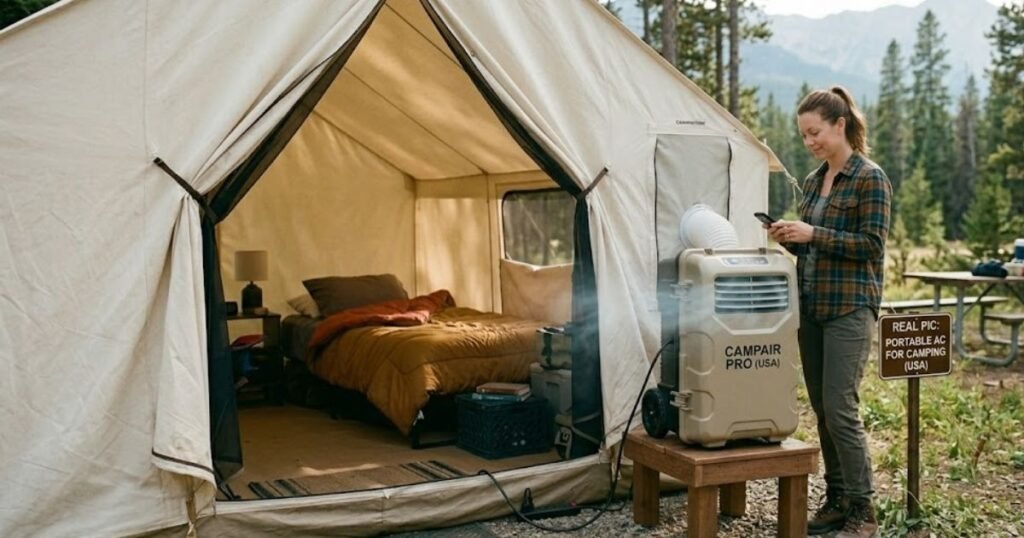
These are the real deal. A portable air conditioner uses refrigerant to pull heat out of the air and blow cooler air into your space. They work just like a window AC unit, but in a compact, movable form. Some plug into a standard outlet, while newer models run on high-capacity battery packs. These give you the most actual cooling power.
2. Battery-Powered Cooling Devices
Many products on the market are marketed as “portable ACs” but are really just battery-powered fans or small evaporative coolers. They can help take the edge off the heat, but they are not true air conditioners. Knowing the difference saves you from disappointment.
3. Evaporative Coolers (Swamp Coolers)
These work by passing air over water-soaked pads. They drop temperatures through evaporation. They work well in dry climates but lose effectiveness in humid conditions. They use much less power than a true AC.
4. Standard Camping Fans
Fans move air but do not actually lower air temperature. They are great for circulation, cheap to run, and easy to carry. But in extreme heat, a fan alone will not cut it.
If you want real, measurable cooling the kind that lets you actually sleep at night a true portable air conditioner for camping is what you need.
READ MORE: Best Off-Grid Solar Kits in the USA: Complete Buyer’s Guide
Is a Portable Air Conditioner Good for Camping?
Honest answer: it depends on how and where you camp.
The Pros
- Real temperature drop. A quality unit can lower the temperature inside a tent or camper by 10 to 20 degrees or more.
- Better sleep. When the temperature drops, your body can actually rest. This alone makes a huge difference in how you enjoy the next day.
- Works in a range of setups. From tents to RVs to cabin rentals, a portable AC gives you flexible cooling wherever you set up.
- Improved air quality. Many units also filter dust and humidity from the air, which is a bonus in outdoor environments.
The Cons
- Power requirements. True portable ACs need consistent power. That usually means a campground hookup, a generator, or a large battery station.
- Weight and size. These are not ultralight backpacking items. They add bulk to your gear.
- Noise. Some units run louder than others. In a quiet campground, this can be an issue.
- Cost. Quality portable ACs for camping are not cheap. Expect to spend between $150 and $700 depending on the model and features.
The bottom line? If comfort matters to you on camping trips, especially in hot climates or summer months, a camping air conditioner is absolutely worth considering.
Types of Camping Cooling Options
There are more ways to cool down at camp than most people realize. Here is a simple comparison:
- Portable Air Conditioners: True cooling power. Best for tents, campers, and RVs. Needs a power source. Heavy and bulky but very effective.
- Battery-Powered Evaporative Coolers: Lightweight and portable. Work best in low humidity. Great for desert camping. Not as powerful as a true AC.
- Camping Fans: Affordable and energy-efficient. Easy to pack. Moves air but does not reduce temperature. Best as a supplement, not a main cooling solution.
- RV Air Conditioners: Built into or mounted on RVs. Very effective. Not portable between different setups. Requires shore power or a generator.
- Personal Neck Fans and Wearables: Ultra-light and personal. Great for daytime hiking. Not useful for cooling your sleep space at night.
- Ice-Based Cooling: Ice packs, ice in a cooler, or DIY setups. Zero power needed. Temporary and high-maintenance, but useful in a pinch.
- Shade Tarps and Reflective Covers: Passive cooling. Reduces radiant heat before it enters your tent. Very affordable. Works well when combined with other methods.
Each option has its place. For the most comfort in serious summer heat, a portable AC for camping paired with good shade management is the winning combo.
READ MORE: Best Small Room 8000 BTU Portable Air Conditioner Units (Comparison & Reviews)
Best Features to Look For in a Camping Air Conditioner
Before you click “buy,” know what actually matters. Here are the key features to evaluate:
1. Cooling Capacity (BTU Rating)
BTU stands for British Thermal Unit. It measures how much heat a unit can remove per hour. For a small tent (up to 80 square feet), 1,000–2,500 BTUs may be enough. For a larger camper or RV space, look for 5,000–8,000 BTUs or more. Do not overbuy or underbuy match the BTU to your space.
2. Power Source
This is critical. Ask yourself: where will I be camping? Options include:
- Shore power / campground hookups — Most reliable. Plug your AC in like you would at home.
- Portable power stations — Great for off-grid camping. Brands like EcoFlow, Jackery, and Bluetti make high-capacity battery stations that can run a portable AC for several hours.
- Generators — Powerful and long-running, but noisy and require fuel.
- Solar panels — Can recharge battery stations during the day. Best as a supplement.
3. Battery Life
If you go the battery station route, know the watt-hour (Wh) capacity of your power station and the wattage of your AC unit. A 1,000 Wh battery running a 150W camping AC can give you roughly 6–7 hours of cooling just enough for a night.
4. Weight and Size
Portability matters. Look for units under 20 pounds if you will be moving them between setups. Some newer designs are surprisingly compact and come with carrying handles or wheels.
5. Noise Level
Measured in decibels (dB). A unit running at 45–50 dB is relatively quiet. Anything above 60 dB may disturb light sleepers. Check reviews and specs carefully.
6. Drainage Options
Air conditioners pull moisture from the air, which has to go somewhere. Some units have self-evaporating systems that vent moisture out with the exhaust. Others require you to empty a water tank manually. Self-evaporating is far more convenient at a campsite.
7. Ease of Setup
Look for units that are intuitive and do not require an engineering degree to operate. Clear controls, simple installation, and good instruction manuals matter in an outdoor setting.
8. Tent or RV Compatibility
Some portable ACs come with window kits or duct hose setups designed for specific use cases. Check whether the unit is designed for tent camping, RV use, or both.
9. Energy Efficiency
Look for the EER rating (Energy Efficiency Ratio). A higher EER means better cooling per watt used. This matters a lot when running off a battery station.
READ MORE: Best 10,000 BTU Portable Air Conditioner: Reviews & Comparison
Who Needs a Portable Air Conditioner for Camping?
Not everyone who camps needs one. But for many people, it is a game-changer. Here is who benefits most:
Family Campers
Kids and parents both sleep better in cooler temperatures. A quiet portable AC can keep the whole tent comfortable through a hot summer night.
RV Owners
RV portable air conditioners are a popular choice for those whose built-in units are underpowered or broken. A portable unit can supplement or replace built-in cooling.
Tent Campers in Hot Climates
Camping in Texas, Arizona, Florida, or the Deep South in summer? Temperatures inside a tent can hit 100°F or more. A tent air conditioner is not a luxury in those conditions it is a safety tool.
Glampers
If your camping style leans toward comfort think canvas tents with real beds, outdoor kitchens, and string lights a portable AC fits right in.
Seniors and Health-Conscious Campers
Heat stress is a real risk, especially for older adults. A camping air conditioner helps manage body temperature safely overnight.
Road Trippers and Van Lifers
Sleeping in a car, SUV, or van in summer heat is brutal without some form of cooling. Compact portable ACs designed for small spaces are ideal here.
How to Choose the Right Portable AC for Camping
Follow this simple process and you will land on the right unit.
Step 1: Know your space.
Measure your tent, camper, or RV in square feet. This tells you roughly how many BTUs you need.
Step 2: Figure out your power situation.
Do you have access to shore power? Will you rely on a generator or portable power station? Your power setup determines which AC models will actually work for you.
Step 3: Set your budget.
Solid camping ACs start around $150 for small evaporative units and go up to $500–$700 for true portable ACs with battery compatibility. Know what you are willing to spend before you browse.
Step 4: Think about how often you camp.
If you camp every weekend all summer, invest in quality. If this is a one-time trip, you might look at renting or buying a budget model.
Step 5: Read real reviews.
Look at reviews from actual campers, not just general buyers. People mention noise, battery performance, and durability in outdoor settings all things product descriptions leave out.
Step 6: Check weight and dimensions.
If you are traveling in a car, this matters less. If you hike to your site, every pound counts.
READ MORE: Best Solar Air Conditioner for Home: The Ultimate USA Homeowner Guide
Tips for Using a Portable Air Conditioner at Camp
Getting the most out of your camping cooling solution takes a little strategy.
- Place the unit low and central. Cool air sinks. Placing the unit near the floor and toward the center of the space helps it cool more evenly.
- Seal up your tent or camper. Gaps, unzipped vents, and open windows let cool air escape fast. Check that all openings are closed before turning on the AC.
- Insulate when you can. Reflective tarps over the tent or camper reduce radiant heat before it enters your space. Less heat in means less work for your AC.
- Pre-cool before bedtime. Run the AC 30–45 minutes before you plan to sleep. This drops the ambient temperature so you start comfortable.
- Use a fan alongside the AC. A small battery-powered fan helps circulate the cooled air throughout the space and lets you run the AC at a lower setting.
- Keep vents and exhausts clear. Never block the exhaust hose or intake vent. Restricted airflow reduces efficiency and can damage the unit.
- Monitor your power levels. If you are running off a battery station, check the remaining capacity before bed. Set a timer if your unit has one so it does not drain your battery completely.
Common Mistakes to Avoid
Even with a great unit, rookie mistakes can ruin the experience.
1. Buying the wrong size.
Too small and it cannot cool the space. Too large and it may not run efficiently on your battery. Match the BTU to your square footage.
2. Ignoring the power math.
Many campers buy a portable AC and then realize their battery station cannot run it for more than an hour. Calculate wattage versus battery capacity before you buy either product.
3. Expecting room-sized performance.
A camping AC is designed for a small, insulated space. Running it with the tent doors open or in a large RV without sealing off sections will disappoint you.
4. Not checking noise levels.
Some models run at 65 dB or more. That is as loud as a normal conversation. In a tent, that gets old fast. Always check the decibel rating before purchasing.
5. Forgetting about drainage.
Portable ACs produce condensate. If you do not have a self-evaporating model, you will need to empty the tank regularly. Forget about it overnight and you may wake up to a flooded tent.
6. Using it in the wrong environment.
Evaporative coolers, in particular, do not work well in humid climates. If you are camping near a lake or in the Southeast, choose a true refrigerant-based AC instead.
Is It Worth the Money?
For some campers, absolutely yes. For others, maybe not.
Worth it if:
- You camp regularly in hot, humid climates
- You or someone in your group is sensitive to heat
- You camp with kids or elderly family members
- Your current setup (RV, large tent, camper van) has enough power
- You value sleep quality and daytime energy on your trips
Might not be worth it if:
- You camp only in cooler seasons or mild climates
- You prefer ultralight, minimalist camping
- You mostly camp at sites without power hookups and do not own a power station
- Your camping trips are one or two nights a year
A solid portable AC for camping that actually works will run you $250–$500. If it means sleeping well every hot summer night for years of camping trips, that investment pays off fast.
Final Buying Advice
Here is the short version: Do not buy a portable AC for camping based on marketing photos alone. Focus on three things BTU rating, power compatibility, and noise level. Get those three right and almost everything else falls into place.
Match the unit to your space and your power setup. If you camp at sites with hookups, you have more flexibility. If you camp off-grid, invest in a good power station alongside your AC. Look for a self-evaporating model to cut down on maintenance. And always read reviews from actual campers before pulling the trigger.
Frequently Asked Questions
Can You Use a Portable Air Conditioner While Camping?
Yes, absolutely. Portable air conditioners are designed specifically for use in small, temporary spaces like tents, RVs, and camper vans.
What Is the Best Portable Air Conditioner for Camping?
The “best” depends on your setup. For tent campers, compact units with low wattage and battery compatibility such as models designed to pair with EcoFlow or Jackery power stations are popular choices.
Do Portable Air Conditioners Work in Tents?
Yes, but with some conditions. A tent must be reasonably sealed, well-sized for the AC unit, and ideally insulated with a shade tarp to reduce heat gain. True portable ACs with refrigerant cooling work best. Evaporative coolers can also help in dry climates.
How Do I Power a Portable AC at a Campground?
The most common options are: (1) campground electrical hookups plug in your AC just like you would at home; (2) portable power stations battery packs from brands like EcoFlow, Jackery, or Bluetti can run a low-wattage AC for 4–8 hours; (3) generators gas or propane generators provide plenty of power but add noise and fuel costs.
Are Camping Air Conditioners Worth It?
For most people who camp in hot climates or summer months, yes. The ability to sleep comfortably through a hot night makes a huge difference in how much you enjoy your trip. Families with children, seniors, and campers with heat sensitivity will notice the biggest benefits.